London calling: Forensics, European crime fiction…and cake

I’m just back from a couple of crime-filled days in London. The main reason for my visit was to speak at a symposium on European crime fiction and data visualisation (of which more later), but I travelled up a day early in order to see the Forensics exhibition at The Wellcome Trust.

16498201563_555d7a914b_z

The Wellcome Trust is by Euston Square station. Get there early, as it’s a popular exhibition

I’ve already written about the Forensics exhibition in a previous post, so here’s a summary of the parts I particularly liked.

  • Its focus, as one would expect, is scientific, but it also incorporates photography and artwork reflecting on violence, murder and its aftermath, which provide some genuinely thought-provoking perspectives.
  • Frances Glessner Lee’s ‘Nutshell Study of Unexplained Death’ – a crime scene recreated in a dollhouse for police training purposes in the 1940s – was fascinating for its miniature juxtaposition of detailed handcrafts and gruesome homicide.
  • Room 4, which explores how forensic archaeologists have gathered evidence of political and war crimes in Chile, Rwanda and Yugoslavia, was highly moving in its emphasis on bearing witness and justice.
  • The vast array of exhibits yielded wildly diverse treasures such as exquisite drawings of deadly plants, a porcelain Royal Doulton morgue table and Sir Bernhard Spilsbury’s hand-written autopsy cards (although I did wonder how the poor victims would have felt about having their personal details on public display…).
  • I took some great new definitions and phrases away with me: the word ‘autopsy’ means ‘to see with one’s own eyes’ and constitutes ‘the last chance to question the dead’; Eduard Locard, head of the first police crime lab in Lyon, introduced ‘the exchange principle’, based on the theory that ‘every contact leaves a trace’ (perpetrator on victim and victim on perpetrator), and Erle Stanley Gardener asserted that medical experts giving evidence at trials ‘must serve but one client, and that client should be truth’.

A note of warning: the exhibition is not for faint-hearted, as some of the images and commentary it contains are extremely graphic. I was grateful for a strong and steadying cup of coffee in the Wellcome Cafe afterwards. But I would highly recommend a visit – see the exhibition website for more details here.

16493725653_5dc547c089_z

Drawing breath in the Wellcome cafe…

Friday was spent at the British Library, taking part in the symposium ‘Towards a Digital Atlas of European Crime Fiction?’ – part of an AHRC project run by Dominique Jeannerod and Federico Pagello of Queen’s University Belfast. The project is evidence of how rapidly the ‘digital humanities’ – which explore the contribution of ‘big data’, technology and data visualisation to humanities research – are expanding, and was of course particularly interesting as it considered these areas in relation to European crime.

17113220571_2d25ebc389_z

Eduardo Paolozzi’s statue of Isaac Newton at the British Library

The morning was spent hearing the project contributors’ findings. What I liked about this section was the chance to see some data visualisations, to discuss the metho-dological and technical challenges involved in their creation (e.g. getting from ‘dirty’ to ‘clean data’), and to get an idea of the kinds of case studies involved (French, Hungarian and European crime). I had expected the speakers to be evangelical about digital research, but they discussed its advantages and disadvantages in very even-handed and thoughtful ways – such as the capacity of ‘distant reading’ to make trends visible against the time that inputting and cleaning data can take. The project is designed to have an exploratory function and as someone considering increased use of digital methods in my research, I found these reflections very useful indeed.

17112350002_673f6fcc1e_z

Federico Pagello (Queens), discussing ‘dirty’ vs ‘clean data’

The afternoon saw presentations from researchers on diverse digital tools and analysis in research on Czech, French, New Zealand and German crime (the latter from yours truly, on my Nazi-themed crime fiction database and this blog), as well as a talk from Samuel Schwiegelhofer of the Paris Bibliothèque des littératures policières (BiLiPo – a library dedicated to crime fiction!). That was followed by a marvellous keynote from Ian Sansom (crime author and academic), which ranged from the work of theorist Franco Moretti to the horse’s head in The Godfather and Ian’s garden shed.
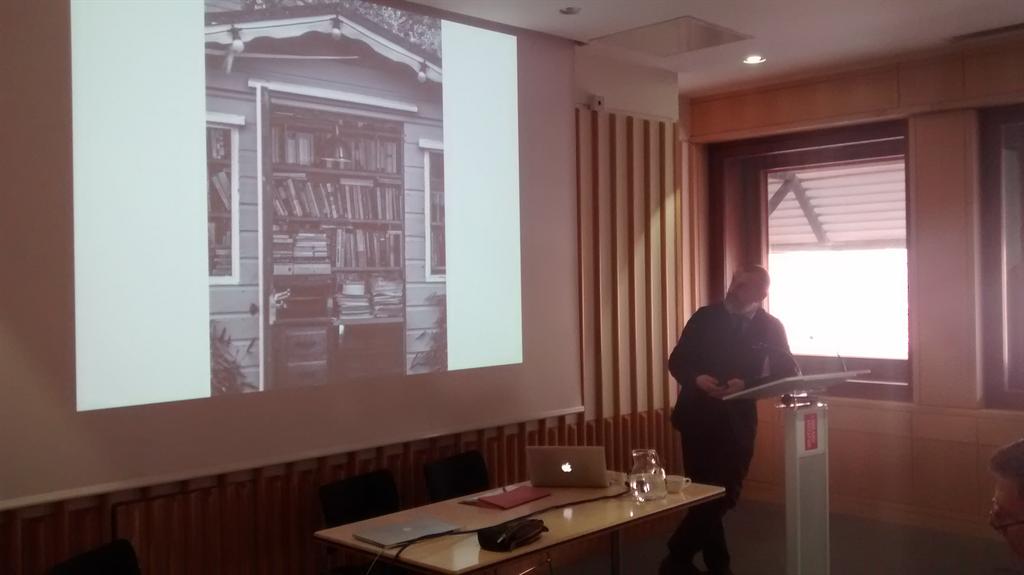
Embedded image permalink

Professor Ian Sansom with his shed. Photo by Federico Pagello

All in all, the symposium was a rich and valuable experience, not least because it provided the chance to meet like-minded researchers from around the world, and has made me think deeply about my own research and its digital possibilities. Many thanks to the organisers for making it such a successful event.

If you’re interested in finding out more about the project, then take a look at the International Crime Fiction Research Group blog or follow the group on Twitter – @crimefictionrg. A website with lots of useful resources is on its way.

Last but not least, the trip provided a great opportunity to meet friends and co-conspirators from the crime blogosphere, including Jacky Collins, Andy Lawrence, Ewa Sherman and Sarah Ward. There were pilgrimages to The Scandinavian Kitchen and Maison Bertaux (the latter, London’s oldest patisserie, was a great find courtesy of Andy).

Large amounts of cake may have been consumed.

16927694999_97f2ef5a2f_z17113890475_61cf3c7f09_z

Serial: the crime podcast phenomenon

Last Friday, to pass some time while ill in bed, I started listening to the podcast SERIAL, which explores a real and very complex murder case from 1999. I don’t consider myself to be a fan of true crime, which is all too often voyeuristic and salacious, and so wasn’t expecting to get drawn in. But I found myself hooked from the opening of the very first episode, and by the end of the day had listened eight (EIGHT!) episodes.

SERIAL is a podcast phenomenon. Since it started in October it has become the fastest podcast on iTunes to be downloaded or streamed 5 million times, and is one of reddit’s most discussed topics. The series first crossed my radar when writer Linda Grant wrote about her fascination with it and I’m glad to have finally caught up, because it’s genuinely brilliant.

SERIAL is an offshoot of This American Life (a weekly radio show by Chicago Public Media), and is presented by journalist Sarah Koenig. This is how SERIAL’s website describes what the podcast is about:

>> On January 13, 1999, a girl named Hae Min Lee, a senior at Woodlawn High School in Baltimore County, Maryland, disappeared. A few weeks later, her body turned up in a city park. She’d been strangled. Her 17-year-old ex-boyfriend, Adnan Syed, was arrested for the crime, and within a year, he was convicted and sentenced to life in prison. The case against him was largely based on the story of one witness, Adnan’s friend Jay, who testified that he helped Adnan bury Hae’s body. But Adnan has always maintained he had nothing to do with Hae’s death. Some people believe he’s telling the truth. Many others don’t.

Sarah Koenig first learned about this case more than a year ago. In the months since, she’s been sorting through box after box (after box) of legal documents and investigators’ notes, listening to trial testimony and police interrogations, and talking to everyone she can find who remembers what happened between Adnan Syed and Hae Min Lee fifteen years ago. What she realized is that the trial covered up a far more complicated story, which neither the jury nor the public got to hear. The high school scene, the shifting statements to police, the prejudices, the sketchy alibis, the scant forensic evidence – all of it leads back to the most basic questions: How can you know a person’s character? How can you tell what they’re capable of? In Season One of Serial, she looks for answers. <<

So the podcast is a 360 degree examination of a murder case, one that Sarah carries out with great intelligence, care and respect for all the individuals involved. Although the hope is to get to the bottom of the case’s contradictions by looking at the evidence with fresh eyes, Koenig pledges to ‘follow the story where it takes us’, even if that means failing to achieve closure. It’s this willingness to accept all outcomes that is one of the series’ chief strengths; in many respects it is a thoughtful meditation on the difficulty of finding the truth.

Eleven episodes of SERIAL are currently available. The 12th and final episode airs this coming Thursday. If you haven’t yet listened, you might want to leave this post and head over to episode 1. If you’ve already caught up, you might be interested in reading on below…

What I’m not going to discuss is the (admittedly fascinating) question of Adnan’s guilt or innocence, because it’s being dissected exhaustively elsewhere, and to an extent that makes me feel uneasy. Arguably, one of the few pitfalls of the podcast is that it’s been treated by some as a fictional crime whodunit, losing sight of the fact that the story is about real people. I’m more interested in the insights Sarah Koenig (SK) has offered listeners into the impact of murder, the minutiae of police investigations and the complexities of the trial process. These are meta-observations that have made me think really, really hard about the justice system in a way that I haven’t done before.

Memory. The first episode of SERIAL opens with an observation about how hard it can be to remember past events. Can you remember exactly what you were doing the whole of last Wednesday? Now, how about a Wednesday six weeks ago, which turns out to have been the day of a murder, in which you are a suspect? What happens if you genuinely can’t remember? Or if you think you can, but then realise you’ve got it wrong? Or if you can, but no one can corroborate what you say? Any of these could be the beginning of a road to wrongful conviction. Unless of course you’re lying, which is when things get even trickier.

A piece of evidence can appear utterly damning when viewed in one context, and completely innocent in another. It all depends on how you build it into a larger narrative or how you spin it. SK demonstrates this by discussing specific bits of evidence with those who think Adnan is guilty and those who don’t. The same applies in the courtroom: building a convincing narrative is key for the prosecution and defence. They are telling competing stories to the jury and are fighting for their own to be believed.

The power of narrative is also illustrated by the podcast itself (something that SK does not explicitly acknowledge). Episodes are constructed in such a way as to consider one side of the argument, then the other, and inevitably sway the listener back and forth as well (ooh, he’s guilty/nooo, he can’t be). There’s a cliff-hanger element built into the episodes, with previews of ‘next time’ promising new evidence that will keep us hooked. Very successfully.

On a moral level, we listeners are gripped by questions of guilt or innocence. But in a legal context, guilt or innocence may never be definitively proved. The more important question then becomes ‘is there reasonable doubt’?

Murder investigations are HUGELY complex. We all know this, but listening to over ten hours of detail about one case makes you appreciate that fact all the more. It instills a respect for police investigators, who have to process mountains of potential evidence and decide what it relevant and what is not. It also makes you realise how easily the truth can be lost if the wrong leads are followed, or if prejudices start to cloud investigators’ judgments.

The police are not necessarily looking for the truth. Rather, they are trying to build a case against someone. This means that there may be ‘verification bias’ present in the investigation – the disregarding of so-called ‘bad evidence’ that does not fit the detectives’ theories of what happened. Scary stuff, and this is why it’s so important for justice systems to have a robust element of defence and cross-examination, so that lots of difficult questions can be asked.

SK’s own investigations show us a range of different perspectives and voices: we hear sound clips of police interviews and court proceedings, readings from Hae’s teenage diary, SK’s interviews with family, friends and witnesses (all of whom were deeply affected by the murder), and her phone conversations with Adnan in prison. These are augmented by her own commentary on the difficulties she is encountering as she tries to figure out this ‘Rubik’s cube of a case’.

‘Cops assume that everyone is lying all the time’. A pragmatic, logical approach or a breach of the presumption of innocence? They will ‘offer the suspect a theme’ – meaning that they will discuss the subject of the crime in a way that suggests understanding to encourage a confession (e.g. ‘I can understand why you hit that man. After all he provoked you’).

‘How easy it is to stir stereotypes in with facts, all of which then gets baked into a story’. SK does a great job of exploring the possible bias of the judicial system (for example, the use of certain types of vocabulary in reports or in court). This quote is also a wonderful example of how SK sums up ideas in an accessible and interesting way.

Serial host Sarah Koenig and producer Dana Chivvis examine some evidence. Photo by Elise Bergerson.

I never quite realised how many factors can feed into the outcome of a trial: the quality of the prosecution or defence lawyers, cultural biases, the composition of the jury, alibis or the lack of alibis, the presence or absence of forensic evidence, the efficiency or inefficiency of the investigators (did they ask for that crucial item to be checked for DNA?), the willingness or refusal of witnesses to testify, the credibility of witnesses, etc. etc. etc.

If you are innocent, and continue to maintain your innocence following conviction, then your chances of parole are low, because the parole board is looking for evidence of remorse. So you can lie and get out, or be honest and stay in. Hmmmm.

SK and her listeners may be playing the role of the detective, but that does not remotely guarantee the discovery of a ‘solution’, because this is real life. Will the final episode offer listeners the closure they crave? At the simplest level, Adnan’s guilt/innocence may only be known to three people: murder victim Hae Lee, Adnan himself and his friend Jay. Of these last two, one has to be lying. I’m doubtful that SERIAL can reveal who’s telling the truth, but it certainly succeeds in showing us plenty of others.

Hinterland on BBC4 … and other crime news

For those in the UK who’ve not yet seen Welsh crime drama Hinterland, now is your chance. Episode One will air again on BBC4 on Monday 28 April at 9.00pm. Further details are available from The Radio Times and an earlier blog post of mine, which contains a spoiler-free review.

And for viewers beyond our shores, the good news is that Hinterland has been picked by Netflix, so crime fans in Canada and the US will shortly be able to enjoy its delights too. Cymru Crime is on its way!

In other news:

The good people at Penguin are still sending me a Simenon a month from their freshly translated Inspector Maigret series, and I’ve had a lovely time working my way through the latest three, The Yellow DogNight at the Crossroads and A Crime in Holland (all originally published in 1931). The latter involves a French lecturer suspected of murder and is therefore right up my street (although I hasten to add that all the French lecturers I know are model citizens). I’ve updated the Maigret page – we’re now up to a total of seven novels.

Holding on to the Dutch theme… I’ve just received a copy of Lonely Graves (Mulholland Books/Hodder), which is set in Amsterdam, and authored by ‘Britta Bolt’, the pseudonym of German Britta Böhler and South African Rodney Bolt. Böhler is a former lawyer in international law, while Bolt has a background in travel writing – an ideal pairing for a crime novel set in foreign climes. Their ‘detective’ is municipal government employee Pieter Posthumus, who arranges so-called ‘lonely funerals’ for those dying without family or means, and who decides to investigate when a young Moroccan is found drowned. I’m a few chapters in, and am enjoying the unusual scenario and Amsterdam setting. The novel is the first in ‘The Posthumus Trilogy’ – looks promising.

Meanwhile, I’ve also been exploring Turkish German novels for the Crime Fiction in German volume, including Jakob Arjouni’s Kayankaya series and Akif Pirinçci’s ‘Felidae’ series (in which Francis the cat detective can be said to represent a migrant perspective). The opening novel has been made into a rather good animated film, but be warned that it’s not suitable for children, as it explores some rather adult themes. Both series are available in English translation and have met with considerable success.

There are also some interesting recent developments, such as Su Turhan’s ‘Kommissar Pascha’ series, featuring Munich Turkish-German police inspector Zeki Demirbilek (not yet translated). My Swansea University colleague Tom Cheesman’s book, Novels of Turkish German Settlement (Camden 2007) has also been very helpful in terms of understanding wider issues relating to migrant experience and identity in Germany, and pointing the way to some crime fiction gems.


The Petrona Award shortlist for 2014

*Fanfare of trumpets*. Here is the shortlist for the 2014 Petrona Award for the Best Scandinavian Crime Novel of the Year:

CLOSED FOR WINTER by Jørn Lier Horst tr. Anne Bruce (Sandstone Press)

STRANGE SHORES by Arnaldur Indriðason tr. Victoria Cribb (Harvill Secker)

THE WEEPING GIRL by Håkan Nesser tr. Laurie Thompson (Mantle)

LINDA, AS IN THE LINDA MURDER by Leif G W Persson tr. Neil Smith (Doubleday)

SOMEONE TO WATCH OVER ME by Yrsa Sigurðardóttir tr. Philip Roughton (Hodder & Stoughton)

LIGHT IN A DARK HOUSE by Jan Costin Wagner tr. Anthea Bell (Harvill Secker)

The judges for the award are Barry Forshaw, Sarah Ward and myself – with additional wise counsel from award founder and administrator Karen Meek.

From left to right: Karen, Mrs Pea, Barry and Sarah, following our rewarding shortlisting session in London.

Here are our comments on each of the shortlisted works:

CLOSED FOR WINTERThis highly atmospheric novel sees Chief Inspector Wisting investigate an off-season burglary and disturbing case of murder on the Norwegian coast of Vestfold. As ever, author Jørn Lier Horst’s police background lends the novel a striking authenticity, with readers treated to the outstanding plotting and characterisation that typify this quality series.

STRANGE SHORESDrawn back to his childhood home by the unresolved disappearance of his brother, Inspector Erlendur takes on the most personal and difficult case of his career. Exploring the series’ enduring themes of loss and the impact of Iceland’s twentieth-century social transformation, this remarkable valedictory novel is one of the finest by a truly incisive writer, the undisputed king of Icelandic crime fiction.

THE WEEPING GIRL: While supposedly on holiday, Detective Inspector Ewa Moreno is pulled into the case of a missing teenage girl and the earlier murder of a woman. This quietly compelling novel from Swedish author Håkan Nesser, with its distinctive European feel, is full of the assurance readers have come to expect from the Van Veeteren series. There is not a single misstep as the grim implications of the narrative are teased out.

LINDA, AS IN THE LINDA MURDER:  Leif G W Persson’s sprawling, state-of-the-nation novels make deft use of crime fiction conventions to expose the faultlines of Swedish society. This more closely focused novel is a brilliant exploration of a young woman’s murder, press sensationalism, and the inner workings of a police investigation, with readers reintroduced to the blackly humorous and truly unforgettable police detective Evert Bäckström.

SOMEONE TO WATCH OVER ME: When a young man with Down’s Syndrome is convicted of arson and murder, lawyer Thóra Gudmundsdóttir is hired by one of his fellow inmates to investigate a possible miscarriage of justice. This ambitious Icelandic crime novel, which skilfully weaves multiple narrative strands together with elements of the supernatural, is another gripping and highly entertaining read from author Yrsa Sigurðardóttir.

LIGHT IN A DARK HOUSE: Still mourning the loss of his wife, Finnish detective Kimmo Joentaa is called to investigate the strange murder of a comatose woman in hospital. German author Jan Costin Wagner delivers another wonderfully written and tightly constructed instalment in the Joentaa series, notable for its moving portrayal of a grief-stricken policeman and its in-depth exploration of victim and perpetrator psychology. 

The winning title will be announced at the international crime fiction event CrimeFest, held in Bristol 15-18 May 2014. I’m already dusting off the posh frock.

More information and updates can be found on the Petrona Award website  (http://www.petronaaward.co.uk).

New MURDER anthology / Making an impact…with kittens

Exciting news! Margot Kinberg at Confessions of a Mystery Novelist has just announced the publication of a new crime anthology.

In a Word: Murder is a tribute to the late Maxine Clarke, crime blogger extraordinaire, and features stories set in the worlds of writing, editing, reviewing and blogging. Treats include the murder of a true-crime magazine editor, a life-or-death short story competition and a deadly literary festival. Deliciously wicked stuff!

in-a-word-murder-cover

Go on…you know you want to…!

Proceeds will go to the Princess Alice Hospice and can be purchased here. I’ve already got my copy and am keen to get reading.

There’s also been a bit of excitement here at Mrs. Peabody Investigates. As many of you know, I’m an academic by trade, and have used the blog to discuss my research on crime fiction, and to promote debate about this very rich literary genre. As a result of the blog’s success, it’s become a university ‘impact case study’, exploring the reach and significance of academic work in the public realm. Remember that survey that I asked you to fill out a little while back? The one with the kittens? That was me trying to find out how much the blog had benefited you as blog users, in terms of widening or changing your reading habits, or making you think more deeply about crime fiction. And the response, from 188 of you, was truly fantastic.

So the excitement today is that Mrs. Peabody Investigates features in The Guardian newspaper in an article about impact. It’s a discussion piece, but might be of interest in terms of seeing how Mrs P fits into my academic life. Please note the bit where I say that ‘making research more accessible to the public also helps to enrich it, by bringing in new voices’. Those voices are yours, and have most definitely had a beneficial impact on my own research. I learn a huge amount from you all the time, which creates a very virtuous circle indeed.

Time for a celebratory kitten!

Criminally good summer treats

First of all, a HUGE THANK YOU to those who took part in last week’s survey and got that kitten tally so high. The result was a phenomenal 188 responses, and I’m incredibly grateful to you for taking the time to help me out. I now have lots of lovely and interesting data to collate, and will share the findings with you in due course.

Now then… Mrs. Peabody will be taking a bit of a blogging breather for a few weeks, as we’re off to the land of Mounties, Moose and Molson to meet some far-flung family. I’m looking forward to finding out a little more about the Canadian crime fiction scene while we’re there as well.

No national stereotyping here, eh?

I have, of course, been stocking up on some summer treats to take along on the journey. Here’s a selection of the novels I’ll be reading, hopefully with a view of the Pacific and a cool drink in my hand.

Anya Lipska’s Where the Devil Can’t Go, a highly-praised debut set in London and Poland. The author is on the ‘New Blood panel’ at the Theakstons Old Peculier Crime Writing Festival at Harrogate on Saturday 20 July (along with Derek B. Miller, author of the wonderful Norwegian by Night). I’m extremely sad that I can’t make it this year, especially as there’s also a panel devoted to German Krimis, winningly entitled ‘Dead in Deutschland’…

Yrsa Sigurdardottir’s Ashes to Dust, the third of the Icelandic Thóra Gudmunds-dottir series. I’ve picked this one because it’s partly set in the 1970s, my favourite decade, and I’ve not read any of this author’s novels before (shocking I know).

Geoffrey McGeachin’s The Diggers Rest Hotel, which won the 2011 Ned Kelly Award for best crime fiction novel, and is the first in the Charlie Berlin series. Set in rural 1947 Australia, it looks to have an interesting take on the legacy of the Second World War. The novel is featured in one of Margot’s Kinberg’s ‘In the Spotlight’ posts, which provides a lovely overview.

Before I head off, here are two additional treats for you:

Word reaches me from Raven and Euro Crime that five more Foreign Bodies episodes are airing on BBC Radio 4 this week. This time the focus is on Greece (Markaris/Haritos – see my post on the author here), Argentina (Mallo/Lascano – my review of Needle in a Haystack is here), Northern Ireland (McGilloway/Devlin), South Africa (Meyer/Griessel), and on female crime drama investigators (Miller/Lund/ Berthaud). If you happen to miss any, they are available online for seven days. It also looks like the first series is being repeated from Monday 15 July.

Last but not least, this week’s ShortList features The 39 Greatest Maverick Cops. I’m not sure I agree with all of their rankings or analysis, but there are some good ones in there, including some storming women.

Wishing you all wonderful, relaxing summer days.

Your blogger needs you! Can you spare 5 minutes for Mrs. P?

This week, in place of my usual post, I’m going to ask you for some help.

If you’re a regular visitor to ‘Mrs. Peabody Investigates’, or even if you just drop by every now and then, would you mind filling out a short, anonymous survey on the blog? Pretty please? It has just nine questions, and mainly involves ticking boxes.

THE SURVEY IS NOW CLOSED 🙂

The survey is linked to my day job as a UK academic: we’re exploring the impact of our research beyond a university audience, for example in blogs or in the media. And your opinion really counts – whether you’re a reader, blogger, publisher, translator, author, bookseller or anything else to do with the wonderful world of crime!

In return, I offer you oodles of gratitude and this picture of an adorable kitten. I’ll be adding an extra kitten for every 10 people who take the survey…

No, not a kitten. Walnut whip reward by special request 🙂

Cute bunny by special request

Puppy from dooziedog.com *melts*

By special request: otters holding hands 🙂

THANK YOU!

BBC Radio 4’s Book at Bedtime from Monday 13 May: John le Carré’s A Delicate Truth

Hot on the heels of the publication of John le Carré’s A Delicate Truth comes an adaptation of the novel for BBC Radio 4’s wonderful ‘Book at Bedtime’ slot.

The first of ten episodes, wittily titled ‘Between A Rock And A Hard Place’, will be broadcast on Monday 13 May, from 10.45 to 11.00pm (GMT). The narrator is Damian Lewis, famous (amongst other things) for his Emmy-winning role as Nicholas Brody in the American hit series Homeland.

Here’s the publicity blurb accompanying the adaptation from the BBC:

>> Damian Lewis begins John le Carré’s gripping, brand-new novel about a good man who must choose between his conscience and his duty to the Service.

An undercover counter-operation in the British colony of Gibraltar [the eponymous Rock]; a middle-ranking man from the Foreign Office serving as ‘eyes on’ and reporting to an ambitious Minister; the aim to capture a jihadist arms-buyer: the success, assured.

But back in the UK a junior officer has his doubts and commits an unthinkable act. Three years on, he will find himself facing an impossible choice. In a journey that will take him from Cornwall to Wales via murky secrets in the depths of Whitehall, Toby Bell will try to find out the truth about the night on the Rock and bring it the attention and justice it deserves.<<

The novel is abridged by Sally Marmion and produced by Di Speirs for the BBC.

Mrs. Peabody’s 2013 reading challenges

A little late in the day, I’ve been thinking about my reading goals for 2013, and have decided to take part in two challenges.

I’m not normally one for reading challenges, because I already have plenty of ‘performance enabling’ and research targets to meet in my professional life. Adding yet more items to tick off the list hasn’t seemed like a particularly good idea.

However, a combination of factors has drawn me to these challenges:

  1. They will help me broaden my reading in a more directed way.
  2. There are ‘easy’ levels, which look invitingly…easy.
  3. They both look like great fun.

The first is the 2013 Global Reading Challenge

The ‘Easy Challenge’ involves ‘reading one novel from each of these continents in the course of 2013: Africa, Asia, Australasia/Oceania, Europe, North America, South America, and The Seventh Continent (Antarctica or your own ‘seventh’ setting, e.g. the sea, the space, a supernatural/paranormal world, history, the future)’.

You’re also asked to ‘find a country, state or author that is new to you from your own continent’.

If you fancy joining me, you can sign up here via the host blog, Kerrie’s ‘Mysteries in Paradise’. There are links to challenges from past years, so that you can get ideas for reading; other wonderful posts out there will also provide inspiration. For example, there’s a great list of Latin American crime fiction over at ‘Ms. Wordopolis Reads’.

The second is the 2013 Translation Challenge

Hosted by ‘Curiosity Killed the Bookworm’, this challenge is a simple one: you’re asked to read one translated book a month.

You can sign up here. There’s also a handy set of links to publishing houses known for their support of translated crime fiction, to help create a reading list.

Those of you with eagle eyes may have noticed that the challenges overlap – books read for one could very well also be submitted for the other. This is a deliberate strategy on my part: if the nineteen-book total begins to feel unmanagable, I can double up where necessary and still complete them both. This could be viewed as a subtle bit of cheating or as a cunning back-up plan. I prefer the latter interpretation… 🙂

My January book for the Translation Challenge was Fred Vargas’ An Uncertain Place (France) and February’s will be Hakan Nesser’s The Return (Sweden), sequel to the wonderful Borkmann’s Point. I probably won’t be submitting these to the Global challenge though, as I’m on the hunt for something a bit more exotic from Europe. Suggestions welcome!

I’ll be building lists of the books I’ve read for my 2013 challenges here.

‘Murder in the Library’: New crime fiction exhibition!

If you’re a crime fan within reach of London over the next few weeks, then you have a number of treats in store.

On 18 January, a new exhibition entitled ‘Murder in the Library: An A-Z of Crime Fiction’, opens in the Folio Society Gallery of the British Library. Entry is *free* and it runs until 12 May.

The exhibition is described thus on the British Library webpages: ‘Crime fiction, which currently accounts for over a third of all fiction published in English, holds millions of people enthralled. ‘Murder in the Library’ will take you on a fascinating journey through the development of crime and detective fiction, from its origins in the early 19th century through to contemporary Nordic Noir, taking in the adventures of Sherlock Holmes, the first appearance of Miss Marple and the fiendish plots of Dr Fu Manchu along the way’.

Complementing the exhibition are a series of British Library events on crime:

‘Real Crime, Real Fiction’ Monday 21 January 2013, 18.30-20.00, at the Conference Centre, British Library: roundtable discussion with Barry Forshaw, authors Laura Wilson, Robert Ryan and Mark Billingham, and Carla Connolly, curator at St Bartholomew’s Pathology Museum. Questions considered include: ‘Does the consumption of crime novels influence the way we read about real crime? Where does ‘true crime’, which takes its inspiration from actual events rather than mere imagination, fit in?  What is the impact of real-life crimes on the writing and production of crime fiction, both on television and in print?’

‘The Story of Crime Fiction’, Friday 8 February 2013, 18.30-20.00, at the Conference Centre, British Library: ‘Mark Lawson, who recently wrote and presented BBC Radio 4 series Foreign Bodies: A History of Modern Europe Through Literary Detectives, is joined by crime fiction writers, P D James, Henry Sutton and Jason Webster to discuss the history of the genre, their favourite classics and their own work’.

‘The Female Detective’, Friday 8 March 2013, 18.30-20.00, at the Conference Centre, British Library: ‘Britain’s first-ever lady detective Miss Gladden appeared in The Female Detective published in 1864, where she exposed killers while concealing her own identity. Since then the female sleuth, from Agatha Christie’s Miss Marple to Alexander McCall Smith’s Mma Ramotswe, has captivated readers of crime fiction. But what is is about the female detective that makes her an icon of the genre? Join an esteemed panel of writers for an entertaining debate’.

Tickets are £7.50 (£5 concession) and can be booked via the British Library website.