Jakob Arjouni’s Turkish-German Kayankaya series

I was delighted to hear that Jakob Arjouni’s Turkish-German investigator Kemal Kayankaya was going to feature on the Radio 4 ‘Foreign Bodies’ series, and to contribute a bit to the episode in question, as it gave me an excellent chance to re-read the Kayankaya novels and to get my hands on the latest instalment, Brother Kemal, published in Germany just this year.

In order of appearance, they are:

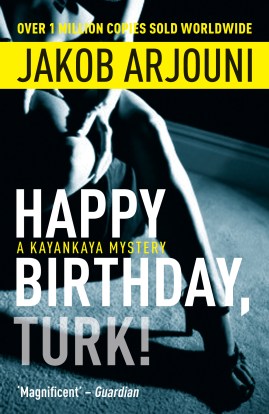
  1. Happy Birthday, Türke / Happy Birthday Turk (1985)
  2. Mehr Bier / More Beer (1987)
  3. Ein Mann, ein Mord / One Man, One Murder (1991)
  4. Kismet / Kismet (2001)
  5. Bruder Kemal / Brother Kemal (2012)

Blue Night 4 Arjouni

The first time I came across Kayankaya was in 1988, in the ‘foreign literature’ section of Borders on Oxford Street in London. The novel was Happy Birthday, Turk, which had been published in Germany in 1985, and had become a surprise critical and commercial hit. It was written by debut author Jakob Arjouni at the tender age of just nineteen.

It’s hard to overestimate how ground-breaking the figure of the Turkish-German P.I. Kemal Kayankaya was in the West Germany of the 1980s, when public attitudes towards the migrant workers who had helped to rebuild post-war Germany were deteriorating (‘job done, now please go home’). Asking German readers to identify with the likeable, wise-cracking, football-and-pickled-herring-loving Kayankaya directly challenged the dominant stereotype of ‘the Turk’ as a kebab-shop owner, rubbish collector or criminal who was poorly integrated into society and spoke only broken German. Kayankaya, the child of a Turkish migrant worker, is depicted as highly articulate, confident in his professional abilities, and – exceptionally for the time – as the holder of a West German passport, courtesy of his adoption by a German couple after his parents’ death. His characterisation thus deliberately up-ends the average German reader’s perception of what a Turkish person living in Germany ‘is like’, and confronts essentialist notions of German national identity. A Turkish-born person with a German passport? A Turkish-German citizen? Really?

Kayankaya’s early investigations, which fuse parts of the American hard-boiled tradition with the German Sozio-Krimi (sociological crime novel) of the 1970s, are used to expose the corruption of the state and to reveal the racism at the heart of West German society – the lingering legacy of National Socialism. The tables are thus deftly turned by Arjouni: the focus is on German criminal activity, and the crimes of Turks and other minorities are shown in the larger context of the unequal power-relations that exist within the state (for example, a ‘bad’ Turk is shown having been blackmailed into dealing drugs by corrupt police officers who threaten him with deportation should he not comply).

DVD cover of the film adaptation of Happy Birthday Turk (1991)

There’s also plenty of wise-cracking, acerbic humour. In fact, wit and sarcasm are shown to be key weapons when dealing with the tedious, casual racism the P.I. encounters as he goes about his daily business in Frankfurt.

Thus we are treated to the following classic exchanges:

  • German woman to Kayankaya: ‘You speak really good German!’
  • Kayankaya to German woman: ‘Thanks (long pause). You too’.

And…

  • German bureaucrat to Kayankaya: ‘Name?’
  • Kayankaya: ‘Kayankaya’.
  • German bureaucrat: ‘Spelling?’
  • Kayankaya: ‘Pretty good. Though I do have a little trouble with those foreign words’.

The Kayankaya novels are not necessarily perfect, but Kemal Kayankaya remains a ground-breaking investigative figure in the history of European crime fiction. A thoroughly original creation, he is used to raise some genuinely troubling questions about dominant social attitudes towards minorities. Many of the points the novels raise about social exclusion and about the uneven distribution of justice within society remain as pertinent today as in the 1980s.

Later novels in the series, as the ‘Foreign Bodies’ episode shows, engage with the seismic changes in Europe following the collapse of communism in 1989/90, and, most recently, with the tensions caused by Islamic fundamentalism (Brother Kemal).

You can listen to the ‘Foreign Bodies’ episode about Kemal Kayankaya, which features an interview with the author Jakob Arjouni, on BBC Radio iPlayer.

Image for PI Kemal Kayankaya

Theakston File 4: Jason Webster interview with Mrs. P.

If you tuned in to the 8th episode of the Radio 4 ‘Foreign Bodies’ series on Wednesday, you’ll have heard crime authors Jason Webster and Antonio Hill in animated discussion with Mark Lawson about Manuel Vázquez Montalbán’s investigator, Pepe Carvalho.

Listening to the episode, I realised now was the time to post my interview with Jason Webster at the 2012 Harrogate Crime Writing Festival. Key areas explored with the author of the ‘Max Cámara’ series, which is set in Valencia, include the legacy of the Spanish Civil War and the influence of Vázquez Montalbán.

Mrs. Peabody (MP): You’re a very versatile author: you started out as a travel writer, examining the history and culture of Spain, before turning your hand to crime fiction. Could you say a little bit about what led you to crime?

Jason Webster (JW): I suppose in some ways writing crime allows me to keep exploring Spain – this massive country that I’m really fascinated by – and has become an extension of the travel books, because the ‘I’ of the narrator in the travel books isn’t a million miles away from a detective: it’s exploration, it’s questioning, it’s looking for clues. And often there was a quest format in my previous books, so my writing has rolled on quite easily from those into crime.

MP: Are you able to take some of the material from those earlier books and incorporate it into your crime novels – say about flamenco or bull-fighting or Spain’s historical past?

JW: Definitely the past – the Spanish Civil War. I draw on that quite heavily for the third Max Cámara book, The Anarchist Detective, which will be coming out next year. So there’s a lot about this dark, dirty legacy of the Civil War – stuff that lots of people in Spain don’t want to talk about. Flamenco a little bit as well. Max likes flamenco so that fits, but it hasn’t played a huge part yet in any of the books.

MP: And do you think the crime genre is particularly suited to tackling subjects like the Spanish Civil War and the legacy of the past?

JW: Yes, absolutely. I mean there’s this largely untold violent history and lots of old wounds which haven’t healed. You have to remember that the families of those who were killed by Franco’s troops couldn’t mourn their dead. Anybody who was on the other side – on Franco’s side – and was killed or wounded – their stories were glorified for years and years. And when Franco died there was this period called ‘the pact of silence’ [pacto de silencio]. During ‘the transition’ [from Franco’s dictatorship to democracy] everybody agreed that you ‘don’t mention the war’… because that’s the only way we’ll get out of the dictatorship and move into democracy. But about eight years ago people started to ask – ‘hang on, what did happen to grandpa?’. So the grandchildren of the people who had suffered during the Civil War were saying, ‘well actually, I want to know’. And that opened up a can of worms, because a whole section of Spanish society – the political right, essentially – just didn’t want to go there. So there are a lot of untold stories, a lot of unhealed wounds, and a legacy of violence.

It’s perfect for writing crime, I think, because there are a lot of secrets … And in a sense there’s a long tradition dating back from the period of ‘the transition’ – just before Franco dies and just afterwards – of great Spanish crime writers like Vázquez Montalbán writing very much from a political point of view. They want to talk about what’s going wrong in Spain, and finally can publish their books once Franco dies, when the dictatorship is over and censorship has come to an end. So that’s very much part of the tradition of Spanish crime writing.

MP: Do you see yourself now as part of that tradition?

JW: In some ways, sure. Vázquez Montalbánwas definitely an inspiration, and the name that I gave Max Cámara…I was thinking of two things, really. I was thinking of Christopher Isherwood and ‘I am a camera’: ‘cámara’ means ‘camera’ in Spanish and it’s a perfectly legitimate surname as well. And this gives us a handle on Max’s character – he observes, he waits, he doesn’t really jump to conclusions. But I was also thinking of Vázquez Montalbán when he was writing under Franco and had been thrown in jail and had to write under a pseudonym – one of the pseudonyms he used was ‘Sixto Cámara’. So there’s a sort of homage to that, to Vázquez Montalbán…

MP: Can I take a tiny detour to your third book, Guerra: Living in the Shadows of the Spanish Civil War. What prompted you to write it?

JW: I was talking to one of the locals near where we live, which is in the middle of nowhere, off the grid. We were just chatting away, when she started telling me some things about the Civil War and took me to a place where she said there was a massacre, in around ’38 – so getting towards the tail end of the war, just as Franco was moving south towards Valencia. And she had seen this happen as a young girl – these bodies being buried. I’d sort of heard about this and it was about the time when it was starting to come out – these mass unmarked graves dotted around the country where people who had died at the hands of the Francoists were just buried… There was no commemorative plaque, there was no gravestone, no one had been allowed to mourn, the dead were buried there for years and years. And you know, death is important in Spain; it’s a culture where you seriously mourn the dead, and so for a whole side of the country not to have been able to mourn their dead… that’s a big deal.

I think a lot of people are just hoping that that generation– anyone who lived through that, anybody who suffered – will just die and then we can all forget about it. But there are quite a lot of people who are trying to recreate the oral history from the time – not let it just slip away. Paul Preston [the historian] and I have met on a number of occasions … and the book that he’s written on the ‘Spanish Holocaust’ is a very interesting one with a very interesting title… He’s deliberately being controversial. And he’s doing that because he’s making a statement about contemporary Spain as much as he is about the past. There are lots of Spaniards who don’t accept what happened. And they say we should just ‘turn the page’. But how are you going to get over the wounds unless you confront the past?

MP: It’s the classic model of the repressed, isn’t it?

JW: Yes, absolutely. Spanish society is still very much divided and this is what forms the backdrop to my second novel, A Death in Valencia. I’m trying to look at these massive divisions that split Spain apart still, eighty years after the Civil War.

MP: You build that history into your crime fiction through the figure of the grandfather, Hilario. He’s somewhat disapproving that his grandson Max chose to join the police.

JW: That deep paradox goes to the heart of who Max is, and I bring this to the fore in the third novel, The Anarchist Detective. Max comes from an anarchist family; he is essentially an anarchist himself, but an anarchist in the broad sense of the word. At the same time he’s an agent of the state, and of state authority, so how does that work? How does he square that circle? In some ways, what I’m doing in the second book, A Death in Valencia, is showing a breakdown in his character, because of this contradiction, whereas in the third book, he kind of resolves that paradox within himself.

MP: Do you think it’s helpful that you speak Spanish? I notice from having read some of A Death in Valencia ­that you include Spanish proverbs [refranes] in their original form, perhaps as a way of communicating with readers who are non-Spanish speakers – imparting the culture and giving us a flavour of the language as well. Is that a deliberate strategy?

JW: I think so. The problem is that it’s hard for me to put myself in the position of not knowing Spanish. Sometimes I’m just writing and there are certain phrases which I just think are so wonderful that I want to put them down in English. The proverbs are there because they are an important part of Max’s character. The Spanish are very, very proud of their proverbs, and it’s one of the things I love about Spain. It’s not Spanish intellectual culture that gets me going in the morning, it’s this intuitive side to the country and to the culture – and I see that in the proverbs. Essentially, there’s a deep wisdom that you feel has been passed on for centuries, by word of mouth – it’s an oral tradition. And I love that, so I did want to get that across in the novels.

MP: What do you think the Spanish would make of your crime novels?

JW: The first one, Or the Bull Kills You, might wind some people up because it’s about bull-fighting, but the second and the third ones don’t deal with so-called Spanish stereotypes, so they might be more acceptable. Basically, don’t talk about anything they term ‘el folklórico’ – flamenco, bull-fighting, all that kind of stuff that the Franco regime tried to promote in the 1950s and 1960s to get tourists to come over. It’s what they consider to be the backward side of their culture and they don’t want to perpetuate the image that that’s all Spain is about. But the Spanish Civil War is a legitimate topic for foreigners to discuss…. It’s complicated!

Interview carried out at the Old Swan Hotel, Harrogate, 20 July 2012

You can still listen to the ‘Foreign Bodies’ episode on Montalbán’s Pepe Carvalho via BBC iPlayer.

BBC Radio 4’s ‘Foreign Bodies’ episode guide…with a bit of Mrs. Peabody in #2!

Mark Lawson’s ‘Foreign Bodies’ series kicked off yesterday with an exploration of two seminal detectives from Belgium –  Hercule Poirot and Jules Maigret. Val McDermid, Andrea Camilleri, P.D. James, Jakob Arjouni and Camilla Lackberg all joined Mark for a fascinating discussion about these two key investigative figures.

Today it was the turn of Friedrich Dürrenmatt’s Swiss detective Inspector Bärlach, featuring a contribution from your very own Mrs. P… Our discussion took in Dürrenmatt’s links to earlier Swiss crime writer Friedrich Glauser, Dürrenmatt’s exploration of the moral crisis facing Europe following the Holocaust, and his subversion of the detective genre to question the possibility of justice. The crime novels discussed included The Judge and his Hangman (Der Richter und sein Henker, 1950), Suspicion (Der Verdacht, 1951) and The Pledge (Das Verprechen, 1958).

Listings for the first 7 episodes are now up on the ‘Foreign Bodies’ website. They air Monday to Friday on Radio 4 at 13.45, and are then available online. For good measure, there’s an omnibus edition on Friday at 21.00.

Episode 1  Belgium: Hercule Poirot and Jules Maigret (Agatha Christie and Georges Simenon)

Episode 2  Switzerland / Germany: Inspector Bärlach (Friedrich Dürrenmatt)

Image for Inspector Barlach

Episode 3  Czechoslovakia: Lieutenant Boruvka (Josef Skvorecky)

Episode 4  The Netherlands: Commissaris Van Der Valk (Nicolas Freeling)

Episode 5  Sweden: Inspector Martin Beck (Maj Sjöwall and Per Wahlöö)

Episode 6  UK: Commander Dalgliesh / Chief Inspector Wexford (P.D. James and Ruth Rendell)

Episode 7  Sicily: Inspector Rogas (Leonardo Sciascia)

You can also hear Bernard Hepton (who played Toby Esterhase in the BBC adaptation of Tinker Tailor Soldier Spy) begin his sublime Radio 4 reading of Dürrenmatt’s novella The Judge and his Hangman (available until 29 October).

Roseanna, the first of the Martin Beck dramatisations – will air on Radio 4 on Saturday 27 October at 14.30, but if you can’t wait, help yourself to this sneak preview.

Mrs. P’s review of Friedrich Dürrenmatt’s The Pledge is available here.

UPDATE 28 October: Mark Lawson has written an overview article about the ‘Foreign Bodies’ series for The Guardian entitled ‘Crime’s Grand Tour: European Detective Fiction’.

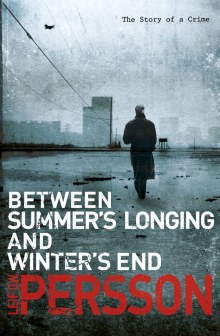
#27 / Leif G.W. Persson, Between Summer’s Longing and Winter’s End: The Story of a Crime

Leif G.W. Persson, Between Summer’s Longing and Winter’s End: The Story of a Crime, trans. from the Swedish by Paul Norlen (London: Black Swan, 2011 [2002]). An epic crime novel and bravura account of one of Sweden’s greatest unsolved crimes  4 stars

Opening line: The best informant is the one who hasn’t understood the significance of what he has told.

Like Peter Høeg’s Miss Smilla’s Feeling for Snow, this novel opens with an unexplained fall from a tall building in the freezing depths of a Scandinavian winter. In the case of Persson’s Between Summer’s Longing and Winter’s End, the casualty is a young American, John Krassner, whose death is initially presumed to be suicide, but might well be something more sinister – for how to explain the fact that his shoe hit the ground a good ten seconds after his body?

For a significant portion of the text, the reader might reasonably assume that Krassner’s death is the ‘crime’ referenced in the novel’s subtitle. However, as the narrative unfolds over a sprawling 638 pages, it becomes clear that his demise is linked to a much larger crime – one that took place in Sweden in 1986 and remains unsolved to this day. If you can’t quite remember that event, I’d advise you to stay away from reviews until you’ve finished the book (my reading experience was considerably enhanced by putting two and two together at a relatively late stage – the biggest ‘OMG’ reading moment I’ve had in years). But if you can’t wait, or are looking for illumination after reading the novel, click here

In common with a number of Swedish crime authors since the 1960s, Persson has a rather jaundiced view of Swedish society and is highly critical of the authorities and the power wielded by the state. The police are depicted as racist or misogynist bunglers, with the Swedish secret police force (Säkerhetspolisen or Säpo) shown in a particularly harsh light. What makes the strength of this critique startling and more than a little interesting is the author’s own long-held position within the Swedish establishment. As the blurb on the inside front cover tells us, Persson has enjoyed an eminent career as ‘Scandinavia’s most renowned criminologist and leading psychological profiler’, as well as being an advisor to the Swedish Ministry of Justice and a professor serving on the National Swedish Police Board. It would be interesting to know how these august bodies reacted to the very negative depictions of the state and its law enforcement agencies within the novel.

One of the few likeable figures in the book is Superintendent Lars Martin Johansson, the ‘honest Swedish cop’ who digs the deepest into Krassner’s death. But even he is only able to discover a portion of the truth: as individual acts collide with one another and fuse with shady political operations in Sweden and beyond, a set of events unfolds whose complexities are beyond the understanding of a lone investigator. In the end, only the reader is provided with a privileged viewpoint in which everything adds up, while being given to understand that no ordinary Swede would ever have a hope of getting near the truth. And of course this is just one possible imagining of those seminal events in 1986 – there are numerous other ways these might have played out.

This is not a crime novel for the faint-hearted: its hundreds of pages, multiple narrative perspectives and complex plotlines require considerable commitment. But once the different strands come together together in the final part the novel, the reader’s efforts are rewarded as the ambition, range and intelligence of the narrative is revealed.  In many ways a political and social history of Sweden since the Second World War, this Kafkaesque narrative tackles big themes (the relation of the individual to the state, loyalty, betrayal, trauma, the precariousness of democracy), but is also rich in satirical humour (look out for ‘Anderson’s Confusion Syndrome’) – and for me was a highly satisfying read.

Between Summer’s Longing and Winter’s End is the first in a trilogy. The second part has recently been translated into English, entitled Another Time, Another Life.

Mrs. Peabody awards Between Summer’s Longing and Winter’s End an ambitious and satisfying 4 stars.

Creative Commons License

.

The Killing 3 is on its way!

Here in the UK there’s been a notable surge in media activity on Forbrydelsen / The Killing 3 over the last couple of weeks.

The series has just started broadcasting in Denmark, where 1.6 million viewers tuned in for the first episode – pretty impressive given the country’s modest 5.5 million population. While there’s been no formal confirmation from BBC4, several sources have given Saturday 17 November as the start date here, with 10 episodes airing in pairs over five weeks.

The makers have stated that this series, in which Lund and the team investigate the murder of a sailor and dodgy dealings in the financial world, will be the final one (sob).

New jumper for The Killing 3! Courtesty of DR TV

Recent links and news

A general, spoiler-free review of the first two episodes of series 3 by Vicky Frost of The Guardian.

A Guardian fashion review of Sarah Lund’s new jumper.

DR TV 35-second trailer for Forbrydelsen III on YouTube.

5 November sees the release of The Killing Original Soundtrack by Frans Bak, featuring music from all three series. There’s a nice piece about the album here. You can sample some of the music via Bak’s SoundCloud page.

15 November sees the publication of The Killing Handbook (‘if you’ve ever wondered who cut the CCTV wire outside Lund’s flat in series 1, why Morten went so far to protect Troels, where you can start your walking tour of Copenhagen from woods to warehouses and the County Hall, or even how you can knit your own Lund jumper – this is the book for you’).

17 November: The Killing 3 begins. Sofa booked. Can’t wait.

#26 / Mons Kallentoft, Midwinter Sacrifice

Mons Kallentoft, Midwinter Sacrifice, translated from the Swedish by Neil Smith (London: Hodder and Stoughton, 2012 [2007]). An impressive debut and the first in a series featuring talented police investigator Malin Fors  4 stars

Opening line: Love and death are neighbours.

I tend to have an allergic reaction to any cover trumpeting that there’s a new Larsson or Nesbo in town, as nine times out of ten such claims are overblown. However, in the case of the debut novel Midwinter Sacrifice, author Mons Kallentoft shows that he can hold his own in such company at least, with a well-written, page-turner of a narrative, and an impressively-realised female detective.  

Set in the city of Linköping in southern Sweden, where the author was raised, the novel makes good use of a ferociously icy nordic winter and the landscapes of the region – dark forests and frozen plains – to create a lyrical, chilling backdrop for the opening crime: the murder and ritual hanging of a local man, who for much of his life was a social outsider. Malin Fors, a gifted police investigator who struggles to balance a demanding job with her role as a single parent following the break-up of her relationship, is called to the crime scene one cold February morning. Together with her partner Zeke, she begins to piece together the events that led to the murder, in a first-class police procedural that repeatedly makes you want to read on (just one more chapter, honest…).

The elements of this crime novel that I particularly liked were: Malin’s nuanced portrayal as a thirty-something woman dealing with the lifelong consequences of her teenage pregnancy; the thematisation of parenting, and the relationships between parents and children (whether infants, teenagers or adults); the depiction of the rest of the police team; the innovative use of the murder victim’s voice in parts of the narrative (difficult to pull off, but effectively done); and a surprise reference to Douglas Adams’ Life, the Universe and Everything (stylish).

The only aspect of the novel that jarred slightly for me was its ending, which was a little too melodramatic for my taste. However, I’m keen to follow Malin on her next case, in the series’ second novel, Summertime Death, which has also recently appeared in translation. The third novel, Autumn Killing, is out in September, revealing a nice use of seasons to structure the series: spring next, I presume…

You can read an extract from Midwinter Sacrifice here.

Mrs. Peabody awards Midwinter Sacrifice a highly more-ish 4 stars.

Creative Commons License

.

This, that and the other…

This … is an interview with Jo Nesbo by James Kidd, which appeared in The Independent over the weekend. Topics covered include Anders Breivik, Nesbo’s father and the publication of the old/new Harry Hole novel The Bat. The interview was carried out following Nesbo’s sell-out appearance at the Theakstons / Harrogate Crime Writing Festival in July.

That is another interview by Kidd (and now I’m really jealous) of Henning Mankell, on the publication of his novel The Shadow Girls (originally published in Sweden in 2001). While not crime fiction, the social critique that’s found in Swedish crime writing in general and Mankell’s works in particular is very much evident in this work.

The other … is a provocative piece by American mystery editor Otto Penzler in Publishers Weekly, entitled ‘Why the Best Mysteries are Written in English’. A number of arguments are put forward by Penzler (albeit not always with total clarity) to justify this grand assertion, and a lively set of responses have now accrued in the comments section, which make for an entertaining read.

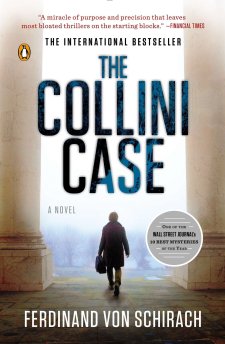
Ferdinand von Schirach’s The Collini Case, tr. Anthea Bell (Germany)

Following a lovely summer break, Mrs. P. kicks off with a review of Ferdinand von Schirach’s The Collini Case, translated from the German by Anthea Bell (London: Penguin/Michael Joseph, 2012 [2011]). It’s an effectively written courtroom drama that asks some big legal and ethical questions.

Opening line: Later, they would all of them remember it: the floor waiter, the two elderly ladies in the lift, the married couple in the fourth-floor corridor.

Ferdinand von Schirach is an eminent defence lawyer based in Berlin. He first came to prominence as a writer in 2009 with the short story collection Verbrechen (Crime), which drew heavily on the real-life cases he’d encountered during his career. It was an instant hit, spending 54 weeks at the top of the German bestseller lists, as well as critically acclaimed (the winner of the 2010 Kleist prize). A second short story collection entitled Guilt was also extremely successful, which was followed by the publication of The Collini Case, his first full-length crime novel, in 2011.

The focus on criminality, justice and the law is as evident in The Collini Case as it was in the author’s earlier works. It’s 2001 Berlin, and young barrister Caspar Leinen is assigned to defend an Italian national, Fabrizio Collini, the perpetrator in an apparently open-and-shut murder case at the famous Adlon Hotel. Only after accepting the brief does Leinen realise that he knew the victim, retired industrialist Hans Meyer: the latter was the grandfather of a close school-friend, who had been kind to Leinen in his youth. While considering whether or not he should continue to represent Collini, Leinen is faced with another problem: the accused refuses to reveal his motive for the crime. How then is Leinen to defend his client when the case comes to court? Leinen’s personal difficulties in representing Meyer’s murderer and his efforts to figure out a viable defence become the key concerns of the unfolding narrative.

Von Schirach is a skilled author who knows how to write an effective page-turner. But by far the most interesting aspect of this novel for me was the legal discussion portrayed in the courtroom section of the novel. And here I find myself in a rather difficult position, as talking about this aspect of the narrative would inevitably mean breaching Mrs. P.’s spoiler rule. So I will have to content myself by saying that the discussion of genuine points of law and their impact on a genuine set of cases since the end of the 1960s was fascinating, and is not something that I’ve seen addressed this way in a German crime novel before. 

The wider impact of the novel has also been quite extraordinary. The legal points it highlights have been raised by German MPs in the Bundestag, with a Ministry of Justice commission established in 2012 to examine the larger issues raised about legislative processes in the 1960s. It’s extremely rare for a crime novel to have such an influence in the ‘real world’, and this sets it apart from others that have tackled the same subject in a very special way.

I would second Maxine’s advice over at Petrona to read the novel before seeking out further information about the author and his work. But once you’re through, you might be interested in the following:

A Spiegel piece by von Schirach in English, in which he talks a bit about his unusual family background (thanks to Maxine for this link).

An interview with the author in German in the newspaper Die Zeit, which includes discussion about the judicial issue at the heart of the trial (contains spoilers!).

This Guardian article also draws on the interview in Die Zeit (contains spoilers!).

The comments on this post may also inadvertently hint at the novel’s content…

UPDATES

May 2013: The Collini Case has been shortlisted for the Crime Writers’ Association International Dagger Award.

And one last note: There’s extensive discussion of Bernhard Schlink’s The Reader in the comments below, which also has a courtroom section, as well as reference to Schlink’s crime novels (the ‘Selb’ series). In my capacity as an academic, I’ve written two articles on Schlink’s work, with links as follows… The first is a comparative analysis of the crime novel Selbs Justiz (which opens the ‘Selb’ series) and The Reader in the journal German Life and Letters (2006). The second looks at the controversies created in critical circles by The Reader, both in Germany and in the English-speaking world (German Monitor, 2013). It’s nearly twenty years since The Reader was published, and critical reaction to the novel and the film continues to be extremely polarised.

Creative Commons License

Mrs. Peabody puts her feet up … with a good book

This blog will take a break for the month of August – during which time Mrs. P. hopes to enjoy the company of her family (most likely in a fair bit of British rain) and some tranquil reading in a seaside setting, together with 150,000 gannets.

Mrs. P’s summer reading, currently gathered in an unsteady pile by the side of the suitcase, looks something like this:

Sofi Oksanen’s Purge (Atlantic 2011 [2008] – Finnish/Estonian]

John le Carré’s The Secret Pilgrim (Penguin 2011 [1991] – the final Smiley novel)

Giorgio Scerbanenco’s A Private Venus (Hersilia Press 2012 [1966] – Italian noir)

Jason Webster’s A Death in Valencia (Chatto & Windus 2012 – British/Spanish)

Reginald Hill’s On Beulah Height (Harper 2009 [1998] – British)

Perfect combination… (copyright Lizzy Siddall)

and finally a rogue book that isn’t crime (gasp):

Jeanette Winterson’s Why Be Happy When You Could be Normal (Vintage 2012).

The Kindle’s also coming along, in case that lot’s not quite enough!

Wishing you all lots of lovely summer reading, hopefully with a bit of sunshine thrown in…

Tantalising glimpse of The Killing 3

The Danish broadcaster DR has released a mini-trailer for the third and apparently final series of Forbrydelsen, in which Sarah and the team investigate the death of a young sailor and dodgy dealings in the financial world.

Click here to view. No Danish required! [Update Sept 2012: link now leads through to DK Forbrydelsen website but the trailer is no longer available.]

There’s no word as yet about when the series will make it to BBC4. Still a little while, I would guess … Can’t wait!