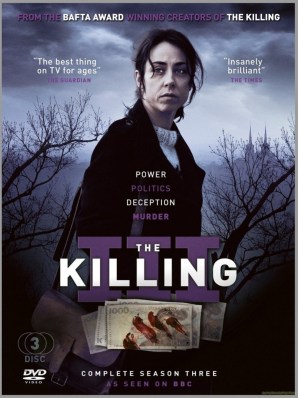
It’s time for ‘The Killing 3’ Bingo!

So it’s T-minus two hours. Tonight sees the start of Forbrydelsen / The Killing 3 at 9pm on BBC4 – the long, long wait of dedicated British fans is nearly over.

If you have loyally accompanied Sarah Lund from the start of her journey in the amazing opening episodes of series one, then you might like to join me this evening in a game of ‘The Killing 3’ Bingo, which pays affectionate tribute to some of the hallmarks of this exceptional crime drama. Enjoy!

(I might add that I’ve had to employ some Lund-like doggedness to import this table into WordPress via Word, Paint and Flickr. My reward is an *extra-large* glass of wine with tonight’s episodes.)

Update: By the end of episode 2, I had 7 boxes crossed and by the end of episode 4, 11 boxes 🙂 Just one to go…

The Killing 3 is on its way!

Here in the UK there’s been a notable surge in media activity on Forbrydelsen / The Killing 3 over the last couple of weeks.

The series has just started broadcasting in Denmark, where 1.6 million viewers tuned in for the first episode – pretty impressive given the country’s modest 5.5 million population. While there’s been no formal confirmation from BBC4, several sources have given Saturday 17 November as the start date here, with 10 episodes airing in pairs over five weeks.

The makers have stated that this series, in which Lund and the team investigate the murder of a sailor and dodgy dealings in the financial world, will be the final one (sob).

New jumper for The Killing 3! Courtesty of DR TV

Recent links and news

A general, spoiler-free review of the first two episodes of series 3 by Vicky Frost of The Guardian.

A Guardian fashion review of Sarah Lund’s new jumper.

DR TV 35-second trailer for Forbrydelsen III on YouTube.

5 November sees the release of The Killing Original Soundtrack by Frans Bak, featuring music from all three series. There’s a nice piece about the album here. You can sample some of the music via Bak’s SoundCloud page.

15 November sees the publication of The Killing Handbook (‘if you’ve ever wondered who cut the CCTV wire outside Lund’s flat in series 1, why Morten went so far to protect Troels, where you can start your walking tour of Copenhagen from woods to warehouses and the County Hall, or even how you can knit your own Lund jumper – this is the book for you’).

17 November: The Killing 3 begins. Sofa booked. Can’t wait.

Tantalising glimpse of The Killing 3

The Danish broadcaster DR has released a mini-trailer for the third and apparently final series of Forbrydelsen, in which Sarah and the team investigate the death of a young sailor and dodgy dealings in the financial world.

Click here to view. No Danish required! [Update Sept 2012: link now leads through to DK Forbrydelsen website but the trailer is no longer available.]

There’s no word as yet about when the series will make it to BBC4. Still a little while, I would guess … Can’t wait!

Reflections on BBC4’s The Bridge / Bron / Broen

Following the utterly gripping and nail-biting finale of The Bridge, it’s time for a few reflections on this ground-breaking Danish-Swedish production.

In line with Mrs P. policy, there are NO FINALE SPOILERS (if that’s what you’re after, do head over to The Guardian‘s ‘Bridge blog‘).

The Bridge vs The Killing

Before The Bridge aired in the UK, a number of people who’d seen the series said they’d liked it even more than The Killing. Although I’ve enjoyed The Bridge hugely, I’m not yet prepared to go that far: the first series of The Killing remains my top crime-drama viewing experience and Sarah Lund still edges it over Saga and Martin’s (admittedly great) investigative duo.

This preference is mainly due to the depth of characterisation in The Killing. In the first series especially, the focus was on a small number of characters whom you got to know very well, whereas The Bridge had a larger cast and, with the exception of Saga and Martin, had less time to dig deep. Compare, for example, the picture we were able to build up of Nanna Birk Larsen as the murder victim in The Killing 1 and those of the politician / prostitute at the beginning of The Bridge (merely the first of many). And there were a number of interesting characters who featured heavily in early plot-lines of The Bridge, but then simply faded away. Their disappearing acts may be a reflection of the reality of investigations – people make their contribution or are ruled out as suspects and then the team moves on – but some of their stories felt incomplete and I’d liked to have known more.

Fabulous biting humour

Those minor quibbles aside, The Bridge was a top-notch Scandi treat that had me gripped throughout, and became increasingly assured as time went on. The last four episodes were absolutely cracking.

One particularly fine quality was apparent right from the start of the series: a biting and at times splendidly irreverent humour. Much of this was generated by the interplay between the odd-ball Danish-Swedish investigative couple, and also provided a way of managing the audience’s reaction to Saga as a character on the autistic spectrum (we’re invited to see her behaviour as ‘endearingly odd’ rather than ‘threateningly weird’). There’s been some debate about the suitability of this strategy, but I felt it worked extremely well, and that the writers kept the balance between the humour and the more serious elements of the drama just right. Episodes 7 and 8 were superb in this respect.

Hey Martin…was it something I said?!

In sum, The Bridge is high-quality crime drama firmly located in the tradition of socially-engaged Scandinavian crime fiction, with a wonderful pair of detectives and more twists than fusilli pasta. If you haven’t yet seen it, you’re in for a treat.

For earlier posts on The Bridge, see here and here.

And, for one last time, a link to the wonderful title sequence, featuring the sublime ‘Hollow Talk’ by the Choir of Young Believers.

The Bridge – Review of Episodes 1 and 2

At the centre of the 7,845 metre Oresund Bridge that links Denmark and Sweden, lying across the yellow line that marks the border between the two, the lifeless body of a woman is found. Although the victim at first appears to be Swedish, the national juristiction of the case turns out to be far from clear, leading a police officer from each country being assigned to the case. Swedish investigator Saga Noren (Sofia Helm) and her Danish counterpart Martin Rodhe (Kim Bodnia) both soon realise that they’ve been pulled into a difficult, bizarre and highly complex case.

Thus begins the acclaimed crime drama The Bridge/Bron/Broen, whose first episodes aired last night on BBC4 between 9.00 and 11.00pm.

Even from the title sequence, with its beautiful, nocturnal time-lapse photography and haunting theme (‘Hollow Talk’ by the Choir of Young Believers), it was clear that we were in for a treat. By the end of the first two episodes I was fully gripped, as the investigative narrative unfolded and two intriguing sub-plots took shape: a rich wife rushing her husband to hospital for a transplant operation, and a man helping a young woman escape an abusive husband, but with a murky past of his own.

In Saga Noren and Martin Rodhe we are given a classic investigative ‘odd couple’. Saga is a particularly interesting character, whose sometimes unconventional behaviour leads her colleagues to regard her as ‘a bit special’. She is a brilliant and knowledgeable investigator, who is ruthlessly logical and focused, and finds social niceties a baffling waste of time. As already discussed in the comments of an earlier post, it’s possible that she has a form of high-functioning autism. (In terms of other TV characters, she reminded me a bit of Star Trek‘s Seven of Nine!) Martin, by contrast, is more of an old school cop, who has a complicated private life and doesn’t always do things by the book, but who seems to take Saga’s behaviour (such as calling him in the early hours with a fresh lead) in his stride. The dynamic between the two looks promising.

- Hmm, not sure what I make of you.
- Feeling's mutual

Some other random observations at this point:

In contrast to The Killing, there are moments of genuine, albeit dark humour in The Bridge, which worked well for me. Watch out for Saga’s ‘romantic’ date (and make a note of how not to put off hunky Swedes the morning after).

The obligatory autopsy scene allows us to appreciate Saga’s intelligence and investigative focus (and was therefore justifiably included in my view). There are some quite graphic photos from the autopsy featured later on, but I’m hoping that’ll be it for now.

The series has an interesting 70s styling. Its palette of browns, oranges and beiges reminded me a little of the recent film adaptation of Tinker Tailor Soldier Spy, directed by the Swede Tomas Alfredson. One of the characters (flares, leather jacket, moustache) could have stepped straight out of Life On Mars.

I’m very much enjoying the transnational flavour of the series, which is evident in the Danish/Swedish credits, the characters’ dialogue, and of course the plot itself. And yes, they do all understand one another, but Martin has to repeat himself more s-l-o-w-l-y at one point so that the Swedes can follow him properly!

The murderer’s motives look complex and interesting: ‘if you had cared there would have been no victims’. It looks like the series will follow in the tradition of Swedish crime writing (Sjowall & Wahloo, Mankell) by foregrounding social issues. Mindful of spoilers, I shall say no more.

The Oresund Bridge looks remarkably like the Severn Bridge at times (Welsh-English remake please!).

Tonight’s episodes are both repeated and available on BBC iPlayer.

Below is a handy map with the Oresund Bridge to help with orientation: it joins Denmark and its capital city Copenhagen on the left and Sweden’s Malmo, the third largest city after Stockholm and Gothenburg, on the right.

Looking forward to next week’s episodes already!

BBC4 The Bridge – start date confirmed

FOR DETAILS ABOUT SERIES TWO SEE HERE.

With many thanks to Rhian for alerting me to the following:

The Swedish/Danish crime series The Bridge begins on Saturday 21 April at 9.00 pm. Two episodes will be aired that evening (totalling two hours). Further details are available via The Radio Times, which features Sofia Helin, one of the series’ stars, on its front cover this week.

A BBC4 press release describes the series thus: “The Bridge, a 10-part investigative crime drama, begins when the body of a woman is found in the middle of the Oresund Bridge between Sweden and Denmark. A bi-national team is put together to solve the crime and the killer, always one step ahead of the police, becomes the object of a dramatic manhunt.”

The stars of The Bridge, Sofia Helin and Kim Bodnia

Not only is The Bridge a Swedish/Danish co-production, it’s a bilingual one.

The original title (which appears on the cover of the DVD) is Bron/Broen, and dialogue is delivered in both languages, reflecting the operations of the bi-national investigative team. I’m not sure if this is a first, but I find the idea of a bilingual crime series quite fascinating (imagine, for example, a British/French series investigating a murder at the exact centre of the Channel Tunnel!). Do the Swedish and Danish investigators all understand/speak their opposite number’s language? Do they switch languages depending on the country they happen to be in? I won’t easily be able to tell, as the languages will only be fully comprehensible to me via subtitles, but perhaps someone can provide illumination!

I’ve heard many good things from those who’ve already watched the series and look forward to seeing it immensely.

Check out the wonderfully atmospheric title sequence with its time-lapse photography on YouTube. The title-track, ‘Hollow Talk’, is by the Danish group Choir of Young Believers.

New Danish crime drama on ITV3: Those Who Kill

My thanks to Rhian over at It’s a Crime! (or a Mystery) for drawing my attention to a new Danish crime drama starting tomorrow, Thursday 23 February, on ITV3 at 10pm.

Those Who Kill (Den Som Dræber) originally aired in Denmark in March 2011 and appears to have been pretty successful – it’s been sold on to a number of other countries and will be remade for the US market (following in the footsteps of Forbrydelsen I).

The investigative team. Wait a minute! Who's that on the right?!*

The series synopsis from ITV3 reads as follows:

‘Those Who Kill is a compelling dark crime series, based on the novels by bestselling author Elsebeth Egholm. It follows the investigations of a special unit of Copenhagen’s police force, consisting of detective inspector Katrina Ries Jenson (Laura Back) and forensic psychiatrist Thomas Schaeffer (Jakob Cedergren). The pair specialise in identifying serial killers that do not fit within traditional behavioural patterns and aim to uncover the psychology of a violent killer in their attempt to solve a case surrounded by fear and mystery’.

I have to confess that this description doesn’t particularly appeal to me, as I’m rather averse to serial killer novels and dramas. They often seem to dwell excessively on sadistic acts of violence and the suffering of (usually) female victims, and of course this violence and suffering are enacted again and again with each successive murder (it’s the grim repetition that really does me in).

But what’s interesting about the ITV3 press release, which I’m guessing from its use of ‘we’ is a translation of Danish press materials, is the way that the subject of serial killings and killers is presented:

‘THOSE WHO KILL is a crime series about a violent criminal surrounded by fear and mystique – the serial killer. Up until now, we have been able to curtail their activities with early – and effective – interventions via the safety net of a comprehensive social welfare system in Scandinavia. But times have changed. Borders have opened up, social welfare is in decline, and slowly but surely the whole system has become imbued with a sense of resigned impotence and callous disregard for those it once sought to rescue. The rifts in the net have become so large that bigger fish are slipping through the mesh, and as a result, a new type of crime is starting to burgeon – killings not grounded in traditional motives and patterns of behaviour.’

So here we are given a sociological explanation for the rise of the serial killer in Scandinavia – the disintegration of the social welfare system (also a principle concern of the 1960s / 1970s ‘Martin Beck’ series by the Swedish crime writers Sjowall and Wahloo). I’d be interested to know if this rise is documented, but, whether real or not, the passage suggests a more thoughtful approach than most dramas to the topic of serial killers, through an exploration of the way in which society and its structures contribute to their making. This impression is reinforced in the description of the investigators’ activities:

‘For both Katrine and Thomas, the challange becomes one of discerning the human behind the monster. For only when they come to understand the fantasies and trauma that drive him are they able to confront him’.

On the one hand, this kind of psychological investigative approach reminds me of Val McDermid’s Carol Jordan/Tony Hill series (of which I’ve read The Last Temptation) and on the other, of historical studies seeking to understand perpetrator motivations and war-crimes (Christopher Browning’s Ordinary Men springs to mind). Both try in their different ways to move beyond the idea of killers as one-dimensional monsters, and to comprehend the logic, however distorted, of their actions.

Of course the press release could simply be sophisticated packaging for the usual serial- killer schlock, but who knows, maybe Those Who Kill will be different. I’ll probably watch, given the high quality of other recent Danish dramas on BBC4 and the welcome presence of another strong female lead, but may find myself switching off if things get too uncomfort-able.

The full press release from ITV3 can be accessed here.

*One of the main characters in the drama, Magnus Bisgaard, is played by actor Lars Mikkelsen, who will be familiar to fans of The Killing 1 from his role as the idealistic politician Troels Hartmann.

24 February update: Due to a conspiracy of circumstances involving a snowboard, suspected concussion and a trip to A+E, I didn’t get to see last night’s opening episode. But here are a few Twitter reviews to give a flavour of how Those Who Kill went down with viewers.

@richard0x4A: thosewhokill pretty good. A bit predictable but I enjoyed it. itv3 in decent foreign drama shock.

@Schmolik: ThoseWhoKill last night was distinctly “meh”. Don’t know if Lars Mikkelsen’s cheekbones are enough to keep me interested.

@Packet_editor: #thosewhokill my new The Killing fix

@crifilover: thosewhokill getting tense!

@fleetstreetfox: Hmm. I could miss that and wouldn’t mind #thosewhokill

SoundCloud link to the music from Forbrydelsen / The Killing

For the many of us who have wondered where to find the wonderfully atmospheric music from the Danish crime drama Forbrydelsen / The Killing, information is finally at hand – thanks to blog readers Viv and Andrew.

From Viv I’ve learned that the soundtrack is by the Danish film composer Franz Bak. In addition to Forbrydelsen I, he’s also scored the music for Forbrydelsen II, an episode of Branagh’s Wallander series (‘The Fifth Woman’), and the American version of The Killing.

A large number of his tracks are available on the Franz Bak website (see right-hand column) and on SoundCloud (Playlist 3). If you’re in search of that haunting title music, it’s the Forbrydelsen Montage…

It doesn’t look like tracks can be downloaded or purchased (if you know otherwise please let us know), but at least they can now be enjoyed in one place via computer. Andrew adds that lots of Franz Bak’s music is also available on Spotify.

Thanks again to Viv and Andrew for passing this information on – it’s eased the pain of returning to work tomorrow considerably!

Forbrydelsen / The Killing Series 2 Finale

First of all, I just have to say: I KNEW IT!!!

I got the murderer dramatically wrong at the end of Forbrydelsen I, so a brief moment of smugness at correctly identifying the perp is permitted!

Some general musings at the end of this excellent second series:                        (no spoilers in line with Mrs. P. policy)

  1. A few people had warned me that the second series wasn’t as good as the first, but I found it immensely enjoyable. The 10-episode format over five weeks inevitably made for a more intense viewing experience, but one that worked extremely well for me. Not least, it was easier to keep the whole of the plot in your head for the duration, and I felt that there were fewer loose ends than in series 1. 
  2. To put this another way, series 2 was a very different entity to the first series, whose 20 episodes explored one central murder and its wider effects at a much slower pace. But Forbrydelsen II worked well on its own more succinct terms.
  3. There were also plenty of similarities between the two series, not least that both featured a strong political storyline and focused on the twin themes of power and corruption. (If there’s a criticism to be made of series 2, it would be of this political strand – for reasons that I can’t go into without revealing major bits of plot…).   
  4. Both series have a pleasing circular narrative (they end where they began in a number of fascinating ways).
  5. Lund rocks! I loved the continuing exploration of her character and the tensions between her duties as a policewoman and her personal life (taken in a slightly different and exceedingly interesting direction this time round).

Roll on Series 3!

Forbrydelsen II's investigative team: Brix, Lund and Strange

If you wish to leave a comment, please don’t give away any details of the plot, to protect those viewers who have yet to see the series.

If you’d like to find out the identity of the murderer or if you wish to comment in more detail on the specifics of the plot, you can do so at Vicky Frost’s excellent blog at The Guardian.

She’s Got the Look: BBC4’s Forbrydelsen / The Killing Series 2

The first two episodes of Forbrydelsen / The Killing Series 2 have finally aired on BBC4. Anticipation had been building over the past week (Sarah Lund on the cover of The Radio Times!), and as I took up my position on the sofa at 8.58pm (complete with patterned Lund tribute jumper), I was practically beside myself with excitement.

Oh! What a wonderfully tense opening! Ah! The dulcet tones of that Neptun soundtrack! Ooh! It’s so good to see you, Sarah, and to hear your funky Danish again!

Series 2 opens a couple of years after the end of the traumatic Nanna Birk Larsen case. Lund has been demoted to an administrative job checking papers in the back of beyond -a mind-numbing exile that makes no use of her exceptional investigative skills. But following the bizarre murder of lawyer Anne Dragsholm, she is recalled to Copenhagen by former boss Lennart Brix, swaps her unflattering POLITI uniform for her traditional chunky-knit jumper, and resumes her rightful role as a police detective (‘this is what I do best’). 

In keeping with The Killing’s status as a police procedural, there’s a continued focus on Lund’s interaction (or non-interaction) with the rest of the investigative team. The wonderfully-monikered Ulrik Strange appears to be the new Meyer (I’m still devastated by the way that partnership turned out), and then there’s Lund’s granite-faced boss Brix, who played a rather ambiguous role in Series 1 (and who is one of the few characters apart from Sarah’s family returning for Series 2). We’re also re-entering the murky world of Danish politics. The (rather endearing) new Justice Minister Thomas Buch is in the midst of complex cross-party negotiations on the introduction of new anti-terrorism laws, and in another plot strand, we see Raben, a former soldier, hoping to be reunited with his wife and young son following his discharge from a psychiatric unit. The connections between the murder and the worlds of high politics and the military are soon, of course, to become the subject of Lund’s sustained investigative interest. 

Sarah Lund and Ulrik Strange (has anyone told him about Meyer?)

What I  particularly enjoyed in these opening episodes was seeing Lund back in her natural habitat – the crime scene. Initially unsure of herself and her abilities following her enforced absence, we see her gradually grow in confidence and take ownership of the investigation. And what’s striking throughout the two episodes is the repeated close-up shots of Lund simply looking, her gaze sweeping across a crime scene, suspect’s house or military office, and continually processing and storing information. As I noted in an earlier post, The Killing frequently references a trope associated with hard-boiled crime fiction – the ‘power of the investigative eye’. It’s all about ‘the look’: looking / seeing / thinking / making links and arriving at an understanding of the complex truth of the crime. Lund looks for and sees things in a way no one else does (be it a bit of cellophane, an ornament, items of furniture, a corpse or a photograph). I absolutely love this focus on the process of detection and on Lund’s intelligence. As ever, it’s a pleasure to see a supremely skilled policewoman on our screens.

So that’s it – the sofa’s now booked every Saturday at 9.00 for the next few weeks (with apologies to the footballing fans in the family). Can’t wait to see more!

Further links

The first two episodes are available on BBC iPlayer for a limited time.

Vicky Frost’s excellent episode-by-episode blog of The Killing returns. Her posts discuss each installment in minute detail and so inevitably contain spoilers. You have been warned!

Guardian Q&A with Sophie Gråbøl.

A short Radio Times piece on translating and subtitling The Killing 2 – with a focus on the particular difficulties presented by expletives. I do hope they haven’t toned down the language too much, given the progamme’s gritty style.

Radio Times: knit your own Sarah Lund jumper.

Radio Times: TV’s top women cops