Ratking: Dibdin’s Zen vs BBC4’s TV adaptation

I’ve just finished reading the first of the Aurelio Zen novels by Michael Dibdin – Ratking – which was published in 1988. Like many new Zen readers, I bought the book after enjoying the BBC adaptations, but was also interested to see how the two compared, having heard that the TV episodes diverged somewhat from their source material.

I’d say that the TV adaptation of Ratking is loosely faithful to the novel, in the sense that both the reader and the viewer see Zen operating as a Venetian ‘outsider’ in a corrupt Italian policing system, and are aware of the dangers he faces should he make the wrong investigative/political move. But the Zen of the book is not the sharp-suited Italian of TV’s Rufus Sewell; nor is he shown negotiating with representatives from the higher echelons of government (he’s far too unimportant). And while the framework Ratking’s plot is taken up to some extent in the TV version, some aspects were significantly altered, like (ahem) the identity of the murderer.

I did, however, enjoy the novel exceedingly. Zen is nicely characterised, and the novel provides an intriguing insight into Italian society at the end of ‘the years of lead’ (a period of terrorism and kidnappings that lasted from the 1960s to the 1980s). It also provides a sharp critique of the power wielded by rich Italian families, and their immunity from the normal rules and regulations of society: sophisticated and cultured on the outside, but decadent and corrupt within. Well-written and entertaining, the novel only dipped slightly for me at the end, when the plot became a touch melodramatic. But it’s certainly worth a read, and I’m looking forward to sampling others from the series.

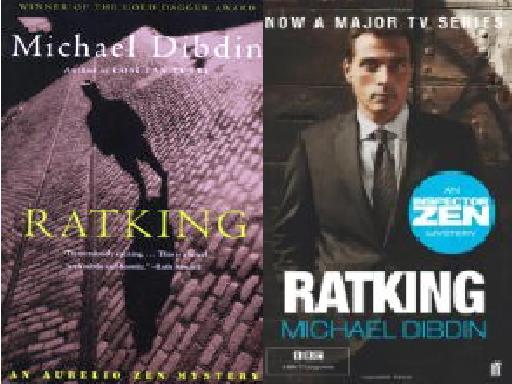
It’s interesting to compare the packaging of Ratking editions past and present: on the left, moody Italian cobbles, shadows and trilby-wearing detective; on the right, the star power of Rufus Sewell as Zen. With thanks to Peabody Jnr for technical assistance with the images.
Top 5 – Nordic Crime

Over at the ‘Tipping My Fedora’ blog, Cavershamragu suggested that I put together a Top 20 Scandinavian crime list. I’ve got as far as a Top 5, as I’m not sure I have 20 I would heartily recommend. I’m also stretching Scandinavian to ‘Nordic’ (read for this anywhere that has a tendency to be cold, snowy and dark for much of the year), as I like Icelandic crime, and it has links to Swedish crime too…

1. Roseanna, Maj Sjowall and Per Wahloo (Sweden 1965). An early police procedural, co-written by a husband-and-wife team, which explores the state of 1960s Swedish society from a left-wing perspective. One of the first crime novels to focus properly on the identity of the female victim as well as on the process of investigation and the murderer. First in the 10 book ‘Martin Beck’ series – read them all while you’re at it!

2. Firewall, Henning Mankell (Sweden 1998) While the Wallander series, of which this is the 8th book, is hugely and rightly lauded, you don’t often see individual Mankell books make top-crime-fiction lists. I think this is because the books work best as part of a series, and none obviously stand out. But even so, this is one of my favourites, and I really wanted Wallander to be represented. Another fine police series – greatly indebted to Sjowall and Wahloo’s ‘first wave’ police procedurals.

3. The Draining Lake, Arnaldur Indridason (Iceland 2004) If the Wallander books are ‘second wave’ police procedurals, then Indridason’s can be thought of as the ‘third’, as they clearly draw on the Mankell and Sjowall/Wahloo books before them. This is the 4th in the ‘Ernaldur’ series, and it’s one of the best crime novels I’ve ever read. Check out my earlier post for a full review.

4. Borkmann’s Point, Hakan Nesser (Sweden 1994). This is an ‘Inspector van Veeteren’ mystery. I haven’t read any of the others in the series, but liked this one very much for its slightly quirky philosophical musings. Another police procedural (are there any other types of Nordic crime, I find myself wondering). 

5. The Killing (on BBC4 tonight!!!) (Denmark 2007) OK, cheating here now – not a book – but it’s a way of getting a Danish one in, even though it’s a TV series. See my review of last week’s opening episodes. Top quality crime. Might be based on a crime novel (not sure / will dig)…

If you expand this list out to include all the books in the respective series, you’ll have enough to keep you going for years 🙂 Unless you’ve read them all already that is…further suggestions welcome…

BBC4’s The Killing Series 1 – review of outstanding new crime drama from Denmark

I’ve just finished watching the first two episodes of the Danish crime drama The Killing on BBC4, and it’s so exceptional I felt I had to blog it straightaway.

Forbrydelson / The Killing is an outstanding, powerful, grown-up drama that seeks to show not just the criminal investigation of a murder, but the devastating effect that the crime has on the victim’s family and friends. Part police-procedural, part family drama, part political drama, it chronicles a 20-day police investigation in 20 episodes, allowing for events to unfold realistically from different points-of-view. It’s extremely moving, particularly in its depiction of parental grief, with outstanding acting all round: I don’t mind admitting that I shed a tear or two (and as Mr. Peabody will tell you, this is a rare event indeed – I’m usually tough as old boots).

The police investigator in charge is Sarah Lund (played by the excellent Sofie Gråbøl), who is sucked into the case on what should be her last day before taking a new job in Sweden. What an absolute joy this character is: a confident, intelligent, nicotine-gum-chewing policewoman who is *extremely* good at her job. The camera often simply lingers on her looking / seeing / thinking things through / making links / understanding (a nod to the trope often present in hard-boiled crime fiction of the ‘power of the investigative eye’). The contrasts between Lund’s methods of investigation and those of her male co-investigator are highlighted throughout (sometimes to droll comedic effect): the implication is that the different policing styles are firmly gendered, and the ‘male’ style does not come off well at all. 

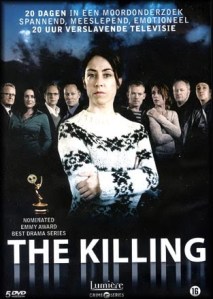
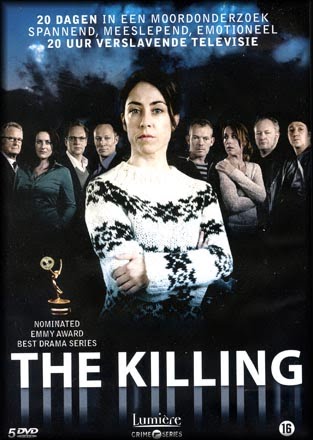
A small, but lovely detail is that Lund wears the same rather tatty-looking jumper throughout the first two days of the investigation (as seen above). Fashion statements are pretty much bottom of the to-do-list, which is extremely refreshing.

I haven’t seen a crime drama this powerful since watching the TV adaptation of David Peace’s Yorkshire Noir quartet – 1974 / 1977 / 1980 / 1983. I would highly recommend The Killing – it’s a significant cut above your average crime series, and was rightly lauded in Denmark where it first appeared in 2007. Fantastic Danish crime drama: who knew?

Well done (again) BBC4 – going great guns on international crime. Both episodes are available on iplayer: catch up while you have the chance and tune in next week for episode 3. I’ll definitely be there.

11 Feb: Rog has posted an audioclip of The Killing‘s theme tune (by Neptun) in the comments section below.

12 Feb: Tweet reviews

punkcinema1 – The Killing is brilliant TV. Best thing made by Denmark since Lego.

richvoorwerp – Imagine a 20 episode, complex, tightly scripted, beautifully acted, crime drama produced by British TV. The Danes can do it.

rosemarymaddy – Going to watch The Killing on BBC iplayer. If you haven’t seen it yet, and you like gritty, intelligent, crime drama, why not take a look?

If you’d like to leave a comment, please make sure there are no spoilers that might interfere with the enjoyment of others still catching up 🙂

Friday treat: Dibdin / Ratking / Zen

I wandered into a bookshop yesterday lunchtime after a tiring week at work and spotted Dibdin’s Ratking, complete with Rufus Sewell’s Zen on the front cover. Couldn’t resist treating myself, especially after all the discussion online about how closely (or not) Sewell’s Zen matches the detective of the novels.

I read the first chapter in bed last night and enjoyed it very much. Zen’s only just appeared, so it’s too early to comment on his characterisation, but I look forward to reviewing Ratking on the blog some time soon. One surprise – the novel was written in 1988, 23 years ago – good grief! – and that’s something to bear in mind when thinking about the portrayal of Italian society and Italian policing in the book.

As for a Saturday treat: I’ve booked the telly this evening from 9.00 to 11.00 to check out the new Danish crime series The Killing. Am a bit over-excited about this (not sure what this says about my life).

BBC4 New Danish crime series – ‘The Killing’

News comes to me via the wondrous Euro Crime blog of a new Danish crime series, The Killing, that’s due to start on BBC4 this Saturday, 22 January (two episodes back to back at 9.00pm and 10.00pm).

  • 20 episodes – one for each of the 20 days of the case (a bit like 24, but days instead of hours, if you see what I mean)
  • Features a female head of investigations, Inspector Sarah Lund (big cheer!)
  • Police procedural (shades of Wallander, perhaps?)
  • Originally shown in 2007 on Danish TV, where it was a big hit.
  • Received a nomination for International Emmy for best Best Drama.

Sounds very promising.

Euro Crime carries the BBC4 press release here, which gives some details about the story-line (no major spoilers though).

[See also my review of the first two episodes in a later post – link on right hand menu]

20 mysteries you must read before you die?

A link came round on Twitter recently to the writer John Connelly’s website, where he and Declan Hughes have posted a joint list of ’20 mysteries you must read before you die’.

This is it:

1. THE GLASS KEY-DASHIELL HAMMETT (1931)

2. THE LONG GOODBYE-Raymond Chandler (1953)

3. THE CHILL-Ross Macdonald (1964)

4. DEEP WATER-Patricia Highsmith (1957)

5.THE FRIENDS OF EDDIE COYLE-George V.Higgins (1972)

6. THE TIN ROOF BLOWDOWN-James Lee Burke (2007)

7. THE LECTER TRILOGY-Thomas Harris.

8. STRANGER IN MY GRAVE-Margaret Millar (1960)

9. LET’S HEAR IT FOR THE DEAF MAN-Ed McBain (1972)

10. THE MURDER OF ROGER ACKROYD-Agatha Christie (1926)

11. THE NAME OF THE ROSE 1980) by Umberto Eco

12. MORALITY PLAY ( 1995) by Barry Unsworth

13. THE BLACK ECHO (1992) by Michael Connelly

14. THE CRYING OF LOT 49 (1966) by Thomas Pynchon

15. THE BIG BLOWDOWN (1999) by George Pelecanos

16. WHAT THE DEAD KNOW (2007) by Laura Lippman

17. HAWKSMOOR (1985)  by Peter Ackroyd

18. FAST ONE (1932) by Paul Cain

19. MIAMI BLUES (1984) by Charles Willeford

20. THE LAST GOOD KISS (1978) by James Crumley

A few observations:

  • Of the above, I’ve read a grand total of … five. And I consider myself to be a complete crime afficionado, with shelves groaning under the weight of hundreds of crime novels.
  • Does this mean that I’m horribly ignorant? Yes and no. Some of the books on the list I know I should have read (Patricia Highsmith, for example). On the other hand, there are some I’m sure I’ll never want to read, such as the Hannibal Lector trilogy. Cannibalism’s just not my thing. Which is another way of saying that crime fiction is so broad, with so many subgenres, that top 20 lists are bound to vary significantly. For example, I’m not spotting any ‘cat detective’ novels here, which will almost certainly feature on someone’s list.
  • I’d agree with the nomination of the five I’ve read for a top 20 (2, 10, 11, 14, 15). I’m pleased to see Agatha Christie included, as she seems to have fallen out of fashion recently. I still remember the first time I read Roger Ackroyd as a teenager – the twist was a complete and hugely enjoyable surprise. Eco’s The Name of the Rose – absolutely. Pynchon’s The Crying of Lot 49 – a little gem and very underrated. Pelecanos’ The Big Blowdown…blew me away.
  • But – I’d have had more foreign-language fiction. And only four women? Surely there must be more out there that merit inclusion?

So there’s only one thing for it, obviously – I’ll need to draw up a top 20 of my own. Already mulling on it and will report back in due course. Thanks to John and Declan for getting me thinking. Their list is here, and is well worth a look: each text has a little explanation of why it was chosen, and there are also some useful recommendations for further reading.

By the way, this one will definitely be on Mrs. Peabody’s list:

BBC1’s Zen

I caught up yesterday on the first episode of BBC 1’s Zen, adapted from the Aurelio Zen crime novels of Michael Dibdin. I haven’t read the novels, and wasn’t particularly taken with the trailer for the programme, so had dragged my feet a bit, but when I finally tuned in, I was pleasantly surprised.

The first episode, ‘Vendetta’, immediately grabbed my attention with its sassy styling. The production seems to be channelling sleek 60s films like The Thomas Crown Affair through its camerawork, music and sharp-suited look.  Dark shades were much in evidence. The feel was very Italian, with lovely vistas of Rome and olive groves in the countryside, and a bleached Mediterranean light (or was that just my telly?). But it was all done with a bit of tongue-in-cheek humour and was tremendously fun.

ZEN (high res)

Rufus Sewell was excellent as Zen. From the comments I’m seeing elsewhere, his Aurelio is a little sleeker and more of a heartthrob than the one in the books, but the characterisation certainly played well with this 40ish female viewer. He’s a genuinely accomplished actor, and his chisled profile was shown off to good effect during his encounters with the alluring Tania (a hint of Michaelangelo’s David there?). There was a strong supporting cast too.

One interesting point: British and Italian actors mingle throughout, and it seems that everyone has been instructed to deliver their lines in their own accents (so we had Queen’s English, northern English, Italian and possibly Irish accents bundled in together). It was a bit odd at first, but somehow seemed to work OK. Better than everyone trying to fake an Italian delivery and getting it tragically wrong.

I watched Zen with my 15-year-old son, who said he would walk after 10 minutes if it was no good. He stayed for the duration, which is a compliment indeed. We both liked the multi-layered plot (until the end, when we got a trifle confused due to the long, drawn-out meaningful looks and cryptic exchanges between the characters, which were undoubtedly significant, but not always intelligible to us). 

We’ll be watching the second episode, ‘Cabal’, tonight  – so the makers of Zen are doing something very right. In particular, I look forward to seeing how Zen’s character navigates the increasingly tricky role of ‘honest cop’ in an Italian police force portrayed as inherently corrupt.

Both episodes of Zen are still available on iplayer.

If watching Zen has made you want to read Dibdin’s series, or other crime novels set in Italy, there’s a good list and overview here, on the Italian Mysteries blog.

Update: Just watched the third episode, ‘Ratking’, which I think was the best yet, especially in terms of snappy one liners:

Man: ‘I hear you’ve found a body?’

Zen: ‘Yes, they think it’s my career.’

All nicely set up for a series now: please BBC, we’d love to see more.

Danish crime: The Woman from Bratislava

One of the crime novels waiting for me under the Christmas tree was Leif Davidsen’s The Woman from Bratislava (2001). I’d been eyeing this one up for a while, and was very pleased that Santa had been clever enough to bring it along.

The Woman from Bratislava (Eurocrime)

I’ve not read any Danish crime fiction since Peter Hoeg’s Miss Smilla’s Feeling for Snow (1992), but Davidsen, described by The Sunday Times as ‘one of Denmark’s top crime writers’, seems like a good author to try out. He’s a former journalist who specialised in Russian and Eastern European affairs, and has a particular interest in the legacy of the Second World War and the Bosnian conflict. He tends to use the crime/thriller format to explore larger political and historical issues, which immediately draws me to his work. In The Woman from Bratislava, a middle-aged Danish lecturer receives a visit from an Eastern European woman who says she’s his half-sister. Their father, a former SS officer, had been declared dead in 1952, but in fact went on to live a second, secret life. Oh, and his other sister is a possible Stasi agent… 

All this before the first murder takes place :O

So far I’ve only read the prologue, but was gripped by its fusion of European history, secret service intrigue and dry humour. I’m hoping that the rest of the novel lives up to this early promise and will report in due course.

The Woman from Bratislava is published by EuroCrime, an imprint of Arcadia. Their website is one of my favourite places to browse for new crime fiction in translation (when I looked in today there were Norwegian, Swiss, French, Spanish and Greek novels on offer – and that was just the first page).

See later post for a full review of The Woman from Bratislava

Historical crime fiction: Sansom vs Eco

I hugely enjoy historical crime fiction, and so was looking forward to reading C.J. Sansom’s Dissolution (2008), which features the lawyer-detective Matthew Shardlake, working under Thomas Cromwell as the monasteries of England are dismantled by Henry VIII.

The reviews I’d seen of Sansom’s work were extremely good, and I was rubbing my hands in anticipation not just of a single book, but of a whole new crime series. But I found Dissolution a bit of a disappointing read. Not bad, by any means, but one that fell short of expectations (an illustration, perhaps, of how the overhyping of crime novels can backfire). I was hoping for richer historical detail, and felt that the depiction of Shardlake’s moral crisis, brought about by his realisation that Cromwell is less than a model of virtue, was rather weak. I guessed the murderer pretty early on as well (which of course is not necessarily a deal-breaker – just sayin’).

As I was reading, I was reminded of a classic historical crime novel: Umberto Eco’s The Name of the Rose, first published thirty years ago (yes really) in 1980.

This was no doubt triggered by the similar narrative framework of the two novels. In both we see the detective and his younger companion entering the enclosed, ritualistic world of the monastery, now transformed into a gruesome crime scene, with monks being picked off left, right and centre, and hints of devilish forces at work. In Eco’s work, though, it’s the young companion, the novice monk Adso, who narrates the tale many years after the events have taken place, rather than the detective in the historical present. Interestingly, Sansom is an admirer of Eco’s (see Guardian interview), and has clearly drawn on aspects of the earlier novel for inspiration when writing his own.

For me, The Name of the Rose leaves Dissolution in the dust, in terms of its depth and erudition, its status as a novel of ideas, and its fabulous evocation of a past time – in this case, of medieval Europe. And I love that Eco, an Italian professor of semiotics, is said to have written The Name of the Rose just to show everyone that he could. Write an international best-seller? Non c’è problema!

There’s a good profile of Eco and his works here.

Of course, it’s possible that my lack of enthusiasm for Dissolution is a reflection (ahem) of my own critical shortcomings. Am I missing something here? Does the series get better as it goes along? Willing to give the Shardlake novels another go if the case is made persuasively enough…

BBC4’s Wallander – The Pyramid

Just caught up with the New Year’s Day showing of Wallander on BBC4, which I’d missed while at my mum’s (we watched the excellent ‘Eric and Ernie’ that night instead). I hadn’t seen this adaptation of ‘Pyramiden’ before, and it was an absolute (and extremely explosive) treat. The storyline reaches back to Wallander’s first days on the Ystad force, and is a poignant exploration of the moral difficulties faced by policemen who become personally caught up in a case. For those of you who haven’t yet had the chance, it’s still available to view for a few days on iplayer. 

The film is part of the Wallander series I enjoy most, made for Swedish Television between 1994 and 2007. I particularly like the rather louche depiction of Kurt Wallander by the actor Rolf Lassgård (pictured leaning on the chair).

The other Swedish actor who plays Wallander, Krister Henriksson, is a bit more buttoned-up, and although the latter’s version is probably more faithful to the characterisation in the books, I think Lassgård’s interpretation plays better on TV. Brannagh’s take on Wallander is OK, but give me either of the original Swedish actors and adaptations any day.

Hats off to BBC4 for making the Christmas season such a festive one for crime fans – full of quality murder and mayhem. There were excellent documentaries on Nordic Noir and Italian Noir, as well as lashings of Swedish and Italian crime. It’s so good to see these programmes in their original languages – please keep them coming.

Also a nice little pressure valve when the Xmas family gatherings got too much (probably saved a life or two and Mrs. Peabody a lengthy stretch in jail).

By the way, there’s a post about the evolution of the Swedish ‘deckare’ on the ‘Gone Elsewhere’ blog – well worth a read.