Kriminally good: NBG Krimi issue, Goethe Institut Krimi panel and David Young’s The Stasi Child

The autumn issue of New Books in German is out – a very special edition that celebrates the best of contemporary German-language crime fiction. In it you can read mouth-watering features, interviews and summaries of the hottest Krimis lining up to be translated into English.

21802651852_c2e309aee2_z

The contents are available online and include: 

A pair of features on British and German-language crime – Barry Forshaw’s ‘A New Golden Age? Contemporary British Crime Fiction’ and my own piece on ‘Quality, Diversity and Untapped Potential: the Contemporary Krimi’. Entertaining mugshots included…

A feature on ‘Killer Thrillers from Austria – an evening with Ursula Poznanski

Interviews with Daniela Rapp (editor at St. Martin’s Press in New York), Alison Hennessey (Senior Editor at Harvill Secker) and Imogen Rose Taylor (translator of Sascha Arango’s The Truth and Other Lies) on bringing international crime fiction to English-language audiences.

You can also browse individual Krimis (spoiler alert!) and take a comprehensive look at UK publishers of crime fiction and thrillers in translation, including Arcadia Books, Bitter Lemon Press, Harvill Secker, Hesperus Press, MacLehose Press, No Exit Press, Sinon & Schuster, Orion, World Noir/Europa Editions, Orenda and Vertigo Pushkin.

And as if all that goodness wasn’t enough, the Goethe-Institut London and New Books in German are hosting a Krimi evening on Tuesday 10th November. Snappily titled ‘In the Library with the Lead Piping’, the event will feature readings and a panel on German and British crime fiction with authors Mechtild Borrmann, Mario Giordano, Michael Ridpath and Louise Welsh.
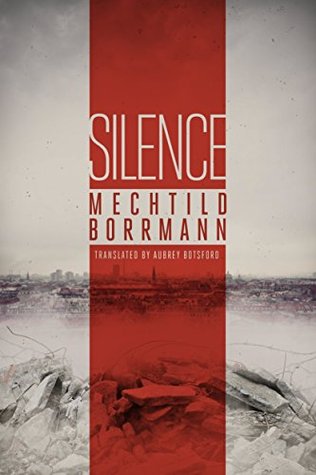
Silence

Mechtild Borrmann is the German author of a number of novels, including the best-selling historical crime novel Wer das Schweigen bricht (Silence), which was the winner of the 2012 Deutscher Krimi Preis (German Crime Fiction Prize).

poldi

Mario Giordano is a German author and screenwriter, who has written for crime series such as Tatort (Crime Scene) and Schimanski. His crime novel Tante Poldi und die sizilianischen Löwen (Aunt Poldi and the Sicilian Lions) was published this year.

s_shadows_of_war_bookMichael Ridpath is the British author of financial thrillers, the Icelandic ‘Fire and Ice’ crime series, and two spy novels, Traitor’s Gate and Shadows of War, which are set in Europe at the beginning of the Second World War.
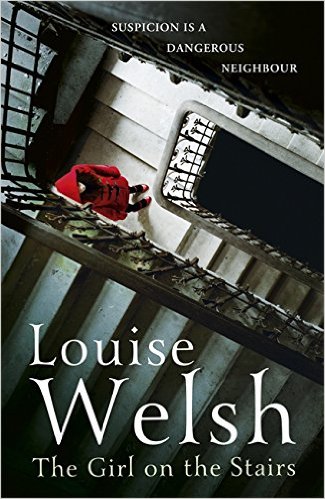
Girl Welsh

Louise Welsh is a Scottish writer who draws on crime fiction, psychological thrillers, apocalypse fiction and the Gothic. Two of her works, The Bullet Trick and The Girl on the Stairsare set in Berlin.

I have the good fortune to be the moderator for the event and am looking forward to it greatly. If you’re in London, do come along! Further details are available here. Entry is free, but booking is essential (simply email info@london.goethe.org).

StasiChild_firstlook_540

And finally… Over the past few days I’ve been reading a preview copy of David Young’s novel Stasi Child, which has the highly original setting of 1975 East Germany, and is proving to be a gripping and hugely absorbing read. It’s published on 1st October by twenty7 and has just been optioned for TV by Euston Films.

Here’s the cover blurb to whet your appetites:

>> When Oberleutnant Karin Müller is called to investigate a teenage girl’s body at the foot of the Wall, she imagines she’s seen it all before. But when she arrives she realises this is a death like no other: it seems the girl was trying to escape – but from the West.

Müller is a member of the People’s Police, but in East Germany her power only stretches so far. The Stasi want her to discover the identity of the girl, but assure her the case is otherwise closed – and strongly discourage her asking questions.

The evidence doesn’t add up, and Müller soon realises the crime scene has been staged. But this is not a regime that tolerates a curious mind, and Müller doesn’t realise that the trail she’s following will lead her dangerously close to home… <<

The novel is the first in a trilogy, and I’m already keen to meet Karin Müller and her team again. If you’re interested in how David came up with his ideas and wrote the novel, then check out his feature over on the twenty7 blog.

Marina Sofia has also just posted a great review of The Stasi Child over at findingtimetowrite.

Eva Dolan’s Long Way Home, the Kappe historical ‘Kettenroman’ (chain novel) and some other tasty bits

What do you do when your TBR pile is so vast it defies all hope of control? Answer: give up and read what you want.

long-way-home-pbk

In that spirit, I picked up Eva Dolan’s Long Way Home (Vintage, 2014). Lots of people had told me about this debut and as soon as I started reading, I could see that the praise for the novel was justified: it’s a beautifully written police procedural, which explores migrant experiences in the UK in a realistic and very sobering way. Its main investigative protagonists, Detectives Zigic and Ferreira of the Peterborough Hate Crimes Unit – with Serbian and Portuguese heritage respectively – are both extremely well drawn, and the story, which starts with the discovery of a body in a burned-out garden shed, is gripping and believable. It’s a hugely accomplished first novel, and I’m already looking forward to the second in the series, Tell No Tales.

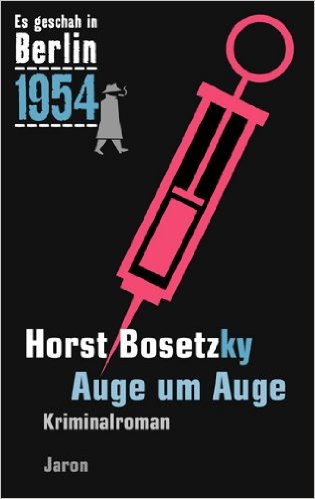
While researching my article on post-war justice in crime fiction this week, I came across the German crime novel Auge um Auge (Eye for an Eye), which explores how doctors involved in medical crimes under National Socialism often went unpunished.

kappe auge

Auge um Auge is part of a remarkable historical crime series called ‘Es geschah in Berlin’ (‘It happened in Berlin’), which uses the cases of policeman Hermann Kappe to trace German history from 1910, before the collapse of the German empire, through to the Cold War era. To date, there are 26 novels set at two-year intervals from 1910 to 1960 (nephew Otto Kappe takes over the investigative reins in 1956):

kappe collection jaron

The image above shows how the novels are packaged, with the series title and year highlighted on the cover, together with a striking abstract design. It also shows that the novels – rather unusually – are written by a collective of authors. Horst Bosetzky, a well known German crime author since the 1960s, conceived the series in 2007 with publishing house Jaron, and the other writers work under his overall guidance.

The series has also been called a Kettenroman or ‘chain novel’, which is a neat term. At the moment, ‘Es geschah in Berlin’ is the most ambitious use I’ve seen of a crime series to ‘investigate’ twentieth-century German history and I’ll definitely be checking out the other novels. Hopefully they’ll make their way into translation too.

In other news:

I’ve been flying the flag for German crime in the Times Literary Supplement, with a review of a fascinating volume called TATORT GERMANYThe Curious Case of German-Language Crime Fiction (Camden House), which is edited by Lynn M. Kutch and Todd Herzog. Unfortunately the review’s behind a paywall, but I bought a copy of the TLS yesterday, and was delighted to see a whole page dedicated to German literature.

tatort germany

Most interesting find of the week: a 2015 Penguin Special by Erich Schlosser called Gods of Metal, an essay exploring America’s nuclear capacity and the frightening ease with which a high-security weapons complex in Tennessee was breached in 2012. Schlosser meets members of the Plowshares movement, who break into nuclear facilities as a form of civil protest, and are subsequently branded as criminals by the state. Thought-provoking stuff, timed to coincide with the 70th anniversary of Hiroshima.

gods of metal

Roberto Costantini’s Italian/Libyan Balistreri Trilogy

I picked up the first novel in Roberto Costantini’s Balistreri TrilogyThe Deliverance of Evil (trans. N. S. Thompson, Quercus, 2014 [2011]), at this year’s CrimeFest after seeing the author on a couple of panels. Costantini was extremely articulate about how his personal links to Tripoli and Rome shaped the trilogy and how his writing style is influenced by his work as an engineer. My interest was also piqued by the description of his main protagonist, Commissario Michele Balistreri, as a morally flawed individual with a complex political past.

Cost

Coming in at just over 600 pages, The Deliverance of Evil is a novel for readers who enjoy complex, multi-layered crime narratives. Framed by Italy’s two Football World Cup victories in 1982 and 2006, it spans twenty-five years of Italian history, but also explores the legacy of Mussolini’s right-wing dictatorship and of the so-called ‘strategy of tension’ – a series of right-wing terrorist attacks in the 1960s and 1970s (possibly encouraged by the military and intelligence services), which were blamed on communists to provoke a political shift to the right. Balistreri, the narrative’s main investigator, acts as a kind of repository for this complex history: as a young man, he was drawn to the ultra right-wing Ordine Nuovo, but when it became involved in terrorist acts, worked undercover for the state in an attempt to stop them. When the narrative opens in 1982, he has supposedly left that past behind him, after being transferred to a quiet police post in Rome.

cover_tu_sei_il_male_web

The original Italian cover

The crime at the heart of the narrative is the murder of Elisa Sordi, a young woman who works for a religious housing organisation. The detective, keen to enjoy the 1982 World Cup final, is distracted during the initial investigation. This and a number of other factors result in the case remaining unsolved until 2006, when another woman is murdered in apparently similar circumstances. Wracked with remorse and guilt for his earlier failures, Balistreri vows to solve both cases and uncover the truth.

The Deliverance of Evil is a hugely absorbing, accomplished piece of work. While the denouement, which resembles an intricate origami creation, had me raising an eyebrow a little at times, the figure of Balistreri, together with the clever construction of the narrative and its dissection of Italian privilege, politics and racism made for a highly gripping read. I’ll definitely be seeking out the second in the trilogy, which moves back in time to the 1960s to explore Balistreri’s troubled past in Libya.

I have a bit of a thing about crime trilogies or quartets. They’re often quite special, which I think is due to two factors. Firstly, they give authors the chance to explore multiple facets of an overarching story in a group of novels, allowing them to create extended and complex literary worlds. Conversely, the limit of having a set number of novels (as opposed to an on-going series), encourages authors to take more risks, especially in terms of the characterisation of their protagonists and the overall denouement. Standalones and trilogies/quartets are thus usually more hard-hitting than a series, not least because they don’t need to safeguard the investigator or main protagonist indefinitely. They also often undertake a wide-ranging social and/or political critique, which I like.

10_peace_quartet

Here are few of my favourite crime trilogies and quartets:

David Peace’s Yorkshire Noir/Red Riding Quartet (1974197719801984), which is set against the backdrop of the Yorkshire Ripper case and provides a brilliant depiction of corrupt policing cultures.

Andrew Taylor’s Roth/Requiem for an Angel Trilogy (The Four Last ThingsThe Judgement of Strangers, The Office of the Dead) which skillfully excavates the history of a female serial killer, beginning in the present day and moving back to the 1970s and the 1950s.

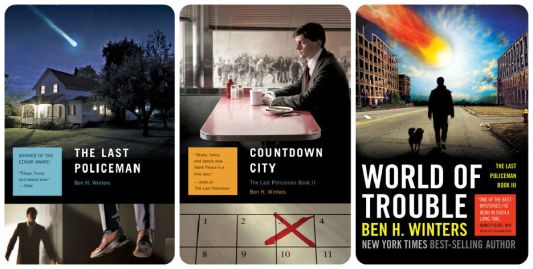
Ben Winter’s Last Policeman Trilogy (The Last Policeman, Countdown City, World of Trouble), set in a superbly realised world on the brink of destruction (I still need to read the final novel, and am looking forward to it very much).

Winter last policeman

Stieg Larsson’s Millennium Trilogy (The Girl with the Dragon Tattoo, The Girl who Played with Fire, The Girl who Kicked the Hornet’s Nest), featuring the remarkable, indefatigable Lisbeth Salander.

Leif G.W. Persson’s Story of a Crime Trilogy (Between Summer’s Longing and Winter’s End, Another Time, Another Life and Free Falling, As in a Dream), which probes the unsolved assassination of Olof Palme in an absorbing and darkly sardonic manner.

Philip Kerr’s Berlin Noir Trilogy (March Violets, The Pale Criminal, A German Requiem), which explores Nazi Germany in 1936 and 1938 and Allied Occupation in 1947 through the eyes of former Berlin policeman Bernie Gunther. The author later extended the trilogy into a series, but the original three novels remain the best in my view.

Perhaps you have others we could add to this list? 

Update: Well, what a brilliant response. Thanks to MarinaSofia, Margot, Rebecca, Bernadette, David, Tracey and Angela for their suggestions (see also their comments and those of others below), and to Barbara, Jose Ignacio and Craig Sisterson via Twitter for trilogies/quartets by women authors. All listed below…

Further great crime fiction trilogies and quartets: 

Lisa Brackman’s China Trilogy (Rock, Paper, Tiger; Dragon Day; Hour of the Rat)

James Ellroy’s L.A. Quartet (The Black Dahlia, The Big Nowhere, L.A. Confidential, White Jazz)

Lyndsay Faye’s New York Trilogy (The Gods of Gotham, Seven for a Secret, The Fatal Flame)

Gordon Ferris’ Glasgow Quartet (The Hanging Shed, Bitter Water, Pilgrim Soul, Gallowglass)

Alan Glynn’s Land Trilogy (Winterland, Bloodland, Graveland – set in Ireland)

Jean-Claude Izzo’s Marseille Trilogy (Total Chaos, Chourmo, Solea)

Peter May’s Lewis Trilogy (The Blackhouse, The Lewis Man, The Chessmen)

William McIllvaney’s Laidlaw Trilogy (Laidlaw, The Papers of Tony Veitch, Walking Wounded – set in Glasgow)

Adrian McKinty’s Troubles Quartet (The Cold Cold Ground, I Hear the Sirens in the Street, In the Morning I’ll Be Gone and Gun Street Girl – set in Ireland)

Denise Mina’s Garnethill Trilogy (Garnethill, Exile, Resolution – set in Glasgow, Scotland)

Denise Mina’s Paddy Meehan Trilogy (The Field of Blood, The Dead Hour, The Final Breath – set in Glasgow, Scotland)

Leonardo Padura’s Havana Quartet (Havana Blue, Havana Gold, Havana Red, Havana Black)

George Pelecanos’ D.C. Quartet (The Big Blowdown, King Suckerman, The Sweet Forever, Shame the Devil)

Dolores Redondo’s Baztan Trilogy. The first, The Invisible Guardian is available in translation and is set in Spain’s Basque country. The other two are entitled Legado en los huesos (Legacy in the Bones) and Ofrenda a la tormenta (Offering to the Storm).

John Williams Cardiff Trilogy (Five Pubs, Two Bars And A Nightclub; Cardiff Dead; The Prince of Wales)

Robert Wilson’s Falcon Quartet (The Blind Man of Seville; The Silent and the Damned; The Hidden Assassins; The Ignorance of Blood – set in Spain)

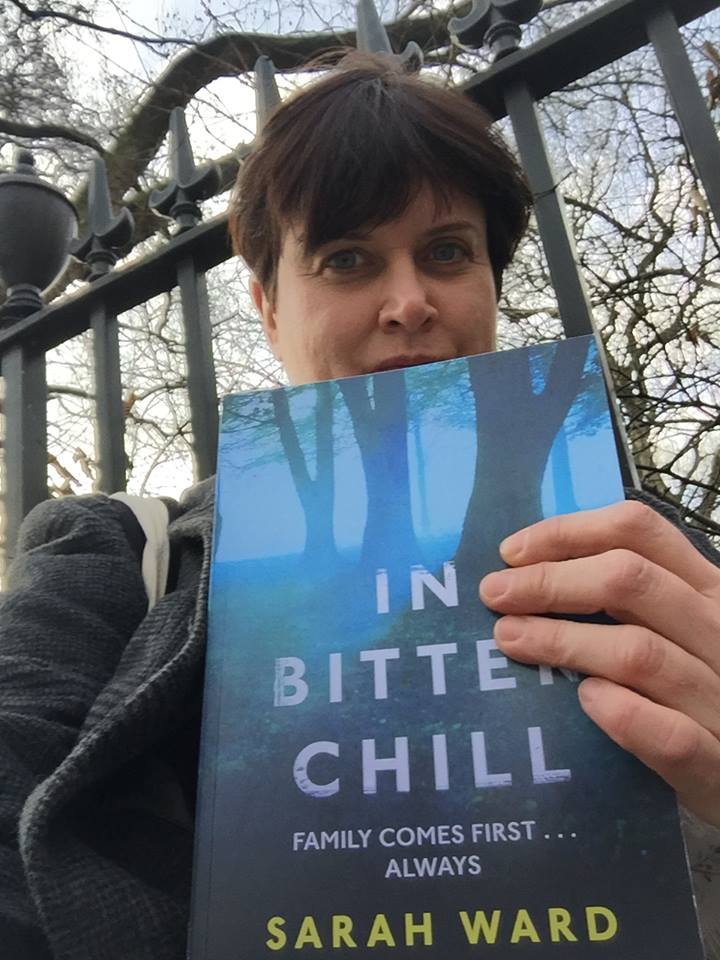
Sarah Ward’s Derbyshire debut – In Bitter Chill

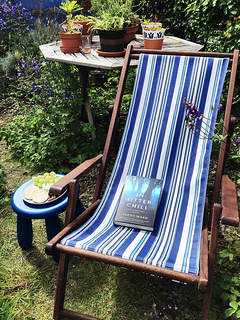
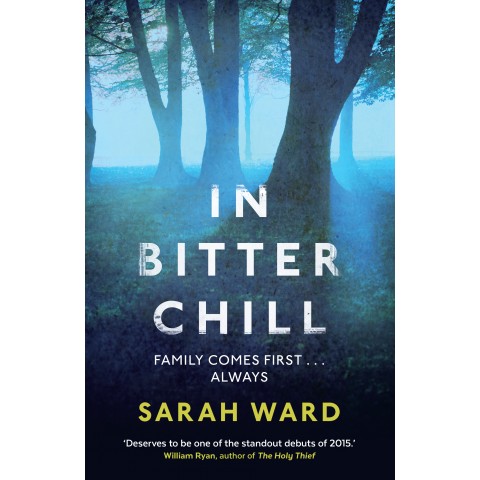
I’ve known Sarah Ward for a few years as a blogger at Crimepieces and as a fellow judge on the Petrona Award, and have watched her journey from aspiring to published crime writer with fascination. I’d been looking forward to reading In Bitter Chill (Faber, 2015) for a number of months and it arrived at a perfect moment: a brief lull in work that coincided with some proper summer weather. So I made a bit of an occasion of starting the book, complete with Welsh deckchair and tapas. A very lovely afternoon.

19520352925_54ccfea77a_n

In Bitter Chill is set in Bampton, Derbyshire, and focuses on an unsolved case from January 1978 – the disappearance of two young girls on their way to school. One, Rachel Jones, was found shortly afterwards, but can only remember flashes of what took place. The other, Sophie Jenkins, remained missing and is presumed dead. Thirty years on, Sophie’s mother commits suicide, triggering a review of the case by the local police team. Rachel, who still lives in Bampton and now works as a family history researcher, finds herself being drawn unwillingly back into the past and its attendant traumas.

cover in bitter chill dd

In Bitter Chill is a gripping and polished debut. A standout factor is the narrative’s deft construction, which shifts between the present and the events of 1978, but whose forward momentum keeps us wanting to read on (I finished the book in two sessions over two days). Another is the characterisation of the main protagonists – I particularly liked Rachel, an endearing but complex figure, and the police team, Detective Inspector Francis Sadler, DS Damian Parker and DC Connie Childs, whose individual temperaments and abilities are extremely well drawn. The way in which the novel switches between the viewpoints of the investigators and of Rachel as a survivor dealing with the fall-out of past events gives the narrative impressive depth. I also enjoyed the strong sense of place – of a Derbyshire not far from cities such as Manchester and Sheffield, but with a fundamentally rural character in close proximity to the Peak District.

In sum, this is a extremely well-written, accomplished debut, which, in spite of its chilly title, is a perfect summer read. Get that deckchair out now and enjoy!

An interview with Sarah is available over at Crime Fiction Lover.

Sarah and book

The author and her book

In-Bitter-Chill-blog-tour

Holiday reading and the 2015 Betty Trask Award: The Spring of Kasper Meier

The Crime Fiction in German volume has had its final polish and been delivered into the tender care of the University of Wales Press. Time for a little break, then – a tour of west Wales in our trusty VW camper, with plenty of downtime for reading in various seaside cafes.

I’ve been eyeing up my real and virtual bookshelves to see what I fancy taking along. So far I have the following modest pile, which will no doubt expand a bit by tomorrow morning.

 Behind God's Back

Finnish author Harri Nykänen’s Behind God’s Back (trans. Kristian London, Bitter Lemon Press, 2015) is the second in the Ariel Kafka series – I enjoyed the first, Nights of Awe, very much. Here’s the publisher description:

>> There are two Jewish cops in all of Helsinki. One of them, Ariel Kafka, a lieutenant in the Violent Crime Unit, identifies himself as a policeman first, then a Finn, and lastly a Jew. Kafka is a religiously non-observant 40-something bachelor who is such a stubborn, dedicated policeman that he’s willing to risk his career to get an answer. Murky circumstances surround his investigation of a Jewish businessman’s murder. Neo-Nazi violence, intergenerational intrigue, shady loans – predictable lines of investigation lead to unpredictable culprits. But a second killing strikes closer to home, and the Finnish Security Police come knocking. The tentacles of Israeli politics and Mossad reach surprisingly far, once again wrapping Kafka in their sticky embrace. << 

Emily St. John Mandel, The Lola Quartet (Picador 2015). I’ve heard lots of good things about this Canadian/British Columbia writer, who often uses crime conventions in her literary works (have heard comparisons to David Mitchell of Cloud Atlas fame):

Emily’s website describes Lola as ‘literary noir’, with the following overview >> Gavin Sasaki is a promising young journalist in New York City, until he’s fired in disgrace following a series of unforgivable lapses in his work. The last thing Gavin wants is to return to his hometown of Sebastian, Florida, but he’s drifting toward bankruptcy and is in no position to refuse when he’s offered a job by his sister, Eilo, a real estate broker who deals in foreclosed homes.

Eilo recently paid a visit to a home that had a ten-year-old child in it, a girl who bears a strong resemblence to Gavin and who has the same last name as Gavin’s high school girlfriend Anna, whom Gavin last saw a decade ago. Gavin — a former jazz musician, a reluctant broker of foreclosed homes, obsessed with film noir and private detectives — begins his own private investigation in an effort to track down Anna and their apparent daughter.<<

And then today saw the announcement of the 2015 Betty Trask Award, a £10,000 prize for debut writers under 35. The winner is Ben Fergusson’s The Spring of Kasper Meier (Little, Brown, 2014), which is set in the ruins of Berlin after 1945 and looks mighty like a crime novel to me. So that’s coming along too.

Here’s the blurb from Ben’s website >> Set in Berlin in 1946, The Spring of Kasper Meier follows the friendship that develops between Kasper Meier, a black-market trader, and Eva Hirsch, the young woman who is blackmailing him. As soldiers in Berlin begin to be killed in mysterious circumstances, both Kasper and Eva’s troubled pasts threaten to reveal themselves, and their fragile lives begin to spiral out of control. <<

The novel has also featured on the Radio 2 bookclub (you can access a free extract via its website here).

What holiday reading do you have lined up? All recommendations gratefully received!

Two compelling female detectives: Rachel (The Girl on the Train) and Maud (Elizabeth is Missing)

I’m writing this post from under a pile of essays – or at least it feels that way. In any case, time for a quick breather from marking to flag up two interesting reads, both from the UK.

While on a train journey recently, I couldn’t resist starting Paula Hawkins’ The Girl on the Train (Riverhead 2015), a psychological thriller that’s been a huge word-of-mouth hit. Its ‘accidental detective’ is Rachel Watson, a rail-commuter who in true Rear Window fashion, sees something disturbing out of the window that will change her life. The novel is a very enjoyable ride (albeit with a few too many coincidences towards the end), but what I particularly liked about it was its characterisation. Rachel, whose life has disintegrated since the end of her marriage, is a complex creation who gives a vivid insight into the destructive effects of alcoholism. She makes for a very intriguing investigator, especially as her drinking means she sometimes can’t trust her own memory.

The author is originally from Zimbabwe, although she’s lived in the UK for many years. There’s an interesting Guardian article on her and the novel here.

Rachel reminded me of another excellent female investigator I encountered recently – 82-year-old Maud Horsham in Emma Healey’s Elizabeth is Missing (Viking 2014). Maud is also investigating a mystery – the disappearance of her best friend Elizabeth – and does so in the most difficult of circumstances: she has dementia and her memory, or rather lack of memory, is constantly tripping her up. A gripping psychological crime novel, Elizabeth also offers the reader a sobering and moving exploration of what it’s like to live with dementia – both for Maud as an individual and for her family. Like Rachel, Maud is portrayed as a determined, characterful, complex woman. I enjoyed meeting both of them very much.

Come to think of it, we could add Christine Lucas from S. J. Watson’s Before I go to Sleep to these two. Do we have a little subgenre emerging?

Stieg Larsson sequel, crime versus thrillers, Easter bunnies

Big news this week: the sequel to Stieg Larsson’s acclaimed ‘Millennium Trilogy’ is well on its way. The cover and English title – The Girl in the Spider’s Web – were revealed by MacLehose Press on Monday, although its contents will remain firmly under wraps until publication on 27 August. Here’s what we know: the sequel is ‘based on Larsson’s universe and characters’, is written by Swedish writer David Lagercrantz; will be published in Sweden by Norstedts; is titled Det som inte dödar oss  (That Which Doesn’t Kill Us) and is currently being translated into 38 languages.


Like many, I have rather mixed feelings about the publication of the new novel. On the one hand, I thought the trilogy had a pretty perfect resolution and am not sure it could be bettered. On the other, I loved Lisbeth Salander and am keen to see how her story develops. I don’t envy Lagercranz the task of taking on such a weighty literary legacy – it must be hugely difficult to find a voice and narrative that are faithful to the original, but more than pure mimicry. I’m keeping my fingers crossed that he’s found a way through. For more information, see this Guardian article by Alison Flood.

There was another interesting article in The Guardian yesterday by Val McDermid, entitled ‘Why crime fiction is left-wing and thrillers are right-wing’ (thanks to Vicky Newham for flagging this up on Facebook).

In it McDermid argues (with help from Ian Rankin) that ‘the current preoccupations of the crime novel, the roman noir, the Krimi lean to the left. It’s critical of the status quo, sometimes overtly, sometimes more subtly. It often gives a voice to characters who are not comfortably established in the world – immigrants, sex workers, the poor, the old. The dispossessed and the people who don’t vote. The thriller, on the other hand, tends towards the conservative, probably because the threat implicit in the thriller is the world turned upside down, the idea of being stripped of what matters to you. And as Bob Dylan reminds us, “When you ain’t got nothing, you got nothing to lose.”’

That got me thinking hard about whether these political distinctions hold up more widely. While I can think of plenty of examples to support McDermid’s argument – especially in the context of European crime – I can also think of a number of exceptions. Golden Age crime fiction is often thought of as being ‘conservative in style, setting, characterisation, subject matter and socio-political views’, with a dubious social order in relation to class, gender and race being restored at the end of the narrative (quote from Lee Horsley’s excellent chapter on ‘Classic Detective Fiction’ in Twentieth Century Crime Fiction, OUP, pp. 12-65, p. 39). Hard-boiled crime fiction features private investigators not known for their tolerance or diplomatic skills. They may well be critical of the status quo, but are often shown delivering violent, eye-for-an-eye justice rather than handing criminals over to the law so they can be properly put on trial. There’s an interesting discussion on these points in an article by Arlene Teraoka, which explores the lack of a private eye tradition in German crime fiction – arguably due to the P.I.’s fascistic tendencies – and the post-war preference for paternalistic police inspectors who guarantee a democratic social order (who also have their conservative sides…).

Equally, two exceptions in relation to thrillers spring to mind. John le Carré’s works are highly critical of the power wielded by governments and shady secret services, and repeatedly highlight the price vulnerable individuals pay in these larger political games (e.g. The Spy who Came in from the Cold, The Looking Glass War, A Most Wanted Man). I also read a very good Swedish thriller in the course of my Petrona judging duties that raises big moral questions about the conduct of national intelligence agencies in wartime – Joakim Zander’s The Swimmer.

In sum, different crime genres/subgenres are flexible enough to be employed for liberal or conservative political ends, and elements of both can even co-exist alongside one another in individual texts. But I’ll be bearing McDermid’s assertions in mind as I read on, to see if her distinctions hold up as current trends.

Update: Over on findingtimetowrite, Marina Sofia also muses on Val McDermid’s article and gives a wonderful overview of the Quais du Polar, at which Val’s comments were originally made. The post gives a summary of various crime writers’ views about writing on politics from the event; these provide a very nice counterpoint to this post – showing how crime fiction is used by many writers as a progressive means of critiquing and exploring the power structures of their societies.

Wishing you all a very happy Easter break filled with fluffy bunnies, chocolate and lots of crime fiction!

New Wellcome Collection exhibition – Forensics: The Anatomy of Crime

An exciting and FREE new exhibition has opened in London that will be of interest to many crime fans.

>> Following a £17.5 million development, Wellcome Collection has opened a major exhibition exploring the history, science and art of forensic medicine. ‘Forensics: The Anatomy of Crime’ travels from crime scene to courtroom, across centuries and continents, exploring the specialisms of those involved in the delicate processes of collecting, analysing and presenting medical evidence. It draws out the stories of victims, suspects and investigators of violent crimes and our enduring cultural fascination with death and detection.

‘Forensics’ contains original evidence, archival material, photographic documentation, film footage, forensic instruments and specimens, and is rich with artworks offering both unsettling and intimate responses to traumatic events. Challenging familiar views of forensic medicine shaped by fictions inspired by the sensational reporting of Victorian murder cases and popular crime dramas, the exhibition highlights the complex entwining of law and medicine, and the scientific methods it calls upon and creates. It surveys real cases involving forensic advances, including the Dr Crippen trial and the Ruxton murders, pioneers of forensic investigation from Alphonse Bertillon, Mathieu Orfila and Edmond Locard to Alec Jeffreys, and the voices of experts working in the field today. << Wellcome Collection Press Release.

Image courtesy of Wellcome Trust

The exhibition, curated by Lucy Shanahan, has five sections:

‘The Crime Scene’ investigates the different techniques used to record the location of a crime and its power both as a repository of evidence and as a haunting site of memory. It includes one of Frances Glessner Lee’s ‘Nutshell Studies of Unexplained Death’ – one of twenty miniature dollhouse crime scenes created by the American heiress and criminologist in the 1940s and 50s. They are still used to train police investigators in observing and collecting evidence today. You can listen to a BBC Radio 4 programme about them here (thanks to Sarah Hilary for the link).

The Nutshell Studies of Unexplained Death

‘The Nutshell Studies of Unexplained Death’ – Image courtesy of Wellcome Collection

‘The Morgue’ traces a history of pathology, from Song Ci’s 13th century Chinese text ‘The Washing Away of Wrongs’, often seen as the first guide to forensics, to the celebrity pathologist Sir Bernard Spilsbury (1877–1947), whose autopsy note cards are displayed for the first time.

Image courtesy Wellcome Collection

‘The Laboratory’: Edmond Locard founded the first police crime laboratory in early 20th century Lyon and his simple theory that ‘every contact leaves a trace’ (now known as the exchange principle) guides the array of disciplines, including serology, toxicology, microscopy, criminal profiling and DNA analysis.

Police crime laboratory, Lyon

‘Every contact leaves a trace.’ Image courtesy Wellcome Collection

‘The Search’ considers the reconstructions of movement and identity required in looking for missing people – both individual cases and mass disappearances. It includes a newly commissioned artwork by Šejla Kameric that seeks to recover the human stories behind the critical mass of statistics and data generated by the on-going identification of massacre victims in the 1992-95 Bosnian war.

‘The Courtroom’ section explores the final test of forensic medicine’s success, as evidence is gathered and presented in the courtroom in pursuit of justice.

William Hartley – Courtroom sketches of the Crippen trial at the Old Bailey, 1910. Image courtesy Wellcome Collection

Doesn’t that look amazing? I’m already plotting my trip to London to see the exhibition, which I suspect will be fascinating and disturbing in equal measure. I have enormous respect for the expert and dogged work that forensic scientists do, so I’m looking forward to learning lots about the history of forensics and the amazing techniques it employs. At the same time, as the press release makes clear, the exhibition seeks to challenge the way in which forensic work is depicted in crime novels and crime dramas – and by extension, may jolt regular crime readers and viewers out of their sometimes overly comfortable fictional world into one that is altogether grimmer. I suspect that being confronted with real cases, techniques and investigations will a sobering experience. I’m also very interested in seeing how the artwork used in the exhibition provides a way of moving behind the science to the human stories and emotions that lie beneath, and how it explores our cultural fascination with crime. It really does look like a very thoughtfully designed exhibition that will engage visitors on a number of different levels.

The book accompanying the exhibition is by crime author Val McDermid – I’m keen to get my hands on this also (memo to self – no reading before, during or just after mealtimes).

The ‘Forensics’ exhibition, curated by Lucy Shanahan, is FREE and runs from 26 February to 21 June 2015 at Wellcome Collection, 183 Euston Road, London NW1 2BE. For travel info, see here.

Further information about ‘Forensics’ is available via the exhibition website and the Wellcome Collection press release.

January 2015: some crime drama treats

Here we all are in a shiny new year. Wishing you and yours a very happy 2015!

There are a number of wonderful crime dramas heading our way in January. Here’s a quick round up of four goodies…

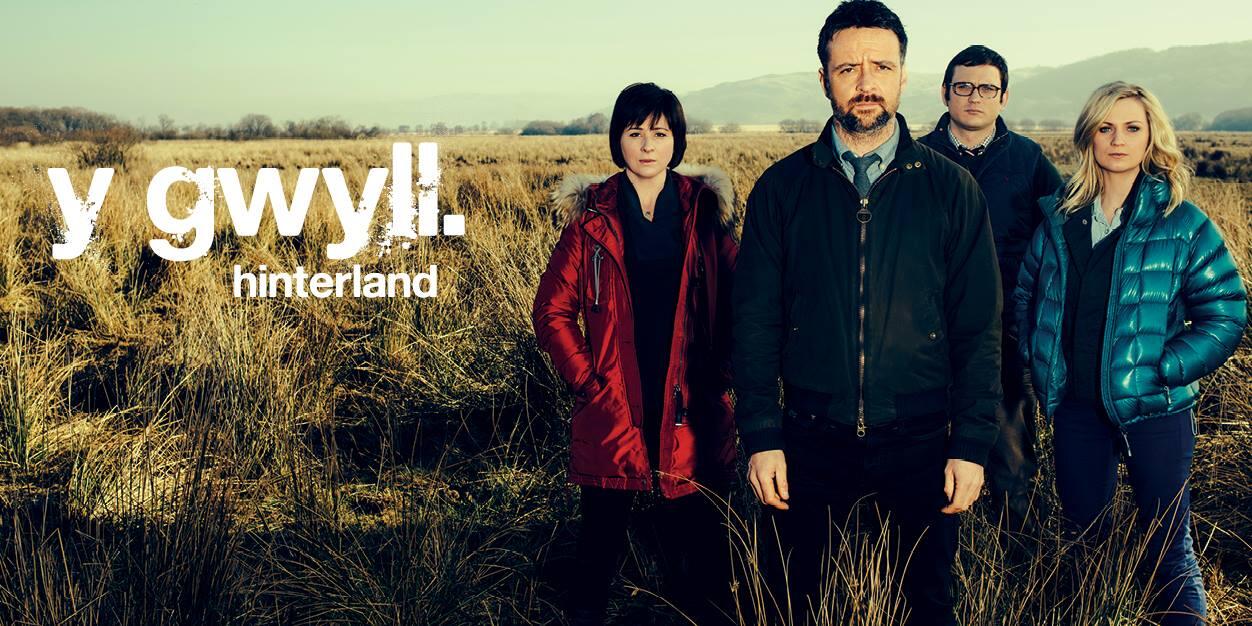
Y Gwyll / Hinterland, S4C, 9pm on Thursday 1 January 

Today sees a special, one-off episode for fans of this bilingual, Welsh-English crime drama. Here’s the S4C description >> Troubled hero DCI Mathias returns to the front-line in this brand new episode. Faced with a suspected arson attack, Mathias is drawn into a community riven by old feuds and bitter jealousies. A story of heartbreak and loss, but for Tom Mathias, will it offer a new beginning? <<

Head over to the S4C website for further information (in English), a trailer and details of how to activate subtitles. If you don’t have access to S4C, don’t worry – you’ll be able to access it later via S4C Clic online (the Welsh equivalent of iPlayer). The episode will no doubt also appear on BBC1 in due course. An earlier Mrs. Peabody post on Y Gwyll is available here, and a new series follows later in 2015.

Fortitude, Sky Atlantic, 9pm on Thursday 29 January

There’s an increasing amount of buzz about this series in the press. Drawing on Scandi Noir traditions, it features a stellar international cast (Stanley Tucci, Michael Gambon, Sofie Gråbøl, Christopher Eccleston), is set in a mining community in the Arctic Circle and was filmed in Iceland. From where I’m standing, that’s an impossible combination to resist.

Sky’s description is as follows: >> Fortitude is a place like nowhere else. Although surrounded by the savage beauty of the Arctic landscape, it is one of the safest towns on earth. There has never been a violent crime here. Until now. In such a close-knit community a murder touches everyone and the unsettling, mysterious horror of this crime threatens the future of the town itself.

The local Chief of Police, Sheriff Dan Anderssen (Dormer), has to investigate alongside DCI Morton (Tucci), the detective who has flown into Fortitude so fast that questions are being asked about how much he knew, and when. As these two cops try to make sense of the killing, each finds compelling reasons to mistrust and suspect the other. <<

Further details are available here and there’s a preview clip too…

Broadchurch, ITV, Monday 5 January

Alec Hardy (David Tennant) and Ellie Miller (Olivia Coleman) return for the second series of this crime drama set on the Dorset coast. I absolutely loved the first series and am intrigued to see where the storyline goes after the explosive revelations of the final episode.

Spiral, BBC4, 9pm on Saturday 10 January (12 episodes)

The fifth season of this gritty French crime drama will be a welcome addition to BBC4’s international crime slot on Saturday evenings. I’ll resist providing a description of the first episode in case there are some who’ve not yet seen the end of season 4 (that includes me), but if you’re interested in knowing more, you can head over to the BBC4 website.

Crime Time Preview has a useful round up of further crime dramas (British and international) that are scheduled for 2015. It looks to be a promising year.

Wishing you all a fabulous start to 2015. My January’s going to be a bonkers one, trying to juggle a number of different publishing and academic commitments, so I may be posting a little less than usual this month. It’s all good though – and I look forward to reporting on a completed project soon 🙂

Merry Christmas! Mrs Peabody’s festive round-up

I’m behind on my Christmas preparations this year, which means that this festive round-up is a little later than usual. On the plus side, it may help a few of you out of a last-minute present conundrum, or lead you to a nice, independent bookshop because it’s too late for online orders. You might also be moved to buy yourself a little gift. Go on, you deserve it.

The following are just some of my favourite crime novels of the year. All, in my view, would make a delightful escape from the mayhem of Christmas or family, especially when curled up on the sofa with a nice glass of wine.

Anne Holt and Berit Reiss-Anderson, The Lion’s Mouth (NORWAY: trans. by Anne Bruce, Corvus, 2014). Anne Holt is often described as the queen of Norwegian crime, and has drawn expertly on her own career in the police, law and government in the creation of the ‘Hanne Wilhelmsen’ police series (she was even Norwegian Minister of Justice for a while). This fourth installment in the series, originally published in 1997, explores the suspicious death of the Norwegian Prime Minister, who is found dead in her office just six months following election. A fusion of locked-room mystery, Borgen and police procedural, it’s a quietly satisfying read that’s held up well.

Arnaldur Indridason, Reykjavik Nights (ICELAND: trans. by Victoria Cribb, Harvill Secker, 2014). This prequel to the ‘Murder in Reykjavik’ series is a wonderfully absorbing read, which traces the start of Erlendur’s journey from young policeman to detective as he investigates the death of a homeless man and the disappearance of a woman. Set in 1974, the year Iceland celebrated 1100 years of settlement, we are also shown how a traumatic childhood event begins to shape Erlendur’s personal life and investigative career. The novel is a great read for those who are new to the series and for long-established Erlendur fans alike.

Hannah Kent, Burial Rites (AUSTRALIA/ICELAND: Picador, 2013). This impressive debut novel by a young Australian author is not for those looking for ‘cosy’ Christmas crime. Kent spent some time in Iceland as an exchange student and describes the book as her ‘dark love letter’ to the country: set in northern Iceland in 1829, it explores the case of Agnes Magnúsdóttir, the last Icelandic woman to be executed for murder. The figure of ‘the murderess’ tells us a lot about the gender, class and power relations of the time, and the picture the author paints of every-day, rural Icelandic life is fascinating. The story, setting and their links to the Icelandic sagas stayed with me long after reading it.

Lahlum

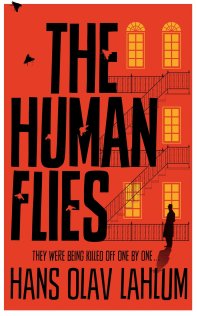
Hans Olav Lahlum’s The Human Flies (NORWAY: trans. by Kari Dickson, Mantle, 2014, [2010]) sounds like a horror film that’s best avoided after a large meal. However, it turns out to be something quite different: a well-constructed and witty homage to the classic crime fiction of Agatha Christie, set in 1968 Oslo, which has some interesting historical depth. Featuring ambitious young police detective Kolbjørn Kristiansen on his first big case – the murder of a former resistance fighter – readers are treated to an apartment building of intriguing suspects and a page-turning investigation, as well as the considerable intellect of Kristiansen’s wheelchair-bound partner Patricia.

Laura Lippman, After I’m Gone (USA: Faber and Faber, 2014). Ignore the rather daft cover. After I’m Gone is a literary crime novel that dissects a murder case by means of a rich narrative with some wonderful characterisation (the latter is one of Lippman’s great strengths). Told on a number of different time levels, it traces the stories of five women left behind when white-collar criminal Felix Brewer disappears in July 1976 – his wife Bambi Gottschalk, his three daughters, and his mistress Julie – as well as the investigation into Julie’s murder by detective Sandy Sanchez in the present. An engrossing, quality read.

Anya Lipska, Death Can’t take a Joke (UK/POLAND: The Friday Project, 2014). This is the second in the ‘Kiszka and Kershaw’ series, featuring Polish ‘fixer’ Janusz Kiszka and London police detective Natalie Kershaw. While I enjoyed Lipska’s first novel, Where the Devil Can’t Go, the second is where the series really gets into its stride: the duo’s investigation into two deaths, including one of Kiszka’s closest friends, is a tightly constructed page-turner with an engaging, blackly comic tone. The novel also features one of the best first chapters I’ve read this year… For a more in-depth exploration, head over to Margot Kinberg’s marvellous Confessions of a Mystery Novelist blog.

Marco Malvaldi, Game for Five and Three Card Monte. 1 and 2 of the ‘Bar Lume Trilogy’ (ITALY: Europa Editions/World Noir 2013/14). These light-hearted crime novels feature amateur detective Massimo Viviani, the maverick owner of Bar Lume, investigating mysterious deaths in Pineta in Northern Italy. Massimo is ably assisted in his work by four cantankerous, octogenarian barflies, including his own extremely opinionated grandfather. Witty, entertaining and stylishly packaged.

Eduardo Sacheri, The Secret in Their Eyes (ARGENTINA: trans. by John Cullen, Other Press, 2011 [2005]). I was given this novel last Christmas and it became one of my first and favourite reads of the year. Benjamin Miguel Chaparro, a newly retired Deputy Clerk in Buenos Aires, begins to write a novel about a case that has haunted him since 1968 – the murder of a young wife, Liliana Colotto, in her own home one summer’s morning. Oscillating between the past and the present, and spanning twenty-five years of Argentine history, the narrative tells the story of the murder and its repercussions for those left behind: husband Ricardo Morales, investigator Benjamin, and the murderer himself. The 2010 film adaptation was also a cracker. A full review is available here.
Olivier Truc, Forty Days without Shadow (FRANCE/LAPLAND: trans. by Louise Rogers LaLaurie, Trapdoor, 2014). This novel uses its criminal investigation as a means of exploring the history, culture and climate of Lapland. It also features the reindeer police! The novel opens with Sámi-Norwegian reindeer policeman Klemet Nango and partner Nina Nansen investigating the theft of a priceless Sámi drum from a museum. Shortly afterwards, Sámi herder Mattis is found dead, and ‘Patrol P9′ finds itself grappling with two crimes that could well be interlinked. A gripping novel that shines a spotlight on a fascinating part of the world. A full review is available here.

If the crime lover in your life is into TV drama, then my two top picks are as follows:

The Australian series The Code, which aired on BBC4 a few weeks ago and I reviewed enthusiastically here. This six-part political thriller opens with the mysterious death of Aboriginal teenager Sheyna Smith in Lindara, a remote New South Wales township. The circumstances of her death are hushed up, so when Ned Banks (a journalist for an internet newspaper) and his brother Jesse (an internet hacker on the autistic spectrum) start to investigate, you just know there’s going to be trouble. An utterly gripping, intelligent drama.

British police drama Happy Valley, a hard-hitting, six-part series that traces the fall-out from a kidnapping in the West Yorkshire valleys, while exploring its protagonists’ complex personal lives. Sarah Lancashire gives an absolutely outstanding performance as policewoman Catherine Cawood, together with an excellent supporting cast. Be warned that there is some very graphic (though in my view not gratuitous) violence. I think that 18 would be a more accurate rating than the 15 on the box. An addictive and top quality crime series.

And my own indulgence this Christmas? That would be the American drama True Detective, which I’m very much looking forward to watching. Have you indulged yourself as well? Do share if so!

Wishing all the readers of this blog a very happy and relaxing Christmas.

See you all in 2015!

German Zimtsternchen (little cinnamon star).    Quite addictive.