The ‘crime-loving library borrowers’ of 2010

Last Saturday’s Guardian (19.02.11) carried a list of the top 100 books borrowed from UK libraries in 2010, along with a piece by John Dugdale on ‘the crime-loving borrowers’.

It turns out that almost two-thirds of the books on the most borrowed list are crime novels or thrillers, including the whole of the top 10 (four Pattersons, two Rankins, and one Child, Brown, Connelly and Slaughter respectively). Impressive stuff, and Dugdale explores a few of the reasons why this might be the case.

But the bit that caught my eye was this:

‘Stieg Larsson (who had the top three places in the sales chart) is relegated to a single entry in 76th place. Library users, this suggests, are less keen on Euro-crime, less responsive to the stimulus of TV or film adaptations, and not fond of lengthy, heavy tomes. What they want instead are American or American-style murder stories that are quick reads…’

What struck me was how much Dugdale ‘deduced’ from one statistic, and I’m wondering if he wasn’t being a little over-hasty in the assertions he made. After all, there’s an extremely complex set of factors that have contributed to Larsson’s position on the list in particular, and to the absence of other examples of Euro-crime in general.

Larsson first. Dugdale quite rightly notes the contrast between the 76th position on the list of The Girl who Played with Fire and Larsson’s dominance of the 2010 UK sales chart. This would actually suggest that readers liked the Millenium Trilogy so much that they wanted to buy it and keep it, rather than to borrow it and give it back. So ironically, it could well be the enormous ‘must have’ success of this crime series that has contributed to its lower position on the library chart. And (ahem), do such ‘lengthy heavy tomes’ really put libary readers off? The presence of Hilary Mantell’s doorstopper Wolf Hall at number 24 appears to suggest otherwise.

Larsson, of course, is a Euro-crime-writing phenomenon, whose world-wide sales were already in excess of 12 million by 2008. Other Euro-crime novels typically have a much bigger hill to climb before making it on to annual lists like these.

Firstly, European crime fiction has to be ‘found’ and translated by a sympathetic publisher like Maclehose. Only a modest selection make it. It’s inevitable, therefore, that the sales and borrowing figures for Euro-crime will reflect the smaller number of  Euro-crime novels that are in print compared with those produced for the massive Anglo-American market. Given this, it’s hardly surprising that only the truly big hitters like Larsson manage inclusion in the top 100.

I’d accept that publishers sometimes have a challenging time convincing a readership reared on a largely British and American cultural diet that European fiction – crime or otherwise – is worth reading. But I’m wondering if the recent surge of Euro-crime dramas on BBC4 is beginning to shift the perceptions of a more mainstream audience towards ‘foreign’ imports. The incredibly positive reaction to the Danish series The Killing is a case in point. One interesting observation from a couple of viewers has been how surprised they are to be enjoying a subtitled programme so much. So perhaps the success of quality foreign-language crime series like this will turn more people on to the wealth of excellent European crime fiction and TV out there. I really do hope that this is the case.

‘Can Scandinavian crime fiction teach socialism?’

There’s a very nice article by Deborah Orr in today’s The Guardian, which explores Scandinavian crime fiction’s role in ‘framing socio-political debate’. She takes in The Killing (‘are political coalitions healthy?’), the ‘Martin Beck’ series (Marxist critique of 1960s Swedish society), Nesbo’s works (‘sexual crime as expression of discord between men and women’) as well as a couple of others in the course of her discussion. Well worth a read.

For the Lund watchers amongst you, the article also features a picture of Lund wearing a third jumper – white diamonds on black!

Top 5 – Nordic Crime

Over at the ‘Tipping My Fedora’ blog, Cavershamragu suggested that I put together a Top 20 Scandinavian crime list. I’ve got as far as a Top 5, as I’m not sure I have 20 I would heartily recommend. I’m also stretching Scandinavian to ‘Nordic’ (read for this anywhere that has a tendency to be cold, snowy and dark for much of the year), as I like Icelandic crime, and it has links to Swedish crime too…

1. Roseanna, Maj Sjowall and Per Wahloo (Sweden 1965). An early police procedural, co-written by a husband-and-wife team, which explores the state of 1960s Swedish society from a left-wing perspective. One of the first crime novels to focus properly on the identity of the female victim as well as on the process of investigation and the murderer. First in the 10 book ‘Martin Beck’ series – read them all while you’re at it!

2. Firewall, Henning Mankell (Sweden 1998) While the Wallander series, of which this is the 8th book, is hugely and rightly lauded, you don’t often see individual Mankell books make top-crime-fiction lists. I think this is because the books work best as part of a series, and none obviously stand out. But even so, this is one of my favourites, and I really wanted Wallander to be represented. Another fine police series – greatly indebted to Sjowall and Wahloo’s ‘first wave’ police procedurals.

3. The Draining Lake, Arnaldur Indridason (Iceland 2004) If the Wallander books are ‘second wave’ police procedurals, then Indridason’s can be thought of as the ‘third’, as they clearly draw on the Mankell and Sjowall/Wahloo books before them. This is the 4th in the ‘Ernaldur’ series, and it’s one of the best crime novels I’ve ever read. Check out my earlier post for a full review.

4. Borkmann’s Point, Hakan Nesser (Sweden 1994). This is an ‘Inspector van Veeteren’ mystery. I haven’t read any of the others in the series, but liked this one very much for its slightly quirky philosophical musings. Another police procedural (are there any other types of Nordic crime, I find myself wondering). 

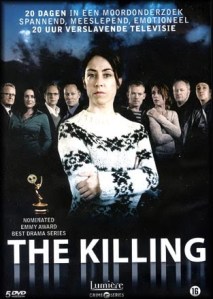
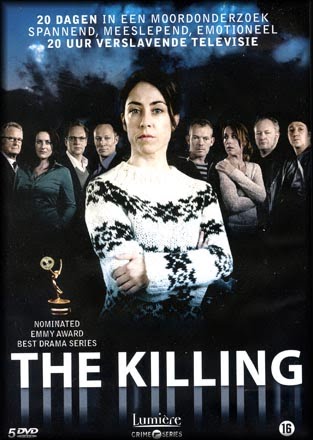
5. The Killing (on BBC4 tonight!!!) (Denmark 2007) OK, cheating here now – not a book – but it’s a way of getting a Danish one in, even though it’s a TV series. See my review of last week’s opening episodes. Top quality crime. Might be based on a crime novel (not sure / will dig)…

If you expand this list out to include all the books in the respective series, you’ll have enough to keep you going for years 🙂 Unless you’ve read them all already that is…further suggestions welcome…

BBC4’s The Killing Series 1 – review of outstanding new crime drama from Denmark

I’ve just finished watching the first two episodes of the Danish crime drama The Killing on BBC4, and it’s so exceptional I felt I had to blog it straightaway.

Forbrydelson / The Killing is an outstanding, powerful, grown-up drama that seeks to show not just the criminal investigation of a murder, but the devastating effect that the crime has on the victim’s family and friends. Part police-procedural, part family drama, part political drama, it chronicles a 20-day police investigation in 20 episodes, allowing for events to unfold realistically from different points-of-view. It’s extremely moving, particularly in its depiction of parental grief, with outstanding acting all round: I don’t mind admitting that I shed a tear or two (and as Mr. Peabody will tell you, this is a rare event indeed – I’m usually tough as old boots).

The police investigator in charge is Sarah Lund (played by the excellent Sofie Gråbøl), who is sucked into the case on what should be her last day before taking a new job in Sweden. What an absolute joy this character is: a confident, intelligent, nicotine-gum-chewing policewoman who is *extremely* good at her job. The camera often simply lingers on her looking / seeing / thinking things through / making links / understanding (a nod to the trope often present in hard-boiled crime fiction of the ‘power of the investigative eye’). The contrasts between Lund’s methods of investigation and those of her male co-investigator are highlighted throughout (sometimes to droll comedic effect): the implication is that the different policing styles are firmly gendered, and the ‘male’ style does not come off well at all. 

A small, but lovely detail is that Lund wears the same rather tatty-looking jumper throughout the first two days of the investigation (as seen above). Fashion statements are pretty much bottom of the to-do-list, which is extremely refreshing.

I haven’t seen a crime drama this powerful since watching the TV adaptation of David Peace’s Yorkshire Noir quartet – 1974 / 1977 / 1980 / 1983. I would highly recommend The Killing – it’s a significant cut above your average crime series, and was rightly lauded in Denmark where it first appeared in 2007. Fantastic Danish crime drama: who knew?

Well done (again) BBC4 – going great guns on international crime. Both episodes are available on iplayer: catch up while you have the chance and tune in next week for episode 3. I’ll definitely be there.

11 Feb: Rog has posted an audioclip of The Killing‘s theme tune (by Neptun) in the comments section below.

12 Feb: Tweet reviews

punkcinema1 – The Killing is brilliant TV. Best thing made by Denmark since Lego.

richvoorwerp – Imagine a 20 episode, complex, tightly scripted, beautifully acted, crime drama produced by British TV. The Danes can do it.

rosemarymaddy – Going to watch The Killing on BBC iplayer. If you haven’t seen it yet, and you like gritty, intelligent, crime drama, why not take a look?

If you’d like to leave a comment, please make sure there are no spoilers that might interfere with the enjoyment of others still catching up 🙂

BBC4 New Danish crime series – ‘The Killing’

News comes to me via the wondrous Euro Crime blog of a new Danish crime series, The Killing, that’s due to start on BBC4 this Saturday, 22 January (two episodes back to back at 9.00pm and 10.00pm).

  • 20 episodes – one for each of the 20 days of the case (a bit like 24, but days instead of hours, if you see what I mean)
  • Features a female head of investigations, Inspector Sarah Lund (big cheer!)
  • Police procedural (shades of Wallander, perhaps?)
  • Originally shown in 2007 on Danish TV, where it was a big hit.
  • Received a nomination for International Emmy for best Best Drama.

Sounds very promising.

Euro Crime carries the BBC4 press release here, which gives some details about the story-line (no major spoilers though).

[See also my review of the first two episodes in a later post – link on right hand menu]