#3 Davidsen / The Woman from Bratislava

Leif Davidsen, The Woman from Bratislava, trans. from the Danish by Barbara J. Haveland (London: Arcadia Books 2010 [2001]). An ambitious thriller that explores the legacy of the Second World War, but doesn’t quite live up to its early promise. 3 stars

The Woman from Bratislava (Eurocrime)

 Opening sentence: It was a story often used by security-cleared lecturers in the civilian branch of FET, by serving officers of a certain rank and other trusted members of PET when briefing new volunteers on the special conditions under which the secret services had to operate in a post-communist world.

As I’ve noted in a previous post, Davidsen has been described as ‘one of Denmark’s top crime writers’ (The Sunday Times). As a former journalist specializing in Russian and Eastern European affairs, he tends to use the crime/thriller format to explore larger political and historical issues – in the case of The Woman from Bratislava, the legacy of the Second World War, set against the backdrop of the Bosnian War and the collapse of communism in the 1990s.

More specifically, the novel uses the story of a rather unusual family as a means of approaching the complex history of Danish involvement in the Second World War. In the post-communist Bratislava of 1999, middle-aged Danish lecturer Teddy Pedersen is approached by Mira, an Eastern European woman who claims to be his half-sister. She reveals that their Danish father, a former Waffen-SS officer, had not died in 1952 as Teddy had been led to believe, but had gone on to lead a secret second life in Yugoslavia. Shortly afterwards, Teddy’s Danish sister Irma is arrested on suspicion of being a former Stasi (East German) agent, one who has possible links to ‘the woman from Bratislava’. The novel explores the father’s influence on the political development of both sisters – and via them the lingering legacy of fascism in post-war Europe. If you haven’t spotted it already, Irma and Mira are anagrams of one another, which I *think* is supposed to indicate how inextricably intertwined their fates are. Or something profound, at any rate.

This is a very ambitious novel, but one that I felt over-reached itself in places. Davidsen chooses to focus on an extremely controversial bit of Denmark’s wartime past, namely the role of thousands of Danes who fought for the Nazis as members of the Danish Legion and Waffen-SS. The author attempts to provide a 360-degree examination of this historical moment, highlighting on the one hand the war-crimes committed by these young Danes in the service of Nazi ideology, and on the other, the hypocrisy of the Danish government, who in 1941 ‘blessed’ their departure for war, only to treat them as ‘pariahs and outcasts’ when Germany was defeated in 1945 (p.100). (Denmark is shown white-washing its wartime history, recasting its years of occupation by the Germans as a period of heroic resistance, and developing a strategic amnesia to cover the less savory aspects of that past).

In some respects, I admire Davidsen’s bravery in taking on such a controversial subject, and in trying to provide a rounded discussion of how these ‘Nazi Danes’ should be viewed. But at times, I felt that the exploration of their actions needed to be more nuanced, and I wasn’t able to follow the reasons why certain individuals felt moved to defend the Waffen-SS father, or to consider his post-war treatment unjust. It’s possible that Davidsen is trying to critique these characters’ blindness to the father’s criminal wartime activities (a form of misguided love or loyalty), but I’m not entirely convinced that this is the case. At certain points, there’s also a casual, problematic elision of fascism and communism, which rather confusingly leads communist characters to exhibit fascist sympathies and/or sympathy for fascists.

As if all of this were not enough, there’s an overarching thriller/espionage plotline involving the downing of a NATO fighter plane over Yugoslavia, which ends in a (for me largely incomprehensible) twist. It was all a bit too much for this simple reader.

Summary: There’s much to admire about the ambition and scope of this thriller, but its constituent parts do not add up to a satisfactory whole. It may be best suited for readers with an interest in the legacy of the Second World War and the Cold War.

Mrs. Peabody awards The Woman from Bratislavia a rather wobbly 3 stars.

Scandinavian Crime Fiction Smorgasbord

Thanks to a tip-off from cavershamragu, I’ve spent the evening wallowing happy as a hippo in mud over at the ScandinavianBooks website.

Rubbing shoulders with Nobel Prize winners Knut Hamsun and Selga Lagerlof are a whole host of Scandinavian crime writers. Indeed, five of the six authors featured under the heading of ‘contemporary and rising authors’ turn out to be crime writers too, illustrating the extent of the Scandi crime boom (as well as the present publishing clout of writers such as Stieg Larsson, Jo Nesbo and Karin Fossum). 

You can browse Scandinavian crime on the site by writer or by nationality (for the latter, hover over the ‘crime’ tab at the top of the homepage). As one would expect, the Swedes are well represented (Sjowall / Wahloo, Mankell, Larsson and Nesser to name just a few), but so are the Norwegians (Dahl, Egeland, Holt, Nesbo, Fossum), the Danes (Davidsen and Peter Hoeg of Miss Smilla fame) and those amazing Icelanders (Indridason, Sigurdardottir). There are also a couple of Finnish authors, Sipila and Joensuu, whom I look forward to checking out. Typically, each author entry features a biography, a review/overview of key works and links to other sites, such as the affiliated Nordic Bookblog. There’s some information on film and TV adaptations too. 

It’s a veritable treasure trove if you’re new to Scandinavian crime and want to find out what all the fuss is about. Or, perhaps like me, you might have read many of the classics, and are keen to lay your hands on some lesser-known works. Either way, this site is a highly useful resource. Tack så mycket! 

Oh, and if you’re into Viking sagas, it’s also definitely the place for you. Apologies for the naffness that follows; unable to resist.

Top 5 – Nordic Crime

Over at the ‘Tipping My Fedora’ blog, Cavershamragu suggested that I put together a Top 20 Scandinavian crime list. I’ve got as far as a Top 5, as I’m not sure I have 20 I would heartily recommend. I’m also stretching Scandinavian to ‘Nordic’ (read for this anywhere that has a tendency to be cold, snowy and dark for much of the year), as I like Icelandic crime, and it has links to Swedish crime too…

1. Roseanna, Maj Sjowall and Per Wahloo (Sweden 1965). An early police procedural, co-written by a husband-and-wife team, which explores the state of 1960s Swedish society from a left-wing perspective. One of the first crime novels to focus properly on the identity of the female victim as well as on the process of investigation and the murderer. First in the 10 book ‘Martin Beck’ series – read them all while you’re at it!

2. Firewall, Henning Mankell (Sweden 1998) While the Wallander series, of which this is the 8th book, is hugely and rightly lauded, you don’t often see individual Mankell books make top-crime-fiction lists. I think this is because the books work best as part of a series, and none obviously stand out. But even so, this is one of my favourites, and I really wanted Wallander to be represented. Another fine police series – greatly indebted to Sjowall and Wahloo’s ‘first wave’ police procedurals.

3. The Draining Lake, Arnaldur Indridason (Iceland 2004) If the Wallander books are ‘second wave’ police procedurals, then Indridason’s can be thought of as the ‘third’, as they clearly draw on the Mankell and Sjowall/Wahloo books before them. This is the 4th in the ‘Ernaldur’ series, and it’s one of the best crime novels I’ve ever read. Check out my earlier post for a full review.

4. Borkmann’s Point, Hakan Nesser (Sweden 1994). This is an ‘Inspector van Veeteren’ mystery. I haven’t read any of the others in the series, but liked this one very much for its slightly quirky philosophical musings. Another police procedural (are there any other types of Nordic crime, I find myself wondering). 

5. The Killing (on BBC4 tonight!!!) (Denmark 2007) OK, cheating here now – not a book – but it’s a way of getting a Danish one in, even though it’s a TV series. See my review of last week’s opening episodes. Top quality crime. Might be based on a crime novel (not sure / will dig)…

If you expand this list out to include all the books in the respective series, you’ll have enough to keep you going for years 🙂 Unless you’ve read them all already that is…further suggestions welcome…

BBC4’s The Killing Series 1 – review of outstanding new crime drama from Denmark

I’ve just finished watching the first two episodes of the Danish crime drama The Killing on BBC4, and it’s so exceptional I felt I had to blog it straightaway.

Forbrydelson / The Killing is an outstanding, powerful, grown-up drama that seeks to show not just the criminal investigation of a murder, but the devastating effect that the crime has on the victim’s family and friends. Part police-procedural, part family drama, part political drama, it chronicles a 20-day police investigation in 20 episodes, allowing for events to unfold realistically from different points-of-view. It’s extremely moving, particularly in its depiction of parental grief, with outstanding acting all round: I don’t mind admitting that I shed a tear or two (and as Mr. Peabody will tell you, this is a rare event indeed – I’m usually tough as old boots).

The police investigator in charge is Sarah Lund (played by the excellent Sofie Gråbøl), who is sucked into the case on what should be her last day before taking a new job in Sweden. What an absolute joy this character is: a confident, intelligent, nicotine-gum-chewing policewoman who is *extremely* good at her job. The camera often simply lingers on her looking / seeing / thinking things through / making links / understanding (a nod to the trope often present in hard-boiled crime fiction of the ‘power of the investigative eye’). The contrasts between Lund’s methods of investigation and those of her male co-investigator are highlighted throughout (sometimes to droll comedic effect): the implication is that the different policing styles are firmly gendered, and the ‘male’ style does not come off well at all. 

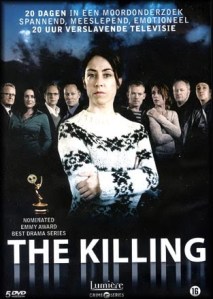
A small, but lovely detail is that Lund wears the same rather tatty-looking jumper throughout the first two days of the investigation (as seen above). Fashion statements are pretty much bottom of the to-do-list, which is extremely refreshing.

I haven’t seen a crime drama this powerful since watching the TV adaptation of David Peace’s Yorkshire Noir quartet – 1974 / 1977 / 1980 / 1983. I would highly recommend The Killing – it’s a significant cut above your average crime series, and was rightly lauded in Denmark where it first appeared in 2007. Fantastic Danish crime drama: who knew?

Well done (again) BBC4 – going great guns on international crime. Both episodes are available on iplayer: catch up while you have the chance and tune in next week for episode 3. I’ll definitely be there.

11 Feb: Rog has posted an audioclip of The Killing‘s theme tune (by Neptun) in the comments section below.

12 Feb: Tweet reviews

punkcinema1 – The Killing is brilliant TV. Best thing made by Denmark since Lego.

richvoorwerp – Imagine a 20 episode, complex, tightly scripted, beautifully acted, crime drama produced by British TV. The Danes can do it.

rosemarymaddy – Going to watch The Killing on BBC iplayer. If you haven’t seen it yet, and you like gritty, intelligent, crime drama, why not take a look?

If you’d like to leave a comment, please make sure there are no spoilers that might interfere with the enjoyment of others still catching up 🙂

Danish crime: The Woman from Bratislava

One of the crime novels waiting for me under the Christmas tree was Leif Davidsen’s The Woman from Bratislava (2001). I’d been eyeing this one up for a while, and was very pleased that Santa had been clever enough to bring it along.

The Woman from Bratislava (Eurocrime)

I’ve not read any Danish crime fiction since Peter Hoeg’s Miss Smilla’s Feeling for Snow (1992), but Davidsen, described by The Sunday Times as ‘one of Denmark’s top crime writers’, seems like a good author to try out. He’s a former journalist who specialised in Russian and Eastern European affairs, and has a particular interest in the legacy of the Second World War and the Bosnian conflict. He tends to use the crime/thriller format to explore larger political and historical issues, which immediately draws me to his work. In The Woman from Bratislava, a middle-aged Danish lecturer receives a visit from an Eastern European woman who says she’s his half-sister. Their father, a former SS officer, had been declared dead in 1952, but in fact went on to live a second, secret life. Oh, and his other sister is a possible Stasi agent… 

All this before the first murder takes place :O

So far I’ve only read the prologue, but was gripped by its fusion of European history, secret service intrigue and dry humour. I’m hoping that the rest of the novel lives up to this early promise and will report in due course.

The Woman from Bratislava is published by EuroCrime, an imprint of Arcadia. Their website is one of my favourite places to browse for new crime fiction in translation (when I looked in today there were Norwegian, Swiss, French, Spanish and Greek novels on offer – and that was just the first page).

See later post for a full review of The Woman from Bratislava

BBC4’s Wallander – The Pyramid

Just caught up with the New Year’s Day showing of Wallander on BBC4, which I’d missed while at my mum’s (we watched the excellent ‘Eric and Ernie’ that night instead). I hadn’t seen this adaptation of ‘Pyramiden’ before, and it was an absolute (and extremely explosive) treat. The storyline reaches back to Wallander’s first days on the Ystad force, and is a poignant exploration of the moral difficulties faced by policemen who become personally caught up in a case. For those of you who haven’t yet had the chance, it’s still available to view for a few days on iplayer. 

The film is part of the Wallander series I enjoy most, made for Swedish Television between 1994 and 2007. I particularly like the rather louche depiction of Kurt Wallander by the actor Rolf Lassgård (pictured leaning on the chair).

The other Swedish actor who plays Wallander, Krister Henriksson, is a bit more buttoned-up, and although the latter’s version is probably more faithful to the characterisation in the books, I think Lassgård’s interpretation plays better on TV. Brannagh’s take on Wallander is OK, but give me either of the original Swedish actors and adaptations any day.

Hats off to BBC4 for making the Christmas season such a festive one for crime fans – full of quality murder and mayhem. There were excellent documentaries on Nordic Noir and Italian Noir, as well as lashings of Swedish and Italian crime. It’s so good to see these programmes in their original languages – please keep them coming.

Also a nice little pressure valve when the Xmas family gatherings got too much (probably saved a life or two and Mrs. Peabody a lengthy stretch in jail).

By the way, there’s a post about the evolution of the Swedish ‘deckare’ on the ‘Gone Elsewhere’ blog – well worth a read.

#1 Indridason/The Draining Lake

Arnaldur Indriđason, The Draining Lake (London: Harvill Secker, 2007 [2004]). Wrap up warm for a chilly Icelandic police procedural. 5 stars

Although this 2004 novel is written by an Icelander and set in Reykjavik, it’s firmly indebted to the classic Swedish police procedural. Detective Inspector Erlendur Sveinsson can be viewed as a third-generation representative of the Swedish police investigator, following in the footsteps of Sjöwall and Wahlöö’s Martin Beck, and Henning Mankell’s Kurt Wallander. Morose, cynical and consumed with self-doubt, these policemen have become progressively more embattled and isolated with each generation. In Erlendur’s case, he’s forced to question the extent to which his absence as a father is responsible for his daughter’s slide into a drug addiction – one the novel describes in sober and hard-hitting detail.

The draining lake of the title is Lake Kleifarvatn, whose mysteriously receding waters reveal an old skeleton weighed down with a heavy Russian radio device. As Erlendur and his team begin the painstaking process of investigating this strange find, they are transported back to an era of international espionage and political unrest during the Cold War, whose consequences can only now be fully understood.

Two things lift this crime novel a cut above the average police procedural. The first is the fascinating insight the novel gives into the Cold War period, and in particular, the experiences of young, idealistic, Icelandic communists who were offered the opportunity to study in East Germany in the 1950s. The second is the sensitive treatment of the theme of ‘the missing’ and of the impact that losing someone without knowing his or her final fate can have on the individual.

A number of the characters, including Erlendur, have lost someone close to them, and the novel is haunted by their many absences. While some eventually learn what happened to their loved ones, others are not so fortunate. They, and crucially the reader, are left without an adequate resolution to the story of these disappearances, a deliberate omission that adds tremendous power to the narrative. Thus, while the central murder is solved, other aspects of the plot are left open, questioning the notion that a case can ever be fully solved. We might know who the murderer is, and understand what motivated them, but the void left by ‘the missing’ remains.

The Draining Lake is well written, enjoyable and thought-provoking: a first-rate, multi-layered crime novel. Erlendur is a welcome and worthy successor to Beck and Wallander, and the novel’s Icelandic setting adds a beguiling and unusual dimension to the chilly subgenre of dark, Nordic crime.

The novel is the 4th in the ‘Reykjavik murder mystery series’, and in my view, it’s the best so far.

Mrs. Peabody awards The Draining Lake a mighty 5 stars