#13 Shuichi Yoshida / Villain

Shuichi Yoshida, Villain, translated from the Japanese by Philip Gabriel (London: Vintage 2011 [2007]). A gripping dissection of a murder and its repercussions  5 stars

Opening sentence: Route 263 runs north and south some forty-eight kilometres, connecting Fukuoka and Saga Prefectures and straddling Mitsuse Pass in the Sefuri mountain range.

Shuichi Yoshida, author of the 2007 novel Villain, opts not to foreground the activities of the police or the private detective when tracing the story of a crime. Instead, ordinary individuals, who’ve unexpectedly found their lives shaken by the murder of a young woman, are placed centre stage, while the police investigation  progresses quietly behind the scenes. This creates a crime novel with an impressive difference, showing us how the ripples from a murder move outwards and impact on a variety of people. As well as dissecting the effect that the crime has on the victim’s and murderer’s families, and on friends and workmates, the novel provides us with in-depth portraits of Yoshino Ishibashi and her killer, and a complex analysis of the circumstances leading to the murder on the desolate mountain road of Mituse Pass.

The identity of the murderer is only confirmed towards the end of the text, and readers are invited to reflect on the extent to which he is indeed a ‘villain’, or whether the contributory actions of others, and the social circumstances in which he was raised should also be viewed as ‘villainous’. The narrative’s sympathies never tip over into an apology for the murderer’s actions, but there is an attempt to move away from a knee-jerk characterisation of the murderer as monster, to a more nuanced understanding of his crime.

One aspect of the novel I particularly liked was the almost complete absence of melodrama. The writing style is spare and matter-of-fact, homing in on ordinary details, such as a grandmother eating a pickled plum, or a shop-assistant reflecting on the difference between expensive designer shirts and the ones she has to sell. The emphasis on everyday experiences that readers will recognise (whether they are Japanese or not), brings this story closer to real life than is often the case, and makes it all the more unsettling: this is a recognisable world populated by recognisable individuals.

That having been said, the story is also very much of its time and place – contemporary Japan – and paints a largely unflattering picture of Japanese society, especially in relation to the issue of class. There are a lot of unhappy people in this book, and a sense of individual entrapment comes over very strongly in the depiction of a number of characters.

Villain has won the prestigious Japanese Osaragi Jiro Prize. The film adaptation, directed by Lee Sang-Il, appeared in 2010 and received mixed reviews.

One last observation: the back cover of the novel contains the by now almost inevitable, lazy comparison to Stieg Larsson, in the shape of a quote from a New Yorker review.

For the record, aside from the fact that it’s a crime novel and contains some social critique, Villain bears no obvious resemblance to Stieg Larsson’s works. I don’t mean this as a value judgement, but simply as a statement of fact. Villain is the in-depth study of one crime, while the Millennium Trilogy explores a number of crimes; Villain examines the lives of individuals dealing with the immediate aftermath of a murder, with the police operating in the background, while the Millennium Trilogy explores the long-term effect of past crimes and foregrounds the investigative activities of Blomkvist and Salander; Villain’s dominant themes are class and patterns of cause and effect, Millennium’s are misogyny and power. And stylistically, the novels are as different as can be.

Mrs. Peabody awards Villain an impressive 5 stars.

Sisters in Crime Book Bloggers Challenge / Ingrid Noll

Over at Barbara Fister’s blog, you can find details of the Sisters in Crime Book Bloggers Challenge, which celebrates 25 years of Sisters in Crime and the wealth of quality crime fiction written by women. 

I’m embarking on the Easy challenge: write a blog post about a work of crime fiction by a woman author; list five more women authors who you recommend.

My choice is The Pharmacist (Die Apothekerin), by one of Germany’s most successful and respected crime novelists, Ingrid Noll.

Ingrid Noll is in now her seventies, and only started writing seriously in her mid-fifties, after her three children had left home. The delayed start to her career as an author -perhaps not too unusual for a woman of her generation – gives all of us late developers hope and is one of the reasons I’ve selected her for this challenge.

I’ve also chosen Noll because (as she herself says), her novels are predominantly concerned with the lives of ordinary women, and how they set about achieving their goals within the constraints of a patriarchal, bourgeois society … by fair means or foul. She’s the writer of darkly humorous and highly original crime novels, often compared to those of Patricia Highsmith, which offer an entertainingly twisted vision of female empowerment – part of the German subgenre known as the Täterinnenkrimi (female perpetrator crime novel). At the same time her depictions of relationships avoid gender stereotyping: both her male and female characters are complex and interestingly flawed, which allows you to sympathise with them and despair of them all at the same time.

Poster for the 1997 film adaptation of Die Apothekerin/The Pharmacist

The Pharmacist, first published in 1994, is narrated in the first person by Hella Moormann. She is the pharmacist of the title, currently a hospital patient, who during the dull evening hours relates her life-story to Rosemarie Hirte, a mousy woman who keeps falling asleep in the next-door bed. We hear how Hella’s penchant for shady characters and co-dependency leads her into a relationship with the younger, amoral Levin, and how before long, she is drawn into a series of dubious, not to mention criminal events. The big question is: just how passive is Hella? Is she a victim of her machiavellian boyfriend? Or is she actually much more in control of the situation than she would care to admit? And just how wise is she to tell her story to the seemingly innocent Frau Hirte, whose snores may not be all they seem?

Delicious stuff!

The Pharmacist, trans. from the German by Ian Mitchell (London: HarperCollins, 1999).

Five other women crime writers I would recommend:

Josephine Tay, author of The Daughter of Time – another ‘hospital mystery’ (UK)

Maj Sjowall, co-author of the Martin Beck series (Sweden)

Fred Vargas, author of the Adamsberg series (France)

Dominique Manotti, author of Affairs of State and a very different writer to Vargas (France)

P.D. James, the grand Dame of British crime writing (UK)

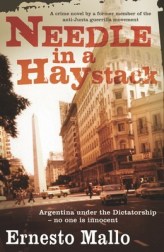
#12 Ernesto Mallo / Needle in a Haystack

Ernesto Mallo, Needle in a Haystack [La aguja en el pajar], translated from the Spanish by Jethro Soutar (London: Bitter Lemon Press 2010 [2006]). This crime novel paints a searing portrait of 1970s Argentina under military rule  5 stars

Opening sentence: Some days the side of the bed is like the edge of an enormous abyss.

This is a hard-hitting crime novel, set against the backdrop of Junta-controlled Argentina in the late 1970s, where power lies primarily in the hands of the military, and ‘disappearances’ of young political activists – supposed ‘subversives’ – are common. Such extra-judicial detentions and executions are typically not questioned by the police (the very body that should be protecting the nation’s citizenry), as doing so is perceived as a pointless exercise that would have extremely negative consequences for the individual.

Superintendent Lascano is a recently bereaved detective (see also Kimmo Joentaa), struggling to maintain his integrity in this morally bankrupt society. In the opening chapter, we see him leaving the house at the beginning of the day, trying to ignore the presumably common sights of bus passengers being searched, and a boy and a girl being driven away in a convoy of military trucks. The girl makes desperate eye-contact with Lascano ‘and then she is swallowed up by the fog’ (8). When Lascano is directed to investigate a report of two bodies dumped by the riverside, he finds that there are now three dead lying there. Unable to investigate the first two, who are clearly the victims of the death squads, he is drawn into investigating the third, and soon finds himself in danger as he treads on some highly-placed military toes.

In the process of following Lascano’s investigations, the reader is presented with a finely-drawn portrait of a corrupt Argentina and its ‘Dirty War’. The narrative is told from a number of viewpoints, giving us multiple perspectives of life under the regime, from a member of a guerrilla cell opposing the Junta (Eva), to the honest cop (Lascano and his friend Fuseli the pathologist), the decadent Argentinian (Amancio, Lara and Horacio), the Jewish businessman (Biterman), the right-wing major (Giribaldi) and the major’s wife (Maisabe). Maisabe is procured a baby by her husband – the newborn son of a young ‘subversive’, who has almost certainly been killed by the regime. The focus is very much on the enormous human price that the younger generation – ‘the kids’ – paid for trying to oppose the regime. The author, who is himself a former member of the anti-Junta movement, would have been the same age as these characters in the 1970s, and it’s hard not to see the novel as a lament for his lost contemporaries and their suffering.

One element I found very interesting was the way that members of the Junta were styled as National Socialists in the novel. For example, we’re told how shortly after a couple have been arrested, the military return to their flat to cart off their possessions: ‘Various conscripts come in and out carrying furniture … and they put everything in the back of a truck, supervised by an arrogant blond captain’ (113). For me, this scene immediately brought to mind the deportations of Jewish citizens in Germany, and the appropriation of their property by the Nazi state (signalled here by the presence of the ‘blond’ captain). Lascano is also Jewish, so there seems to be a fundamental opposition being posited in the novel between good versus evil along the fault-line of Jews:Nazis. The kind of right-wing equivalences being made here also reminded me of Imre Kertész’s 1977 novel Detective Story, which is set in an unspecified South American dictatorship and features a police-man whose interrogation methods are modelled on those of the Nazis. (Kertész is a Hungarian Holocaust survivor and writer who won the Nobel Prize for Literature in 2002, and the novel, which can loosely be viewed as a crime novel, is well worth a read – published in translation by Vintage in 2009).

It’s notable (and rather fascinating) that the English translation of Needle in a Haystack was funded by the ‘Sur Translation Support Program of the Ministry of Foreign Affairs, International Trade and Worship of the Argentine Republic’. This suggests that the novel is viewed as part of a national project of engaging with the crimes committed in the Argentine past. The first two novels are also being adapted for film in Argentina, which will undoubtedly help them reach a wider audience.

Needle in a Haystack is a compelling, absorbing and unsettling read. I’d recommend Mallo to anyone who likes quality crime novels that address serious political issues and the legacies of difficult historical pasts. It’s the first of a trilogy and the second, Sweet Money, is already out with Bitter Lemon Press.

Mrs. Peabody awards Needle in a Haystack an outstanding 5 stars.

Update: for a recent article on the process of bringing former members of the junta to justice for the theft of babies from female political prisoners, see here.

#11 Henning Mankell / The Troubled Man

Henning Mankell, The Troubled Man, translated from the Swedish by Laurie Thompson (London: Harvill Secker 2011 [2009]). Wallander’s final case, in which he faces his biggest challenge yet 5 stars

Opening sentence: The year Kurt Wallander celebrated his fifty-fifth birthday, he fulfilled a long-held dream.

While at the airport bookshop before going on holiday, I spotted Henning Mankell’s The Troubled Man, a novel I’ve been looking forward to reading for a good year. After a few moments I decided rather regretfully to resist, as I wasn’t sure the Very Last Wallander would make for a cheery holiday read. Later that day, while exploring the hotel, I came across the usual bookshelf of novels left by other holidaymakers. There, but of course, was another copy of The Troubled Man, at which point I gave in, put aside the carefully selected crime novels I’d brought with me and, armed with a hanky, started to read.

Before saying any more I should confess that I am a thoroughly biased reviewer when it comes to this Swedish writer and series. I have loved all the Wallander novels, and it would have taken a complete car-crash of a book for me to rate it anything other than five stars. So a five it is – and in some senses this is a rating for the entire series, which is referenced numerous times in various ways throughout the book.

Troubled Men

The first troubled man of the title is Hakan von Enke, a retired Swedish naval official and the father of Linda Wallander’s partner Hans, who disappears into thin air one day while out on his regular walk. Shortly before he vanishes, Hakan voices some concerns to Wallander about an unsettling naval incident that took place in 1982 involving a Russian submarine. Not long afterwards, Hakan’s wife Louise also disappears. To help a distraught Linda and Hans, Wallander begins an unofficial investigation, and uncovers an espionage story that reaches back into the complex history of the Cold War. This forms the central case within the novel, and is an absorbing and well-constructed read (albeit with the odd loose end that’s rather too casually tied up at the end). As ever, Mankell challenges us to question our assumptions, in this case about the dominant historical narrative of the Cold War years – there are a number of enjoyable and unexpected twists that force us to see key events in a whole new light.

The second troubled man, of course, is Kurt Wallander himself, whose personal and working life is overshadowed by a growing anxiety, in spite of the joy that becoming a grandfather brings. Now at the age of sixty, when most people start reflecting on their lives and the choices they have made, Wallander becomes a vehicle for Mankell to explore some very large themes: the value of family ties, the passing of time, the individual’s fear of losing his or her identity and, of course, death. There’s very much a feeling of closing the circle, with a number of references to Rydberg (Wallander’s mentor early in the series), Wallander’s late father (whose relationship with his son was often fraught), Baiba Leipa (his one-time love from The Dogs of Riga), and individuals from past cases (such as the husband of the victim in The White Lioness). For anyone who has travelled with Wallander down the long and winding road of this ten book series, it can’t help but be an absorbing, poignant and moving read.

One final word: if you’ve not yet read the earlier Wallander books, or if there are any in the series that you need to catch up on, I would strongly recommend doing so before embarking on The Troubled Man, which should be read at the end of the sequence as the author intends.

Mrs. Peabody awards The Troubled Man a slightly mournful, but deeply satisfying 5 stars.

Other Mankell/Wallander links you may enjoy

Henning Mankell’s official website

In the Footsteps of Wallander – a PDF guide to the locations featured in the books, films and TV series.

Scandinavian Crime Fiction – a blog that does what it says on the tin.

Mrs Peabody’s suitcase of holiday crime 2011

So here’s a list of the holiday crime novels I’ve finally settled on this year. Something of an eclectic bunch, these have either been recommended by other bloggers and readers, or caught my eye while browsing in real and virtual bookshops.

Ernesto Mallo, Needle in a Haystack and Sweet Money (Bitter Lemon Press). Set in the Argentina of 1970s military rule and beyond – both come highly recommended by Petrona.

Ellis Peters omnibus of A Morbid Taste for Bones and One Corpse Too Many – the first of the Brother Cadfael mysteries (which I’ve actually never read before), waiting for me in the bargain bucket at The Works. Bones has a Welsh connection to remind me of home.

Best International Crime: 36 Stories by Boris Akunin, Jeffery Deaver, Jo Nesbo, Ian Rankin and many more, edited by Max Jakubowski. A veritable treasure trove of 40 short stories, going for a song on Amazon.

Rex Stout, Fer-de-Lance and The League of Frightened Gentlemen (classic Nero Wolfe mysteries), as recommended by Kathy from the States. To my shame, I knew nothing of Stout until a short while ago – time to make amends.

Colin Bateman, Murphy’s Law: Sex, Psychos and a Grave Situation (off-beat, darkly humorous crime, picked up in Oxfam Books).

I’m looking forward to sampling all of these very much.

Mrs. Peabody Investigates will be taking a break for August. 

Wishing you all a very happy and restful summer.

Harrogate Crime Writing Festival, 21-24 July 2011

Today marks the start of the 2011 Harrogate Crime Writing Festival, which, as ever, looks to have a rich and varied programme.

I attended the festival back in 2006, where I learned a great deal about crime fiction and even more about the (ahem) legendary sociability of crime writers, bloggers and fans. It’s probably no coincidence that the festival is sponsored by Theakstons – its official title is actually Theakstons Old Peculier Crime Festival.

I keep meaning to go back, and definitely will do so one day, but am honouring a date I’ve made with 10,000 puffins on the Welsh island of Skomer this weekend. To those of you who are lucky enough to be attending: have a wonderful time, and please report back to us on all the riches you find there.

Summer’s here! Mrs Peabody’s holiday crime fiction recommendations

Now that it’s July, my thoughts are turning to the serious business of holiday reading.

Choosing reading matter to take on holiday is something I take extremely seriously: an afternoon of peaceful reading with ice-cubes tinkling in a cool drink by my side is one of my chief holiday pleasures, and the quality, quantity and variety of the crime fiction in my suitcase needs to be just right. Major disasters in the past have included being caught short in Spain, resulting in an exhaustive hunt for an English-language bookshop, and paying well over the odds for some crime fiction in New Zealand, where book prices are incredibly high. As a result, I now always carry a small library with me abroad (Kindle, of course, is another option, although I like to take second-hand paperbacks I can leave for other holiday-makers, which I then cunningly replace in my luggage with souvenirs).

The following are some random holiday crime fiction recommendations – all books that I’ve read and enjoyed, albeit for varying reasons. If you feel like posting suggestions in return I’d be very pleased to see them.

  • Light and frothy, with an emphasis on entertainment. Perfect for lounging by the pool or whiling away a few hours in a café with a cappuccino.

Fred Vargas’ Detective Commissaire Adamsberg series: a quirky and erudite collection of crime novels, mostly set in Paris. It’s not essential to read them in order, in my view, but Have Mercy on Us All is a good place to start. You may or may not know, but Fred is actually a female author, and an archaeologist by trade.

Colin Bateman’s Mystery Man: Murder, Mayhem and Damn Sexy Trousers (2009). It’s rare for writers to pull off a successful comic crime novel. This one made me laugh out loud, in spite of its ultimately rather serious subject matter – the legacy of the Nazi past and the weighty theme of post-war justice. A deft juggling act.

Michael Dibdin’s Aurelio Zen series (televised earlier this year). Written quite a while ago now, but they’ve held up well, with a nicely rounded investigative figure. A wry look at Italian policing, politics and life. An earlier Mrs P. post on Ratking is available here.

  • Stronger stuff – more intense and challenging crime. The sort of novel you might not normally get round to, and which isn’t necessarily the easiest of reads in terms of its content or style.

Andrew Taylor’s Roth Trilogy. Brilliant and somewhat underrated, this trilogy excavates the history of a sociopathic killer, moving backwards in time from the present day to the 1970s and the 1950s. Best read in order for cumulative effect.

George P. Pelecanos, The Big Blowdown. First in the Washington Quartet by an author also famous for his contribution to The Wire. Grim and gritty depiction of D.C. just after the Second World War. Breathtakingly good.

Jussi Adler Olsen’s Mercy – a recent Danish sensation, which is brilliantly written, but very hard-hitting. First in the Department Q series, featuring detective Carl Mørck. A Mrs P. review of Mercy is available here.

Happy holidays and enjoy!

#10 Dominique Manotti / Affairs of State

Dominique Manotti, Affairs of State, translated from the French by Ros Schwarz and Amanda Hopkinson (London: EuroCrime 2009 [2001]). A breathtaking exposé of political power games and corruption in 1980s Paris  4 stars


Opening sentence: Outside, it’s sunny, summer’s round the corner, but the offices of the RGPP, the Paris police intelligence service, are dark and gloomy with their beige walls, grey lino, metallic furniture and tiny north-facing windows overlooking an interior courtyard.

In one way, Affairs of State is less a crime novel than a tale of power and corruption, in which murders are inevitable as the stakes for political survival rise. In another, though, this is a crime novel through and through, in the sense that it dissects a bewildering range of criminal behaviour and leaves the reader looking at the world of politics through somewhat jaundiced eyes.

The spider at the centre of the web is François Bornand, a special advisor to the French President, who is guilty of all manner of corruption and decadence in the mid-1980s: the sinking of the Greenpeace ship Rainbow Warrior, lucrative arms deals with Iran, and a never-ending consumption of high-class call girls.

Bornand is the ultimate survivor, and when information about his illicit activities threatens to reach the press, he uses a maverick security unit based at the Elysée, the very heart of the French political establishment, to protect his empire. As the bodies pile up, the novel focuses less on the puzzle of who commits each crime (readers are privy to the identities of all the murderers), than on the investigative efforts of the police and intelligence service, who would like nothing more than to bring Bornand down. In the process, we are shown the fascinating journey of rookie policewoman Noria Ghozali, who starts out at the periphery of the investigation, but makes the crucial shift into intelligence work by the end of the novel. Like one of the murder victims, Ghozali is of Arab extraction, and her battle for acceptance within the police force and wider society allows Manotti to examine French attitudes to gender and race in an uncompromising and very effective way.

What’s particularly fascinating about the novel is how closely it dares to reference the reality of French politics in the 1980s. The original title of the novel is Nos fantastique années fric, or ‘our fantastic years of dosh’, and Manotti sets out to critique what she describes in her afterword as ‘this decade in which money came to represent, for an entire political class, an end and a value in itself’. Particular venom is reserved for the Socialists who came to power with Mitterrand and who ‘assumed and practiced their new religion with the zeal of neophytes’.  A professor of economic history in Paris, Manotti demonstrates an acute understanding of the corrupting influence of money in political life – and this is really the novel’s central theme. Bornand appears to be a composite of several politicians of the time, outwardly respectable but tainted by a Vichy past, and bears a particularly marked resemblance to one individual (as I learned from Véronique Desnain’s paper at the Belfast ‘States of Crime’ conference). Manotti sails remarkably close to the wind here, and I salute her bravery in doing so.

That having been said, there are elements of the narrative that are overly melodramatic, especially towards the end of the novel. But I suspect these are designed as symbolic indicators of corruption more than anything else – and they didn’t overly detract from the power of the narrative.

One lovely extra detail: it’s noted on the inside front cover that ‘this book is supported by the French Ministry of Foreign Affairs’!

 A film of the novel, entitled Une affaire d’État, was released in 2009.

Mrs. Peabody awards State of Affairs an intrigue-filled 4 stars.

Belfast, Bateman and Bora

I thoroughly enjoyed my recent visit to Belfast in Northern Ireland. Highlights included:

The Belfast ‘States of Crime’ Conference…

which was held 17-18 June and featured 60 academics from over 14 countries speaking on a wide range of international crime fiction. The focus of the conference was ‘the state’ and papers explored crime’s treatment of this topic from a number of angles, such as: state authority, state violence, the state and social exclusion, the criminal state, state memories and counter-memories, the welfare state, complicity with the state and resistance to the state. My paper was on the ‘The Nazi Detective and the State’, and examined the depiction of this controversial figure in three texts: Philip Kerr’s The Pale Criminal, Robert Harris’s Fatherland, and the German crime novel Wer übrig bleibt, hat recht by Richard Birkefeld and Göran Hachmeister [published the journal Comparative Literature Studies in 2013].

Other crime writers under discussion included Ian Rankin, Friedrich Dürrenmatt, James Ellroy, Ross MacDonald, Massimo Carlotto, David Peace, Dominique Manotti, Stieg Larsson, Chester Himes and Didier Daeninckx.

There’s a real buzz about crime fiction as an area of academic research at the moment. In the past there’s been some snobbery in academic circles about the value of studying popular culture, and many academics from previous generations felt they had to research crime fiction ‘on the side’ as a kind of guilty pleasure. There’s a significant shift now, with younger academics already writing doctorates on crime fiction rather than waiting until later when they’ve established an academic reputation. It’s a very welcome development, especially given that crime fiction is read by such huge audiences, and has an important cultural influence that merits analysis.

The Belfast Book Festival…

was running at the same time as the conference. Delegates and crime fans joined together for a roundtable with David Peace and Eoin McNamee on Friday evening. Both authors were very eloquent about their work and the kinds of problems raised when writing about real life crimes (the Yorkshire Ripper murders and the Patricia Curran murder respectively). Both also felt strongly that depicting the victims’ stories, so often overlooked in crime fiction, was of paramount importance to their own projects.

Each of the authors read from their works. Peace’s selection of GB84 was especially resonant given the the current economic climate.

The No Alibis Bookstore

on Botanic Avenue, just around the corner from the university, is a treasure trove of crime fiction from all four corners of the world. But it also has a literary claim to fame, as it’s the same bookshop that’s featured in Belfast crime writer Colin Bateman’s Mystery Man: Murder, Mayhem and Damn Sexy TrousersI had an illuminating discussion with the owner about what it was like to see your shop, and in large measure yourself, depicted in a work of fiction…

Aside from the fabulous selection of crime fiction, I’d recommend a visit for the following lovely touch: all customers are offered a cup of tea as they browse the bookshelves or read on the highly comfy sofas. What’s not to love?!

A greatly enlarged TBR pile for my own research project on Nazi-themed crime has resulted from those four days away. New reading includes: Dominique Manotti’s Affairs of State, Andreas Pittler’s Bronstein series (largely set in Austria before and during Nazi Occupation and featuring a Jewish policeman, but not yet translated, alas), Camilla Lackberg’s The Hidden Child, and Ben Pastor’s Lumen. The latter, which I’ve just started, is the first in the Martin Bora series, set in Nazi-occupied Cracow in 1939. It’ll be very interesting to compare it to other historical crime fiction set in the same period such as Kerr’s Bernie Gunther series.

A bit of a treat: Belfast ‘States of Crime’ conference

Tomorrow I’m heading off to Belfast for a few days, and will pop my head round the door of the ‘States of Crime’ conference being held at Queen’s on Friday and Saturday. As its title suggests, the conference will be looking at representations of the state in crime fiction, and how it is shown negotiating issues such as criminality, policing, justice and civil rights. 

I’ve had a peek at the programme, and it’s stuffed with talks on international crime (Italian, French, German, Austrian, Swiss, Russian, Finnish, Swedish, African, Spanish, British, Irish, American). Heaven! 

The icing on the cake is a round table with David Peace and Eoin McNamee. Peace is a bit of a literary god in my eyes: I think his Red Riding Quartet is one of the best things ever written – irrespective of genre – and I’m really looking forward to seeing him in discussion at the No Alibis Bookstore on Friday evening.