#29 / Stuart Neville, The Twelve

Stuart Neville, The Twelve (London: Vintage, 2010). Hard-hitting Belfast noir that excavates the controversial past of The Troubles  4.5 stars

Opening line: Maybe if he had one more drink they’d leave him alone.

I read the first two chapters of The Twelve late one night at the Harrogate crime festival, and was immediately hooked. An extremely well-written blend of hard-hitting noir and ghost story, it tackles the controversial subject of The Troubles in Northern Ireland in a highly original and effective way.

The novel is set in 2007, around the time of the St. Andrew’s Agreement. Its central protagonist is Gerry Fegan, a former paramilitary hitman, who has been haunted nightly since his release from prison by the ghosts of the twelve people he murdered. When the ghosts demand that he exact eye-for-an-eye justice on their behalf, by executing various individuals complicit in their deaths, Gerry agrees, on the condition that they’ll leave him alone once he’s done. However, he also has to deal with the fallout of his actions in a fragile post-conflict Belfast.

Gerry’s ghosts consist of three British soldiers, two soldiers from the Ulster Defence Regiment, a Royal Ulster Constabulary policeman, two Ulster Freedom Fighter Loyalists, as well as four civilians – a shopkeeper, a teenager, and a woman and her baby. The way they haunt him (a trope with a rich pedigree in the work of Emily Brontë, Charles Dickens, Henry James, Toni Morrison and Stephen King, amongst others), allows the author to examine the history and violence of The Troubles to devastating effect, and to explore larger themes of guilt, justice and responsibility in the post-conflict era. 

There is a particularly ingenious openness built into the ghostly figures and how we understand them as readers. We can either choose to accept that they’re a genuine supernatural happening, or alternatively, as Gerry’s psychologist argues, that they are a ‘manifestation’ of his guilt.

If we opt for the former interpretation, then the ghosts’ desire for vengeance can be seen as a response to the lack of justice in the wake of their deaths. The men who sanctioned their murders, some of whom are now respectable politicians with their eyes on power at Stormont, have evaded punishment. Even the little justice that was served has been sacrificed to facilitate an end to the conflict: murderers like Gerry were released from prison early and re-classified as ‘political prisoners’ following the 1998 Good Friday Agreement. (This is a common conflict-resolution dilemma – to what extent can or should justice be sacrificed in the interests of achieving political stability?) 

If, on the other hand, we view the ghosts as the creation of Gerry’s fevered imagination, they can be seen as the embodiment of his guilt, but also as the means by which he sidesteps that guilt. Instead of fully accepting moral responsibility, he uses the ghosts to hold those who were above him in the chain of command accountable for his own crimes (the classic ‘I was following a superior’s orders’ defence).

So the ghosts point up the price paid for sacrificing justice as part of the peace settlement (the ghouls are a vicious ‘return of the repressed’), while also delivering a complex portrait of a perpetrator’s struggle to cope with his guilt. Very clever indeed.  

Alternate cover…

The key question for me throughout the narrative was how the author was going to square the circle of Gerry’s own guilt, given the latter’s ultra-violent past and present (he was and is a murderer, no matter how you spin the motivation for his actions). I’m not *quite* sure that the narrative’s moral logic was wholly sustained at the end (I won’t say more for fear of spoilers). But given the complexities of the subject-matter, I think the novel does an admirable job of maintaining a balanced point of view: barely anyone – be they Catholic, Protestant, Northern Irish, British or other – comes out of this story morally intact. Crucially, the narrative’s emotionally ‘cool’ tone ensures that readers are not tempted to empathise with Gerry in such a way as to excuse his crimes or moral failings.     

Given the assurance with which the narrative is written, it’s hard to believe that this was the author’s publishing debut. I haven’t been this impressed by a first novel since reading Sam Hawken’s The Dead Women of Juárez.   

You can read the first two chapters of The Twelve here.

There are also a number of ‘deleted scenes’ from the novel available on Stuart Neville’s website, which are worth a read after you’ve finished the novel.

The Twelve (titled The Ghosts of Belfast in the US), is the first of a three-part series. The others are Collusion and Stolen Souls.

Mrs. Peabody awards The Twelve a hard-hitting and memorable 4.5 stars.

Creative Commons License

.

Depictions of violence and women in crime fiction (with list of STRONG WOMEN IN CRIME)

A few days ago an extremely interesting discussion kicked off in the ‘about’ section of this blog on depictions of violence and women in crime fiction. I’m taking the slightly unusual step of reproducing the thread here (in a lightly edited form), as it would other-wise remain largely invisible. It closes with a fabulously affirmative list of ‘strong women in crime’, sourced via Twitter and the blog.

With thanks to the participants in the discussion – Susan, Cassandra, Maxine and Bernadette – and to everyone who put forward their favourites for the list!

The discussion began with a comment about Sjöwall and Wahlöö’s Roseanna (1965).

Susan Wright: I recently discovered your blog thanks to Mark Lawson’s ‘Foreign Bodies’ series on Radio 4. I’m enjoying your reviews and I agree with many of your opinions, especially about the cliched representations of women in some crime fiction. Like you I thought Varesi’s River of Shadows was wonderfully atmospheric but marred by the sex scenes. I’m now reading the first Martin Beck novel; having been told it was a Marxist critique and had a left-wing perspective, I was surprised by the prurient description of the victim, particularly the interview of her boyfriend by the US cop which goes into graphic detail about her sex life. I know this was written before 70s feminism, but I was disappointed all the same. It seems cliches about women and female sexuality are not limited to Italian male crime authors.
Mrs P: What you’ve said about Roseanna, the first Martin Beck novel, has really got me thinking. It’s a little while since I read it, but I understood the role of those sexual details in a slightly different way. I saw them as providing the reader with a portrait of Roseanna as a very independent, sexually-liberated person, and instead of indulging in the stereotypes one might find in literature of the time (that her sexuality was what ‘got her into trouble’), the authors give her full victim status. Beck, for example, never wavers in his quest to bring her murderer to justice. So in that respect the novel is arguably groundbreaking.

But I take your point, and think I may need to read the novel again, so that I can see that interview with the American cop in the context of the whole narrative!

Susan Wright: I agree it is a groundbreaking novel and the authors wanted to show Roseanna (and themselves) as modern and sexually liberated, but I found some of their approach quite disturbing, almost voyeuristic, although I suppose all fiction is voyeurism to some extent! As well as the American cop scene, at one point Beck asks a colleague to write a detailed description of the corpse which I also found a little prurient. I cannot ever recall reading a crime novel which described a male victim in that way. I’m only half way through the book but it is striking how few women there are and how marginal they seem, though I suppose this reflects how different women’s roles were in the 60s – so far there are no female police. I like Beck’s compassion, not just for Roseanna but for the woman Karin who worked on the cruise boat and has fled a violent man.

Cassandra Clark (author): I am disturbed by what Susan Wright says as it resonates so closely with my own feelings about the kind of obsessively detailed descriptions of violence against women in some crime novels. I don’t think it’s good enough to say it takes place in the 1960s so it’s OK. The same prurience is rarely directed towards male murderees. Maybe we should ask ourselves why not? I suppose until it is (though heaven protect us against what that will mean for our humanity) there will be no equality between men and women. This is just a thought. I have to deal with this problem every time I write because my series is set in the fourteenth century when things were a bit rough – and women had even less say than now.

Mrs. P: Depictions of violence against women in crime fiction (especially sadistic sexual violence) have bothered me as long as I’ve been reading in the genre, and I would agree with you that this is a topic that should be acknowledged and properly discussed. Every now and then I consider writing a blog post on the subject and then get cold feet, because in many ways it’s such a minefield. In any case – a few thoughts in response to your comment:

Time of publication: I agree that misogyny should not be excused if it appears in a book written in the 1960s, but it does provide at least a partial explanation that helps us understand its presence.

Authorial intent: some authors like Val McDermid have been criticised for writing eye-watering depictions of violence against women (usually by serial killers). I’ve heard McDermid argue that her intent is to highlight the shocking realities of misogyny and violence against women in our society, which are often ignored. However, the risk that a reader might get some kind of perverse kick out of those depictions remains, as the author can never completely steer the interpretation of his or her writing. Her later books have apparently toned down this element.

The same problem could be said to exist in relation to David Peace’s ‘Red Riding’ quartet (1974, 1977, 1980 and 1983), which explore the Ripper killings in some detail, and which I greatly admire. (This is where things get complicated for me – why do I view some depictions of violence against women as justifiable and some not? I need to think about this in more detail, but think it has to do with the purpose of those depictions / what the inclusion of those depictions achieves in the larger context of the narrative.)

Misogyny sells? One really depressing thought for me is that publishers / film studios are actively on the lookout for explicit depictions of violence against women (whether in crime fiction or other genres such as horror), because they know that these will sell. What that says about us as a society is pretty bleak.

Equality: funnily enough, I happen to be reading An Uncertain Place by the French crime novelist Fred Vargas at the moment, which features an unbelievably brutal murder of a man, with some pretty prurient features! Still undoubtedly an exception to the rule, and I agree with you that this isn’t the kind of equality for which we should aim!

There was a bit of a media storm in 2009, when Jessica Mann, an author and critic, declared that she was no longer willing to review some books due to their misogynist content. (Her original statement can be accessed here). Val McDermid then wrote a response (she felt that female authors were being unfairly targeted for criticism).

I’d be very interested to hear in a little more detail how you deal with all of these complexities as a writer yourself…

Maxine (Petrona blog): I am allergic to crime novels depicting violence (torture, serial killer, mentally unstable kidnappers, etc.) against women, children and other victims and I am afraid that the genre seems to be increasingly popular. I have failed to finish several “raved about” books on these grounds, and failed even to start others, e.g. Stuart MacBride’s latest whose plot blurb is horribly off-putting.

That having been said, I do not think the criticism of Roseanna by Sjowall/Wahloo is fair. I think this is a serious book, not prurient, and I feel that Beck’s sympathy for the victim drives him on to solve a crime that others would long since have forgotten. I think the S/W novels are as far from some of the poorly written, sensationalist rubbish that is written these days as it is possible to be!

Mrs. P: I feel the same way about Roseanna, but to be fair this was an impression gained from a partial reading of the book (am keen to see what Susan thinks on completion!).

Thanks also for the link (via Friendfeed) to the blog-post you wrote on the Mann discussion. Some extra links there that might be of interest to others…

bernadetteinoz (Reactions to Reading blog): This is a perennial topic and one I suspect will be with us for several generations yet. I do my best to avoid books in which the violence against women feels particularly prurient but, like you Mrs P, I might not always appear consistent as I do tend to take intent into account and, of course, it is usual that I have to infer intent from things outside the book in question (e.g. the author’s previous work). Somewhat perversely I absolutely do not think that we should be censoring our publications based on the fact that some perverted sicko somewhere might get some enjoyment or, heaven forbid, some ideas, from what he (and it will almost definitely be a he) reads. That way madness (and totalitarian dictatorships lie).

I think I do disagree with one point made earlier in this discussion, well half-disagree anyway. I think the reason we don’t see nearly as many graphic descriptions of torture and sexually motivated violence occurring to men in crime fiction is that the genre is after all in some ways a reflection of real life and that kind of violence does not happen as much to men in real life as it does to women. However, the kind of violence that men are often subject to – being shot or dying in violent person-to-person fighting – is depicted quite a lot. George Pelecanos’ books are full of it as are the books of many other authors I’m sure – but I can’t name heaps of them because I tend to avoid them just as I do the books in which violence against women for the sake of it appears to be a central point to the book’s existence.

Mrs P: I absolutely agree with you about the censorship issue, although one thing I’m interested in is the ‘self-censorship’ angle, by which I mean authors who may change their approach to depicting violence in a series, due to audience reactions or because they feel that they went a step too far in their early work. I’ve heard David Peace say (at a reading in Belfast a couple of years ago) that he would have written parts of his ‘Red Riding’ quartet differently today, particularly the detailed depictions of what was done to the female child victims in the novel. He saw this shift as being partly due to his own development as a writer; he now felt elements of those depictions were gratuitous. I’d be very interested to hear if other authors have modified their depictions of violence as their writing careers progressed (in either direction, in relation to either gender, and if so why).

‘Gendered’ types of violence as a reflection of real life: this is a really good point, and I think what Val McDermid was arguing when defending depictions of violence against women in her own books (as I heard her do at a Harrogate panel in 2006). I was barely able to read portions of The Last Temptation , but I could at least see what she was trying to achieve. It did put me off reading her works for a while though. George Pelecanos: another author I greatly admire, whose novel The Big Blowdown is on my list of all-time crime greats. His depictions of violence seem to me to be carefully contextualised in larger narratives of ethnic and class tensions, and work for that reason in my view.

Maxine: Agree with you both on the censorship aspects, and Bernadette makes a good point about the “macho” violence which is more commonly the way it is done to males in crime fiction, than the type of nastiness done to the weak (women, children). Reminds me of the way some comedians on TV are said to target the disabled.

Val McDermid seems to have toned down her torture-style books over the past few years, so she herself may be an example. Probably to do with appealing to a wider, non-crime-reading audience.

It is nice to me that some of the very best-selling and top (my view!) crime authors don’t depict unnecessary violence while still being hard-hitting, e.g. M. Connelly, D. Meyer, I. Rankin, R. Rendell, L. Marklund. I also like authors like Peter Temple who address tough issues such as abuse of children (in care homes), young women, etc. – making the topics harrowing and not airbrushing, but still not dwelling on them in unnecessarily “revelling in it” ways. Connelly, Marklund etc. do quite a bit of this, too.

Mrs P: I very much agree with your last paragraph, Maxine: a huge amount depends on the quality of the writer, and the skill with which he or she situates depictions of violence in the context of larger issues. That’s when the crime novel reaches its full potential as a vehicle for critiquing society, and highlighting crimes and injustices perpetrated within it.

Cassandra Clark: I do agree that context is important, but when people say it’s ok if well written this is to put aesthetics above ethics. Something to discuss there, I feel. I also question one of the contributors’ remarks about violence being mostly done to women and therefore it’s a true picture of society. (Novelists are not journalists.) I haven’t checked the statistics but I would imagine most murders are a result of street violence between young men. It’s the criticism of unbalance, also levelled at crime novels set in Iceland or Sweden – more corpses than inhabitants! – leading one to imagine the crime rate in these places is ten times higher than that in Chicago, tipping the balance towards blatant untruth and undermining the argument that they provide a true picture of society. What gets me down is the constant dwelling on women as victims. Yes, we know about misogyny but what do we know about how to fight back? If detailed descriptions of the nasty things people can do to other people is considered necessary to tell a good story then I want to see a few winning women in this literary-engendered battle. In fact, come to think of it, that’s how I deal with it in my own writing. Hildegard fights back. I hope she always will.

bernadetteinoz: I’ll respond to this as I was the one who made the original claim and I do think it stands up. If women are going to be subject to violence it is most likely to be domestic violence or sexual assault by someone she knows (and by knows I mean everything from is ‘married to’ to ‘has met briefly’) – that’s what the health stats say anyway (which I know about from my day job) – I think crime fiction reflects this, though of course it takes things to extremes (often for no good reason, sometimes to make a perfectly valid point) – of course there is also a whole load of serial killer fiction in which mostly women are tortured and whatnot, but most of these are cashing in on a trope that I think had its origins in something far less flashy and probably a lot more realistic (e.g. the guy meets girl and when she says no he decides she meant yes and rapes her scenario). That certainly appears to be what the early books depicting quite graphic violence from authors like Patricia Cornwell were doing (I think Cornwell lost track of this early theme, but that’s another story).

That said I think there is a whole load of crime fiction that does not treat women as victims – there are loads of strong female characters who fight the good fight either due to some trauma in their own past or their viewing of the realities of what has happened to other people they know. Certainly most of the crime fiction I read these days does not cast women as the perennial victim. But I rarely read any of the mainstream crime/thriller/ slasher stuff in which people are making things out of human skin or collecting women’s body parts or any of that kind of nonsense.

Cassandra Clark: Yes, I think I was generalising about mainstream i.e. best-seller paperbacks. What about a list of strong women novels then?

Mrs. P: Great idea – and a lovely way to wrap up this discussion.

Update, 5 December: Margot Kinberg has written a very thoughtful blog post over at Confessions of a Mystery Novelist about some of the more difficult questions raised in this discussion (such as why graphic depictions of violence sell). It’s well worth a read.

Update, 9 February: Thanks to author J.J. Marsh for alerting me to her excellent discussion with author Frances di Plino entitled ‘Feminists and crime fiction – an odd couple?’.

STRONG WOMEN IN CRIME

  • Lena Adams (Karin Slaughter’s Grant County series, USA)
  • Adelia Aguilar (Ariana Franklin, ‘Mistress of the Art of Death’ series, UK)
  • Jo Beckett (Meg Gardiner’s Jo Beckett series, USA)
  • Annika Bengtzon (Liza Marklund’s Bengtzon series, Sweden)
  • Tempe Brennan (Kathy Reichs’ Tempe Brennan series, USA)
  • Siobhan Clarke (Ian Rankin’s Rebus novels, UK)
  • Jenny Cooper (M. R. Hall’s Jenny Cooper series, UK)
  • Dr. Anya Crichton (Kathryn Fox’s Anya Crichton series, Australia)
  • DCI Kate Daniels (Mari Hannah’s Kate Daniels series, UK)
  • Evan Delaney (Meg Gardiner’s Delaney series, USA)
  • Marie Donovan (Alex Walter’s Marie Donovan series, UK)
  • Detective Elinborg (Arnadur Indridason, Outrage, Iceland)
  • Bell Elkins (Julia Keller, A Killing in the Hills, USA)
  • Erica Falck (Camilla Läckberg’s Fjällbacka series, Sweden)
  • Amanda Fitton / Campion (Margery Allingham, Campion series, UK)
  • Charlie Fox (Zoë Sharp’s Charlie Fox series, UK)
  • Ruth Galloway (Elly Griffiths’ Ruth Galloway series, UK)
  • Bina Gelbfish (Michael Chabon, The Yiddish Policeman’s Union, USA)
  • Noria Ghozali (Dominique Manotti, Affairs of State, France)
  • Gunnhildur ‘Gunna’ Gísladóttir (Quentin Bates’ Gísladóttir series, UK; set in Iceland)
  • Thóra Gudmundsdóttir (Yrsa Sigurðardóttir’s Thóra series, Iceland)
  • Mumtaz Hakim (Barbara Nadel’s Hakim and Arnold series, UK
  • Dr. Clare Hart (Margie Orford’s Clare Hart series, South Africa)
  • Barbara Havers (Elizabeth George’s Inspector Lynley series, USA; set in UK)
  • Hildegard of Meaux (Cassandra Clark’s Hildegard of Meaux series, UK)
  • Irene Huss (Helene Tursten’s Huss series, Sweden)
  • Smilla Jaspersen (Peter Hoeg’s Miss Smilla’s Feeling for Snow, Denmark)
  • Lena Jones (Betty Webb’s Lena Jones series, USA)
  • Carol Jordan (Val McDermid’s Tony Hill series, UK).
  • Jayne Keeney (Angela Savage’s Keeney series, Australia)
  • Nhu ‘Ned’ Kelly (P.M. Newton, The Old School, Australia)
  • Detective Constable Maeve Kerrigan (Jane Casey’s Maeve Kerrigan series, UK)
  • Edie Kiglatuk (M.J. McGrath, White Heat, UK; set in the Arctic)
  • Sal Kilkenny (Cath Staincliffe’s Sal Kilkenny series, UK)
  • Simone Kirsch (Leigh Redhead’s Kirsch series, Australia)
  • Anni Koskinen (Barbara Fister’s Anni Koskinen series, USA)
  • Aimée Leduc (Cara Black’s Aimée Leduc series, USA; set in Paris)
  • DCI Janine Lewis (Blue Murder, UK; TV series created by Cath Staincliffe)
  • Karin Lietze (Pieke Biermann, Violetta, Germany)
  • Dr. Sara Linton (Karin Slaughter’s Grant County series, USA)
  • Sarah Lund (The Killing, Denmark; TV)
  • Rory Mackenzie (Meg Gardiner, Ransom River, USA)
  • Kathleen Mallory (Carol O’Connell’s Mallory series, USA)
  • Ella Marconi (Katherine Howell’s Marconi series, Australia)
  • Miss Marple (Agatha Christie’s Miss Marple series, UK)
  • Rebecka Martinsson (Åsa Larsson’s Martinsson series, Sweden)
  • Sharon McCone (Marcia Muller’s Sharon McCone series, USA)
  • Anna-Maria Mella (Åsa Larsson’s Martinsson series, Sweden)
  • Kinsey Millhone (Sue Grafton’s Kinsey Millhone series, USA)
  • Alex Morrow (Denise Mina’s Morrow series, UK)
  • DS Rachel Narey (Craig Robertson, Cold Grave, UK)
  • Saga Norén (The Bridge; Denmark and Sweden; TV)
  • Maureen O’Donnell (Denise Mina’s Garnethill trilogy, UK)
  • Anna Pigeon (Nevada Barr’s Anna Pigeon series, USA)
  • Stephanie Plum (Janet Evanovich’s Stephanie Plum series, USA)
  • Annie Raft (Kerstin Ekman, Blackwater, Sweden)
  • Agatha Raisin (M.C. Beaton’s Agatha Raisin series, UK)
  • Annie Raymond (Penny Grubb’s Annie Raymond series, UK)
  • Detective Inspector Louise Rick (Sara Blaedel’s Louise Rick series, Denmark)
  • Jane Rizzoli and Maura Isles (Tess Gerritsen’s Rizzoli and Isles series, USA)
  • Mattie Ross (Charles Portis, True Grit, USA)
  • DS Geraldine Steel (Leigh Russell’s Geraldine Steel series, UK)
  • Kay Scarpetta (Patricia Cornwell’s Scarpetta series, USA)
  • DC Janet Scott and DC Rachel Bailey (Scott and Bailey, UK; TV)
  • Lisbeth Salander (Stieg Larsson’s Millennium Trilogy, Sweden)
  • Jill Shadow (T. J. Cooke, Kiss and Tell, UK)
  • Vera Stanhope (Ann Cleeves’ Vera Stanhope series, UK)
  • Clarice Starling (Thomas Harris, The Silence of the Lambs, USA)
  • D.I. Roberta Steel (Stuart McBride’s Logan McRae series, UK)
  • Emily Tempest (Adrian Hyland’s Emily Tempest series, Australia)
  • Jane Tennison (Prime Suspect, UK; TV)
  • Elsie Thirkettle (L.C. Tyler’s Elsie and Ethelred series, UK)
  • Baroness Ida ‘Jack’ Troutbeck (Ruth Dudley Edwards’ Troutbeck series, UK)
  • Harriet Vane (Dorothy L. Sayers’ Lord Peter Wimsey and Harriet Vane series, UK)
  • V.I. Warshawski (Sara Paretsky’s Warshawski series, USA)
  • Merrily Watkins (Phil Rickman’s Merrily Watkins series, UK)
  • Hanne Wilhelmsen (Anne Holt’s Hanne Wilhelmsen series, Norway)

#28 / Jussi Adler-Olsen, Disgrace

Jussi Adler-Olsen, Disgrace, translated from the Danish by Kyle Semmel (London: Penguin, 2012). A second, rather lacklustre outing for Carl Mørck of Department Q        2.5 stars

Opening line: Another shot echoed over the treetops.

Mercy, the first novel in the Danish ‘Department Q’ series, was one of my top reads of 2011 and I was very much looking forward to reading this follow-up. However, as is sometimes the way with that tricky second novel, Disgrace didn’t quite live up to the brilliance of its predecessor, and is ultimately an uneven read.

While the cold-case format and the conflicted figure of police detective Carl Mørck remain engaging, the depictions of the suspects in the twenty-year-old murder of two teenagers are disappointingly one-dimensional and let the novel down. Spoiled, fabulously wealthy individuals, they’re shown using money and social status to indulge their sadistic desires in a number of over-the-top, yet yawningly predictable ways. Having failed to accept them as realistic depictions, I tried viewing them as representative of a larger malaise within Danish society or the product of capitalism gone mad – but didn’t feel that either of these readings worked particularly well either.       

A rare exception to the novel’s monochrome characterisations is the figure of Kimmie, the only girl to have been part of the group, whose more complex psychological profile allows us to understand the origins of her behaviour, and her reasons for choosing to live rough in the present. Her status is that of both abuser and abused, and her representation raises some interesting questions about gender and power relations. In this respect, the novel links back positively to Mercy, whose core strength was the strong depiction of its central female protagonist Merete.

I’m still keen to read the next instalment in the series, as the concept of a cold-case Department Q led by maverick detective Mørck has plenty of potential. However, if the third novel is closer to Disgrace than Mercy as a reading experience, I may call it a day. Either way we’ll be hearing more of the series shortly, as according to the publisher, both the first and second novels are to be adapted by the makers of the Stieg Larsson films.

You can read an extract from Disgrace here.        

Mrs. P’s review of Mercy is available here.

Thanks to Penguin for providing Mrs. Peabody Investigates with a review copy. 

Mrs. Peabody awards Disgrace an underwhelmed 2.5 stars.

Creative Commons License

.

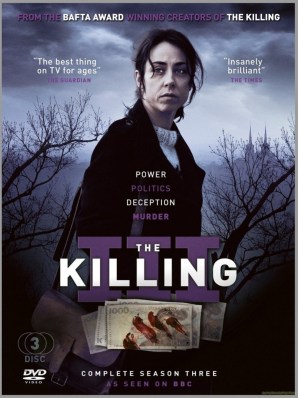
The Killing 3: Lund is back…one last time

Watching the opening of The Killing 3 tonight was a bitter-sweet experience. On the one hand, there was the delight of seeing ‘our Sarah’ again and hearing that oh-so-evocative theme tune, and on the other, a sense of melancholy, because this is really it – the final series – as director Søren Sveistrup has repeatedly stressed in interview.

Cover of the Series 3 DVD, due out mid-December

Warning: slight spoilers below

In the previous two series of The Killing, Sarah Lund has faced a stark choice between the conventional happiness provided by a strong family life and her commitment to the role of police detective, one that ultimately alienated everyone around her, leaving her painfully isolated. Viewer reactions to Lund’s professional tenacity have sometimes been divided between admiration (without her, cases wouldn’t have been solved), and criticism for neglecting her family (in particular her son). These reactions have in turn generated some interesting discussion about gender stereotypes, especially as Sofie Gråbøl, the actress playing Lund, has said that the key to her characterisation was ‘acting like a man’.

When we meet Lund at the beginning of Series 3, it looks like she’s opting for happiness: after 25 years on the force she’s completed her fair share of murder investigations, and is moving sideways into a comfortable desk-job at the OPA (Operational Planning and Analysis unit). She’s trying to make time for herself (gardening! cooking! a funky new jumper!) and to repair her relationship with her son Mark. Of course, we know it can’t last – seeing Sarah cook a tasty Stuvet Oksekød doth not a riveting crime series make. And so, when a man’s dismembered body is found by the Copenhagen docks ahead of a visit by the Danish prime minister, it’s clear that she’ll soon be back to her old investigative ways. And when she is, we’re treated to a heady (and topical) brew of big business, politics, kid-napping and murder that’s gripping to watch. I already have a bit of a theory, which I’m writing on a bit of paper to be unfolded only after episode 10…

To be honest, though, I’m a little fearful for Lund. After the traumas sustained in the last two investigations, I’m not sure she can survive a third intact, either physically or mentally. I’m also a bit worried that director Søren Sveistrup will send her off with a bang that’s way too literal for my liking at the close of the series. Lund’s death in service would in many ways be a fitting and logical end to her unswerving dedication to the job, which takes her into dangerous situations and annoys some exceedingly nasty people. But I would really rather that didn’t happen to our girl.

On a lighter note, I settled down on the sofa this evening for a highly enjoyable game of  ‘Forbrydelsen Bingo’. I can report that I put a cross in a grand total of 7 of my boxes. I’ll hang on to my sheet to see if I can cross off the other 5 next week.

Finally … here’s a whole heap of marvellous links for your delectation

Episodes 1 will be repeated on Monday 19. November at 11.25pm, with episode 2 following on Tuesday 20. at 11.25pm. Both are also available on BBC iPlayer.

I’d love to hear your thoughts on the beginning of the series, but please try to avoid big spoilers so that we protect the enjoyment of those still to watch 🙂

Update: there are a few spoilers in the comments below, so please look away if you haven’t yet watched!

It’s time for ‘The Killing 3’ Bingo!

So it’s T-minus two hours. Tonight sees the start of Forbrydelsen / The Killing 3 at 9pm on BBC4 – the long, long wait of dedicated British fans is nearly over.

If you have loyally accompanied Sarah Lund from the start of her journey in the amazing opening episodes of series one, then you might like to join me this evening in a game of ‘The Killing 3’ Bingo, which pays affectionate tribute to some of the hallmarks of this exceptional crime drama. Enjoy!

(I might add that I’ve had to employ some Lund-like doggedness to import this table into WordPress via Word, Paint and Flickr. My reward is an *extra-large* glass of wine with tonight’s episodes.)

Update: By the end of episode 2, I had 7 boxes crossed and by the end of episode 4, 11 boxes 🙂 Just one to go…

Jakob Arjouni’s Turkish-German Kayankaya series

I was delighted to hear that Jakob Arjouni’s Turkish-German investigator Kemal Kayankaya was going to feature on the Radio 4 ‘Foreign Bodies’ series, and to contribute a bit to the episode in question, as it gave me an excellent chance to re-read the Kayankaya novels and to get my hands on the latest instalment, Brother Kemal, published in Germany just this year.

In order of appearance, they are:

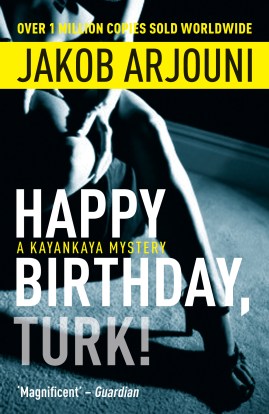
  1. Happy Birthday, Türke / Happy Birthday Turk (1985)
  2. Mehr Bier / More Beer (1987)
  3. Ein Mann, ein Mord / One Man, One Murder (1991)
  4. Kismet / Kismet (2001)
  5. Bruder Kemal / Brother Kemal (2012)

Blue Night 4 Arjouni

The first time I came across Kayankaya was in 1988, in the ‘foreign literature’ section of Borders on Oxford Street in London. The novel was Happy Birthday, Turk, which had been published in Germany in 1985, and had become a surprise critical and commercial hit. It was written by debut author Jakob Arjouni at the tender age of just nineteen.

It’s hard to overestimate how ground-breaking the figure of the Turkish-German P.I. Kemal Kayankaya was in the West Germany of the 1980s, when public attitudes towards the migrant workers who had helped to rebuild post-war Germany were deteriorating (‘job done, now please go home’). Asking German readers to identify with the likeable, wise-cracking, football-and-pickled-herring-loving Kayankaya directly challenged the dominant stereotype of ‘the Turk’ as a kebab-shop owner, rubbish collector or criminal who was poorly integrated into society and spoke only broken German. Kayankaya, the child of a Turkish migrant worker, is depicted as highly articulate, confident in his professional abilities, and – exceptionally for the time – as the holder of a West German passport, courtesy of his adoption by a German couple after his parents’ death. His characterisation thus deliberately up-ends the average German reader’s perception of what a Turkish person living in Germany ‘is like’, and confronts essentialist notions of German national identity. A Turkish-born person with a German passport? A Turkish-German citizen? Really?

Kayankaya’s early investigations, which fuse parts of the American hard-boiled tradition with the German Sozio-Krimi (sociological crime novel) of the 1970s, are used to expose the corruption of the state and to reveal the racism at the heart of West German society – the lingering legacy of National Socialism. The tables are thus deftly turned by Arjouni: the focus is on German criminal activity, and the crimes of Turks and other minorities are shown in the larger context of the unequal power-relations that exist within the state (for example, a ‘bad’ Turk is shown having been blackmailed into dealing drugs by corrupt police officers who threaten him with deportation should he not comply).

DVD cover of the film adaptation of Happy Birthday Turk (1991)

There’s also plenty of wise-cracking, acerbic humour. In fact, wit and sarcasm are shown to be key weapons when dealing with the tedious, casual racism the P.I. encounters as he goes about his daily business in Frankfurt.

Thus we are treated to the following classic exchanges:

  • German woman to Kayankaya: ‘You speak really good German!’
  • Kayankaya to German woman: ‘Thanks (long pause). You too’.

And…

  • German bureaucrat to Kayankaya: ‘Name?’
  • Kayankaya: ‘Kayankaya’.
  • German bureaucrat: ‘Spelling?’
  • Kayankaya: ‘Pretty good. Though I do have a little trouble with those foreign words’.

The Kayankaya novels are not necessarily perfect, but Kemal Kayankaya remains a ground-breaking investigative figure in the history of European crime fiction. A thoroughly original creation, he is used to raise some genuinely troubling questions about dominant social attitudes towards minorities. Many of the points the novels raise about social exclusion and about the uneven distribution of justice within society remain as pertinent today as in the 1980s.

Later novels in the series, as the ‘Foreign Bodies’ episode shows, engage with the seismic changes in Europe following the collapse of communism in 1989/90, and, most recently, with the tensions caused by Islamic fundamentalism (Brother Kemal).

You can listen to the ‘Foreign Bodies’ episode about Kemal Kayankaya, which features an interview with the author Jakob Arjouni, on BBC Radio iPlayer.

Image for PI Kemal Kayankaya

Theakston File 4: Jason Webster interview with Mrs. P.

If you tuned in to the 8th episode of the Radio 4 ‘Foreign Bodies’ series on Wednesday, you’ll have heard crime authors Jason Webster and Antonio Hill in animated discussion with Mark Lawson about Manuel Vázquez Montalbán’s investigator, Pepe Carvalho.

Listening to the episode, I realised now was the time to post my interview with Jason Webster at the 2012 Harrogate Crime Writing Festival. Key areas explored with the author of the ‘Max Cámara’ series, which is set in Valencia, include the legacy of the Spanish Civil War and the influence of Vázquez Montalbán.

Mrs. Peabody (MP): You’re a very versatile author: you started out as a travel writer, examining the history and culture of Spain, before turning your hand to crime fiction. Could you say a little bit about what led you to crime?

Jason Webster (JW): I suppose in some ways writing crime allows me to keep exploring Spain – this massive country that I’m really fascinated by – and has become an extension of the travel books, because the ‘I’ of the narrator in the travel books isn’t a million miles away from a detective: it’s exploration, it’s questioning, it’s looking for clues. And often there was a quest format in my previous books, so my writing has rolled on quite easily from those into crime.

MP: Are you able to take some of the material from those earlier books and incorporate it into your crime novels – say about flamenco or bull-fighting or Spain’s historical past?

JW: Definitely the past – the Spanish Civil War. I draw on that quite heavily for the third Max Cámara book, The Anarchist Detective, which will be coming out next year. So there’s a lot about this dark, dirty legacy of the Civil War – stuff that lots of people in Spain don’t want to talk about. Flamenco a little bit as well. Max likes flamenco so that fits, but it hasn’t played a huge part yet in any of the books.

MP: And do you think the crime genre is particularly suited to tackling subjects like the Spanish Civil War and the legacy of the past?

JW: Yes, absolutely. I mean there’s this largely untold violent history and lots of old wounds which haven’t healed. You have to remember that the families of those who were killed by Franco’s troops couldn’t mourn their dead. Anybody who was on the other side – on Franco’s side – and was killed or wounded – their stories were glorified for years and years. And when Franco died there was this period called ‘the pact of silence’ [pacto de silencio]. During ‘the transition’ [from Franco’s dictatorship to democracy] everybody agreed that you ‘don’t mention the war’… because that’s the only way we’ll get out of the dictatorship and move into democracy. But about eight years ago people started to ask – ‘hang on, what did happen to grandpa?’. So the grandchildren of the people who had suffered during the Civil War were saying, ‘well actually, I want to know’. And that opened up a can of worms, because a whole section of Spanish society – the political right, essentially – just didn’t want to go there. So there are a lot of untold stories, a lot of unhealed wounds, and a legacy of violence.

It’s perfect for writing crime, I think, because there are a lot of secrets … And in a sense there’s a long tradition dating back from the period of ‘the transition’ – just before Franco dies and just afterwards – of great Spanish crime writers like Vázquez Montalbán writing very much from a political point of view. They want to talk about what’s going wrong in Spain, and finally can publish their books once Franco dies, when the dictatorship is over and censorship has come to an end. So that’s very much part of the tradition of Spanish crime writing.

MP: Do you see yourself now as part of that tradition?

JW: In some ways, sure. Vázquez Montalbánwas definitely an inspiration, and the name that I gave Max Cámara…I was thinking of two things, really. I was thinking of Christopher Isherwood and ‘I am a camera’: ‘cámara’ means ‘camera’ in Spanish and it’s a perfectly legitimate surname as well. And this gives us a handle on Max’s character – he observes, he waits, he doesn’t really jump to conclusions. But I was also thinking of Vázquez Montalbán when he was writing under Franco and had been thrown in jail and had to write under a pseudonym – one of the pseudonyms he used was ‘Sixto Cámara’. So there’s a sort of homage to that, to Vázquez Montalbán…

MP: Can I take a tiny detour to your third book, Guerra: Living in the Shadows of the Spanish Civil War. What prompted you to write it?

JW: I was talking to one of the locals near where we live, which is in the middle of nowhere, off the grid. We were just chatting away, when she started telling me some things about the Civil War and took me to a place where she said there was a massacre, in around ’38 – so getting towards the tail end of the war, just as Franco was moving south towards Valencia. And she had seen this happen as a young girl – these bodies being buried. I’d sort of heard about this and it was about the time when it was starting to come out – these mass unmarked graves dotted around the country where people who had died at the hands of the Francoists were just buried… There was no commemorative plaque, there was no gravestone, no one had been allowed to mourn, the dead were buried there for years and years. And you know, death is important in Spain; it’s a culture where you seriously mourn the dead, and so for a whole side of the country not to have been able to mourn their dead… that’s a big deal.

I think a lot of people are just hoping that that generation– anyone who lived through that, anybody who suffered – will just die and then we can all forget about it. But there are quite a lot of people who are trying to recreate the oral history from the time – not let it just slip away. Paul Preston [the historian] and I have met on a number of occasions … and the book that he’s written on the ‘Spanish Holocaust’ is a very interesting one with a very interesting title… He’s deliberately being controversial. And he’s doing that because he’s making a statement about contemporary Spain as much as he is about the past. There are lots of Spaniards who don’t accept what happened. And they say we should just ‘turn the page’. But how are you going to get over the wounds unless you confront the past?

MP: It’s the classic model of the repressed, isn’t it?

JW: Yes, absolutely. Spanish society is still very much divided and this is what forms the backdrop to my second novel, A Death in Valencia. I’m trying to look at these massive divisions that split Spain apart still, eighty years after the Civil War.

MP: You build that history into your crime fiction through the figure of the grandfather, Hilario. He’s somewhat disapproving that his grandson Max chose to join the police.

JW: That deep paradox goes to the heart of who Max is, and I bring this to the fore in the third novel, The Anarchist Detective. Max comes from an anarchist family; he is essentially an anarchist himself, but an anarchist in the broad sense of the word. At the same time he’s an agent of the state, and of state authority, so how does that work? How does he square that circle? In some ways, what I’m doing in the second book, A Death in Valencia, is showing a breakdown in his character, because of this contradiction, whereas in the third book, he kind of resolves that paradox within himself.

MP: Do you think it’s helpful that you speak Spanish? I notice from having read some of A Death in Valencia ­that you include Spanish proverbs [refranes] in their original form, perhaps as a way of communicating with readers who are non-Spanish speakers – imparting the culture and giving us a flavour of the language as well. Is that a deliberate strategy?

JW: I think so. The problem is that it’s hard for me to put myself in the position of not knowing Spanish. Sometimes I’m just writing and there are certain phrases which I just think are so wonderful that I want to put them down in English. The proverbs are there because they are an important part of Max’s character. The Spanish are very, very proud of their proverbs, and it’s one of the things I love about Spain. It’s not Spanish intellectual culture that gets me going in the morning, it’s this intuitive side to the country and to the culture – and I see that in the proverbs. Essentially, there’s a deep wisdom that you feel has been passed on for centuries, by word of mouth – it’s an oral tradition. And I love that, so I did want to get that across in the novels.

MP: What do you think the Spanish would make of your crime novels?

JW: The first one, Or the Bull Kills You, might wind some people up because it’s about bull-fighting, but the second and the third ones don’t deal with so-called Spanish stereotypes, so they might be more acceptable. Basically, don’t talk about anything they term ‘el folklórico’ – flamenco, bull-fighting, all that kind of stuff that the Franco regime tried to promote in the 1950s and 1960s to get tourists to come over. It’s what they consider to be the backward side of their culture and they don’t want to perpetuate the image that that’s all Spain is about. But the Spanish Civil War is a legitimate topic for foreigners to discuss…. It’s complicated!

Interview carried out at the Old Swan Hotel, Harrogate, 20 July 2012

You can still listen to the ‘Foreign Bodies’ episode on Montalbán’s Pepe Carvalho via BBC iPlayer.

BBC Radio 4’s ‘Foreign Bodies’ episode guide…with a bit of Mrs. Peabody in #2!

Mark Lawson’s ‘Foreign Bodies’ series kicked off yesterday with an exploration of two seminal detectives from Belgium –  Hercule Poirot and Jules Maigret. Val McDermid, Andrea Camilleri, P.D. James, Jakob Arjouni and Camilla Lackberg all joined Mark for a fascinating discussion about these two key investigative figures.

Today it was the turn of Friedrich Dürrenmatt’s Swiss detective Inspector Bärlach, featuring a contribution from your very own Mrs. P… Our discussion took in Dürrenmatt’s links to earlier Swiss crime writer Friedrich Glauser, Dürrenmatt’s exploration of the moral crisis facing Europe following the Holocaust, and his subversion of the detective genre to question the possibility of justice. The crime novels discussed included The Judge and his Hangman (Der Richter und sein Henker, 1950), Suspicion (Der Verdacht, 1951) and The Pledge (Das Verprechen, 1958).

Listings for the first 7 episodes are now up on the ‘Foreign Bodies’ website. They air Monday to Friday on Radio 4 at 13.45, and are then available online. For good measure, there’s an omnibus edition on Friday at 21.00.

Episode 1  Belgium: Hercule Poirot and Jules Maigret (Agatha Christie and Georges Simenon)

Episode 2  Switzerland / Germany: Inspector Bärlach (Friedrich Dürrenmatt)

Image for Inspector Barlach

Episode 3  Czechoslovakia: Lieutenant Boruvka (Josef Skvorecky)

Episode 4  The Netherlands: Commissaris Van Der Valk (Nicolas Freeling)

Episode 5  Sweden: Inspector Martin Beck (Maj Sjöwall and Per Wahlöö)

Episode 6  UK: Commander Dalgliesh / Chief Inspector Wexford (P.D. James and Ruth Rendell)

Episode 7  Sicily: Inspector Rogas (Leonardo Sciascia)

You can also hear Bernard Hepton (who played Toby Esterhase in the BBC adaptation of Tinker Tailor Soldier Spy) begin his sublime Radio 4 reading of Dürrenmatt’s novella The Judge and his Hangman (available until 29 October).

Roseanna, the first of the Martin Beck dramatisations – will air on Radio 4 on Saturday 27 October at 14.30, but if you can’t wait, help yourself to this sneak preview.

Mrs. P’s review of Friedrich Dürrenmatt’s The Pledge is available here.

UPDATE 28 October: Mark Lawson has written an overview article about the ‘Foreign Bodies’ series for The Guardian entitled ‘Crime’s Grand Tour: European Detective Fiction’.

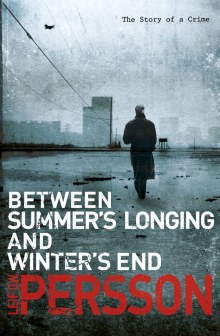
#27 / Leif G.W. Persson, Between Summer’s Longing and Winter’s End: The Story of a Crime

Leif G.W. Persson, Between Summer’s Longing and Winter’s End: The Story of a Crime, trans. from the Swedish by Paul Norlen (London: Black Swan, 2011 [2002]). An epic crime novel and bravura account of one of Sweden’s greatest unsolved crimes  4 stars

Opening line: The best informant is the one who hasn’t understood the significance of what he has told.

Like Peter Høeg’s Miss Smilla’s Feeling for Snow, this novel opens with an unexplained fall from a tall building in the freezing depths of a Scandinavian winter. In the case of Persson’s Between Summer’s Longing and Winter’s End, the casualty is a young American, John Krassner, whose death is initially presumed to be suicide, but might well be something more sinister – for how to explain the fact that his shoe hit the ground a good ten seconds after his body?

For a significant portion of the text, the reader might reasonably assume that Krassner’s death is the ‘crime’ referenced in the novel’s subtitle. However, as the narrative unfolds over a sprawling 638 pages, it becomes clear that his demise is linked to a much larger crime – one that took place in Sweden in 1986 and remains unsolved to this day. If you can’t quite remember that event, I’d advise you to stay away from reviews until you’ve finished the book (my reading experience was considerably enhanced by putting two and two together at a relatively late stage – the biggest ‘OMG’ reading moment I’ve had in years). But if you can’t wait, or are looking for illumination after reading the novel, click here

In common with a number of Swedish crime authors since the 1960s, Persson has a rather jaundiced view of Swedish society and is highly critical of the authorities and the power wielded by the state. The police are depicted as racist or misogynist bunglers, with the Swedish secret police force (Säkerhetspolisen or Säpo) shown in a particularly harsh light. What makes the strength of this critique startling and more than a little interesting is the author’s own long-held position within the Swedish establishment. As the blurb on the inside front cover tells us, Persson has enjoyed an eminent career as ‘Scandinavia’s most renowned criminologist and leading psychological profiler’, as well as being an advisor to the Swedish Ministry of Justice and a professor serving on the National Swedish Police Board. It would be interesting to know how these august bodies reacted to the very negative depictions of the state and its law enforcement agencies within the novel.

One of the few likeable figures in the book is Superintendent Lars Martin Johansson, the ‘honest Swedish cop’ who digs the deepest into Krassner’s death. But even he is only able to discover a portion of the truth: as individual acts collide with one another and fuse with shady political operations in Sweden and beyond, a set of events unfolds whose complexities are beyond the understanding of a lone investigator. In the end, only the reader is provided with a privileged viewpoint in which everything adds up, while being given to understand that no ordinary Swede would ever have a hope of getting near the truth. And of course this is just one possible imagining of those seminal events in 1986 – there are numerous other ways these might have played out.

This is not a crime novel for the faint-hearted: its hundreds of pages, multiple narrative perspectives and complex plotlines require considerable commitment. But once the different strands come together together in the final part the novel, the reader’s efforts are rewarded as the ambition, range and intelligence of the narrative is revealed.  In many ways a political and social history of Sweden since the Second World War, this Kafkaesque narrative tackles big themes (the relation of the individual to the state, loyalty, betrayal, trauma, the precariousness of democracy), but is also rich in satirical humour (look out for ‘Anderson’s Confusion Syndrome’) – and for me was a highly satisfying read.

Between Summer’s Longing and Winter’s End is the first in a trilogy. The second part has recently been translated into English, entitled Another Time, Another Life.

Mrs. Peabody awards Between Summer’s Longing and Winter’s End an ambitious and satisfying 4 stars.

Creative Commons License

.

Jo Nesbø’s Harrogate Crime Festival interview on Radio 4’s Front Row

Newsflash! Norwegian author Jo Nesbø’s interview with Mark Lawson at the Theakstons / Harrogate Crime Writing Festival will feature on tonight’s Front Row.

You can listen on Radio 4 at 19.15, or catch up later at the Front Row website, where the whole of the interview is also available (and most interesting it is too).

Nesbø  will also feature in the ‘Foreign Bodies’ series which Lawson is presenting for Radio 4 from 22 October (see previous post for further details). Harry Hole is one of the 15 fictional detectives used by the series to explore how crime writing depicts the history of modern Europe.

Image for Foreign Bodies

Copyright BBC Radio 4

Also spotted: the ‘Front Row Crime Writers Collection’ – a marvellous set of interviews with leading crime novelists including Henning Mankell, Andrea Camilleri, Val McDermid, P.D. James and John le Carré.