BBC4 announces new international crime acquisitions

BBC Four has announced three new foreign-language drama series: Crimes Of Passion, a Swedish crime series set in the 1950s, Hostages, an Israeli thriller series, and 1864, a Danish historical drama series (the latter starring a certain Sidse Babett Knudsen – further information available here).

The BBC4 press release gives the following details about the two crime acquisitions:

>> Crimes Of Passion (6 x 90-minute episodes)

With love, sex, intrigue, betrayal, secrets, lies – and murder – Crimes Of Passion is based on the popular crime novels of author Maria Lang. Set in the 1950s in the magically beautiful region of Bergslagen, Sweden, these entertaining whodunnits follow amateur sleuth Puck Ekstedt and fiancé Einar Bure, along with police superintendent Christer Wijk, in their quest to reveal the murderous intent beneath the seemingly idyllic surroundings – where the killer is always one of the community. [You can see a clip here. Shades of Agatha Christie and Midsomer Murders?]

Made by Pampas Produktion AB, Crimes Of Passion is executive produced by Johan Mardell, produced by Reneé Axö and directed by Birger Larsen, Christian Eklöw, Christopher Panov, Molly Hartleb and Peter Schildt.

Hostages (10 x 60-minute episodes)

Hostages is an intense psychological crime-thriller about a renowned surgeon who has been asked to perform a routine operation on the president of Israel. The night before the procedure, her family is taken hostage and she is ordered to sabotage the operation and kill the president – or her family will die. Her battle to save both her family and the president takes us on a journey in which everyone is fighting for survival. [Ooh, this looks good – see the trailer here. A rare and welcome chance to hear some Hebrew too. The American remake  – because of course it had to be remade in English – has just aired on CBS with Toni Collette in the leading role].

Hostages

Cast of the Israeli series Bnei Aruba / Hostages

Hostages is created by Rotem Shamir and Omri Givon and produced by Haim Sharir. Avi Armoza of Armoza Formats says: “We are proud to represent the first-ever Israeli series to air on the BBC, and believe that the BBC is the perfect home for this highly acclaimed drama.”

UPDATE: The first two episodes of Hostages aired on BBC4 on Saturday 21, 2015. There was lots of positive buzz on Twitter afterwards, and having caught up with the opener myself now, I can see why. This is a high quality TV drama, which sets up its ingenious premise in a very effective way – it’s gripping from start to finish, with complex characterisation and a nice twist at the end (the first of many, I’m sure). I also love that the hot-shot surgeon at the heart of it all is a women. Altogether, the series looks very promising indeed.

It’s the first time I’ve watched any Israeli crime drama or, by extension, heard any Hebrew for a sustained length of time. It’s an interesting experience, not least because (for a little while) we see a representation of an affluent, everyday life in Israel that’s at odds with what’s normally reported in the news. In my very limited experience of reading contemporary Israeli crime, the Israel-Palestine conflict is not something that tends to be addressed directly. I discuss this a little in my review of D. A. Mishani’s The Missing File, whose focus is very much on the minutiae of a murder committed in the small Israeli city of Holon. The more overtly political framework of The Hostages provides increased scope for an engagement with larger political issues, but I wonder if it will. Palestine, at least, may be too sensitive and divisive an issue to touch. I’ll be watching with great interest to see where the plot goes… 


#41 / Håkan Nesser, The Weeping Girl

Håkan Nesser, The Weeping Girl [Ewa Morenos Fall], translated from the Swedish by Laurie Thompson (London, Mantle 2013 [2000])  4 stars

Hmmm. Didn’t like this cover: at odds with the description of ‘the weeping girl’ in the book

Opening lineWinnie Maas died because she changed her mind. 

The Weeping Girl is the eighth in Håkan Nesser’s Inspector van Veeteren series, although its lead investigator is actually his very capable protégé Ewa Moreno, as signalled by its original title, Ewa Morenos fall (Ewa Moreno’s Case). I have to say that I much prefer the Swedish title: placing an emphasis on the figure of the policewoman rather than the ‘weeping girl’ who triggers the investigation feels right, as the novel offers a 360 degree portrait of Ewa’s professional life and personal circumstances. In this respect, it also reminded me of Indridason’s 1998 Icelandic crime novel Outrage, in which Elinborg takes centre stage.

Cover of the French translation, which retains the original title’s focus on the lead investigator

I’ve been a fan of Nesser’s work since reading Borkmann’s Point many moons ago (published in the UK in 2006). I remember loving the characterisation, the clever narrative construction, the gentle satirical humour, and the way the novel was situated in a generic European context, with people and place names that sound Dutch, German, Spanish or Polish. Six novels down the line, The Weeping Girl has maintained the very high standard of that earlier work (no mean feat this far into a series).

The novel uses a classic Golden Age trope: the detective pulled unexpectedly into an investigation while on holiday (e.g. Miss Marple, Lord Peter Wimsey, Harriet Vane). Ewa is drawn into not just one but three investigations while staying in Port Hagen near Lejnice, the most prominent being the disappearance of a young woman, Mikaela, who has just discovered that her father – former school-teacher Arnold Maager – was convicted of murdering a teenager 16 years ago. Plotwise one could argue that there’s nothing especially new on offer here, but oh my, it’s extremely well done. Nesser balances the descriptions of the personal and professional aspects of Ewa’s life perfectly, provides us with a range of well-drawn and interesting characters (such as Lejnice police chief Vrommel), and combines the various narrative strands in such a way that makes you want to keep reading, but without ever feeling overloaded. All in all it’s a hugely enjoyable, quality read, and I’m now keen to catch up with the earlier novels in the series that I’ve missed.

A quick aside: the focus on team members other than the dominant investigator (such as van Veeteran or Erlendur) is a welcome development for the police procedural as far as I’m concerned, especially as it often places very interesting female investigators in the spotlight. It’s one I’ve only really just noticed, but must have been going since at least 1998 when Nesser published Münsters fall (Münsters Case)… Can anyone think of earlier examples?

Mrs. Peabody awards The Weeping Girl an expertly crafted and absorbing 4 stars

With thanks to Mantle for sending me a copy of this book (Petrona Award submission).

Creative Commons License

.

Nominations, shortlists and stacks of crime

A few tasty tidbits as we (finally) make it to the weekend.

1. Spotted on It’s a Crime! (Or a Mystery): the BAFTA TV nominations are out, and the International category includes two series with strong elements of crime – The Bridge and Homeland. They make up half of the nominations (listed below).

The one I want to win…

The Bridge – Hans Rosenfeldt, Charlotte Sieling, Anders Landstrom, Bo Ehrhardt (Filmlance, Nimbus, ZDF Enterprises/BBC Four)
Game of Thrones – David Benioff, D.B Weiss, Carolyn Strauss, Frank Doelger (HBO/Sky Atlantic)
Girls – Lena Dunham, Jennie Konner, Judd Apatow (HBO/Sky Atlantic)
Homeland – Production Team – (20th Century Fox/Channel 4)

The full list with all categories is available here (thank you, Rhian!).

2. The Independent foreign fiction prize 2013 shortlist has been announced, and contains one of the crime narratives I highlighted in an earlier post – Gerbrand Bakker’s The Detour (translated from the Dutch by David Colmer / Harvill Secker).

Publisher description: A Dutch woman rents a remote farm in rural Wales after confessing to an affair with one of her students. In Amsterdam, her stunned husband forms a strange partnership with a detective who agrees to help him trace her. They board the ferry to Hull on Christmas Eve. Back on the farm, a young man out walking with his dog injures himself and stays the night, then ends up staying longer. Yet something is deeply wrong. Does he know what he is getting himself into? And what will happen when her husband and the policeman arrive? The Detour is a deeply moving new novel, shot through with longing and the quiet tragedy of everyday lives.

It all sounds rather existential. I’m intrigued! Here’s the full shortlist, which might need further exploration as well.

3. Petrona Award for Best Scandinavian Crime Novel of the Year

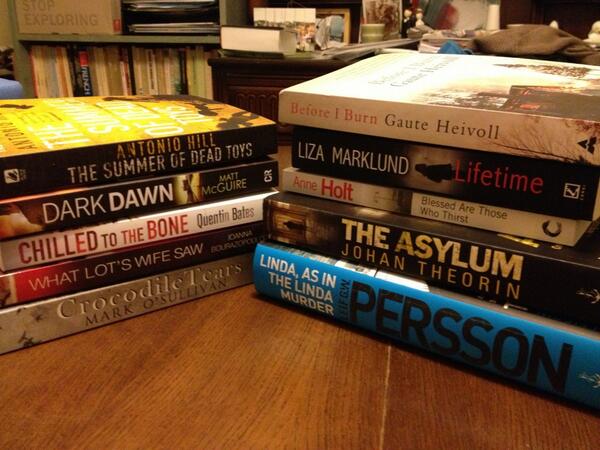
I’m getting very excited as crime novels for the 2014 Petrona begin to arrive. Having been away from the university for a while over Easter, I returned to a veritable mountain of packages, and felt like proverbial kid in a sweet shop as I opened them all up.

Embedded image permalink

Petronas on the right; other goodies to the left

The winner of the first Petrona Award will be announced at CrimeFest in Bristol (30. May to 2. June). I’ve just booked my ticket and hotel and am looking forward to it all greatly, not least because this will be my first ever visit to the convention. The programme looks very inviting. Perhaps see you there?

Arne Dahl’s The Blinded Man airs this Saturday (6 April) on BBC4

As I reported in a recent post on forthcoming international crime drama, the TV adaptation of Arne Dahl’s ‘Intercrime’ series is about to hit our screens, airing this Saturday on BBC4 between 9.00 and 10.30pm. We begin with a two-parter of The Blinded Man (first published in the U.S. as Misterioso), with the same pattern being repeated for another four Intercrime novels (ten episodes in total).

I’ll be very interested to see how the adaptation is handled. The storyline seems to be fundamentally the same as in the novel, but the Head of the A-Unit, Jan-Olov Hultin, has morphed into Jenny Hultin (pictured in the burgundy jacket below).

Image for Arne Dahl

Image courtesy of BBC4

The BBC4 synopsis of Episode 1 reads as follows (light spoilers): High-flying financiers are being murdered and it’s beginning to appear like the work of a serial killer. CID inspector Jenny Hultin puts together a team of top detectives to crack the case before there are more deaths and a national panic. One of the team, Paul Hjelm, is saved from a disciplinary hearing for shooting a hostage taker when he said he was unarmed. Together with his new colleagues he finds himself working 24 hours a day to find the killer quickly. They are the ‘A Unit’ and their pursuit of the Fat Cat Killer will expose tensions within the newly-formed group and put some of them in fear of their lives.

Further links

Radio Times interview: ‘Arne Dahl on the success of Nordic Noir and taking tips from Prime Suspect’.

Full details of the 10 Intercrime novels on Arne Dahl’s website (and lots more besides).

A review of The Blinded Man / Misterioso at Petrona.

An earlier Mrs. P. post on Arne Dahl and his novel Chinese Whispers (the first in Dahl’s ‘Europol’ series).

An advance review at Crime Time Preview (should you wish to sneak a peek).

Leif G.W. Persson’s Linda, As in the Linda Murder

Leif G.W. Persson, Linda, As in the Linda Murder (Linda – som i Lindamordet), trans. from the Swedish by Neil Smith (London: Doubleday, 2013 [2005]). 5 stars

linda

Opening line: It was a neighbour who found Linda, and, all things considered, that was far better than her mother finding her. 

The dedication at the front of Linda, As in the Linda Murder reads ‘for Maj Sjöwall and Per Wahlöö – who did it better than almost anyone’. In this newly-translated novel, first published in 2005, author Leif Persson undoubtedly pays homage to the godparents of the Swedish police-procedural, and in particular to the first in Sjöwall and Wahlöö’s Martin Beck series, Roseanna, published exactly 40 years prior to Linda in 1965. Consider the following:

  • both novels are named after a young female murder victim
  • both open with the discovery of the victim’s body, on 4 July and 8 July respectively
  • both are set outside Stockholm in smaller Swedish cities (Motala and Växjö)
  • both depict the police investigation in exhaustive detail
  • both critique misogynist attitudes in Swedish society and foreground the female victim

However, the lead investigator in Linda, tasked with solving the murder of 20-year-old trainee police officer Linda Wallin one hot summer night, is no Martin Beck. Meet Detective Superintendent Evert Bäckström, also known as ‘that fat little bastard from National Crime’, whose egotistical, sexist, racist, homophobic, vain and supremely-blinkered mind we are invited to see in all its dubious glory. Bäckström is a darkly comic tour-de-force, a monstrous creation who cares solely about his financial interests, maintaining a steady supply of drink, and the welfare of his pet goldfish Egon. His character is used to shine a spotlight on a less-than-heroic side of Swedish policing: while he is busy impeding the progress of the investigation, capable detectives such as Jan Lewin are forced to work around his prejudices and incompetence as best they can.

Thus, while paying tribute to Sjöwall and Wahlöö, Persson stamps his own style on the Swedish police procedural, imbuing it with a highly satirical edge. Other aspects of Roseanna, such the critique of the press’s prurient interest in female murder victims, are also extended further in Linda.

In the context of Persson’s own work, Linda forms a departure from his first two hugely ambitious novels, Between Summer’s Longing and Winter’s End and Another Time, Another Life, which are set against the much larger political and historical backdrop of post-war Sweden and the Cold War. In Linda, the focus is kept deliberately local, with the exploration of the consequences of just one crime, and strongly drawn characters such as detectives Jan Lewin and Anna Holt, as well as the murderer and the victim’s mother. Hats off also to translator Neil Smith, who captures Persson’s dry, satirical tone perfectly.

In sum, Linda is a rich and satisfying read from an author who’s now one of my absolute favourites.

*****

A useful further note from Neil Smith on Persson’s novels – poached with Sarah’s kind permission from the comments of the excellent Crimepieces Linda review  and with a couple of additions from me in square brackets:

Neil says >> As so often happens, Leif’s books are being published in a slightly different order in translation to their original Swedish publication.

The three books Between Summer’s Longing and Winter’s End (Sw. 2002, tr. 2011), Another Time, Another Life (Sw. 2003, tr. 2012), and Free Falling, as if in a Dream (Sw. 2007, tr. 2014), together make up a trilogy entitled ‘the Decline of the Welfare State’.

One of the main characters from that trilogy, Lars Martin Johansson, takes the lead in a later novel, The Dying Detective (Sw. 2010, as yet untranslated) [and appears a bit in Linda as well].

Evert Bäckström [who appears as a secondary character in the ‘Welfare State’ trilogy] is the focus of a further series of books, of which Linda, As in the Linda Murder (Sw. 2005) is the first. He Who Kills the Dragon (Sw. 2008), due to be published in English in October 2013, is the second in the series, and will be followed by Pinocchio’s Nose (not yet published in Sweden). <<

Mrs. Peabody awards Linda, As in the Linda Murder, a wonderfully rich and satisfying 5 stars

With thanks to Transworld for sending me an advance copy of this book.

Creative Commons License

.

International crime drama news from BBC4: Dahl, De Luca, Young Montalbano, The Bridge 2 and more!

I’ve just seen the following on a BBC4 press release and couldn’t resist reporting IMMEDIATELY.

>> BBC Four has announced two exciting additions to an outstanding new year of international drama and film on the Channel: Swedish crime series Arne Dahl and Italian series Inspector Da Luca.

Arne Dahl (a pseudonym of award-winning author Jan Arnald) is based on five of Dahl’s novels, beginning with The Blinded Man. The series revolves around a tight-knit team of elite specialists who investigate the dark side of Swedish society. It is produced by Filmlance International and written by Rolf Börjlind and Cecilia Börjlind.

Inspector De Luca is made by Ager 3/Rai Radiotelevisione Italiana. A four-part crime series based on the novels by Carlo Lucarelli, it is set in and around Bologna during the tumultuous years of Mussolini’s dictatorship. Inspector De Luca is an investigator whose brutal honesty and uncompromising character may help him solve cases, but combined with his love of women, they also conspire to get him in trouble…

Other crime drama and film highlights in 2013 include:

Young Montalbano. Set in the early 1990s and starring Michele Riondino in the title role, Young Montalbano gives an insight into the private life and early crime-fighting career of the idiosyncratic Sicilian detective. This prequel series, also written by Andrea Camilleri, was recently shown to critical acclaim in Italy. (See here for details of the start date of this series.)

The Bridge, Series 2. A rusty old coaster en route in the Öresund sound suddenly veers off course and rams the concrete foundations laid out to protect the Öresund Bridge. The ship is empty – or so it is believed until five people are found chained, cold and exhausted below deck. The unknown victims, of whom three are Swedish and two Danish, are brought to a hospital in Malmö. Without hesitation, Saga Norén (Sofia Helin) from Malmö CID contacts her Danish colleague, Martin Rhode (Kim Bodnia) and their new investigation begins.

Inspector Montalbano. The popular Sicilian detective makes a welcome return in four brand new episodes.

The King Of Devil’s Island. Based on a true story, The King of Devil’s Island tells the unsettling tale of a group of young delinquents banished to the remote prison of Bastøy in Norway. Under the guise of rehabilitation the boys suffer a gruelling daily regime at the hands of their wardens until the arrival of new boys Erling and Ivar spark a chain of events that ultimately ignite rebellion.

Point Blank. In this action-packed French thriller, Samuel Pierret is a nurse who saves the life of a criminal whose gang then take Samuel’s pregnant wife hostage to force him to help their boss escape. A race through the subways and streets of Paris ensues. As the body count rises, Samuel must evade the cops and the criminal underground to rescue his wife <<

I’m so excited I can hardly breathe. Though I’m not sure how to break the news to my family that the telly will be off-limits for most Saturday nights this year.

For the full press release see here (contains info about series 3 of BORGEN as well). There’s also a very atmospheric trailer of all the international drama coming up.

Enjoy!

The Petrona award for best Scandinavian crime novel

The crime blogosphere has been abuzz with news of the freshly established Petrona Award for Best Scandinavian Crime Novel of the Year.

Set up in memory of Maxine Clarke, who blogged as Petrona and was an expert in Scandinavian crime fiction, the award will be presented for the first time at the UK CrimeFest convention this coming May.

The 2013 shortlist has been compiled on the basis of Maxine’s own reviews:

PIERCED by Thomas Enger, tr. Charlotte Barslund (Faber and Faber)
BLACK SKIES by Arnaldur Indridason, tr. Victoria Cribb (Harvill Secker)
LAST WILL by Liza Marklund, tr. Neil Smith (Corgi)
ANOTHER TIME, ANOTHER LIFE by Leif GW Persson tr. Paul Norlen (Doubleday)

enger428586_287692644633128_120240158045045_704808_1282709077_n517CY6O6qWL51Bigz1qx7L._BO2,204,203,200_PIsitb-sticker-arrow-click,TopRight,35,-76_AA300_SH20_OU02_

Submissions are also now being invited for the 2014 award, which will be judged by crime critic Barry Forshaw, Sarah Ward of Crimepieces, and your very own Mrs. P. It’s an honour to have been asked, and I look forward to some lively discussions with my fellow judges! Karen Meek from Eurocrime will be keeping us all in line.

The rules governing eligibility are available on the Petrona Remembered blog. You can also read Petrona’s excellent review of Indridason’s Voices there – fittingly, it’s the inaugural post on the site, and will be followed by more from a variety of contributors.

For a Bookseller piece on the award, see here.

The press on trial: crime fiction and the media

One of my favourite things when reading crime fiction is the random emergence of a theme that links successive books. I experienced this recently with three quite diverse novels from Sweden, America and Australia, all of which focused heavily on the role of the media. None were too flattering of journalists and their trade, using the crime narrative to put the press ‘on trial’.

Leif G.W. Persson’s Linda, as in the Linda Murder (2005), is a recently translated Swedish police procedural that investigates the killing of Linda Wallin, a trainee police-woman at Vaxjo Police Academy. The novel is particularly scathing of the media’s sensationalist depictions of female murder victims, which are designed to generate sales: ‘From trainee police officer Linda Wallin, 20. To the Linda murder […] The Kajsa murder, the Petra murder, the Jenny murder… They had quite simply been transformed from women of flesh and blood into media messages’. This transformation is especially resonant in its original Swedish context, where the victim’s first name forms part of a compound noun that reduces her life to no more than its violent end – in this case, the Lindamordet [‘the Lindamurder’]. In contrast, the narrative notes drily, ‘men’s names were never used as prefixes to the word ‘murder”.

Gillan Flynn’s 2011 novel Gone Girl, a darkly humorous dissection of a marriage gone sour, critiques the media’s damaging influence when reporting criminal cases. Husband Nick Dunne, dealing with the press in the aftermath of his wife’s disappearance, soon discovers how fickle journalists can be: he’s styled as an anxious, bereft husband one minute, and as a sinister-looking potential murderer the next. Before long, he’s forced to hire a savvy lawyer who specialises in manipulating media narratives in his clients’ favour. The truth becomes largely superfluous: expensive lawyers and public opinion appear to count more than any meaningful judicial process (one can’t help thinking of the media circus that was the OJ Simpson case, and of the more recent Pistorius case).

Yvonne Erskine’s 2011 novel The Brotherhood is a 360 degree examination of the events leading up to and following a Tasmanian policeman’s murder. The police are shown having to manage press reactions to the killing from the minute the news gets out, a time-consuming and politically sensitive job, as the main suspect has Aboriginal heritage. We’re also introduced to amoral journalist Tim Roberts, who writes up a potentially damaging story knowing that he might jeopardise the case. Investigative journalism is portrayed here as seedy and self-interested, with no positive contribution to make to society.

Three crime novels obviously don’t make a trend, but I’d be interested to know if there are others that are similarly critical of the media. Of course, some crime novels contain more sympathetic depictions of the press: Stieg Larsson’s Mikael Blomkvist and Liza Marklund’s Annika Bengtzon are two examples of journalists who are given leading investigative roles within crime narratives, and who are depicted as thoughtful practitioners of their trade.

If you think of more, let me know – I’ll compile a list if we gather enough!

Update 3 May 2013: The Guardian has just run a profile of Gillian Flynn (interesting discussion on misogyny and female villains amongst other things, including the press angle). My review on Wendy James’ The Mistake (as recommended by Angela Savage in the comments below), can be read here.

Mrs. Peabody’s 2012 review

It’s been a busy year for Mrs. Peabody Investigates, with reviews of international crime fiction from Denmark, Finland, Germany, Italy, Northern Ireland, South Africa, Sweden, Switzerland and the USA. There were also a number of lively discussions on subjects including autopsy scenes; violence and women; Jewish detective figures; national image; strong female protagonists, and the crime writer as social commentator. Many thanks to everyone who joined in with their expertise and views! Last but not least, interviewing crime writers at the Harrogate Crime Writing Festival and contributing to Mark Lawson’s ‘Foreign Bodies’ series on Radio 4 were definite highlights.

So to finish off the year, here’s a random round-up of the best – and worst – of Mrs Peabody’s 2012 (with thanks to apuffofjack for the idea).

Most Satisfying Read: Tom Franklin’s Crooked Letter, Crooked Letter (2010), a gripping examination of the repercussions of a murder, set in the American Deep South of the 1970s, 1980s, and the present day.

Most Disappointing Read: Jussi Adler-Olsen’s Disgrace.Wooden characterisation was the real villain of this crime novel, but I’m still hoping for better from the next in the Department Q series.

Best Historical Crime Novel: Tie between Malla Nunn’s A Beautiful Place to Die (2010), which provides a fascinating insight into apartheid South Africa in the 1950s, and Stuart Neville’s The Twelve (2010) – hard-hitting Belfast noir exploring the legacy of The Troubles.

Crime Novel that Lingered Longest in the Mind: Jim Thompson’s The Killer Inside Me (1952), which presents a chilling, but surprisingly nuanced portrait of murderer Lou Ford.

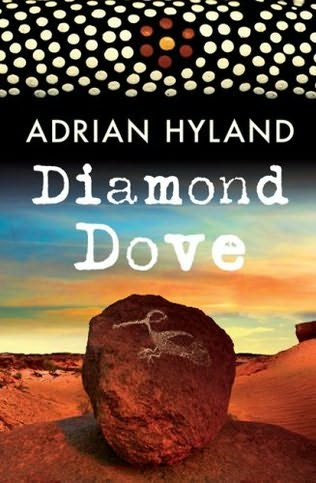
Best Female Detective: Tie between Edie Kiglatuk from M.J. McGrath’s White Heat (2011) and Emily Tempest from Adrian Hyland’s Diamond Dove (2006) (reviews pending). In many ways, these characters are twins: feisty, tough women who have complex insider / outsider roles in marginalised indiginous communities (the Inuit of the Arctic Circle and the Aboriginal people of the Australian outback).

Best Male Detective: Finnish-Jewish police inspector Ariel Kafka in Harri Nykänen’s Nights of Awe (2010): a highly original and witty investigator, whom I look forward to meeting again (albeit with a slightly less convoluted plot).  

Best Discovery: Leif G.W. Persson is well-known in his native country as a top criminologist and crime writer, but his razor-sharp dissections of Swedish society have only started to be translated relatively recently. I’ve just finished Another Time, Another Life (2012), which was a gem, and am keen to read more.

Last Policeman

Most Original Premise: Ben Winters’ The Last Policeman (2012) is a ‘pre-apocalypse police procedural’, in which Detective Hank Palace investigates a suspicious suicide six months before asteroid 2011GV1 is due to hit the earth. The first in a trilogy (review pending).

Best Re-read: Jakob Arjouni’s Turkish-German Kemal Kayankaya series (1985-2012). A ground-breaking detective who uses intelligence and wit to make his way in a largely racist society. The first in the series, Happy Birthday, Turk (1985), remains a cracker.

Best Use of Humour: Leif G.W. Persson uses satirical humour to great effect as he lifts the lid on the workings of Swedish society. Look out for the pathologist nicknamed ‘Esprit de Corpse’ in Another Time, Another Life.

Best crime TV series: The Killing III, in which Sarah Lund strode forth for the last time (still in denial that it’s over *sob*).

Best crime film: Tie between Romanzo Criminale (dir. Michele Placido, 2006), which traces the rise and fall of an Italian street gang, and Once Upon a Time in Anatolia (dir. Nuri Bilge Ceylan, 2011), which plays out over a dream-like night of a police investigation (reviews to follow).

Most Anticipated Reads for 2013: Stuart Neville’s Ratlines (2013), set in a 1960s Ireland whose government is keen to play down its links with former Nazis, and Y.A. Erskine’s The Brotherhood (2011), a much-praised depiction of police corruption and betrayal set in Tasmania.

All best wishes for a healthy and happy New Year, filled with lots of  wonderful crime fiction.

In Cold Blood: CultureCritic Guest Guide to Wintry Crime Fiction

The good people over at CultureCritic recently invited me to contribute a piece to their fabulous blog. The result is a guest guide to ‘wintry’ crime and the role of chilly settings in five of my favourite novels.

  • Jan Costin Wagner, The Winter of the Lions (German author; Finnish setting; 2011)
  • Leif G. W. Persson, Between Summer’s Longing and Winter’s End (Swedish author; Swedish setting; 2010)
  • A.D. Miller, Snowdrops (British author / Russian setting / 2011)
  • Julia Keller, A Killing in the Hills (US author / Appalachian mountain setting / 2012)
  • MJ McGrath, White Heat (UK author; Arctic Circle setting; 2011)

Many thanks to CultureCritic for the invitation; it was fun to do!

If you’re not yet familiar with the CultureCritic blog, do pop over: you’ll find all the latest on film, music, books, exhibitions, theatre, opera, dance and more…. It’s a regular smörgåsbord of cultural delights.