Review of Tinker Tailor Soldier Spy: British espionage thriller meets Swedish crime

I never thought I’d say this, but I was glad of some Welsh rain this afternoon, as it gave me and Mr. Peabody the perfect opportunity to go to the cinema. There, we treated ourselves to the 1970s espionage fest that is Tomas Alfredson’s Tinker Tailor Soldier Spy, adapted from the John le Carré classic of 1974.

The film has received rave reviews, including a rare 5 stars from The Guardian’s Peter Bradshaw, and I can understand why: this is film-making of the highest quality, which is beautifully acted and styled, and recreates a tense Cold War atmosphere to perfection.

Although the plot is fiendishly complex in places, with some mind-boggling twists and turns, the fundamentals of the story are always clear. There is a Soviet mole in the highest echelons of the British Secret Service, working for ‘Karla’, the enigmatic head of the KGB. It falls to George Smiley, a forcibly ‘retired’ senior intelligence officer, to flush the mole out. The spy has to be one of four people, all of whom Smiley has worked with for years, and so he is dealing not just with a political betrayal, but with a long-running personal betrayal as well.

The film allows Smiley’s investigation to unfold at a leisurely pace, as he tracks down the key players whose recollections will allow him to identify the mole. We are also shown Smiley’s own memories of past events (including a Christmas office party with Le Carré as an extra), which he is forced to view with new eyes – a painful process that reveals how one person’s betrayal has undermined all their supposed achievements down the years. Seeing things clearly is a dominant theme: early in the film, Smiley visits an optician’s and emerges with a new pair of glasses – the big, rectangular type worn by Alec Guinness’s Smiley in the 1970s TV adaptation. But this is much more than simple homage to the famous earlier series: the new glasses have a deeply symbolic function, showing how Smiley has sharpened his vision, in order to see the truth properly for the first time.

The acting is excellent throughout. Gary Oldman is a wonderfully controlled Smiley, whose close-ups reveal, through the minutest of facial movements, the tensions that lie beneath. There are also wonderful performances by John Hurt, Benedict Cumberbatch, Toby Jones, Colin Firth and Kathy Burke (who has possibly the best line of the whole film). Hats off, as well, to the film’s cinematographers, stylists, and lighting crew, who evoke a gloomy 70s Britain so perfectly: there’s no James Bond glitz or glamour here, just a succession of dark, windowless secret-service offices and hideouts, in a 1970s palette made up almost exclusively of browns (from beige to fawn to mud and a thousand shades in-between). The humdrum office life of the secret service is beautifully depicted (Trebor Mint, anyone?) and in some ways the whole story can be read as just mundane office-room politics, with various divisional heads pitted against one another for supremacy over the years … albeit with more geo-political issues and human lives at stake than your average workplace.

So how does a review of this seemingly ultra-British film end up on a transnational crime blog? Well, the film was co-funded by France’s StudioCanal, and the director, Tomas Alfredson, is Swedish. Best known for his 2008 vampire film Let the Right One In, Alfredson has done a tremendous job of adapting le Carré’s depiction of the classic Cold War crimes of treachery and betrayal. And in its understated style and underlying melancholia, I see this film connecting back to Swedish crime writers such as Sjowall & Wahloo and Henning Mankell, whose investigative figures, like Smiley, plod their way in a dogged and melancholy fashion towards the truth.

In Tinker Tailor Soldier Spy, the quintessential British espionage thriller meets the best of Swedish crime writing. It’s a winning combination and I can only hope that the other two novels in the Karla Trilogy will make it to the big screen via the same film-making team.

There’s also a lovely A-Z of TTSS from The Guardian available here.
#12 Ernesto Mallo / Needle in a Haystack

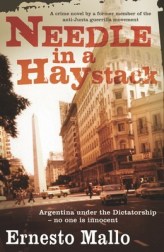
Ernesto Mallo, Needle in a Haystack [La aguja en el pajar], translated from the Spanish by Jethro Soutar (London: Bitter Lemon Press 2010 [2006]). This crime novel paints a searing portrait of 1970s Argentina under military rule  5 stars

Opening sentence: Some days the side of the bed is like the edge of an enormous abyss.

This is a hard-hitting crime novel, set against the backdrop of Junta-controlled Argentina in the late 1970s, where power lies primarily in the hands of the military, and ‘disappearances’ of young political activists – supposed ‘subversives’ – are common. Such extra-judicial detentions and executions are typically not questioned by the police (the very body that should be protecting the nation’s citizenry), as doing so is perceived as a pointless exercise that would have extremely negative consequences for the individual.

Superintendent Lascano is a recently bereaved detective (see also Kimmo Joentaa), struggling to maintain his integrity in this morally bankrupt society. In the opening chapter, we see him leaving the house at the beginning of the day, trying to ignore the presumably common sights of bus passengers being searched, and a boy and a girl being driven away in a convoy of military trucks. The girl makes desperate eye-contact with Lascano ‘and then she is swallowed up by the fog’ (8). When Lascano is directed to investigate a report of two bodies dumped by the riverside, he finds that there are now three dead lying there. Unable to investigate the first two, who are clearly the victims of the death squads, he is drawn into investigating the third, and soon finds himself in danger as he treads on some highly-placed military toes.

In the process of following Lascano’s investigations, the reader is presented with a finely-drawn portrait of a corrupt Argentina and its ‘Dirty War’. The narrative is told from a number of viewpoints, giving us multiple perspectives of life under the regime, from a member of a guerrilla cell opposing the Junta (Eva), to the honest cop (Lascano and his friend Fuseli the pathologist), the decadent Argentinian (Amancio, Lara and Horacio), the Jewish businessman (Biterman), the right-wing major (Giribaldi) and the major’s wife (Maisabe). Maisabe is procured a baby by her husband – the newborn son of a young ‘subversive’, who has almost certainly been killed by the regime. The focus is very much on the enormous human price that the younger generation – ‘the kids’ – paid for trying to oppose the regime. The author, who is himself a former member of the anti-Junta movement, would have been the same age as these characters in the 1970s, and it’s hard not to see the novel as a lament for his lost contemporaries and their suffering.

One element I found very interesting was the way that members of the Junta were styled as National Socialists in the novel. For example, we’re told how shortly after a couple have been arrested, the military return to their flat to cart off their possessions: ‘Various conscripts come in and out carrying furniture … and they put everything in the back of a truck, supervised by an arrogant blond captain’ (113). For me, this scene immediately brought to mind the deportations of Jewish citizens in Germany, and the appropriation of their property by the Nazi state (signalled here by the presence of the ‘blond’ captain). Lascano is also Jewish, so there seems to be a fundamental opposition being posited in the novel between good versus evil along the fault-line of Jews:Nazis. The kind of right-wing equivalences being made here also reminded me of Imre Kertész’s 1977 novel Detective Story, which is set in an unspecified South American dictatorship and features a police-man whose interrogation methods are modelled on those of the Nazis. (Kertész is a Hungarian Holocaust survivor and writer who won the Nobel Prize for Literature in 2002, and the novel, which can loosely be viewed as a crime novel, is well worth a read – published in translation by Vintage in 2009).

It’s notable (and rather fascinating) that the English translation of Needle in a Haystack was funded by the ‘Sur Translation Support Program of the Ministry of Foreign Affairs, International Trade and Worship of the Argentine Republic’. This suggests that the novel is viewed as part of a national project of engaging with the crimes committed in the Argentine past. The first two novels are also being adapted for film in Argentina, which will undoubtedly help them reach a wider audience.

Needle in a Haystack is a compelling, absorbing and unsettling read. I’d recommend Mallo to anyone who likes quality crime novels that address serious political issues and the legacies of difficult historical pasts. It’s the first of a trilogy and the second, Sweet Money, is already out with Bitter Lemon Press.

Mrs. Peabody awards Needle in a Haystack an outstanding 5 stars.

Update: for a recent article on the process of bringing former members of the junta to justice for the theft of babies from female political prisoners, see here.

#11 Henning Mankell / The Troubled Man

Henning Mankell, The Troubled Man, translated from the Swedish by Laurie Thompson (London: Harvill Secker 2011 [2009]). Wallander’s final case, in which he faces his biggest challenge yet 5 stars

Opening sentence: The year Kurt Wallander celebrated his fifty-fifth birthday, he fulfilled a long-held dream.

While at the airport bookshop before going on holiday, I spotted Henning Mankell’s The Troubled Man, a novel I’ve been looking forward to reading for a good year. After a few moments I decided rather regretfully to resist, as I wasn’t sure the Very Last Wallander would make for a cheery holiday read. Later that day, while exploring the hotel, I came across the usual bookshelf of novels left by other holidaymakers. There, but of course, was another copy of The Troubled Man, at which point I gave in, put aside the carefully selected crime novels I’d brought with me and, armed with a hanky, started to read.

Before saying any more I should confess that I am a thoroughly biased reviewer when it comes to this Swedish writer and series. I have loved all the Wallander novels, and it would have taken a complete car-crash of a book for me to rate it anything other than five stars. So a five it is – and in some senses this is a rating for the entire series, which is referenced numerous times in various ways throughout the book.

Troubled Men

The first troubled man of the title is Hakan von Enke, a retired Swedish naval official and the father of Linda Wallander’s partner Hans, who disappears into thin air one day while out on his regular walk. Shortly before he vanishes, Hakan voices some concerns to Wallander about an unsettling naval incident that took place in 1982 involving a Russian submarine. Not long afterwards, Hakan’s wife Louise also disappears. To help a distraught Linda and Hans, Wallander begins an unofficial investigation, and uncovers an espionage story that reaches back into the complex history of the Cold War. This forms the central case within the novel, and is an absorbing and well-constructed read (albeit with the odd loose end that’s rather too casually tied up at the end). As ever, Mankell challenges us to question our assumptions, in this case about the dominant historical narrative of the Cold War years – there are a number of enjoyable and unexpected twists that force us to see key events in a whole new light.

The second troubled man, of course, is Kurt Wallander himself, whose personal and working life is overshadowed by a growing anxiety, in spite of the joy that becoming a grandfather brings. Now at the age of sixty, when most people start reflecting on their lives and the choices they have made, Wallander becomes a vehicle for Mankell to explore some very large themes: the value of family ties, the passing of time, the individual’s fear of losing his or her identity and, of course, death. There’s very much a feeling of closing the circle, with a number of references to Rydberg (Wallander’s mentor early in the series), Wallander’s late father (whose relationship with his son was often fraught), Baiba Leipa (his one-time love from The Dogs of Riga), and individuals from past cases (such as the husband of the victim in The White Lioness). For anyone who has travelled with Wallander down the long and winding road of this ten book series, it can’t help but be an absorbing, poignant and moving read.

One final word: if you’ve not yet read the earlier Wallander books, or if there are any in the series that you need to catch up on, I would strongly recommend doing so before embarking on The Troubled Man, which should be read at the end of the sequence as the author intends.

Mrs. Peabody awards The Troubled Man a slightly mournful, but deeply satisfying 5 stars.

Other Mankell/Wallander links you may enjoy

Henning Mankell’s official website

In the Footsteps of Wallander – a PDF guide to the locations featured in the books, films and TV series.

Scandinavian Crime Fiction – a blog that does what it says on the tin.

BBC4 starts repeat of Forbrydelsen / The Killing on Sunday 21 August 2011

For those of you who have yet to see Forbrydelsen, the original Danish production of The Killing, your moment has come! 

BBC4 starts repeating the series this Sunday at 10 o’clock. There are five two-hour episodes being shown per week (20 episodes in all), which promises to be a pretty intensive viewing experience, but if you haven’t yet sampled this superlative crime drama, I very much recommend that you do. It’s even quite a tempting prospect for those of us who caught the series the first time round…  

You can read my review of the first episodes here.

An added bonus: Sunday’s showing of The Killing is preceded at 9.00 by a repeat of Timeshift’s Nordic Noir – The Story of Scandinavian Crime Fiction.

For those of you into Italian crime drama, BBC4 is also repeating an Inspector Montalbano two-parter, Excursion to Tindari. It starts tonight, Saturday at 9pm. And there’s another chance to catch Timeshift’s Italian Noir – The Story of Italian Crime, on Tuesday at 11pm. Molto bene!

The case of the missing translation: Konop’s No Kaddish for Sylberstein

A fellow crime researcher and friend recently read a cracking little French crime novel called Pas de kaddish pour Sylberstein and recommended it to me as one I would enjoy. I duly trotted off to find the translation but came up against a sizeable problem: it’s not available in English.

The novel, by journalist Guy Konopnicky (aka ‘Konop’), was first published in France in 1994,  and went down extremely well with the critics at the time. It was also adapted for film as ‘K’ in 1997 – as I found out courtesy of the Swedish Film Database. And yet not a sniff of it in the UK or States.

However, I then discovered that the novel was available in a German translation entitled Kein Kaddisch fur Sylberstein (btb, 2004). This was a lucky break for me, as I read German a lot better than I do French, and so I was able to sample its delights after all.

Kein Kaddisch für Sylberstein.

This meandering little journey got me musing on the logic (or simply luck) that results in some texts being translated while others are not. There are a couple of good reasons I can think of that would explain why Sylberstein was translated into German. Firstly, some of it is set in Berlin and explores 20th century German history. Secondly, Germans have an insatiable appetite for both homegrown and international crime fiction (another crime researcher colleague of mine was telling me in all seriousness the other day that Swedish crime fiction sometimes appears in German before it has even been published back in Sweden). So there’s an extraordinarily huge market for crime in Germany, as this article on the Deutsche Welle website explains (in English :)).

Here in the UK, fewer translations make it through to the English-language dominated market, although there is of course a very healthy international crime fiction scene now, thanks to visionaries such as Christopher MacLehose at MacLehose Press – not to mention the good folk at Bitter Lemon Press and Arcadia.

It looks like my Konop novel slipped through the net, but perhaps (ahem) one of the above might be interested in picking up this little gem? Here’s a taster from the blurb on the inside cover of the German btb translation:

‘Paris, 20th district. Jewish antiques dealer Simon Sylberstein shoots and kills a German tourist, whom he recognises as his old tormentor. He then hands himself into the police and dies of natural causes shortly afterwards. But Police Inspector Samuel Benamou, originally from Algeria and also Jewish, can’t let go of the case: he travels to the newly reunified Berlin to continue the investigation himself. Once there, Benamou quickly realises that he’s not the only one interested in Sylberstein and his story…’

All in all, I found No Kaddish for Sylberstein an enjoyable and thought-provoking read. Darkly humorous and entertainingly over-the-top at times, it also succeeds in addressing the serious theme of post-war justice (and its lack) following the Second World War and the Holocaust. If you’re lucky enough to speak French or German, it’s available online for a reasonable price.

#10 Dominique Manotti / Affairs of State

Dominique Manotti, Affairs of State, translated from the French by Ros Schwarz and Amanda Hopkinson (London: EuroCrime 2009 [2001]). A breathtaking exposé of political power games and corruption in 1980s Paris  4 stars


Opening sentence: Outside, it’s sunny, summer’s round the corner, but the offices of the RGPP, the Paris police intelligence service, are dark and gloomy with their beige walls, grey lino, metallic furniture and tiny north-facing windows overlooking an interior courtyard.

In one way, Affairs of State is less a crime novel than a tale of power and corruption, in which murders are inevitable as the stakes for political survival rise. In another, though, this is a crime novel through and through, in the sense that it dissects a bewildering range of criminal behaviour and leaves the reader looking at the world of politics through somewhat jaundiced eyes.

The spider at the centre of the web is François Bornand, a special advisor to the French President, who is guilty of all manner of corruption and decadence in the mid-1980s: the sinking of the Greenpeace ship Rainbow Warrior, lucrative arms deals with Iran, and a never-ending consumption of high-class call girls.

Bornand is the ultimate survivor, and when information about his illicit activities threatens to reach the press, he uses a maverick security unit based at the Elysée, the very heart of the French political establishment, to protect his empire. As the bodies pile up, the novel focuses less on the puzzle of who commits each crime (readers are privy to the identities of all the murderers), than on the investigative efforts of the police and intelligence service, who would like nothing more than to bring Bornand down. In the process, we are shown the fascinating journey of rookie policewoman Noria Ghozali, who starts out at the periphery of the investigation, but makes the crucial shift into intelligence work by the end of the novel. Like one of the murder victims, Ghozali is of Arab extraction, and her battle for acceptance within the police force and wider society allows Manotti to examine French attitudes to gender and race in an uncompromising and very effective way.

What’s particularly fascinating about the novel is how closely it dares to reference the reality of French politics in the 1980s. The original title of the novel is Nos fantastique années fric, or ‘our fantastic years of dosh’, and Manotti sets out to critique what she describes in her afterword as ‘this decade in which money came to represent, for an entire political class, an end and a value in itself’. Particular venom is reserved for the Socialists who came to power with Mitterrand and who ‘assumed and practiced their new religion with the zeal of neophytes’.  A professor of economic history in Paris, Manotti demonstrates an acute understanding of the corrupting influence of money in political life – and this is really the novel’s central theme. Bornand appears to be a composite of several politicians of the time, outwardly respectable but tainted by a Vichy past, and bears a particularly marked resemblance to one individual (as I learned from Véronique Desnain’s paper at the Belfast ‘States of Crime’ conference). Manotti sails remarkably close to the wind here, and I salute her bravery in doing so.

That having been said, there are elements of the narrative that are overly melodramatic, especially towards the end of the novel. But I suspect these are designed as symbolic indicators of corruption more than anything else – and they didn’t overly detract from the power of the narrative.

One lovely extra detail: it’s noted on the inside front cover that ‘this book is supported by the French Ministry of Foreign Affairs’!

 A film of the novel, entitled Une affaire d’État, was released in 2009.

Mrs. Peabody awards State of Affairs an intrigue-filled 4 stars.

The Killing – BBC4 Series 2 Trailer

For some reason, I’m particularly missing the wondrousness that is The Killing at the moment.

BBC4 has thoughtfully supplied a glimpse of autumn’s Series 2 to allieviate my withdrawal symptoms. I never thought I’d be so happy to hear Danish! 

‘It’s good to see you again…’

Note: BBC4 rates the clip as suitable for 16+ only.

Pssst! No word from BBC4 as yet, but there was an article in The Guardian the other day (about jumpers!), which referenced Sarah Lund as a style icon and let slip a start date of mid-November for The Killing 2.

See http://www.guardian.co.uk/fashion/2011/oct/18/jumpers


#9 Jan Costin Wagner / Silence

Jan Costin Wagner, Silence, translated from the German by Anthea Bell (London: Vintage 2011 [2007]). The second novel in the Kimmo Joentaa series. An absorbing police procedural and a sensitive portrayal of grief  5 stars


Opening sentence: The time came when they got into the little red car and drove away.

I wrote a short but enthusiastic post on Jan Costin Wagner’s Ice Moon back in March. While German by nationality (and writing in German), Costin Wagner is an honorary Finn by marriage, and appears to have acquired the stylistic DNA of nordic crime in the process. His police detective Kimmo Joentaa convincingly goes about his business in and around the Finnish city of Turku, and little within the narrative hints at the fact that its author was actually born and brought up in Frankfurt, nearly 1500 kilometers to the south-west.

Silence is the second in the Kimmo Joentaa series. The first, Ice Moon, depicted the harrowing weeks following the death of Kimmo’s young wife Sanna, and his desperate attempts to manage his grief by throwing himself into police-work. Silence is set a year or so later, and continues the sensitive exploration of Kimmo’s grief, as well as other kinds of grief felt by those around him, such as the parents of those who have disappeared or been murdered, or the former work colleague trying to communicate with his gravely troubled child.

When I’ve read an outstanding first novel, I’m often a bit wary of reading the second in the series, in case it doesn’t live up to the high standards of its predecessor. But Silence does a fantastic job of picking up the threads of Ice Moon, while developing the characterisation of the investigative team and providing the reader with an aborbing new crime narrative. In particular, the developing relationship between Joentaa and his recently retired and rather curmudgeonly boss, Ketola, is very nicely handled.

The novel’s investigation centres on the sudden disappearance of a teenager on her way to volleyball practice. The girl’s bicycle is found in exactly the same spot where another girl was attacked and murdered thirty-three years earlier, raising the possibility of a belated copy-cat killing. The cold case, in particular, has haunted Ketola, who was involved in the original investigation at the beginning of his career, and who now employs some rather unorthodox methods in his attempts to uncover the truth. In common with Ice Moon, the narrative also shows events from the perspective of the perpetrator, allowing readers to gain insights into the circumstances of the crime that are denied even Joentaa and Ketola. By employing this dual narrative structure, the novel succeeds in both satisfying the reader and in providing a thoughtful, nuanced, and rather disturbing conclusion to the case.

The third novel in the series, The Winter of the Lions, has just been published in translation by Vintage.

Mrs. Peabody awards Silence a classy 5 stars.

#8 Karin Alvtegen / Shadow

Karin Alvtegen, Shadow, translated from the Swedish by McKinley Burnett (London: Canongate 2009 [2007]). A gripping psychological thriller, but one which tips over into melodrama at times  4 stars

Opening sentence: The key to the flat had arrived in a padded envelope from the police.

Karin Alvtegen’s Shadow immediately caught my eye with its rather intriguing opening. When 92-year-old Gerda Persson dies alone, estate administrator Marianne Folkesson visits her flat to glean the details of her life, and finds the freezer packed with signed copies of books by prize-winning author Axel Ragnerfeld. What on earth could have led Gerda to put them there? And what connection might they have to a young boy who was abandoned in an amusement park back in 1975?

So far so good: a literary puzzle that leads the reader into the dark heart of a family’s story – as well as that of a traumatised Holocaust survivor – and expertly keeps us wanting to know more. Well-written and gripping, and with a multi-layered, uncompromising ending, Shadow is in many respects a highly enjoyable read. In particular, I found many of the novel’s characters sensitively drawn, and their relationships described with a keen eye for psychological detail. Alvtegen is particularly good at exploring human weaknesses, and the kind of personal prisons individuals create for themselves without even realising what they are doing. Tracing the consequences of these weaknesses, and of the criminal decisions or actions they generate, are the novel’s great strength.

However … there was one element of Alvtegen’s story-telling that grated, namely a tendency to melodrama in the final third of the novel. There came a point where so many dramatic events were piled on top of one another that the narrative threatened to tip over into ridiculousness, and to undo the finely observed psychological detail of the rest of the novel.  This tendency also weakened the depiction of a couple of characters, whose actions at certain moments just didn’t ring true.

In spite of these reservations, I did enjoy the novel, and found that the questions it raised about life choices, trauma and morality lingered on. In particular, the ‘one last question’ on the final page of the book stayed with me for a number of days after closing its covers.

Mrs. Peabody awards Shadow a thoughtful 4 stars.

Trivia special, courtesy of @Petrona: Karin Alvtegen is the great-niece of Pippi Long-stocking author Astrid Lindgren. Petrona’s own excellent review of Shadow can be read on the Euro Crime blog (and contains a more detailed description of some elements of the plot).

.

BBC4’s The Killing – BAFTA International Winner 2011

A quick post in celebration of The Killing’s BAFTA win last night.

This low-budget Danish crime drama beat off stiff competition from Mad Men, Glee and Boardwalk Empire to take the International Prize for 2011. There couldn’t have been a more deserving winner in my view: a cracking day for quality Danish and European crime drama.

Lovely footage below of the award and a brief backstage interview with Piv Bernth (producer), Sophie Grabol (Sarah Lund), Soren Svelstrup (writer) and Birger Larsen (lead director).

(If the arrow button doesn’t take you through directly, just click on the ‘Watch on YouTube’ link that appears. Tak!)

.

For other Mrs. Peabody posts on this programme, click on ‘The Killing’ tag (bottom right-hand side of page). No spoilers 🙂