The Killing 3 is on its way!

Here in the UK there’s been a notable surge in media activity on Forbrydelsen / The Killing 3 over the last couple of weeks.

The series has just started broadcasting in Denmark, where 1.6 million viewers tuned in for the first episode – pretty impressive given the country’s modest 5.5 million population. While there’s been no formal confirmation from BBC4, several sources have given Saturday 17 November as the start date here, with 10 episodes airing in pairs over five weeks.

The makers have stated that this series, in which Lund and the team investigate the murder of a sailor and dodgy dealings in the financial world, will be the final one (sob).

New jumper for The Killing 3! Courtesty of DR TV

Recent links and news

A general, spoiler-free review of the first two episodes of series 3 by Vicky Frost of The Guardian.

A Guardian fashion review of Sarah Lund’s new jumper.

DR TV 35-second trailer for Forbrydelsen III on YouTube.

5 November sees the release of The Killing Original Soundtrack by Frans Bak, featuring music from all three series. There’s a nice piece about the album here. You can sample some of the music via Bak’s SoundCloud page.

15 November sees the publication of The Killing Handbook (‘if you’ve ever wondered who cut the CCTV wire outside Lund’s flat in series 1, why Morten went so far to protect Troels, where you can start your walking tour of Copenhagen from woods to warehouses and the County Hall, or even how you can knit your own Lund jumper – this is the book for you’).

17 November: The Killing 3 begins. Sofa booked. Can’t wait.

#26 / Mons Kallentoft, Midwinter Sacrifice

Mons Kallentoft, Midwinter Sacrifice, translated from the Swedish by Neil Smith (London: Hodder and Stoughton, 2012 [2007]). An impressive debut and the first in a series featuring talented police investigator Malin Fors  4 stars

Opening line: Love and death are neighbours.

I tend to have an allergic reaction to any cover trumpeting that there’s a new Larsson or Nesbo in town, as nine times out of ten such claims are overblown. However, in the case of the debut novel Midwinter Sacrifice, author Mons Kallentoft shows that he can hold his own in such company at least, with a well-written, page-turner of a narrative, and an impressively-realised female detective.  

Set in the city of Linköping in southern Sweden, where the author was raised, the novel makes good use of a ferociously icy nordic winter and the landscapes of the region – dark forests and frozen plains – to create a lyrical, chilling backdrop for the opening crime: the murder and ritual hanging of a local man, who for much of his life was a social outsider. Malin Fors, a gifted police investigator who struggles to balance a demanding job with her role as a single parent following the break-up of her relationship, is called to the crime scene one cold February morning. Together with her partner Zeke, she begins to piece together the events that led to the murder, in a first-class police procedural that repeatedly makes you want to read on (just one more chapter, honest…).

The elements of this crime novel that I particularly liked were: Malin’s nuanced portrayal as a thirty-something woman dealing with the lifelong consequences of her teenage pregnancy; the thematisation of parenting, and the relationships between parents and children (whether infants, teenagers or adults); the depiction of the rest of the police team; the innovative use of the murder victim’s voice in parts of the narrative (difficult to pull off, but effectively done); and a surprise reference to Douglas Adams’ Life, the Universe and Everything (stylish).

The only aspect of the novel that jarred slightly for me was its ending, which was a little too melodramatic for my taste. However, I’m keen to follow Malin on her next case, in the series’ second novel, Summertime Death, which has also recently appeared in translation. The third novel, Autumn Killing, is out in September, revealing a nice use of seasons to structure the series: spring next, I presume…

You can read an extract from Midwinter Sacrifice here.

Mrs. Peabody awards Midwinter Sacrifice a highly more-ish 4 stars.

Creative Commons License

.

This, that and the other…

This … is an interview with Jo Nesbo by James Kidd, which appeared in The Independent over the weekend. Topics covered include Anders Breivik, Nesbo’s father and the publication of the old/new Harry Hole novel The Bat. The interview was carried out following Nesbo’s sell-out appearance at the Theakstons / Harrogate Crime Writing Festival in July.

That is another interview by Kidd (and now I’m really jealous) of Henning Mankell, on the publication of his novel The Shadow Girls (originally published in Sweden in 2001). While not crime fiction, the social critique that’s found in Swedish crime writing in general and Mankell’s works in particular is very much evident in this work.

The other … is a provocative piece by American mystery editor Otto Penzler in Publishers Weekly, entitled ‘Why the Best Mysteries are Written in English’. A number of arguments are put forward by Penzler (albeit not always with total clarity) to justify this grand assertion, and a lively set of responses have now accrued in the comments section, which make for an entertaining read.

Ferdinand von Schirach’s The Collini Case, tr. Anthea Bell (Germany)

Following a lovely summer break, Mrs. P. kicks off with a review of Ferdinand von Schirach’s The Collini Case, translated from the German by Anthea Bell (London: Penguin/Michael Joseph, 2012 [2011]). It’s an effectively written courtroom drama that asks some big legal and ethical questions.
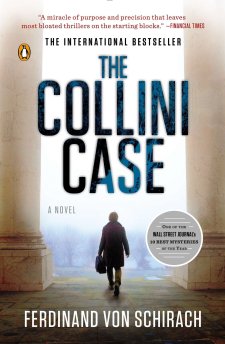
Opening line: Later, they would all of them remember it: the floor waiter, the two elderly ladies in the lift, the married couple in the fourth-floor corridor.

Ferdinand von Schirach is an eminent defence lawyer based in Berlin. He first came to prominence as a writer in 2009 with the short story collection Verbrechen (Crime), which drew heavily on the real-life cases he’d encountered during his career. It was an instant hit, spending 54 weeks at the top of the German bestseller lists, as well as critically acclaimed (the winner of the 2010 Kleist prize). A second short story collection entitled Guilt was also extremely successful, which was followed by the publication of The Collini Case, his first full-length crime novel, in 2011.

The focus on criminality, justice and the law is as evident in The Collini Case as it was in the author’s earlier works. It’s 2001 Berlin, and young barrister Caspar Leinen is assigned to defend an Italian national, Fabrizio Collini, the perpetrator in an apparently open-and-shut murder case at the famous Adlon Hotel. Only after accepting the brief does Leinen realise that he knew the victim, retired industrialist Hans Meyer: the latter was the grandfather of a close school-friend, who had been kind to Leinen in his youth. While considering whether or not he should continue to represent Collini, Leinen is faced with another problem: the accused refuses to reveal his motive for the crime. How then is Leinen to defend his client when the case comes to court? Leinen’s personal difficulties in representing Meyer’s murderer and his efforts to figure out a viable defence become the key concerns of the unfolding narrative.

Von Schirach is a skilled author who knows how to write an effective page-turner. But by far the most interesting aspect of this novel for me was the legal discussion portrayed in the courtroom section of the novel. And here I find myself in a rather difficult position, as talking about this aspect of the narrative would inevitably mean breaching Mrs. P.’s spoiler rule. So I will have to content myself by saying that the discussion of genuine points of law and their impact on a genuine set of cases since the end of the 1960s was fascinating, and is not something that I’ve seen addressed this way in a German crime novel before. 

The wider impact of the novel has also been quite extraordinary. The legal points it highlights have been raised by German MPs in the Bundestag, with a Ministry of Justice commission established in 2012 to examine the larger issues raised about legislative processes in the 1960s. It’s extremely rare for a crime novel to have such an influence in the ‘real world’, and this sets it apart from others that have tackled the same subject in a very special way.

I would second Maxine’s advice over at Petrona to read the novel before seeking out further information about the author and his work. But once you’re through, you might be interested in the following:

A Spiegel piece by von Schirach in English, in which he talks a bit about his unusual family background (thanks to Maxine for this link).

An interview with the author in German in the newspaper Die Zeit, which includes discussion about the judicial issue at the heart of the trial (contains spoilers!).

This Guardian article also draws on the interview in Die Zeit (contains spoilers!).

The comments on this post may also inadvertently hint at the novel’s content…

UPDATES

May 2013: The Collini Case has been shortlisted for the Crime Writers’ Association International Dagger Award.

And one last note: There’s extensive discussion of Bernhard Schlink’s The Reader in the comments below, which also has a courtroom section, as well as reference to Schlink’s crime novels (the ‘Selb’ series). In my capacity as an academic, I’ve written two articles on Schlink’s work, with links as follows… The first is a comparative analysis of the crime novel Selbs Justiz (which opens the ‘Selb’ series) and The Reader in the journal German Life and Letters (2006). The second looks at the controversies created in critical circles by The Reader, both in Germany and in the English-speaking world (German Monitor, 2013). It’s nearly twenty years since The Reader was published, and critical reaction to the novel and the film continues to be extremely polarised.

Creative Commons License