The end of BBC4’s The Killing: crime drama at its very best

Mrs Peabody’s review of the first two episodes is available here.

So BBC4’s The Killing has finished. Twenty hours of superb crime drama, which had 500,000 of us gripped for two hours every single week, aired its last two episodes last night.
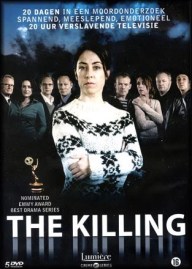
The Killing maintained its suspense and quality in a quite remarkable fashion over each of its 20 episodes. In Sarah Lund, it gave us a gritty, obsessive and sometimes flawed investigator, who won our hearts with her single-minded determination and her jumpers. And last night, it delivered a nail-biting and utterly gripping denouement that was Shakespearian in its tragedy and pathos. We ended, with perfect circularity, in the woods where we started Nanna’s story – one last, lovely touch. 

In line with the policy of Mrs. Peabody Investigates, no spoilers are given here. But if you would like to know whodunnit and to read some cogent analysis of the last two epiosodes, the place to go is Vicky Frost’s excellent blog at The Guardian. I might add that my guess at the murderer was completely wrong (and many others on Twitter had smugly got it right). At some point, I’ll be watching the whole 20 episodes again in the knowledge of who committed the murder – which I’m sure will be an equally rewarding viewing experience.

Lund and Meyer, we’ll miss you more than you’ll ever know. Already looking forward to Series 2 later this year.

31 March: Lund makes the cover of G2! Full article available here.

The last Wallander: UK publication of Henning Mankell’s The Troubled Man

Today sees the UK publication of Henning Mankell’s tenth – and final – Kurt Wallander novel, The Troubled Man.

Here’s the Vintage synopsis:

>> The first new Wallander novel for a decade, the culmination of the bestselling series from the godfather of Swedish crime.

Every morning Håkan von Enke takes a walk in the forest near his apartment in Stockholm. However, one winter’s day he fails to come home. It seems that the retired naval officer has vanished without trace.

Detective Kurt Wallander is not officially involved in the investigation but he has personal reasons for his interest in the case as Håkan’s son is engaged to his daughter Linda. A few months earlier, at Håkan’s 75th birthday party, Kurt noticed that the old man appeared uneasy and seemed eager to talk about a controversial incident from his past career that remained shrouded in mystery. Could this be connected to his disappearance? When Håkan’s wife Louise also goes missing, Wallander is determined to uncover the truth.

His search leads him down dark and unexpected avenues involving espionage, betrayal and new information about events during the Cold War that threatens to cause a political scandal on a scale unprecedented in Swedish history. The investigation also forces Kurt to look back over his own past and consider his hopes and regrets, as he comes to the unsettling realisation that even those we love the most can remain strangers to us. <<

The Daily Telegraph carries an exclusive extract – available here.

There’s also a nice piece in The Guardian, in which Jon Henley talks to Henning Mankell about The Troubled Man, the Wallander series, and looking back over life at 60.

Can’t wait to get my hands on it.

An odd case of Zen-o-phobia as BBC decides not to recommission TV series

I’ve just seen a post on the It’s a Crime (or a Mystery) blog reporting that the BBC has decided not to recommission the Aurelio Zen TV series. This really does seem to be a short-sighted move given its evident popularity. It seemed to grow on people over time as well – a slow burner that had the potential to turn into something significantly bigger. There’s still a chance that another channel will want to pick it up, but what a missed opportunity for the BBC, which has been showing such excellent taste lately with The Killing.  

How could anyone not want to recommission this stylish police investigator?!

For further details and links, see the post on It’s a Crime (or a Mystery). Lots of comments are being left there to encourage the BBC to reconsider. Do add your own if you feel moved to do so.

Germany meets Finland: Jan Costin Wagner’s Ice Moon

Things have (ahem) been somewhat biased towards Danish and Scandinavian crime fiction in the last few posts. So I’m trying to broaden my horizons by means of a German crime novel by Jan Costin Wagner. But wait…his wife’s Finnish and the book’s set in Finland? So much for weaning myself off Nordic crime.

First line: Kimmo Joentaa was alone with her when she went to sleep.

I hadn’t heard of Costin Wagner before, but really liked Ice Moon (Eismond), his second novel, which features the young Finnish policeman Kimmo Joentaa. The novel opens with the death of Joentaa’s wife after a long illness, and in many ways is a study of grief that happens to be woven into a murder investigation. Each of the victims has been smothered in their sleep, and Joentaa becomes fascinated by these ‘eerily tranquil’ killings, while trying to absorb the loss of his own wife.

The novel’s nicely written, with a characteristic Nordic feel, and the both the investigator and the murderer’s story are explored with sensitivity. The Independent on Sunday described the book as ‘intriguing and touching’, which is spot on. A lovely little read.

Ice Moon is published in translation by Vintage Books (2006), and you can read the first few chapters online here.

BBC4 buys second series of The Killing / Forbrydelsen

Excellent news for fans of The Killing: it’s been confirmed today that BBC4 has bought the rights to the second series (10 episodes) and that it will air later this year.

‘The Killing is the most intensely thrilling televison drama experience in British broadcasting of the moment and I’m delighted that series two will be on BBC Four. It is a diamond of a series – complex, dramatic, thoroughly gripping. It never loses sight of its truly brilliant insight: the humanity and the emotion that goes on behind a police investigation into a brutal and sordid murder. At its heart, this is The Killing‘s genius – to truly portray the human cost of tragedy. And it is to the BBC’s acquisition department that real credit lies for the clever discretionary spot-and-pick-up of a gem of a series’ – Richard Klein, controller of BBC4.

For full details, see Neil Midgley’s article in The Telegraph

Nick Cohen on BBC4’s The Killing (Standpoint Magazine)

Now that we’re over half-way through the first season of The Killing, and now that everyone’s woken up to just how extraordinary this series is, some really good articles about it are beginning to appear.

Nick Cohen’s piece in Standpoint, ‘Murder most mundane’, provides a nice analysis of why viewers might be drawn to The Killing, and to Scandinavian crime per se. The article’s also very good on the figure of Lund, and the way in which the series’ makers have successfully found ‘a middle way between the art-house and the multiplex by making an exciting drama about consequences rather than body counts; about how a murder can touch everyone caught up in a police investigation’.

Thanks to @PeterSmith for drawing this article to my attention.

Wishing you all a Happy St. David’s Day!

See full size image