#10 Dominique Manotti / Affairs of State

Dominique Manotti, Affairs of State, translated from the French by Ros Schwarz and Amanda Hopkinson (London: EuroCrime 2009 [2001]). A breathtaking exposé of political power games and corruption in 1980s Paris  4 stars


Opening sentence: Outside, it’s sunny, summer’s round the corner, but the offices of the RGPP, the Paris police intelligence service, are dark and gloomy with their beige walls, grey lino, metallic furniture and tiny north-facing windows overlooking an interior courtyard.

In one way, Affairs of State is less a crime novel than a tale of power and corruption, in which murders are inevitable as the stakes for political survival rise. In another, though, this is a crime novel through and through, in the sense that it dissects a bewildering range of criminal behaviour and leaves the reader looking at the world of politics through somewhat jaundiced eyes.

The spider at the centre of the web is François Bornand, a special advisor to the French President, who is guilty of all manner of corruption and decadence in the mid-1980s: the sinking of the Greenpeace ship Rainbow Warrior, lucrative arms deals with Iran, and a never-ending consumption of high-class call girls.

Bornand is the ultimate survivor, and when information about his illicit activities threatens to reach the press, he uses a maverick security unit based at the Elysée, the very heart of the French political establishment, to protect his empire. As the bodies pile up, the novel focuses less on the puzzle of who commits each crime (readers are privy to the identities of all the murderers), than on the investigative efforts of the police and intelligence service, who would like nothing more than to bring Bornand down. In the process, we are shown the fascinating journey of rookie policewoman Noria Ghozali, who starts out at the periphery of the investigation, but makes the crucial shift into intelligence work by the end of the novel. Like one of the murder victims, Ghozali is of Arab extraction, and her battle for acceptance within the police force and wider society allows Manotti to examine French attitudes to gender and race in an uncompromising and very effective way.

What’s particularly fascinating about the novel is how closely it dares to reference the reality of French politics in the 1980s. The original title of the novel is Nos fantastique années fric, or ‘our fantastic years of dosh’, and Manotti sets out to critique what she describes in her afterword as ‘this decade in which money came to represent, for an entire political class, an end and a value in itself’. Particular venom is reserved for the Socialists who came to power with Mitterrand and who ‘assumed and practiced their new religion with the zeal of neophytes’.  A professor of economic history in Paris, Manotti demonstrates an acute understanding of the corrupting influence of money in political life – and this is really the novel’s central theme. Bornand appears to be a composite of several politicians of the time, outwardly respectable but tainted by a Vichy past, and bears a particularly marked resemblance to one individual (as I learned from Véronique Desnain’s paper at the Belfast ‘States of Crime’ conference). Manotti sails remarkably close to the wind here, and I salute her bravery in doing so.

That having been said, there are elements of the narrative that are overly melodramatic, especially towards the end of the novel. But I suspect these are designed as symbolic indicators of corruption more than anything else – and they didn’t overly detract from the power of the narrative.

One lovely extra detail: it’s noted on the inside front cover that ‘this book is supported by the French Ministry of Foreign Affairs’!

 A film of the novel, entitled Une affaire d’État, was released in 2009.

Mrs. Peabody awards State of Affairs an intrigue-filled 4 stars.

#8 Karin Alvtegen / Shadow

Karin Alvtegen, Shadow, translated from the Swedish by McKinley Burnett (London: Canongate 2009 [2007]). A gripping psychological thriller, but one which tips over into melodrama at times  4 stars

Opening sentence: The key to the flat had arrived in a padded envelope from the police.

Karin Alvtegen’s Shadow immediately caught my eye with its rather intriguing opening. When 92-year-old Gerda Persson dies alone, estate administrator Marianne Folkesson visits her flat to glean the details of her life, and finds the freezer packed with signed copies of books by prize-winning author Axel Ragnerfeld. What on earth could have led Gerda to put them there? And what connection might they have to a young boy who was abandoned in an amusement park back in 1975?

So far so good: a literary puzzle that leads the reader into the dark heart of a family’s story – as well as that of a traumatised Holocaust survivor – and expertly keeps us wanting to know more. Well-written and gripping, and with a multi-layered, uncompromising ending, Shadow is in many respects a highly enjoyable read. In particular, I found many of the novel’s characters sensitively drawn, and their relationships described with a keen eye for psychological detail. Alvtegen is particularly good at exploring human weaknesses, and the kind of personal prisons individuals create for themselves without even realising what they are doing. Tracing the consequences of these weaknesses, and of the criminal decisions or actions they generate, are the novel’s great strength.

However … there was one element of Alvtegen’s story-telling that grated, namely a tendency to melodrama in the final third of the novel. There came a point where so many dramatic events were piled on top of one another that the narrative threatened to tip over into ridiculousness, and to undo the finely observed psychological detail of the rest of the novel.  This tendency also weakened the depiction of a couple of characters, whose actions at certain moments just didn’t ring true.

In spite of these reservations, I did enjoy the novel, and found that the questions it raised about life choices, trauma and morality lingered on. In particular, the ‘one last question’ on the final page of the book stayed with me for a number of days after closing its covers.

Mrs. Peabody awards Shadow a thoughtful 4 stars.

Trivia special, courtesy of @Petrona: Karin Alvtegen is the great-niece of Pippi Long-stocking author Astrid Lindgren. Petrona’s own excellent review of Shadow can be read on the Euro Crime blog (and contains a more detailed description of some elements of the plot).

.

#7 Jussi Adler-Olsen / Mercy

Jussi Adler-Olson, Mercy, translated from the Danish by Lisa Hartford (London: Penguin, 2011 [2008]). A bravura start to the Department Q series: powerful, gripping and moving in equal measure  5 stars

jussi-adler-olsen-mercy

Opening sentence: She scratched her fingertips on the smooth walls until they bled, and pounded her fists on the thick panes until she could no longer feel her hands.

On Friday 13th May, the author of Mercy joined John Lloyd, contributing editor on the Financial Times, to discuss his novel on BBC Radio 4. There was an entertaining clash of views: while Lloyd felt the book was ‘terribly, terribly, terribly dark’, Adler-Olsen thought Lloyd ‘completely wrong – it’s a very funny story in many aspects’. Having finished the novel today, I’ve come to the strange conclusion that they’re both right: Mercy will take you to the very darkest of places, while also somehow retaining the capacity to make you laugh out loud.

Mercy is the first in the ‘Department Q’ series, published in Denmark to great acclaim in 2008, and is the winner of a clutch of crime fiction prizes, including the Danish Reader’s Book Award. The novel introduces Copenhagen detective Carl Mørck, an outstanding investigator whose erratic behaviour following a traumatic shooting gets him kicked upstairs to lead the newly formed Department Q. Its remit: reopening and solving cold cases. Except being kicked upstairs actually means being kicked downstairs to a pokey office in the basement, without any investigative support other than chauffeur, cleaner and beverage-maker Assad.

The first case taken up by Mørck is that of rising Democrat politician Merete Lynggaard, whose sudden disappearance five years previously has never been satisfactorily explained. Everyone, including Mørck, assumes that she is dead. But is she?

Mercy is a beautifully constructed crime novel, weaving an account of Merete’s story since 2002 into Mørck’s investigations in present-day 2007. The movement between these strands creates a beguiling momentum that carries the reader forward in anticipation of the moment when – just maybe – the two narratives will intersect.

Merete’s tale is extremely dark and easily the most powerful part of the narrative: the crimes committed against her are horrifying, although the author manages to avoid the pitfall of crude misogynism through a compelling examination of how this young woman attempts to resist the powerful forces bent on her destruction.

The story of Mørck’s investigation into Merete’s case is lighter, in spite of his struggle with the trauma of a past shooting. Both his tussles with police colleagues and his developing relationship with Assad, an unlikely assistant sleuth with a few secrets of his own,  provide genuine moments of humour, although these are never allowed to interfere with the progression of a first-class police procedural.

Interestingly, I managed to work out the ‘solution’ to the mystery at the heart of Merete’s story quite early on. Even more interestingly, this didn’t matter to me in the slightest. Mercy was such a quality reading experience that my enjoyment of the text wasn’t remotely impeded. I’m already impatiently looking foward to the second novel in the series, Disgrace.

An extract from Mercy is available here. With thanks to Penguin for providing Mrs Peabody Investigates with a review copy.

Mrs. Peabody awards Mercy an outstanding 5 stars.

The end of BBC4’s The Killing: crime drama at its very best

Mrs Peabody’s review of the first two episodes is available here.

So BBC4’s The Killing has finished. Twenty hours of superb crime drama, which had 500,000 of us gripped for two hours every single week, aired its last two episodes last night.

The Killing maintained its suspense and quality in a quite remarkable fashion over each of its 20 episodes. In Sarah Lund, it gave us a gritty, obsessive and sometimes flawed investigator, who won our hearts with her single-minded determination and her jumpers. And last night, it delivered a nail-biting and utterly gripping denouement that was Shakespearian in its tragedy and pathos. We ended, with perfect circularity, in the woods where we started Nanna’s story – one last, lovely touch. 

In line with the policy of Mrs. Peabody Investigates, no spoilers are given here. But if you would like to know whodunnit and to read some cogent analysis of the last two epiosodes, the place to go is Vicky Frost’s excellent blog at The Guardian. I might add that my guess at the murderer was completely wrong (and many others on Twitter had smugly got it right). At some point, I’ll be watching the whole 20 episodes again in the knowledge of who committed the murder – which I’m sure will be an equally rewarding viewing experience.

Lund and Meyer, we’ll miss you more than you’ll ever know. Already looking forward to Series 2 later this year.

31 March: Lund makes the cover of G2! Full article available here.

Germany meets Finland: Jan Costin Wagner’s Ice Moon

Things have (ahem) been somewhat biased towards Danish and Scandinavian crime fiction in the last few posts. So I’m trying to broaden my horizons by means of a German crime novel by Jan Costin Wagner. But wait…his wife’s Finnish and the book’s set in Finland? So much for weaning myself off Nordic crime.

First line: Kimmo Joentaa was alone with her when she went to sleep.

I hadn’t heard of Costin Wagner before, but really liked Ice Moon (Eismond), his second novel, which features the young Finnish policeman Kimmo Joentaa. The novel opens with the death of Joentaa’s wife after a long illness, and in many ways is a study of grief that happens to be woven into a murder investigation. Each of the victims has been smothered in their sleep, and Joentaa becomes fascinated by these ‘eerily tranquil’ killings, while trying to absorb the loss of his own wife.

The novel’s nicely written, with a characteristic Nordic feel, and the both the investigator and the murderer’s story are explored with sensitivity. The Independent on Sunday described the book as ‘intriguing and touching’, which is spot on. A lovely little read.

Ice Moon is published in translation by Vintage Books (2006), and you can read the first few chapters online here.

#3 Davidsen / The Woman from Bratislava

Leif Davidsen, The Woman from Bratislava, trans. from the Danish by Barbara J. Haveland (London: Arcadia Books 2010 [2001]). An ambitious thriller that explores the legacy of the Second World War, but doesn’t quite live up to its early promise. 3 stars

The Woman from Bratislava (Eurocrime)

 Opening sentence: It was a story often used by security-cleared lecturers in the civilian branch of FET, by serving officers of a certain rank and other trusted members of PET when briefing new volunteers on the special conditions under which the secret services had to operate in a post-communist world.

As I’ve noted in a previous post, Davidsen has been described as ‘one of Denmark’s top crime writers’ (The Sunday Times). As a former journalist specializing in Russian and Eastern European affairs, he tends to use the crime/thriller format to explore larger political and historical issues – in the case of The Woman from Bratislava, the legacy of the Second World War, set against the backdrop of the Bosnian War and the collapse of communism in the 1990s.

More specifically, the novel uses the story of a rather unusual family as a means of approaching the complex history of Danish involvement in the Second World War. In the post-communist Bratislava of 1999, middle-aged Danish lecturer Teddy Pedersen is approached by Mira, an Eastern European woman who claims to be his half-sister. She reveals that their Danish father, a former Waffen-SS officer, had not died in 1952 as Teddy had been led to believe, but had gone on to lead a secret second life in Yugoslavia. Shortly afterwards, Teddy’s Danish sister Irma is arrested on suspicion of being a former Stasi (East German) agent, one who has possible links to ‘the woman from Bratislava’. The novel explores the father’s influence on the political development of both sisters – and via them the lingering legacy of fascism in post-war Europe. If you haven’t spotted it already, Irma and Mira are anagrams of one another, which I *think* is supposed to indicate how inextricably intertwined their fates are. Or something profound, at any rate.

This is a very ambitious novel, but one that I felt over-reached itself in places. Davidsen chooses to focus on an extremely controversial bit of Denmark’s wartime past, namely the role of thousands of Danes who fought for the Nazis as members of the Danish Legion and Waffen-SS. The author attempts to provide a 360-degree examination of this historical moment, highlighting on the one hand the war-crimes committed by these young Danes in the service of Nazi ideology, and on the other, the hypocrisy of the Danish government, who in 1941 ‘blessed’ their departure for war, only to treat them as ‘pariahs and outcasts’ when Germany was defeated in 1945 (p.100). (Denmark is shown white-washing its wartime history, recasting its years of occupation by the Germans as a period of heroic resistance, and developing a strategic amnesia to cover the less savory aspects of that past).

In some respects, I admire Davidsen’s bravery in taking on such a controversial subject, and in trying to provide a rounded discussion of how these ‘Nazi Danes’ should be viewed. But at times, I felt that the exploration of their actions needed to be more nuanced, and I wasn’t able to follow the reasons why certain individuals felt moved to defend the Waffen-SS father, or to consider his post-war treatment unjust. It’s possible that Davidsen is trying to critique these characters’ blindness to the father’s criminal wartime activities (a form of misguided love or loyalty), but I’m not entirely convinced that this is the case. At certain points, there’s also a casual, problematic elision of fascism and communism, which rather confusingly leads communist characters to exhibit fascist sympathies and/or sympathy for fascists.

As if all of this were not enough, there’s an overarching thriller/espionage plotline involving the downing of a NATO fighter plane over Yugoslavia, which ends in a (for me largely incomprehensible) twist. It was all a bit too much for this simple reader.

Summary: There’s much to admire about the ambition and scope of this thriller, but its constituent parts do not add up to a satisfactory whole. It may be best suited for readers with an interest in the legacy of the Second World War and the Cold War.

Mrs. Peabody awards The Woman from Bratislavia a rather wobbly 3 stars.

BBC4’s The Killing Series 1 – review of outstanding new crime drama from Denmark

I’ve just finished watching the first two episodes of the Danish crime drama The Killing on BBC4, and it’s so exceptional I felt I had to blog it straightaway.

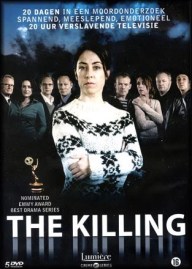
Forbrydelson / The Killing is an outstanding, powerful, grown-up drama that seeks to show not just the criminal investigation of a murder, but the devastating effect that the crime has on the victim’s family and friends. Part police-procedural, part family drama, part political drama, it chronicles a 20-day police investigation in 20 episodes, allowing for events to unfold realistically from different points-of-view. It’s extremely moving, particularly in its depiction of parental grief, with outstanding acting all round: I don’t mind admitting that I shed a tear or two (and as Mr. Peabody will tell you, this is a rare event indeed – I’m usually tough as old boots).

The police investigator in charge is Sarah Lund (played by the excellent Sofie Gråbøl), who is sucked into the case on what should be her last day before taking a new job in Sweden. What an absolute joy this character is: a confident, intelligent, nicotine-gum-chewing policewoman who is *extremely* good at her job. The camera often simply lingers on her looking / seeing / thinking things through / making links / understanding (a nod to the trope often present in hard-boiled crime fiction of the ‘power of the investigative eye’). The contrasts between Lund’s methods of investigation and those of her male co-investigator are highlighted throughout (sometimes to droll comedic effect): the implication is that the different policing styles are firmly gendered, and the ‘male’ style does not come off well at all. 

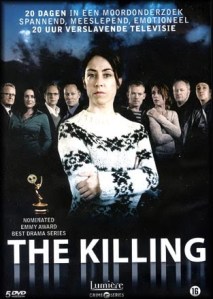
A small, but lovely detail is that Lund wears the same rather tatty-looking jumper throughout the first two days of the investigation (as seen above). Fashion statements are pretty much bottom of the to-do-list, which is extremely refreshing.

I haven’t seen a crime drama this powerful since watching the TV adaptation of David Peace’s Yorkshire Noir quartet – 1974 / 1977 / 1980 / 1983. I would highly recommend The Killing – it’s a significant cut above your average crime series, and was rightly lauded in Denmark where it first appeared in 2007. Fantastic Danish crime drama: who knew?

Well done (again) BBC4 – going great guns on international crime. Both episodes are available on iplayer: catch up while you have the chance and tune in next week for episode 3. I’ll definitely be there.

11 Feb: Rog has posted an audioclip of The Killing‘s theme tune (by Neptun) in the comments section below.

12 Feb: Tweet reviews

punkcinema1 – The Killing is brilliant TV. Best thing made by Denmark since Lego.

richvoorwerp – Imagine a 20 episode, complex, tightly scripted, beautifully acted, crime drama produced by British TV. The Danes can do it.

rosemarymaddy – Going to watch The Killing on BBC iplayer. If you haven’t seen it yet, and you like gritty, intelligent, crime drama, why not take a look?

If you’d like to leave a comment, please make sure there are no spoilers that might interfere with the enjoyment of others still catching up 🙂

Historical crime fiction: Sansom vs Eco

I hugely enjoy historical crime fiction, and so was looking forward to reading C.J. Sansom’s Dissolution (2008), which features the lawyer-detective Matthew Shardlake, working under Thomas Cromwell as the monasteries of England are dismantled by Henry VIII.

The reviews I’d seen of Sansom’s work were extremely good, and I was rubbing my hands in anticipation not just of a single book, but of a whole new crime series. But I found Dissolution a bit of a disappointing read. Not bad, by any means, but one that fell short of expectations (an illustration, perhaps, of how the overhyping of crime novels can backfire). I was hoping for richer historical detail, and felt that the depiction of Shardlake’s moral crisis, brought about by his realisation that Cromwell is less than a model of virtue, was rather weak. I guessed the murderer pretty early on as well (which of course is not necessarily a deal-breaker – just sayin’).

As I was reading, I was reminded of a classic historical crime novel: Umberto Eco’s The Name of the Rose, first published thirty years ago (yes really) in 1980.

This was no doubt triggered by the similar narrative framework of the two novels. In both we see the detective and his younger companion entering the enclosed, ritualistic world of the monastery, now transformed into a gruesome crime scene, with monks being picked off left, right and centre, and hints of devilish forces at work. In Eco’s work, though, it’s the young companion, the novice monk Adso, who narrates the tale many years after the events have taken place, rather than the detective in the historical present. Interestingly, Sansom is an admirer of Eco’s (see Guardian interview), and has clearly drawn on aspects of the earlier novel for inspiration when writing his own.

For me, The Name of the Rose leaves Dissolution in the dust, in terms of its depth and erudition, its status as a novel of ideas, and its fabulous evocation of a past time – in this case, of medieval Europe. And I love that Eco, an Italian professor of semiotics, is said to have written The Name of the Rose just to show everyone that he could. Write an international best-seller? Non c’è problema!

There’s a good profile of Eco and his works here.

Of course, it’s possible that my lack of enthusiasm for Dissolution is a reflection (ahem) of my own critical shortcomings. Am I missing something here? Does the series get better as it goes along? Willing to give the Shardlake novels another go if the case is made persuasively enough…

#1 Indridason/The Draining Lake

Arnaldur Indriđason, The Draining Lake (London: Harvill Secker, 2007 [2004]). Wrap up warm for a chilly Icelandic police procedural. 5 stars

Although this 2004 novel is written by an Icelander and set in Reykjavik, it’s firmly indebted to the classic Swedish police procedural. Detective Inspector Erlendur Sveinsson can be viewed as a third-generation representative of the Swedish police investigator, following in the footsteps of Sjöwall and Wahlöö’s Martin Beck, and Henning Mankell’s Kurt Wallander. Morose, cynical and consumed with self-doubt, these policemen have become progressively more embattled and isolated with each generation. In Erlendur’s case, he’s forced to question the extent to which his absence as a father is responsible for his daughter’s slide into a drug addiction – one the novel describes in sober and hard-hitting detail.

The draining lake of the title is Lake Kleifarvatn, whose mysteriously receding waters reveal an old skeleton weighed down with a heavy Russian radio device. As Erlendur and his team begin the painstaking process of investigating this strange find, they are transported back to an era of international espionage and political unrest during the Cold War, whose consequences can only now be fully understood.

Two things lift this crime novel a cut above the average police procedural. The first is the fascinating insight the novel gives into the Cold War period, and in particular, the experiences of young, idealistic, Icelandic communists who were offered the opportunity to study in East Germany in the 1950s. The second is the sensitive treatment of the theme of ‘the missing’ and of the impact that losing someone without knowing his or her final fate can have on the individual.

A number of the characters, including Erlendur, have lost someone close to them, and the novel is haunted by their many absences. While some eventually learn what happened to their loved ones, others are not so fortunate. They, and crucially the reader, are left without an adequate resolution to the story of these disappearances, a deliberate omission that adds tremendous power to the narrative. Thus, while the central murder is solved, other aspects of the plot are left open, questioning the notion that a case can ever be fully solved. We might know who the murderer is, and understand what motivated them, but the void left by ‘the missing’ remains.

The Draining Lake is well written, enjoyable and thought-provoking: a first-rate, multi-layered crime novel. Erlendur is a welcome and worthy successor to Beck and Wallander, and the novel’s Icelandic setting adds a beguiling and unusual dimension to the chilly subgenre of dark, Nordic crime.

The novel is the 4th in the ‘Reykjavik murder mystery series’, and in my view, it’s the best so far.

Mrs. Peabody awards The Draining Lake a mighty 5 stars