#20 Malla Nunn / A Beautiful Place to Die

Malla Nunn, A Beautiful Place to Die (London: Picador, 2010). An intriguing debut novel set in 1950s South Africa as apartheid is taking hold 4 stars
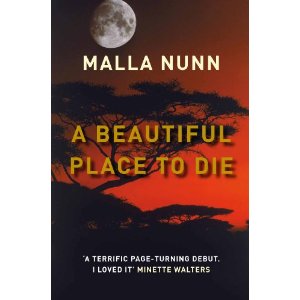
 Opening sentence:  Detective Sergeant Emmanuel Cooper switched off the engine and looked out through the dirty windscreen.

I’ve been looking for a good crime novel to sink my teeth into, and this one stood out from the crowd as I was browsing online recently. A Beautiful Place to Die is the debut crime novel by Malla Nunn, an Australian-based but Swaziland-born author, and is the first of the Emmanuel Cooper series, set in 1950s apartheid South Africa. It was awarded the Australian ‘Sisters in Crime Davitt Award for Best Adult Crime Novel’ and was shortlisted for the American Edgar Awards (‘Best Novel’ category).

The book opens in September 1952 with the discovery of a murdered police captain, Willem Pretorius, in a river by the South African settlement of Jacob’s Rest, near the Mozambique border. Detective Emmanuel Cooper is called in to investigate, and soon realises that the case is extremely sensitive, as Pretorius is a well-connected Afrikaaner within the powerful National Party movement, and Security Branch investigators are poised to take political advantage by framing a black communist for the crime. It quickly becomes clear that getting to the bottom of this murder will place a number of individuals, including Cooper himself, in a great deal of danger.

For me, the great strength of this novel was the way it used the crime narrative to illustrate the socially divisive and destructive effect of the racial segregation laws, introduced by the Nationalist government from 1948 onwards. Cooper, who served in Europe during the Second World War, notes despondantly that ‘eight years after the beaches of Normandy and the ruins of Berlin, there was still talk of folk-spirit and race purity out on the African plains’. Ironically, apartheid was gearing up for four decades of oppression at practically the same time as German fascism in Europe was defeated.

The novel convincingly captures the tensions apartheid generates within Jacob’s Rest, as well the inevitable tangles that its simplistic racial categorisations bring about: the dedicated Volk ideologue who furtively thinks of himself as part-Zulu; fair-skinned children of black and white parents who ‘pass’ illegally as whites; illicit liasons between white men and black women that fall foul of the Immorality Act because no law can successfully control desire. The novel also has interesting points to make about the gendered power-dynamics of interracial relationships, and the limited options open to black women being pursued by white men.

While I felt the first half of the book was extremely well-written, with a tremendous sense of place, portions of the second half dipped substantially for me, mainly because the plot became too melodramatic for my taste. In spite of this I still find myself keen to read the second book in the series, due to the depiction of Cooper (a complex, well-drawn investigative figure negotiating a repressive regime), the novel’s successful portrayal of 1950s South Africa, and the fact that the novel lingered in my mind for many days after I’d turned the final page.

The second novel in the series, Let the Dead Lie, was published in 2011. The publisher’s synopsis is available here.

Mrs Peabody awards A Beautiful Place to Die a slightly wobbly but fascinating 4 stars.

Creative Commons License
.

Edinburgh City Libraries: map of international crime fiction

Courtesy of a retweet by @eurocrime, I happened to see a link to a lovely resource provided by Edinburgh City Libraries via their blog Tales of One City. It’s an interactive map of international crime fiction, entitled, in a stroke of undoubted genius, ‘Around the World in 80 D.I.s’.

Clicking on the map in the post takes you through to a Google-powered world map with 80 book covers sprinkled across it. You can either click on the book of your choice to find out more about it, or browse by country/city and sleuth in the column on the left-hand side. Aside from the usual Scandinavian suspects, novels from less obvious countries are featured such as Laos, Mongolia, Algeria, Greece and Kenya (at least, these are less familiar to me). And it’s great to see that they’ve included some classics as well, like Friedrich Glauser’s Swiss ‘Studer’ novels, written in the 1930s, along with more contemporary writers such as French author Fred Vargas.

Diane Wei Liang's The Eye of Jade: set in Beijing and one of the crime novels featured on the map.

What a wonderful initiative, and a fine example of the kind of contribution our libraries can make in opening up the world of literature to everyone … for free.

14 March 2012  Thanks very much to Maxine for pointing me in the direction of another international crime map, this time from Bitter Lemon Press. Another wonderful resource, and one that readers are invited to add to with further suggestions, providing a whole extra level of interactivity!

#19 Maurizio de Giovanni / I Will Have Vengeance

Maurizio de Giovanni, I Will Have Vengeance: The Winter of Commissario Ricciardi, translated from Italian by Anne Milano Appel (Hersilia Press, 2012 [2007]). An intriguing debut novel featuring the mournful Commissario Ricciardi  4 stars

 Opening sentenceThe dead child was standing motionless at the intersection between Santa Teresa and the museum.   

I Will Have Vengeance: The Winter of Commissario Ricciardi was originally published in 2007 and is the first in a series featuring Luigi Alfredo Ricciardi, Commissario of Police with the Regia Questura di Napoli in 1930s Italy. The series has already been translated into French, Spanish and German, and its fourth installment (Il giorno dei morti / The Day of the Dead) won the prestigious Premio Camaiore in 2011.

Given its setting in the Naples of 1931, nine years into Mussolini’s rule, I expected this book to be an interesting but fairly conventional historical crime novel. From the opening line, however, it’s made clear that this text offers readers something different – an investigative figure able to see the dead and hear their last anguished utterances, which (in some cases) can be used to shed light on the manner and cause of their death.

Opting to employ this kind of narrative device is exceedingly risky and difficult to pull off. However, de Giovanni selects just the right style and tone to allow the reader to suspend disbelief, one that I found a little reminiscent of magical realist authors such as Isabel Allende:

“He saw the dead. Not all of them, and not for long: only those who had died violently, and only for a period of time that revealed extreme emotion, the sudden energy of their final thoughts. He saw them as though in a photograph that captured the moment their lives ended, one whose contours slowly faded until they disappeared” (p. 12).

Ricciardi’s daily exposure to the turbulent emotions of the dead leaves him an introverted, isolated and damaged individual, who is watched over by devoted family servant Rosa at home and by Brigadier Raffaele Maione at work. The original title of the novel, il senso del dolore (which can be translated as ‘a sense of sorrow’ / ‘a sense of pain’), could apply equally to the sorrow radiating from the departed and to its effect on Ricciardi. His is an interesting, nuanced character, imbued with an appealing stoicism when handling a ‘life sentence’ (p. 12) of receiving messages from the restless dead.

So can I Will Have Vengeance also be viewed as a historical crime novel? In many respects, yes. Mussolini’s fascist regime is mentioned very early on, and the social framework within which Ricciardi has to operate is visible throughout the text. For example, Ricciardi is shown musing on the regime’s attitude to crime, which supposedly does not exist within ordered fascist society: ‘No crime, only safety and well-being dictated by the regime. So it was ordained, by decree. Yet the dead kept vigil in the streets, in homes, demanding peace and justice’ (p.99). He is also shown having to manage a demanding superior, Vice Questore Garzo, who is loyal to the regime, albeit for personal gain rather than due to ideological conviction.

However, unlike other crime novels featuring investigators working within repressive regimes, such as Philip Kerr’s Bernie Gunther (Nazi Germany), Tim Robb Smith’s Leo Demidov and William Ryan’s Alexei Korolev (Stalin’s Russia), there is no sustained examination of the moral difficulties encountered by a policeman working in the service of the state and of the political dangers he might face. Ricciardi appears to be largely apolitical, is shielded by his record as an outstanding investigator, and does things ‘his way’ with relative ease when investigating the murder of renowned tenor Maestro Vezzi (a wonderfully drawn character, whose case will delight opera buffs). It will be interesting to see if this portrayal of Ricciardi remains the same in subsequent books within the series, or whether he is shown becoming embroiled in sticky political situations further down the line.

In sum: this is a very enjoyable read, which expertly fuses elements of the historical crime novel with a distinctive, other-worldly dimension, courtesy of its police investigator’s highly unusual abilities. I look forward to reading the other novels in the series soon.

The first chapter of the novel is available on the Hersilia Press website.

With thanks to Hersilia Press for providing me with a proof copy to review.

Mrs Peabody awards I Will Have Vengeance an entertaining, ghostly 4 stars.

Creative Commons License
.

BBC4: Inspector Montalbano returns!

This Saturday, following the end of the excellent Danish political thriller Borgen, BBC4 returns to international crime in the shape of Andrea Camilleri’s The Snack Thief, starring Sicily’s Commissario Salvo Montalbano.

I’ve had my differences with the Camilleri novels in the past due to their rather dated representation of women (see my review of The Terracotta Dog), and have to confess that I haven’t got on particularly well with the TV adaptation either (is it just me or has some of the novels’ humour been lost?). But I know there are lots of fans out there who will be delighted to see Montalbano back on our screens in the form of actor Luca Zingaretti. This episode was the first to be made back in 1999, and has not yet been aired in the UK.

Montalbano (second from left) and his handsome team

If I had the chance, I would definitely sneak a peek at Camilleri’s Sicily, if only to escape our current cold-snap. But by the time the episode airs, I will be in an even chillier Berlin, where I’m lucky enough to be spending the week. Tschüss for now!

The Snack Thief airs on Saturday 11 February at 9pm.

UPDATE: Series 2 of Montalbano (12 episodes) will begin on BBC4 on Saturday 25 August 2012 at 9pm. See The Radio Times for further details. With thanks to Rhian for alerting me to this information 🙂

#18 Jan Costin Wagner / The Winter of the Lions

Jan Costin Wagner, The Winter of the Lions, translated from German by Anthea Bell (London: Harvill Secker, 2011 [2009]). The third novel in the beguiling Kimmo Joentaa series. 4 stars

 Opening sentence:  Kimmo Joentaa had been planning to spend the last hours of Christmas Eve on his own, but it didn’t turn out like that.

I was given a copy of The Winter of the Lions by my lovely brother for Christmas (following a sisterly nudge in the right direction) and it proved to be the perfect festive read, as the novel’s action begins on 24th December and ends on New Year’s Eve. The evocative cover, with its snowy Finnish birches, also made the novel an attractive winter gift.

Regular readers to this blog will know that I’m a firm fan of of the Kimmo Joentaa series, which, intriguingly, is set in Finland but is authored by a German whose wife is Finnish. The novels are suffused with nordic melancholia, and are in large measure a study of grief, as the first novel, Ice Moon, opens with the death of Detective Joentaa’s young wife. Thus, while each book contains a discrete police investigation, collectively they trace the arc of Joentaa’s grief and the slow process by which he comes to terms with his loss. The Winter of the Lions, set around three years later, sees him embarking on a fragile and rather unconventional new relationship with a women he meets through his duties as a policeman.

One of the big strengths of the series is its focus on the characters within the police team, in a way that’s reminiscent of Scandinavian writers such as Sjowall & Wahloo and Mankell. Joentaa isn’t the only team member with problems, and there are some very human depictions of individuals trying to juggle the demands of their professional lives with the stresses and strains of life beyond the office. In this novel, however, the team also has to deal with the collective trauma of one of their own being murdered. Forensic pathologist Patrik Laukkanen is found dead on a snowy cross-country ski trail in the forest, the victim of a frenzied knife attack. Soon afterwards, another man is found stabbed, and when the link between the two victims is established it proves to be a strange one: both were guests on the popular Hamalainen talk show. As the front cover tantalisingly points out, ‘careless talk costs lives’…

As in previous Joentaa novels, sections of the narrative are written from the murderer’s point of view, and we gradually build up a picture of their character and the circumstances that have led them to commit their crimes. The murderer in The Winter of the Lions is portrayed with sensitivity and a degree of sympathy, although the consequences of his/her crimes for the families of the victims are also carefully spelled out. Here, again, trauma and grief are key themes, and as in Ice Moon, there are some intriguing similarities between the murderer and the investigator whose job it is to track him/her down.

I enjoyed The Winter of the Lions almost as much as the previous two Joentaa novels (although I missed the presence of Ketola, Joentaa’s former boss), and will certainly be back for more. At the end of this third book, I realise that the value of the series lies less for me in the plot or investigative process and more in the novels’ use of the crime genre to explore human reactions to death, trauma and loss. Melancholy and beguiling, these novels are a wintry treat of the highest order.

For other Mrs P. posts on the Joentaa series see Ice Moon and Silence.

The first few chapters are available via the Random House website.

Incidentally, Silence was made into a German film in 2010 (entitled Das letzte Schweigen [the final silence]. You can see the trailer here, which looks great and makes wonderful use of the Finnish *summer* landscape (for a change). It’s in German, but don’t let that put you off!

Mrs Peabody awards The Winter of the Lions a snow and vodka fuelled 4 stars.

Creative Commons License
.

#17 Sam Hawken / The Dead Women of Juárez

Sam Hawken, The Dead Women of Juárez (London: Serpent’s Tail, 2011). An outstanding crime novel set in the corrupt Mexican border city of Juárez, infamous for its high rate of ‘feminicidios’ (female homicides)  5 stars

 Opening sentence:  Roger Kahn wrote, ‘Boxing is smoky halls and kidneys battered until they bleed,” but in Mexico everything bled in the ring.

The Dead Women of Juárez is one of those crime novels that transcends genre and can be thought of, quite simply, as an excellent piece of writing. Set in the Mexican border city of Juárez, just across from El Paso, Texas, it draws on the legacy of American writers such as Hemingway to explore in succinct, precise, but highly evocative language the brutalising nature of life in Juárez, and the violence and corruption that pervade its politics and policing.

Ciudad Juárez is arguably the perfect place to set a crime novel, given its dubious real-life distinction of being the murder capital of the world. But Hawken chooses to focus on one specific group of the city’s murder victims, namely the 400 women killed there since 1993, and the estimated 3000 (that’s three thousand) women who have simply disappeared and are presumed dead – the victims of sexual attacks and ‘femicide’.

The novel explores the abject failure of the authorities to deal with the feminicidios, and the toll that the murders take on the women’s families, from the perspective of two highly damaged individuals: Kelly Courter, a washed-up American boxer reduced to the role of punchbag for talented younger fighters in the ring, and Raphael Sevilla, a narcotics investigator jaded from his many years on the police-force, who is hiding a serious drink problem. The link between the two is Paloma Esteban, Courter’s on-off girlfriend, the sister of a local drug dealer Sevilla is trying to nail, and a campaigner for the group Mujeres Sin Voces (Mothers without Voices), which seeks justicia (justice) for Juárez’s victims of femicide. When yet another woman goes missing, Courter and Sevilla find themselves drawn into an investigation that will radically change both of their lives.

As well as being a hard-hitting crime novel, and a scathing critique of power, corruption and misogyny, The Dead Women of Juárez offers readers an eye-opening depiction of contemporary Mexican society, whose impoverished majority endure punishing and poorly-paid working conditions in the maquiladoras – factories that turn out consumer goods for American companies. While only a stone’s throw away from America, the workers of Juárez may as well inhabit a different planet, given the disjunction between their lives and those of more affluent U.S. citizens living a few miles away. On another level, the novel also functions as a study of failed masculinity, through the symbolic figure of the boxer who undergoes a series of highly bruising rounds with life. The characterisation of Courter is superb, as is that of Sevilla, and the novel is worth reading for these two nuanced and very human portraits alone.

I especially like the way this book openly identifies itself as a campaigning crime novel (one of its key sources is Teresa Rodriguez’s journalistic study The Daughters of Juarez). In his afterword, Hawken states that his aim was to ‘shine a light on these femicides’ and the state’s failure to respond adequately to the epidemic of violence against women. Only a handful of cases have ever reached court, which is extraordinary given the scale of the murders and disappearances. (Imagine for a second how we would feel if the same were happening in the British city of Birmingham, which like Juárez has a population of around one million people…). An additional problem is that the murders have been overshadowed by the drug wars in the area, in spite of the work carried out by Amnesty International  and women’s groups such as Voces sin Echo (Voices without an Echo) and Las Mujeres de Negro (Women in Black). Hawken emphasises the importances of securing justice for the women before the law (providing an interesting contrast to the way that justice is depicted in the narrative), and his novel is a great example of how the crime genre can be harnessed to raise awareness of real crimes and miscarriages of justice.

The Dead Women of Juárez was shortlisted for the CWA New Blood Dagger 2011, which means that this highly accomplished piece of work is – remarkably – Sam Hawken’s debut novel. Beautifully written and with a tremendous sense of place, it stands head and shoulders above many others in its field. Along with Ernesto Mallo’s Needle in a Haystack and Jussi Adler-Olsen’s Mercy, it is one of my stand-out crime novels of the year.

Mrs Peabody awards The Dead Women of Juárez a superlative 5 stars.

Creative Commons License
.

Vikas Swarup’s Six Suspects (India)

Vikas Swarup, Six Suspects (London: Black Swan 2008). The crime novel as vehicle for a darkly humorous and highly critical portrait of modern India. 

 Opening sentence: Not all deaths are equal. There’s a caste system even in murder.

For the first time this blog travels to India, as part of a concerted effort to broaden its transnational criminal horizons.

Six Suspects is the second literary offering of Vikas Swarup, who hit the international jackpot when his highly-praised first novel, Q&A, was adapted for film as the phenomenally successful Slumdog Millionaire (eight Oscars and numerous other accolades). Not bad for a book that was written in a mere two months.

Six Suspects is a rather unusual crime novel. While drawing heavily on the conventions of classic detective fiction (there’s a murder, a drawing room of sorts, and the eponymous set of suspects), Swarup uses the genre primarily for satirical purposes, providing the reader with a darkly humorous and often scathing critique of modern India.

The suspects – a bureaucrat, a Bollywood actress, a thief, a politician, an American tourist and a tribesman from the Andaman Islands – are selected for the spectrum of perspectives they offer on contemporary Indian society, and allow Swarup to explore his key themes of political corruption, power and class in an uncompromising fashion (pretty daring given his day job as a member of the Indian civil service; currently Consul-General of India in Osaka-Kobe, Japan).

Much of the novel is taken up with tracing the life stories of the suspects and the motives that they might have had for killing Vivek ‘Vicky’ Rai, a disreputable thirty-two-year-old businessman and playboy, who also happens to be the son of the powerful Home Minister of Uttar Pradesh. In contrast, relatively little emphasis is placed upon the process of investigation: the role of detective is played in part by Arun Advani, a journalist renowned for exposing corruption and injustice, but he only features significantly at the beginning and the end of this chunky 557-page text.

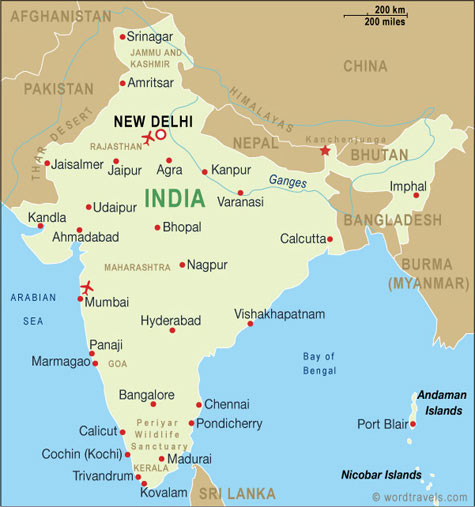
I found Six Suspects very enjoyable in a number of respects. As someone who has visited India in the past, the novel’s evocative descriptions of the sights and sounds of everyday life, and the huge disjunction between rich and poor rang very true. The novel also travels widely around India, beginning and ending in Delhi, but taking in other locations such as Srinagar, Jaisalmer, Varanasi, Kolkata and the Andaman Islands on the way (the latter are a remote and very beautiful group of islands in the Bay of Bengal that ‘belong’ politically to India, and which are home to ethnic tribes such as the Onges and Jarawa). The novel thus takes readers on a wide-ranging geographical and cultural journey which will be highly rewarding for those with an interest in India.

Another hugely enjoyable aspect of the novel is its biting satirical humour, and its witty nod to Salman Rushdie and magical realism (I particularly liked the possession of a grumpy, philandering ex-politician by the spirit of Mahatma Gandhi).

On the minus side, I felt the novel was a bit overlong and that its depiction of some characters and incidents was too exaggerated to be effective in the larger context of Swarup’s satire. As a result, the narrative felt rather uneven at times, and while I remained admiring of the author’s ambitious use of the crime genre to create a satirical portrait of India, I wasn’t sure that he’d completely succeeded in his aim when I closed the book for the final time.

I discovered Six Suspects at our city library, which has a superlative collection of crime fiction. If you’d like to read an extract from the novel, you can do so here on the author’s website.

The Kindle and the criminally inclined

I recently treated myself to a shiny new Kindle – half gleefully and half guiltily due to the size of the initial outlay (although with the added justification of helping to keep the beleagured British economy afloat). While not completely convinced of the merits of owning one, I felt it was the right time to give an e-reader a go, especially as previous generations of Kindle buyers have so considerately helped to iron out the early technological and design flaws. 

I’ve had the Kindle for a week now, and am gradually learning to appreciate its benefits. As a crime reader, I consume a huge amount of books, and one big plus is that the Kindle will help keep my bookshelves from collapsing in the too-near future. I’m also finding reading on it a pleasant and user-friendly experience (especially as one can customise the appearance of the type to suit one’s aging eyes). But best of all, I’ve been able to widen the scope of my reading through opportunistic scavenging for bargain crime. Gems have come my way through the Kindle Daily Deal, while others are simply waiting to be found in the course of browsing. There’s some very good stuff out there that costs very little, and because they’re so reasonably priced, I’m willing to take a flyer on novels I might not otherwise try – which is no doubt the idea. In any case, it’s having the effect of allowing me to broaden my horizons and to fill in the gaps for good authors I’ve missed to date. So far I’ve snapped up low cost (or even free) crime from the US, Norway, Iceland and the UK, and now have a nice range of different types of novels stored on the Kindle to suit different types of crime-reading mood.  

One of my bargains...

That’s not to say that I’ll ever give up the wondrous paper book. I’ll continue to buy crime in indie and charity bookshops, as I’ll always love the feel of a book in my hand, especially when having a nice hot bath at the end of a long working day. That’s one advantage the Kindle will never have – and that’s quite OK by me.

#15 Valerio Varesi / River of Shadows

Valerio Varesi, River of Shadows (Il fiume delle nebbie), translated from the Italian by Joseph Farrell (London: Maclehose Press 2011 [2003]). An atmospheric crime novel set against the backdrop of flooding in the Po Valley, and introducing Commissario Soneri  3.5 stars

 Opening sentence:  A steady downpour descended from the skies.

Given that Italy is currently in the headlines courtesy of Berlusconi’s imminent resignation, it seems fitting to review an Italian crime novel (I also happened upon an Inspector Zen novel in a charity shop today, so this week has become a bit of an Italian affair).

Valerio Varesi’s River of Shadows was shortlisted for the 2011 CWA International Dagger, and in most respects, is an enjoyable, quality read. The novel is set in the Po Valley of northern Italy, and offers a fascinating insight into the boatmen’s communities that work the Po river (if your knowledge of geography is as scanty as mine see here for further context; there’s also a helpful little map at the front of the book).

The novel has a tremendous sense of place, as its evocative cover suggests. The opening chapter describes the drama of the river’s rising floodwaters after four days of rain, and the strange disappearance of an experienced, but unpopular boatman named Anteo Tonna. When another man with the same surname falls from a window of the local hospital, Commissario Soneri is determined to establish a connection between the two, and the motivation for what he believes is a double murder. However, he soon comes up against the silence of the tightknit community of boatmen, led by the communist Barigazzi, who are unwilling to discuss their complex relationship with the missing man, one compromised by the murky politics of the fascist past.

I loved the atmospheric feel of this novel, the detail provided about life on the water, and the way the symbolism of the river was woven into the crime narrative (the rising floodwaters coincide with the violent deaths of the Tonnas, while the falling waters help to reveal the truth behind the case). Commissario Soneri is an astute and engaging investigative figure, and his interviews with various intriguing river dwellers, such as ‘Maria of the sands’, are nicely portrayed.

But there was one element of the novel I found highly irritating, namely the characterisation of Soneri’s girlfriend Angela, a one-dimensional, sex-mad fantasy figure who is averse to any kind of conventional commitment. Aside from being laughable, her presence undercuts the depiction of the otherwise professional Commissario. For example, I find it hard to believe that a policeman so committed to solving the case would consent to using a crime scene for an erotic rendevouz!

Readers of my previous posts will know that I’ve taken exception to the depiction of women in Italian crime fiction before (see my comments on Ingrid in Camilleri’s The Terracotta Dog). There does seem to be a pattern emerging, and I can’t help but wonder if these kinds of highly stereotyped representations of women are characteristic of Italian crime fiction in a way that they are not, say, for most Scandinavian crime novels. My impression is that male Italian crime writers tend to write for a male audience that expects its crime fiction to have an erotic dimension. However, in my view the latter doesn’t do the central crime narrative any favours (and I say this not out of primness, but because it’s so badly done!).

I will reserve judgement until I have read some further examples of Italian crime, and am actively on the lookout for a novel that proves my theory wrong. If anyone can point me in its direction I would be very grateful…

Mrs. Peabody awards River of Shadows an atmospheric 3.5 stars (one star deducted for its tedious representation of women).

Creative Commons License
.

#14 Christian von Ditfurth / A Paragon of Virtue

Christian von Ditfurth, A Paragon of Virtue (Mann ohne Makel), translated from the German by Helen Atkins (London: The Toby Press 2008 [2002]). An intriguing crime novel which sees historian turn detective to help solve a murder with links to the Nazi past  4 stars

A Paragon of Virtue

Opening sentence:  The pain shot into his left knee.

Christian von Ditfurth is a German historian turned crime writer, whose debut novel, A Paragon of Virtue, was a best-seller in Germany and forms the first of the successful ‘Stachelmann series’ (currently six novels).

Part police procedural and part PI mystery, the novel divides its investigative duties between Ossi Winter, a detective with the Hamburg police, and his old friend Josef Maria Stachelmann, a historian at Hamburg University whose area of expertise is the Third Reich. It’s ultimately Stachelmann’s archival research that will prove decisive in solving the murders of a property dealer’s wife and two children, whose deaths have taken place at yearly intervals since 1999 – he’s both a detective of history, piecing together a forgotten past through archival clues, and a detective who uses those clues to solve a present-day crime. In the process, Stachelmann becomes the historical guide of a post-war Hamburg police force with scant knowledge of its Nazi past. As he educates Ossi and his colleagues about police complicity in Jewish deportations and the seizure of Jewish assets, the reader is given a sobering insight into the criminal activities of the Nazi state.

This is a highly interesting novel, set at the turn of the new millennium when a reunited Germany was (once again) examining its relation to the Nazi past. Stachelmann’s position on this issue is made very clear: we’re told he’s the author of a study entitled Forgetting and Repressing, which is critical of post-war Germany’s lack of engagement with National Socialist history. Unsurprisingly, the big theme of the novel is justice for the crimes of the past, and it’s one that’s problematised throughout the narrative: what form should post-war justice take; to what extent, if at all, has justice been done in the decades since the war; can any form of justice ever truly be considered adequate? These questions are most fully explored in the sections told from the murderer’s perspective: to a significant degree, the novel evolves into a ‘whydunit’, with the murderer’s motivation increasingly at the forefront of the narrative.

The narrative zips along at a good pace and deploys its two contrasting detective figures well. My only reservation is the characterisation of Stachelmann, who was rather irritating at times: his regular bouts of self-pity and neurotic tendencies are rather overplayed, and would have benefited from some judicious editing. On the other hand, the author’s integration of complex historical material into the crime narrative deserves praise: the information given about the operations of the Nazi state is illuminating but never feels too much like a history lesson.

I’m very interested by the fact that von Ditfurth, as a historian, has chosen to disseminate information about the Nazi era in his capacity as crime author. It would be easy to be cynical and suspect purely monetary motives (it’s still very much the case that ‘Nazis sell’), but I do think that such writers also have a genuine educative aim, and see the crime narrative as an ideal vehicle for the discussion of the criminal activities of the Nazi regime or other repressive states (Tim Rob Smith’s Child 44 also springs to mind here). The original German novel has been reprinted seventeen times, and will therefore almost certainly have had more readers than academic studies on the period, which are far less accessible (in both senses of the word) than popular fiction.

The translation into English was supported by a grant from the Goethe-Institut, which suggests that the text is seen as having historical and cultural value. The author’s website (in German) is available here. A short excerpt in English is available here.

Two other Stachelmann novels engage with the legacy of the German past, but have yet to be translated into English. They are Lüge eines Lebens (Lifelong Lie, 2008) and Labyrinth des Zorns (Labyrinth of Rage, 2009), the fourth and fifth novels in the series.

Mrs. Peabody awards A Paragon of Virtue a slightly wobbly, but very interesting 4 stars.