The Theakston Files

I’m just back from four days at the Theakstons Old Peculier Crime Writing Festival, which, as ever, was a wonderful mixture of interviews, panel discussions and a crime-writing knees-up.

Our first evening was very special: we saw Colin Dexter, creator of the Inspector Morse series, honoured with the Outstanding Contribution to Crime Fiction award, and ‘tartan noir’ writer Denise Mina win the Crime Novel of the Year Award for her ‘hugely atmospheric and haunting book’, The End of the Wasp Season.   

Scene of the crime: the ‘chalk outline’ and ‘blood splatter’ that greeted us on arrival at Harrogate Station

As ever, there were a bewildering number of fascinating and (in some cases controversial) sessions to attend over the following three days. Karen from Euro Crime was spotted quietly tapping away on her laptop in the audience, and her notes on a variety of events, including ‘America’s Got Talent’, ‘Writing for Your Life’, ‘Drawing the Line’, ‘Crime in Another Dimension’, and the John Connolly interview are available here. Many thanks, Karen!

This lucky blogger was given the chance to interview four outstanding crime writers –Arne Dahl (Sweden), Camilla Läckberg (Sweden), Stuart Neville (Northern Ireland) and Jason Webster (UK/Spain) – and also had interesting chats with authors Liza Marklund (Sweden), Margie Orford (South Africa) and Antonio Hill (Spain). Norwegian publishing sensation Jo Nesbø‘s wide-ranging discussion with Mark Lawson completed a very satisfying festival that showcased the best of international crime fiction.    

I’ll shortly be posting a series of ‘Theakston Files’ (a nod there to one of my favourite TV detectives), with interview transcripts and notes from the Nesbø session. Hope you enjoy!

Theakstons Old Peculier Crime Writing Festival 2012

I’ll be setting off early tomorrow morning to the lovely spa-town of Harrogate for the Theakstons Old Peculier Crime Writing Festival (19 – 22 July).

The programme is packed with all sorts of wonders, but I’ll be focusing in particular on the wealth of international crime writing talent taking part, including British writers who set their works beyond the UK.

These include the following (and many, many more…)

Harlan Coben (America)

Arne Dahl (Sweden)

Antonio Hill (Spain)

Ryan David Jahn (America)

Camilla Läckberg (Sweden)

Laura Lippman (America)

Liza Marklund (Sweden)

Deon Meyer (South Africa)

Stuart Neville (Northern Ireland)

Margie Orford (South Africa)

Jo Nesbø (Norway)

Jason Webster (England / Spain)

For those of you keen to hear news from the festival as it unfolds, I’ll be tweeting as @Mrs_Pea68, using the hashtag #TOPcrime2012

If you’re at the festival, perhaps see you in Betty’s or at the bar!

Jo Nesbø – upcoming film adaptations

A recent issue of Film3Sixty magazine carries an interesting feature on two upcoming film adaptations of Norwegian crime author Jo Nesbø’s work.

These follow the phenomenal success of 2011’s Headhunters, adapted from Nesbø’s standalone novel of 2008, which was memorably described by Philip French of The Observer as moving ‘with the speed of a demented lemming heading for the cliff-edge of a fjord’.

Oslo-based director Magnus Martens has completed production on Jackpot (based on a Nesbø storyline), which is due for release on 10. August 2012. Martens says in the Film3Sixty piece that his adaptation channels the black comedy of the Coen brothers and films such as Fargo (a comparison I’ve heard from some viewers of Headhunters as well).

And acclaimed American director Martin Scorsese is adapting The Snowman, the seventh in the Harry Hole series, first published in 2007. This will be the first English-language adaptation of one of Nesbø’s books and is being made in conjunction with the British production company Working Title Films.

Nesbø will be appearing at the Theakstons Crime Writing Festival in Harrogate on 22 July (very exciting).

For a recent New York Times article on Nesbø, see here.

Review of Branagh’s Wallander: Episode 1, Series 3 – ‘An Event in Autumn’

I’ve just finished watching Episode 1 of the new Wallander series, ‘An Event in Autumn’, which got proceedings off to a hard-hitting and occasionally heart-stopping start.

It all begins so well! Wallander and his girlfriend have just moved into their dream home together, a fresh start designed to allow him to ‘leave work at the door’. He’s so happy he even smiles! Then Jussi the dog finds a skeleton under the blackberry bushes in the garden and it’s all downhill from there: the corpses pile up, there are scary encounters in poorly lit locations, and the icy winds of winter begin to blow. In sum: the classic, gloomy Wallander we know and love.

I do like Branagh’s Wallander very much (and isn’t Mankell fortunate to have found three such wonderful actors over the years to realise his creation?). The quality of the production, as in earlier series, is extremely high, and is undoubtedly anchored by Branagh’s performance, which allows us a privileged insight into the strengths and weaknesses of Wallander’s character. The frequent, beautiful shots of chilly beaches and bleak landscapes reinforce his nordic / melancholic loneliness perfectly.

For those of you interested in the theme music, it’s by Emily Barker & The Red Clay Halo, and is called ‘Nostalgia‘.

I’m already looking forward to seeing the second episode, ‘The Dogs of Riga’, next week. I’ll be intrigued to see how they adapt a novel originally set during the collapse of communism in the early 1990s.

The Crime Writers’ Association Awards 2012

Last night, the CWA awards for 2012 were announced in London.

Two of the categories were of particular interest to me as a fan of international crime fiction. Firstly (and most obviously), the CWA International Dagger, whose shortlist included three novels from Italy, and one from Norway, Sweden and South Africa respectively. Secondly the CWA Ellis Peters Historical Dagger, whose shortlist featured the Italian crime novel I Will Have Vengeance by Maurizio de Giovanni (Hersilia Press) and Philip Kerr’s Prague Fatale (Quercus), set in Nazi Germany.

The Historical Dagger shortlist was also interesting in terms of highlighting a shift away from  ‘historical crime fiction’ set in the distant historical past (such as Ellis Peters’ famous ‘Brother Cadfael’ series) to crime fiction engaging with twentieth-century history (all but two of the shortlisted novels are set following 1930).

And the winners are…..*drumroll*

CWA International Dagger: The Potter’s Field by Andrea Camilleri               (trans. by Stephen Sartarelli and published by Mantle)

The judges said ‘Camilleri’s Montalbano novels show just how much can be achieved with familiar materials when a writer conveys the sense of life in a recognizable place. He combines characters, plots, and reflections on Italy’s particular social and political problems with wry—but never bitter—satire. In this novel the late-afternoon shadows lengthen; Montalbano is feeling his age.’

Further information about the winner and the other shortlisted novels can be found on the CWA website here.

CWA Ellis Peters Historical Dagger: Icelight by Aly Monroe                              (published by John Murray)

The judges were unanimous in their decision to award Icelight the Historical Dagger, commenting that “this tale of British post-war malaise, the third of Monroe’s Peter Cotton thrillers, is authentically downbeat yet absolutely gripping. Monroe has the young le Carré’s ability to conjure atmosphere and a poetic style worthy of Len Deighton.”

Further information about the winner and the other shortlisted novels can be found on the CWA website here.

Many congratulations to all the CWA winners and I hope everyone had a great night!

#24 / Jim Thompson, The Killer Inside Me

Jim Thompson, The Killer Inside Me (London: Orion, 2006 [1952]). A hard-hitting noir crime novel, whose complex and disturbing portrait of a killer will linger in the mind 5 stars

Opening line: I’d just finished my pie and was having a second cup of coffee when I saw him.

Every now and then, you encounter a crime novel you know you have to read straight away. So it was with Jim Thompson’s classic 1952 American noir The Killer Inside Me, which made it from the Waterstone’s bookshelf to the nice lady at the till and into my eager hands in the space of five minutes.

Lou Ford is Deputy Sheriff of Central City, Texas, population 48,000. While outwardly affable and well-liked, it’s clear from the beginning of his narrative that he’s not all he seems. Lou is suffering from a ‘sickness’, a psychopathic disorder that has lain dormant for a number of years, and his carefully constructed identity as a good-natured and none-too-bright ‘rube’ is designed to render him invisible within mainstream society. When Lou’s ‘sickness’ is reactivated by a chance encounter with prostitute Joyce Lakeland, he’s soon drawn into a series of violent crimes, fuelled by a complex mixture of revenge for past wrongs, his love-hate relationship with a certain ‘type’ of woman, and, increasingly, self-preservation. As suspicions about Lou begin to surface within the community, the novel charts his increasingly desperate attempts to keep control of the unravelling situation and himself.

Thompson creates a powerful first-person narrative that admits the reader into a killer’s highly-disturbed mind, and deftly traces the complexities of its warped logic and self-deceptions. At the same time, the narrative provides a detailed and (for the time) remarkably daring analysis of the origins of Lou’s condition, asserting that nature and nurture have both played a role. The reader is even provided with a clinical diagnosis at the end of the novel, complete with a supporting quote from the work of German psychiatrist Emil Kraepelin, which reiterates this point. While not qualified to judge if the diagnosis offered is medically correct (it may well not be 60 years on), I found the narrative’s refusal to conform to the ‘mad and bad’ model one would expect from 1950s fiction extremely impressive, given the unenlightened attitudes to mental health issues prevalent at the time. One radical suggestion put forward by the novel is that labelling certain types of sexual practice as deviant or shameful won’t help to eliminate them from society, but will cause a severe and damaging backlash instead (the ‘return of the repressed’ writ large). Sexually conservative attitudes and social hypocrisy are figured as a partial cause of Lou’s condition and the behavioural choices he makes in adulthood – an amazingly bold critique to make of small-town America at any point, let alone in the early 1950s.

Thompson deals brilliantly with the challenge of managing the reader’s reactions to the narrator-as-murderer, creating just enough redeeming features to avoid a reductive, one-dimensional portrayal, whilst avoiding the pitfall of generating too much empathy for him or excusing his crimes. It’s an extraordinary authorial feat, one that a lesser writer would not pull off.

The novel was adapted for film in 2010 with Michael Winterbottom directing and Casey Affleck in the main role. It received mixed reviews and generated controversy due to its graphic depiction of violence towards women. I’ve not seen it yet, but can imagine adapting such a book would be hugely tricky, especially when so much of the narrative’s complexity is communicated via Ford’s distinctive first-person voice.

Clearly, The Killer Inside Me will not be everyone’s cup of tea, given its hard-hitting and explicit content. However, if you’re interested in the classics of the genre and haven’t read this novel yet, it could be one for you.

A biography of Jim Thompson is available here.

Mrs. Peabody awards The Killer Inside Me a highly thought-provoking 5 stars.

Creative Commons License

.

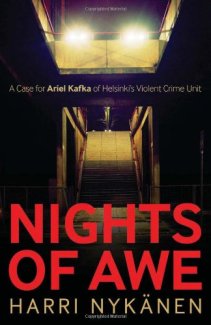
#23 / Harri Nykänen, Nights of Awe

Harri Nykänen, Nights of Awe, translated from the Finnish by Kristian London (London: Bitter Lemon Press, 2012 [2004]). The first in a new series featuring Finnish-Jewish police inspector Ariel Kafka 4 stars

Opening line: Men are born, they live, and they die.

Ariel Kafka, a detective in Helsinki’s Violent Crime Unit and one of only two Jewish policemen in Finland, is called to investigate the deaths of two Arabs in the Linnunlaulu area of the city. As the case unfolds over the Days of Awe, the ten days of repentance leading up to Yom Kippur, Kafka is faced with the unwelcome possibility that the crimes have a Jewish dimension, in the shape of Israeli / Mossad involvement.

The main strength of this Finnish crime novel for me was the wonderfully realised and very likeable investigative figure of Ariel Kafka. Nykänan succeeds in creating a rounded first-person narrator with a distinctive Finnish-Jewish voice (surely a first), which draws entertainingly on the wise-cracking archetype of the hard-boiled detective. The following quote illustrates how nicely these elements are blended together:

‘It wasn’t the first time I had been asked this question [You’re Jewish and you’re a cop?]. People seemed to have a strong belief that Jews have some secret, Old Testament-based motive for not joining the police force. In reality there was only one reason: the lousy pay.’ 

Nykänen, a former crime journalist, uses the narrative to explore Kafka’s triple identity as Finn/Jew/cop, and the tensions generated when these different elements come into conflict with one another. We’re also given a strong sense of the Jewish community in Helsinki (there are around 1500 Jews currently living in Finland), and its efforts to uphold Jewish traditions. The novel reminded me a little of the Rabbi Small series in its descriptions of Jewish life and religious debates (such as the question of  whether women should be accepted as part of the minyan – the quorum necessary to allow public worship). There are also interesting reflections on the way that the legacy of the Holocaust has shaped individuals and families, and the difficulties that ‘diasporic’ Jews have taking a position in relation to the politics and actions of the Israeli state.

Intriguingly, as a Jewish Chronicle article by Jenni Frazer reveals, Nykänen is not himself Jewish, but carried out extensive research for the novel, including discussions with Dennis Paderstein, a Finnish-Jewish chief inspector in Helsinki. The author views the Finnish-Jewish community as being ‘very small, but important’, and in many ways the novel is a celebration of its continued existence.

Less successful, perhaps, is the novel’s rather convoluted plot, which lost me in a number of places as the body count rose, although it did make a kind of sense in the end. In spite of this weakness, I would gladly read others in the series. There are apparently three more (Ariel and the Spiderwoman, Behind God’s Back and Holy Ceremony), which have already been translated into German. Hopefully, more English translations will follow soon.

Mrs. Peabody awards Nights of Awe a slightly flawed but highly entertaining 4 stars.

See also my earlier post on an intriguing trio of Jewish detectives.

Creative Commons License

.

Spiral 2 and ‘Romanzo Criminale’

Following the Sebastian Bergman two-parter, BBC4 will be repeating series 2 of Spiral (Engrenages) from this Saturday, 9 June, at 9.00pm. It looks like there will be two episodes each week, following the pattern of The Killing, Borgen and the like.

For those catching up, there’s a nice little review in the Radio Times to set the scene.

Spiral: gritty and urban, innit?

While looking around the website, an Italian crime series that aired back in October 2011, but is being repeated on Sky Arts 1, also caught my eye. Romanzo Criminale (‘Crime Novel’) has been styled as an ‘Italian Killing’ (pure hype, as the two series are completely different to one another), but I must say that I like the look of it, especially given its interesting historical and political setting.

70s mobster chic means looooaads of wonga

Amy Raphael describes the series in her Radio Times article as follows:

‘Set in Rome between 1977 and 1992, Romanzo Criminale has been an Italian television sensation, based on the exploits of a real-life criminal street gang.

La Banda della Magliana was a mob of fearless, ultraviolent suburban youths, who became, in the words of judge [and author] Giancarlo de Cataldo, “a real criminal power”.

De Cataldo’s novel [on La Banda] was first made into a film, but the television series that followed has aired in Italy to rapturous acclaim. One broadsheet called it “perhaps the best series ever made in Italy”, while another insisted that “it’s the only Italian series of which we can be proud… that we can export abroad”.

Opening in 1977, the drama is sharply written, beautifully shot, funny, violent and political. These were Italy’s “years of lead” when student protesters fought the police and the Red Brigades tried to destabilise the country. It’s a compelling backdrop for a series that’s brutally honest about Italy’s bloody criminal past.’

Has anyone already seen the series, and if so, what did you think of it?

Sebastian Bergman: Review of Episode 1 (with a little word on Episode 2)

Today I managed to catch up with the first installment of the Swedish crime series Sebastian Bergman, which originally aired last Saturday on BBC4. My expectations were pretty low having viewed a dire trailer made by the German broadcaster ZDF (see my earlier comments here), but happily, ‘The Cursed One’ turned out to be a decently-made, entertaining 90 minutes of crime.

The key investigative figure, Professor Sebastian Bergman, is a renowned Swedish profiler of unpleasant disposition: he’s tetchy, uncooperative, and a serial seducer of vulnerable women. Although we find out the main reason for this behaviour, he remains a troubled and rather unlikable figure, and is nicely portrayed by the actor Rolf Lassgård (well known to Henning Mankell fans as the ‘first’ TV Wallander). 

The opening episode shows Bergman inching back into policework after an extended break, following the brutal murder of a 15-year-old boy. The investigation proceeds at a brisk pace (we work through as many suspects as in the whole of The Killing 1 by the end of the first hour), uncovering a number of suburban secrets on the way. The denouement is reasonably satisfying, although I couldn’t help but be amused at how wide of the mark Bergman’s perpetrator profiling had been. 

In sum: a good start with some potential, should the relationship between Bergman and his police colleagues be allowed to develop more. There’s a nice little twist at the end that augers well.

Update on 8 June: I’ve just caught up with Episode 2, and wasn’t quite as enamoured as many people seem to have been on Twitter. As this blog’s readers will know, I’m not a fan of serial killer narratives / misogynist violence, so points had to be taken off from the word go. In addition, the development of the plot felt wholly predictable… Would I watch more Sebastian Bergman if it came to our screens? Probably, but it won’t be at the top of my list of Saturday night treats.

Saturday treats: Sebastian Bergman / CWA International Dagger / Israeli crime fiction

Three little treats on this lovely sunny day in the UK.

1. For fans of Swedish crime and of Wallander actor Rolf Lassgård: the ‘police thriller’ Sebastian Bergman begins tonight on BBC4 at 9pm. See the second half of this earlier post for an overview and trailer.

Photo from BBC/ZDF

2. CRIMEFEST 2012 – the annual International Crime Fiction Convention – is in full swing in Bristol this weekend. While extremely sad to be missing the party, I’m enjoying tweets on the various panels from @Eurocrime and @NicciPrasa amongst others. The hashtag for the event is #crimefest12.

Thrillingly, the CWA (Crime Writers’ Association) shortlists for the following ‘Daggers’ were announced there last night: International, Historical, Non-Fiction, Library, Short Story and Debut. Thanks to Rhian over at ‘It’s a Crime! (Or a Mystery…)’ for a comprehensive listing of all the works shortlisted.  

There are 6 works listed for the International Dagger (‘crime, thriller, suspense or spy fiction novels which have been translated into English from their original language, for UK publication’):

The Potter’s Field by Andrea Camilleri, trans. by Stephen Sartarelli (Mantle)
I will have Vengeance by Maurizio de Giovanni, trans. by Anne Milano Appel (Hersilia Press)
Until Thy Wrath Be Past by Åsa Larsson, trans. by Laurie Thompson (Quercus/Maclehose)
Trackers by Deon Meyer, trans. by T K L Seegers (Hodder & Stoughton)
Phantom by Jo Nesbø, trans. by Don Bartlett (Harvill Secker)
The Dark Valley by Valerio Varesi, trans. by Joseph Farrell (Quercus/Maclehose)

Further details about the novels are available via the CWA website here.

And over at Petrona, you’ll find a list of all International Dagger winners since 2006, along with a wealth of links to reviews and CWA webpages (thanks, Maxine, for this excellent resource).

3. A guest post on Israeli crime fiction by Uri Kenan at the ‘Detectives Beyond Borders’ blog caught my eye this week. For someone like me, who knew nothing about the history of crime fiction in Israel, it was a very illuminating read. I’m already looking forward to part 2, which I imagine will look at more contemporary offerings.

Peter Rozovsky, who runs the blog, is also at CrimeFest at the moment, and has already posted three reports, which are well worth a read

I hope the sun is shining for all of you wherever you are: have a lovely weekend.