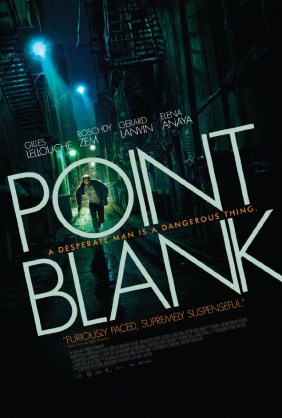
French thriller Point Blank on BBC4 – Saturday 31 August

French crime thriller Point Blank airs tomorrow, Saturday 31 August, in the 9.00pm international crime slot on BBC4. This one has had a number of favourable reviews (Empire gave it 4 stars), and looks to be 80 minutes packed full of heart-stopping action and suspense.

You can see a trailer for the film on the Radio Times website (although I’m not usually a fan of hostage/countdown scenarios, I have to admit it does look very good).

The Radio Times synopsis reads as follows: ‘Violent strangers threaten to kill the pregnant wife of Paris hospital employee Samuel Pierret unless he smuggles out an injured patient in this blisteringly exciting crime thriller from director Fred Cavayé (Anything For Her). Rugged Gilles Lellouche is perfect as the Hitchcockian “Wrong Place, Wrong Time, Wrong Man” whose life spirals out of control as he is drawn into a web of police corruption and murder in high places.’

And … here’s a lovely bit of news: Sergio over at the fabulous Tipping My Fedora blog has nominated Mrs. Peabody Investigates for a WordPress Family Award.

I’m touched and honoured – thank you, Sergio! – as the award celebrates what I most value about blogging: the global ‘family networks’ that our interactions in the virtual world create. I have to say, in spite of our rather bloody-thirsty interests as crime fans, that the crime blogging community is a particularly warm, welcoming and friendly one!

The idea with this award is that recipients nominate another 10 other WordPress blogs. But given that I’d nominate lots of the same blogs as Sergio and my fellow nominees (could get very confusing), I’ll just point you to the blogroll on the right of this page, which will lead you to all kinds of criminal delights. Enjoy!

At last! BBC4’s international crime slot gets back into gear

I don’t know about you, but I feel like I’ve been waiting forever for the BBC to deliver on its March 2013 crime press release. While Arne Dahl has aired, three new series (Inspector de Luca, Young Montalbano and The Bridge 2) and two stand-alone films have yet to be shown.

Finally, after a summer of Wallander and Sebastian Bergmann repeats, it looks like things are starting to move. This Saturday – 24 August – will see the showing on BBC4 of the 2010 Norwegian film The King Of Devil’s Island (9.00 to 10.50pm). The film, originally titled Kongen av Bastøy, is based on a true story, and explores Norway’s treatment of youth criminality in the early twentieth century. 

Here’s the BBC blurb: ‘The King of Devil’s Island (dir. Marius Holst) tells the unsettling tale of a group of young delinquents banished to the remote prison of Bastøy, Norway, in 1915. Under the guise of rehabilitation the boys suffer a gruelling daily regime at the hands of the prison governor (Stellan Skarsgård), until the arrival of new boys Erling and Ivar (Benjamin Helstad and Magnus Langlete) sparks a chain of events that lead to rebellion’. I last saw Skarsgård in the film version of Mamma Mia. Something tells me this will be a very different kind of role.

A short review of The King of Devil’s Island and programming details are available at The Radio Times.

I’m not sure when the outstanding series will be aired, as the BBC keeps its cards notoriously close to its chest – hopefully we will know more soon. For those who can’t wait, here’s a trailer for The Bridge 2 from Swedish broadcaster SVT, which looks brilliant. No subtitles needed. Thanks to @AndyLawrence5 for sending this my way.

#40 / Ioanna Bourazopoulou, What Lot’s Wife Saw (first review of Greek crime!)

What Lots Wife Saw

Ioanna Bourazopoulou, What Lot’s Wife Saw, translated from the Greek by Yannis Panas (Edinburgh: Black and White Publishing, 2013 [2007])  4.5 stars

Opening line: Perhaps reality is but a mass delusion, thought Phileas Book, watching the waves of the Mediterranean Sea breaking against the concrete quays of Paris.

Well! I was hoping for something a bit different when I opened this book, and it certainly didn’t disappoint. Winner of the 2008 Athens Prize for Literature, What Lot’s Wife Saw is a dazzling, hybrid crime novel that takes readers on an extraordinary journey of the imagination.

The novel is set in the future, twenty-five years after The Overflow, a tsunami that destroyed large portions of southern Europe, and whose cause was the eruption of a highly addictive violet salt through the Dead Sea Rift. The harvesting of this valuable commodity at a remote ‘Colony’ is now controlled by the mysterious Consortium of Seventy-Five, but when the operation is placed in jeopardy following the suspicious death of the Colony’s Governor, an expert is asked to help investigate.

And this is where things get really interesting. The expert is Phileas Book, who works for The Times newspaper compiling Epistlewords, a new kind of three-dimensional crossword shaped like a Greek meandros or key pattern, which uses fragments of letters (and the ways in which their ‘soundhues’ interact with one another) as clues. For this reason, Book is asked to inspect six letters from inhabitants of the Colony who were close to the Governor, in the hope that he will be able to ‘detect’ the truth of what happened. Along with Book, we are given access to the letters, and invited to take up the role of investigators, by comparing and contrasting the accounts of these rather dubious individuals, and trying to sift the truth from what may well be a tissue of lies. The six letter-writers are Bernard Bateau, Presiding Judge; Andrew Drake, Captain of the Guards; Montague Montenegro, Orthodox Priest; Charles Siccouane, the Governor’s Private Secretary; Niccolo Fabrizio, Surgeon General; and Regina Bera, the Governor’s wife. All have secrets that they would rather not share…

What I’ve said so far doesn’t even come close to conveying the richness of the narrative, which manages – don’t ask me how – to combine a re-imagining of the biblical tale of Sodom and Gomorrah with a critique of multinationals and totalitarianism. From a literary perspective, the novel feels like a slightly bonkers mash up of Thomas Pynchon (think the tour de force that is Gravity’s Rainbow), Agatha Christie (won’t say which one) and The Usual Suspects (super-stylish narrative construction). Really.

If you’re looking for an easy read, then put this book to one side for now. But if you’re in the mood for a challenging, vividly imagined and highly original crime novel with plenty of chutzpah and heart, then this one could be for you. A compelling read that’s perhaps a little too long in the middle, but is redeemed by a bravura ending, What Lot’s Wife Saw will stay in my mind for a while to come.

Mrs. Peabody awards What Lot’s Wife Saw a staggeringly inventive 4.5 stars

With thanks to Black and White Publishing for sending me an advance copy of this book.

Creative Commons License

.

Canadian reading pleasures 2

Now back from three lovely weeks in Canada, I can confirm that British Columbia – or at least the fraction we saw of its expanse (four times that of the UK) – is breathtakingly beautiful. We divided our stay between Vancouver and Vancouver Island, with lots of time spent on ferries, water-taxis and seaplanes, and my abiding memory will be the blue of the seascapes and the American Olympic mountains to the south.

Evening view from the Vancouver Island ferry as it threads its way through the Gulf Islands

In my previous post I mentioned Munro’s Books, a famous bookshop in Victoria on Vancouver Island.  Thanks to a tip from Cathy Ace, the Welsh-Canadian crime novelist, I subsequently found my way to Chronicles of Crime, a mystery bookshop run by Frances Thorsen on Fort Street. If you’re a crime fan and are ever in Victoria, you MUST visit this wonderful bookshop, which is an absolute treasure-trove and an excellent place to meet other crime aficionados. Frances also ships overseas (time to sit on the credit card)…

Chronicles of Crime. The armchair in the foreground is very comfortable

I spent a couple of happy hours browsing the bookshelves, which are helpfully and imaginatively categorised.

Yes please!

As a tourist, I obviously made a beeline for the Canadian section, and picked up some reading to help me get a feel for different parts of this vast country.

Copyright Lonely Planet

Louise Penny’s Bury the Dead (2010) – Quebec City, Quebec (on the lower right of the map).  This is the sixth instalment in the acclaimed Inspector Gamache series, and provides a fascinating insight into the tensions between French and English-speaking parts of Canada. Set during a freezing winter in the heart of old Quebec, the novel has a great sense of history and place, and Gamache is a well-drawn investigative figure. However, with three major plot-lines, I felt there was too much going on in the narrative, and the writing style grated in places. I’m new to the series, and might benefit from going back to earlier books.  

Anthony Bidulka, Amuse Bouche (2003) – Saskatoon, Saskatchewan (left of centre on map). I very much enjoyed this first novel in the Russell Quant series, whose highly engaging P.I. (‘cute, gay, with a nose for good wine and bad lies’), is based in the city of Saskatoon in the Canadian plains. I’ll definitely be chasing up the other Quant novels in due course. 

Stanley Evans, Seaweed on the Street (2005) and Seaweed on Ice (2006) – Victoria, Vancouver Island, British Columbia (far left on map). These novels were the find of the trip for me. I’d not heard of the author before, who started writing this series in his seventies (there’s hope for us all yet). Set in downtown Victoria and in the coastal areas surrounding the city, it features Silas Seaweed, a Coast Salish (First Nations) neighbourhood cop, whose investigations illuminate the traditions of Canada’s aboriginal communities and the difficulties they face in modern life. Well-written and with a wry sense of humour, they capture Victoria perfectly and were a pleasure to read while staying there. The second novel, Ice, which opens with the disappearance of an elderly Jewish immigrant, can also be added to my research database – a happy bonus.

So now I feel like I’ve made a modest start on Canadian crime fiction, although there’s clearly much more work to be done! I’ll be browsing the Crime Writers of Canada website, which has a wealth of useful resources, for more in the near future. I think I’ll start in the Canadian crime novels by region section…

Canadian reading pleasures

A quick hello from sunny Victoria in British Columbia, Canada.

Yesterday we popped into Munro’s, a rather famous local bookshop, which has a wonderful selection of homegrown and international crime fiction.

I picked up the following treat, featuring Chief Inspector Armand Gamache, which promises to tell me all about the history of French-speaking Quebec…

…and will read it somewhere like this…

…while keeping an eye out for these… 🙂

Criminally good summer treats

First of all, a HUGE THANK YOU to those who took part in last week’s survey and got that kitten tally so high. The result was a phenomenal 188 responses, and I’m incredibly grateful to you for taking the time to help me out. I now have lots of lovely and interesting data to collate, and will share the findings with you in due course.

Now then… Mrs. Peabody will be taking a bit of a blogging breather for a few weeks, as we’re off to the land of Mounties, Moose and Molson to meet some far-flung family. I’m looking forward to finding out a little more about the Canadian crime fiction scene while we’re there as well.

No national stereotyping here, eh?

I have, of course, been stocking up on some summer treats to take along on the journey. Here’s a selection of the novels I’ll be reading, hopefully with a view of the Pacific and a cool drink in my hand.

Anya Lipska’s Where the Devil Can’t Go, a highly-praised debut set in London and Poland. The author is on the ‘New Blood panel’ at the Theakstons Old Peculier Crime Writing Festival at Harrogate on Saturday 20 July (along with Derek B. Miller, author of the wonderful Norwegian by Night). I’m extremely sad that I can’t make it this year, especially as there’s also a panel devoted to German Krimis, winningly entitled ‘Dead in Deutschland’…

Yrsa Sigurdardottir’s Ashes to Dust, the third of the Icelandic Thóra Gudmunds-dottir series. I’ve picked this one because it’s partly set in the 1970s, my favourite decade, and I’ve not read any of this author’s novels before (shocking I know).

Geoffrey McGeachin’s The Diggers Rest Hotel, which won the 2011 Ned Kelly Award for best crime fiction novel, and is the first in the Charlie Berlin series. Set in rural 1947 Australia, it looks to have an interesting take on the legacy of the Second World War. The novel is featured in one of Margot’s Kinberg’s ‘In the Spotlight’ posts, which provides a lovely overview.

Before I head off, here are two additional treats for you:

Word reaches me from Raven and Euro Crime that five more Foreign Bodies episodes are airing on BBC Radio 4 this week. This time the focus is on Greece (Markaris/Haritos – see my post on the author here), Argentina (Mallo/Lascano – my review of Needle in a Haystack is here), Northern Ireland (McGilloway/Devlin), South Africa (Meyer/Griessel), and on female crime drama investigators (Miller/Lund/ Berthaud). If you happen to miss any, they are available online for seven days. It also looks like the first series is being repeated from Monday 15 July.

Last but not least, this week’s ShortList features The 39 Greatest Maverick Cops. I’m not sure I agree with all of their rankings or analysis, but there are some good ones in there, including some storming women.

Wishing you all wonderful, relaxing summer days.

Your blogger needs you! Can you spare 5 minutes for Mrs. P?

This week, in place of my usual post, I’m going to ask you for some help.

If you’re a regular visitor to ‘Mrs. Peabody Investigates’, or even if you just drop by every now and then, would you mind filling out a short, anonymous survey on the blog? Pretty please? It has just nine questions, and mainly involves ticking boxes.

THE SURVEY IS NOW CLOSED 🙂

The survey is linked to my day job as a UK academic: we’re exploring the impact of our research beyond a university audience, for example in blogs or in the media. And your opinion really counts – whether you’re a reader, blogger, publisher, translator, author, bookseller or anything else to do with the wonderful world of crime!

In return, I offer you oodles of gratitude and this picture of an adorable kitten. I’ll be adding an extra kitten for every 10 people who take the survey…

No, not a kitten. Walnut whip reward by special request 🙂

Cute bunny by special request

Puppy from dooziedog.com *melts*

By special request: otters holding hands 🙂

THANK YOU!

#39 / D.A. Mishani, The Missing File (first review of Israeli crime!)

D.A. Mishani, The Missing File, translated from the Hebrew by Steven Cohen (London, HarperCollins 2013 [2011])  4 stars

Opening line: Across the desk from him sat a mother.

The reviews I’ve read so far of this novel, while pleased to see a contemporary Israeli crime novel in translation, have given it rather a cool reception. Although I’d be the first to admit that The Missing File is not perfect, I wonder if it deserves some extra praise for the profound comment it makes on the processes of detection and interpretation, and the implications of those processes for securing (or not securing) proper justice.

The setting for the novel is the small city of Holon, where the author grew up, which was established in the 1930s on sand dunes a few kilometers south of Tel Aviv and has a very suburban feel. Here we’re introduced to Inspector Avraham Avraham of the Israeli police, as he listens somewhat wearily to a mother reporting the disappearance of her sixteen-year-old son at the end of a long shift. That disappearance predictably turns into a major missing persons case, with potentially serious implications for Avraham’s career.

Original cover of The Missing File

Pretty much the whole of the novel – aside from a bizarre and largely redundant interlude in Belgium – is devoted to solving the riddle of schoolboy Ofer Sharabi’s whereabouts. As a result the narrative has a slow-moving feel that takes a little getting used to in an era of fast-paced, eventful plotlines. It was actually only when I reached the end of the novel that I really began to understand what it was all about, and to appreciate its cleverness.

In a sense, the case itself is marginal: what’s really being explored is what it means to be a good or bad detective – one who really listens to what he’s being told and can accurately sift the information he is given, versus one who allows his judgement to be clouded by false assumptions or to be influenced by outside pressures. Avraham has the potential to be an extremely good detective, but is shown at various points to be either under- or over-confident, leading him into investigative cul-de-sacs from which he has to be rescued (please note) by two women – his police boss Ilana, and Marianka, a young woman he meets on his trip to Belgium. He’s therefore a long way from the seasoned, engagingly brilliant detectives that we’re accustomed to in our crime narratives, and I wonder if this is another reason why the novel hasn’t won over more readers.

The novel also reminded me a little of Friedrich Dürrenmatt’s The Pledge, in the sense that it can be viewed as an existential detective novel – consciously reflecting on the genre and its conventions. We are told that Avraham’s hobby is reading detective novels and watching past episodes of Law and Order in order to ‘prove the detectives wrong’. ‘With every crime novel I read [he says], I conduct my own investigation and prove that the detective in the book is mistaken, or else deliberately misleads the readers, and that the true solution is not the one he presents’. And at the end of the novel, we as readers are invited to reflect deeply on that pronouncement. I’ve come to the conclusion that this is a crime novel that needs to be read twice over: once to be swept along with Avraham as the case unfolds with all its minute twists and turns, and then again knowing the probable truth, in order to see the clues that were pointing us in the right direction all along (my favourite two are contained in one of Avraham’s pronouncements on detective fiction and in the title of a book). We readers, it’s implied, also need to open our eyes and ears a bit more…

Overall, this felt very much like a first novel setting things up for a series. I’m keen to meet Avraham again, hopefully in a stronger investigative position following his experiences on this case, and to hear more about life in Holon (the novel has a nice, albeit understated sense of place and Jewish-Israeli culture). I’m also intrigued by the brief mention of Uri from the Shin Bet (Israel Security Agency), whom Avraham ‘detests’, and who leads him to reflect that ‘Israel had another police force about which he knew very little – a special police force, only for Arab-related matters, without stations, without published telephone numbers’. This reference made me wonder if a later novel in the series might dare to explore Israel’s relationship with Palestine. I imagine that this would probably be a first for Israeli crime fiction (does anyone know?) and would be very interested to see how its complexities are depicted.

The Missing File is one of six novels shortlisted for the 2013 International Dagger.

Mishani has written a series of very interesting blog posts for the Jewish Book Council on Hebrew crime fiction and how his own detective departs from the conventions of the Israeli literary hero.

Part 1: The Mystery of the Hebrew Detective

Part 2: The Mystery of the Hebrew Detective: The Investigation Begins

Part 3: Detective Fiction and the Zionist Cultural Revolution

Part 4: Can a Policeman be an Israeli Hero?

Part 5: Introducing Inspector Avraham Avraham

If you’re interested in finding out more about Israeli crime fiction, there are a couple of illuminating guest posts on the subject by Uri Kenan at Detectives Beyond Borders.

Mrs. Peabody awards The Missing File an unusual and intriguing 4 stars.

Creative Commons License

.

James Gandolfini of The Sopranos

What sad news today: the actor James Gandolfini has died while in Italy attending a film festival. He was 51.

Gandolfini was best known for his role as troubled Mafia boss Tony Soprano in HBO’s epic The Sopranos. This groundbreaking series ran for six seasons (86 episodes) between 1999 and 2007, and won a clutch of awards, including three Outstanding Lead Actor Emmys for Gandolfini (with cigar, bottom right). It was recently voted the best-written TV show of all time by the Writers Guild of America.

I vividly remember watching the first episode of The Sopranos. Within seconds, I’d been hooked by the incredible opening sequence, which sees Tony Soprano driving home to New Jersey accompanied by the thumping bass and harmonica of Alabama 3‘s ‘Woke up this Morning’. And then the magnificent premise: a brutal mob boss who has panic attacks and is in therapy; who struggles to balance his activities as the head of a criminal organisation with a demanding home life; who has mixed feelings, to say the least, about his domineering mother Livia. Just brilliant.

The Sopranos bristled with fine acting (Edie Falco’s Carmela is a particular favourite), and is in many ways an ensemble piece. But Gandolfini’s central performance as Tony Soprano was undoubtedly crucial to the success of the series, and remains an outstanding portrait of a conflicted criminal and anti-hero.

If you haven’t yet seen The Sopranos, there’s never been a better time to start.

Further links

James Gandolfini: Master Soprano, dies of suspected heart-attack in Italy, The Guardian

James Gandolfini: Sopranos Superstar, The Guardian (obituary)

James Gandolfini is dead at 51: A Complex Mob Boss in The Sopranos, New York Times

James Gandolfini (1961-2013): As a Made Man, He Made TV Great, Time Entertainment

James Gandolfini’s Life in Pictures, The Guardian

HBO Sopranos website

The 101 Best-Written TV Shows: The Sopranos tops WGA list, HuffPost TV

The Guardian’s Top 50 Television Dramas of All Time (Sopranos at No. 1)

GDR Glossary for Simon Urban’s Plan D

Here’s an East/West German glossary that might come in handy when reading Simon Urban’s alternative history Plan D. Just dip in as and when you fancy (no plot spoilers…).

This glossary is a companion to my review of Plan D, available here.

plan-d
*

The German Democratic Republic (die Deutsche Demokratische Republik) was a communist state, also known as East Germany, which existed for just over forty years between 1949 and 1990, and formed part of the Eastern Bloc during the Cold War. In Plan D, set in 2011, the GDR still exists. The novel presents us with an alternative history of the past two decades and shows us an East Germany that is now sixty-two years old.

Reunification (die Wiedervereinigung): the process by which East and West Germany became a single German state in 1990 following the collapse of the GDR in 1989. In Plan D, reunification never took place. Instead, the novel’s characters refer to ‘Wieder-belebung’ or ‘Revitalisation’, a moment of political rebirth around 1990 that set the GDR on a modernised course – the ‘Neuausrichtung’ or ‘New Direction’.

The Berlin Wall (die Berliner Mauer) was erected by East Germany in 1961 to stop its citizens, especially young skilled labourers, leaving for democratic, capitalist West Germany. It was termed an ‘antifaschistische Schutzmauer’ (anti-fascist protective wall) by the authorities to convince East Germans that the state was trying to stop fascists from getting in, rather than East Germans from getting out. In reality, the Berlin Wall fell on 9. November 1989, but in the 2011 of Plan D it still stands and is referred to as an ‘anti-capitalist protective wall’.

This cross-section shows that the Berlin Wall was eventually made up of a series of fortifications on the East German side. East Berlin is on the far right (1) and West Berlin is on the far left (13). Anyone trying to escape to the west ran a high risk of being caught in the ‘Todesstreifen’ (death strip) in the middle.

Republikflucht or ‘flight from the republic’ was made a criminal offence by the East German state in 1957 to halt the exodus of its citizens. Those caught were likely to receive a prison sentence and have limited future prospects in GDR society. Travel permits were tightly controlled.

Die Volkspolizei or ‘VoPo’ was the East German People’s Police, which had close links with the Stasi. In Plan D, Martin Wegener holds the rank of Hauptmann or captain in the Köpenick criminal police department (which appears to be a nod to the famous figure ‘der Hauptmann von Köpenick’ and his battles with kafkaesque bureaucracy; a production of Zuckmayer’s famous play recently ran at the National Theatre in London).

The Stasi (Ministerium für Staatssicherheit / Ministry for State Security) or state security service (Staatssicherheitsdienst) had its headquarters in Normannenstrasse in Berlin (now a museum). Established in 1950, the Stasi’s remit was to stamp out internal opposition to the state, and it specialised in forcing compliance through a range of psychological techniques. Alongside its own operatives, many ordinary citizens were pressurised/bribed/blackmailed into becoming so-called IMs (‘inoffizielle Mitarbeiter’ or ‘unoffical colleagues’), reporting on work colleagues, neighbours, family and friends. Today, around 111 kilometres of Stasi files are held in official archives, and can be accessed by the public. In Plan D, the activities of the ‘old’ Stasi were officially curbed as part of the reforms carried out during ‘Revitalisation’.

Wolf Biermann’s ballad ‘The Stasi is my Eckermann’ (‘Die Stasi ist mein Eckermann’). The songwriter Wolf Biermann, one of the GDR’s most famous political dissidents, was the subject of extensive Stasi surveillance and was stripped of his GDR citizenship in 1976 while on tour in West Germany. The ballad, written in 1974, is referred to by Martin in Plan D. Its first two verses translate as follows (listen to the original here):

biermann

Wolf Biermann in concert in 1976

I feel a common humanity / With the poor Stasi dogs / Required to sit through snow and downpours of rain / Tediously listening to me through the / Microphone they have installed / Which catches every sound / Songs, jokes and soft curses / Sitting on the toilet and in the kitchen. / Brothers from state security – you alone / Know all my troubles.

You alone can attest / How my whole human effort / Is committed with passionate tenderness / And zest to Our Great Cause. / Words which otherwise would be lost / Are captured firmly on your tapes / And – I’m sure of it – now and again / You sing my songs in bed. / I sing my gratitude to you / Stasi is my Ecker- / Stasi is my Ecker- / Stasi is my Eckermann.

[Johann Peter Eckermann was a poet whose self-appointed task was to record the words of the famous German author Johann Wolfgang Goethe for posterity].

The Invisible Cross-hairs (Das unsichtbare Visier), whose groovy theme tune features as a mobile ringtone in Plan D, was an East German TV series that ran from 1973 to 1979, produced in conjunction with the Ministry for State Security. The central protagonist is Werner Bredebusch, a Stasi agent operating abroad under the alias of Achim Detjen – East Germany’s own James Bond! Ironically, the actor playing Bredebusch, Armin Mueller-Stahl, got into hot water with the state when he spoke out in support of Wolf Biermann in 1976.

Socialist Unity Party (Sozialistische Einheitspartei or SED): the only political party that mattered in the GDR, which shaped all aspects of political and social policy according to communist principles … and the wishes of the Soviet Union. It is still the dominant political party in Plan D.

The Palace of the Republic (der Palast der Republik) was the seat of the East German Volkskammer or People’s Chamber – the heart of GDR government – and doubled as a cultural centre. It was built in the 1970s, on the site of the historic Stadtschloss or Berlin City Palace, which was badly damaged in the Second World War and was demolished by the East German authorities in 1950. Following the Palace of the Republic’s own demolition in 2008 due to high levels of asbestos, a reconstruction of the Berlin City Palace has begun (criticised by some as a deliberate attempt to erase the GDR past). In Plan D, the Palace of the Republic has survived and remains a potent symbol of the GDR state. The national emblem is visible in the picture below: a hammer and compass surrounded by a garland of rye (to represent the workers, intelligensia and farmers respectively).

The Trabant (‘Trabi’) and Wartburg were GDR makes of car (see foreground of image above), for which waiting lists of over a decade were not uncommon. They are still around in Plan D, along with a new model, the Phobus, which runs on rapeseed oil.

Walter Ulbricht was General Secretary of the SED from 1950 to 1971 and Chairman of the State Council (effectively GDR head of state) from 1960 to 1963.

Erich Honecker was General Secretary of the SED from 1971 to 1989 and Chairman of the State Council from 1976 to 1989. His wife Margot was also an influential political figure. In the German original of Plan D, the character of the former head of state is named Erich Honecker. In the English translation, the character of the former head of state is named Heinrich Stangier.

Honecker and top brass at the 1971 SED Party Conference. Marx, Engels and Lenin look moodily into the distance.

Egon Krenz was the last GDR head of state for three months in 1989. In the German original of Plan D, the character of the current head of state is named Egon Krenz. In the English translation, the character of the current head of state is named Hans-Walter Moss.

Erich Mielke was head of the Stasi between 1959 and 1989. Otto Schily was German Federal Minister of the Interior from 1998-2005. In the German original of Plan D, Erich Mielke’s role as head of the Stasi is taken over in 1989 by a character named Otto Schily. In the English translation, Erich Mielke’s role is taken over by a character named Uwe Speckmann.

Oskar Lafontaine was the West German Social Democratic Party (SPD) candidate for Chancellor in the historic German federal elections of 1990. His opponent, CDU politician Helmut Kohl, triumphed and became the first Chancellor of the reunited Germany. In Plan D, Oskar Lafontaine is the name of the left-leaning Chancellor of West Germany in 2011.

With exquisite humour, the novel is dedicated to Günter Schabowski, the SED spokes-man who inadvertantly triggered the ‘early’ fall of the Berlin Wall when answering a press conference question on 9 November 1989.

GDR brands mentioned in the novel include Florena Deodorant, KARO Cigarettes, Goldkrone Schnaps, Club Cola and Nautik soap. Delikat was a chain of state-owned ‘luxury’ shops for East Germans; Intershop was a chain of state-owned shops that targeted foreigners in order to encourage a flow of hard currency (primarily the West German Deutschmark) into East Germany.

Solyanka is a spicy-sour soup, originating from Russia, that was a staple of GDR cuisine. Pictures and recipe (in German) available here.

Aktuelle Kamera was the official East German TV news programme, which delivered the government’s worldview to GDR citizens every evening (watch a clip, with a *gripping* report of Honecker’s state visit to Finland at 2.18 minutes). Der Spiegel was a West German (now German) news magazine, known for its political and investigative journalism.    

Further reading

Mary Fulbrook, History of Germany 1918-2000: The Divided Nation, 3rd edition (Blackwell, 2008). Fulbrook is a highly respected historian who has written a number of excellent books on twentieth-century Germany.

Mary Fulbrook, The People’s State: East German Society from Hitler to Honecker (Yale University Press, 2008)

Frederick Taylor, The Berlin Wall: 13. August 1961 – 9. November 1989 (Bloomsbury 2009). Political, historical and social history of the Berlin Wall and the divided Berlin.

Anna Funder, Stasiland: Stories from Behind the Berlin Wall (Granta 2011 [2003]). Gripping exploration of the role of the Stasi in the GDR and the impact of its activities on ordinary people.    

Jana Hensel, After the Wall: Confessions from an East German Childhood (Public Affairs 2008). A thoughtful memoir of childhood and adolescence; original German title Zonenkinder (Rowohlt 2002).