New Wellcome Collection exhibition – Forensics: The Anatomy of Crime

An exciting and FREE new exhibition has opened in London that will be of interest to many crime fans.

>> Following a £17.5 million development, Wellcome Collection has opened a major exhibition exploring the history, science and art of forensic medicine. ‘Forensics: The Anatomy of Crime’ travels from crime scene to courtroom, across centuries and continents, exploring the specialisms of those involved in the delicate processes of collecting, analysing and presenting medical evidence. It draws out the stories of victims, suspects and investigators of violent crimes and our enduring cultural fascination with death and detection.

‘Forensics’ contains original evidence, archival material, photographic documentation, film footage, forensic instruments and specimens, and is rich with artworks offering both unsettling and intimate responses to traumatic events. Challenging familiar views of forensic medicine shaped by fictions inspired by the sensational reporting of Victorian murder cases and popular crime dramas, the exhibition highlights the complex entwining of law and medicine, and the scientific methods it calls upon and creates. It surveys real cases involving forensic advances, including the Dr Crippen trial and the Ruxton murders, pioneers of forensic investigation from Alphonse Bertillon, Mathieu Orfila and Edmond Locard to Alec Jeffreys, and the voices of experts working in the field today. << Wellcome Collection Press Release.

Image courtesy of Wellcome Trust

The exhibition, curated by Lucy Shanahan, has five sections:

‘The Crime Scene’ investigates the different techniques used to record the location of a crime and its power both as a repository of evidence and as a haunting site of memory. It includes one of Frances Glessner Lee’s ‘Nutshell Studies of Unexplained Death’ – one of twenty miniature dollhouse crime scenes created by the American heiress and criminologist in the 1940s and 50s. They are still used to train police investigators in observing and collecting evidence today. You can listen to a BBC Radio 4 programme about them here (thanks to Sarah Hilary for the link).

The Nutshell Studies of Unexplained Death

‘The Nutshell Studies of Unexplained Death’ – Image courtesy of Wellcome Collection

‘The Morgue’ traces a history of pathology, from Song Ci’s 13th century Chinese text ‘The Washing Away of Wrongs’, often seen as the first guide to forensics, to the celebrity pathologist Sir Bernard Spilsbury (1877–1947), whose autopsy note cards are displayed for the first time.

Image courtesy Wellcome Collection

‘The Laboratory’: Edmond Locard founded the first police crime laboratory in early 20th century Lyon and his simple theory that ‘every contact leaves a trace’ (now known as the exchange principle) guides the array of disciplines, including serology, toxicology, microscopy, criminal profiling and DNA analysis.

Police crime laboratory, Lyon

‘Every contact leaves a trace.’ Image courtesy Wellcome Collection

‘The Search’ considers the reconstructions of movement and identity required in looking for missing people – both individual cases and mass disappearances. It includes a newly commissioned artwork by Šejla Kameric that seeks to recover the human stories behind the critical mass of statistics and data generated by the on-going identification of massacre victims in the 1992-95 Bosnian war.

‘The Courtroom’ section explores the final test of forensic medicine’s success, as evidence is gathered and presented in the courtroom in pursuit of justice.

William Hartley – Courtroom sketches of the Crippen trial at the Old Bailey, 1910. Image courtesy Wellcome Collection

Doesn’t that look amazing? I’m already plotting my trip to London to see the exhibition, which I suspect will be fascinating and disturbing in equal measure. I have enormous respect for the expert and dogged work that forensic scientists do, so I’m looking forward to learning lots about the history of forensics and the amazing techniques it employs. At the same time, as the press release makes clear, the exhibition seeks to challenge the way in which forensic work is depicted in crime novels and crime dramas – and by extension, may jolt regular crime readers and viewers out of their sometimes overly comfortable fictional world into one that is altogether grimmer. I suspect that being confronted with real cases, techniques and investigations will a sobering experience. I’m also very interested in seeing how the artwork used in the exhibition provides a way of moving behind the science to the human stories and emotions that lie beneath, and how it explores our cultural fascination with crime. It really does look like a very thoughtfully designed exhibition that will engage visitors on a number of different levels.

The book accompanying the exhibition is by crime author Val McDermid – I’m keen to get my hands on this also (memo to self – no reading before, during or just after mealtimes).

The ‘Forensics’ exhibition, curated by Lucy Shanahan, is FREE and runs from 26 February to 21 June 2015 at Wellcome Collection, 183 Euston Road, London NW1 2BE. For travel info, see here.

Further information about ‘Forensics’ is available via the exhibition website and the Wellcome Collection press release.

25 years on: the fall of the Berlin Wall and the ‘deutsch-deutscher Krimi’

On a wall in my study hangs a Falk map of Berlin, on which the Berlin Wall is marked with a subtle rosy line. It’s the map I used on my year abroad in Germany, in the tumultuous year of 1989. In the space of six months I visited West and East Berlin (via Checkpoint Charlie), stayed with an East German family in Karl Marx Stadt (relatives of my German boyfriend), and then, rather disbelievingly, watched the Wall fall on TV with my great-aunt (who had seen it go up in 1961) before heading back to Berlin, this time to climb through a freshly created hole in the Wall and ponder the craziness of history while standing in the former no-man’s land.

This image of the Berlin Wall was taken in 1986 by Thierry Noir and corresponds with my memories of it in 1989

9th November 2014 marks the 25th anniversary of the remarkable day that East Germany collapsed without a single shot being fired. It’s being commemorated with a programme of events in Berlin, culminating in a Lichtgrenze (Border of Light), which sees 12 kilometers of the Wall’s former route lit with 8000 helium lights as an act of remembrance and as ‘a symbol of hope for a world without walls’. This is what it’ll look like at night:

Embedded image permalink

Lichtgrenze installation, 7-9 November (http://www.bauderfilm.de/lichtgrenze/)

Of course, one of the myriad ways in which the legacy of the East German past is still being explored is via crime fiction. Here are some examples of recent Krimis that engage with the so-called ‘deutsch-deutscher’ (German-German) question. (Unfortunately only the first one is in English translation at the moment, but hopefully the summaries below will give non-German speakers a flavour of what’s out there. And who knows, perhaps some publishers might be tempted?)

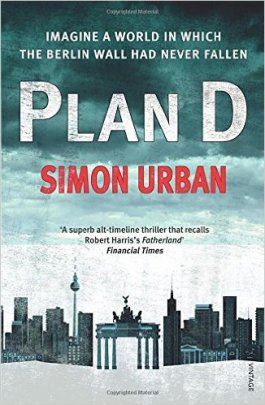
Simon Urban, Plan D (Schoeffling, 2011; Harvill Secker translation, 2013). This gutsy alternative history imagines a 2011 world in which the Berlin Wall did not fall. A blackly humorous satire, it follows the misadventures of Volkspolizei (People’s Police) investigator Martin Wegener, while giving readers an insight into life in East Germany and its historical contexts. I reviewed it favourably in 2013, and posted an East German glossary that explains some of the key events and terms in the novel.

Christa Bernuth’s Innere Sicherheit (Inner Security; Piper, 2006) is set in the East Germany of the early 1980s, before reunification seemed likely. GDR police investigator Martin Beck (a nod to Sjöwall/Wahlöö?) looks into a fatal case of Republikflucht (‘flight from the republic’) that’s not all it seems. Why has the victim been shot with a bullet used by the West? And what are her links to the West German terrorism of the 1970s? There’s an extract available (in German) on the author’s website.

Uwe Klausner, Stasi-Konzern (Stasi Business; Gmeiner, 2014). Retired police chief Tom Sydow is strolling through a West Berlin park on 9. October 1964 when shots ring out. A man has been murdered, but perpetrator and corpse quickly disappear. Sydow discovers the victim was meeting a Stasi officer and is pulled into a case that leads to the top of the East German secret police. This is the sixth installment in the historical ‘Sydow’ series. The fifth, Kennedy-Syndrom, is set in August 1961, just as the Berlin Wall goes up.

Oliver G. Wachlin, Wunderland (Wonderland; Emons, 2008). This humorous ‘Berlin-Krimi’ takes place as the Wall is falling in 1989. West German police investigator Hans Dieter Knoop views a corpse by a lake who’s wearing ice-skates … even though the water’s not yet frozen. He sets about solving this puzzle in the midst of the historical jubilation around him, and receives some unexpected visitors from the East. The second in the series, Tortenschlacht (Death by Cake), plays in 1990, shortly before German reunification.

Jay Monika Walther, Goldbroiler oder die Beschreibung einer Schlacht (Roast Chicken or the Chronicle of a Slaughter; Orange Cursor, 2009). Set shortly after the fall of the Berlin Wall in Warnemünde, this novel shows former East German citizens floundering economically in the new order. The villains are former Nazis from the west, who co-opt eastern neo-Nazis, former Stasi members and disgruntled former GDR citizens into activities such as extortion, smuggling and importing women as sex workers from eastern Europe. A bleak view of the reunited Germany.

As this small selection shows, there’s a huge amount of diversity in crime novels that engage with the East German past – in terms of the historical moment they examine (from 1961 to 1990), the perspectives they adopt (investigators from East and West), the themes they pick up (political repression, corruption, the impact on ordinary people of major social and political changes), and the style in which they are written (satirical, thriller, comic). They link to other legacies of the German past (National Socialism, left-wing terrorism) and sometimes form part of larger historical series attempting to process twentieth-century German history (Klausner’s ‘Sydow’ novels). All of them form part of a wider boom in German-language historical crime fiction, which was triggered by 1989 and the renewed interest in Germany’s ‘double past’ of fascism and communism – Eric Hobsbawm’s ‘age of extremes’ writ large. I’ve just finished a chapter on this subject for the University of Wales Crime Fiction in German volume, which has been very illuminating to write. A final point: only one of the authors above actually had lived experience of East Germany – Oliver Wachlin, who was born in the GDR in 1966. The latter is obviously not a prerequisite for writing crime about the GDR, but I find it interesting nonetheless.

The famous image of the East German Trabi busting through the Berlin Wall

Here are a few extra links to articles and websites about the former East Germany and the fall of the Berlin Wall. Coverage has been excellent:

A brilliant collection of video clips from rbb (Rundfunk Berlin-Brandenburg) that chronicle the history of the Berlin Wall and its fall. They can be viewed in German or in English.

Before and after shots of the Berlin Wall and the city from The Guardian. Click on the old image and the modern one appears – quite uncanny!

Great piece on the fall of the Berlin Wall by Timothy Garton Ash, a historian who was also an eye witness – some great images too.

An interesting piece by Philip Oltermann, on how some positive aspects of GDR society (from football to gender equality to education) are only now being properly acknowledged.

Over at Kafka’s Mouse, PD Smith has a great post on the changes to urban Berlin in the wake of reunification, with before and after images.

The British Museum currently has a major exhibition on exploring German history through a variety of objects. It’s called Germany – Memories of a Nation, and runs until January 2015. There’s a companion Radio 4 series: you can listen to an episode on the two Germanies here – the object in question is a wet-suit that was used in an escape attempt from the East in 1987.

The 2014 Nobel Prize for Literature goes to Patrick Modiano (who’s a bit of a crime writer)

The winner of the 2014 Novel Prize for Literature was announced yesterday. He is French writer Patrick Modiano, who appears to be extremely well known at home, but less so internationally, although some of his works have been translated into English down the years, and have won acclaim in Germany for their engagement with the wartime past.

Patrick Modiano

I’ve not read any of Modiano’s works, but am keen to do so for two reasons. Firstly, he’s of Jewish-Italian, Belgian and French extraction, and much of his writing focuses on the German Occupation of France (1940-44) and the themes of history, memory, identity and guilt.

Secondly, he’s the author of an intriguing, off-beat crime novel, entitled Rue des Boutiques Obscures (the street of shadowy shops), which was published in 1978 and received the Prix Goncourt, France’s premier literary prize, the same year.

The novel was translated into English by Daniel Weissbort, published by Jonathan Cape in 1980, and republished by Verba Mundi in 2004. Here’s the blurb from the back cover of the latter:

>> In this strange, elegant novel, Patrick Modiano portrays a man in pursuit of the identity he lost in the murky days of the Paris Occupation, the black hole of French memory.

For ten years, Guy Roland has lived without a past. His current life and name were given to him by his recently retired boss, Hutte, who welcomed him, a one-time client, into his detective agency. Guy makes full use of Hutte’s files – directories, yearbooks, and papers of all kinds going back half a century – but his leads are few. Could he really be the person in that photograph, a young man remembered by some as a South American attaché? Or was he someone else, perhaps the disappeared scion of a prominent local family? He interviews strangers and is tantalized by half-clues until, at last, he grasps a thread that leads him through the maze of his own repressed experience.

On one level Missing Person is a detective thriller, a 1950s film-noir mix of smoky cafés, illegal passports and insubstantial figures crossing bridges in the fog. On another level, it is also a haunting meditation on the nature of the self. Modiano’s sparce, hypnotic prose, superbly translated by Daniel Weissbort, draws his readers into the intoxication of a rare literary experience. <<

An amnesiac detective investigating his own identity and past in a post-war Parisian setting. Mmmmm, yes please!

See also: ‘Nobel Prize winner Patrick Modiano hailed as modern Marcel Proust’The Guardian, Thursday 9 October.

The Pistorius trial, Peter Murphy’s A Matter for the Jury (2014) and Fritz Lang’s M (1931)

The international media is full of the news that South African athlete Oscar Pistorius has been found guilty of the culpable homicide of Reeva Steenkamp.

Without for an instant forgetting that real people rather than fictional characters are involved in this case, it’s been fascinating watching the trial unfold, and seeing how judge Thokozile Masipa has evaluated the arguments presented by the prosecution and defence, and key points of South African law – such as the distinctions between murder (planned/intending to kill), common-law murder (intending to kill, or knowing that your actions might kill, but without malice aforethought) and culpable homicide (not intending to kill, but guilty of negligent action; akin to the British concept of manslaughter). There’s now of course lots of debate about whether those distinctions have been applied correctly.

Interesting too, is that South African crime writers have been asked for their views on the case in press coverage from South Africa to the UK, Germany and the US, thereby taking up the role of social commentators. Two interesting pieces are Margie Orford’s on ‘the imaginary black stranger at the heart of the defence’ and Deon Meyer’s on how our fascination with the case is linked to our fear of death and a need to see justice done. Both are well worth a read. (I’ve just seen another excellent piece by Orford here: a reaction to the verdict in the larger contexts of male violence and South Africa’s macho culture.)

As is often the way, the extensive discussion of the Pistorius trial has intersected with two other crime narratives currently on my radar, both of which draw on real cases and feature trials. I’ve just finished reading Peter Murphy’s A Matter for the Jury (No Exit Press, 2014), an excellent courtroom drama that explores a murder trial in the era of capital punishment (which was abolished in Britain in 1965, a year after the narrative takes place).

Based loosely on the James Hanratty case, the novel is illuminating in three key respects: it shows the tremendous pressure defence barristers were under when their client faced the death penalty; it shows how evidence has to be marshalled into a convincing narrative for the jury, who deliver the final verdict in court (a contrast here to the Pistorius case, which in accordance with South African practice had no jury); and it shows the sometimes contradictory and inadequate nature of the law (for example, murder ‘in furtherance of theft’ is deemed a capital offence, whereas murder and rape is not). Like all the best crime novels, A Matter for the Jury raises difficult legal and moral questions that are not easily resolved: it’s a rich and absorbing read.

A classic crime film, freshly re-released, has also been in the papers: Fritz Lang’s 1931 Expressionist masterpiece Meine Stadt sucht einen Mörder (M – A City Searches for a Murderer), whose child killer, played by Peter Lorre, is modelled on the real figure of Peter Kürten.

I’m delighted to see this film back in the spotlight. Brilliantly made, it contains a fascinating depiction of a trial set up by Berlin’s network of criminals, who capture ‘M’ ahead of the police. This kangaroo court features criminal boss Schränker in the role of ‘judge’, who promptly prejudices proceedings by declaring that child murderers should forfeit any legal rights due to the nature of their crimes. The argument of the lone ‘defence lawyer’ – that M cannot control his actions due to a psychiatric disorder and needs treatment by doctors – is rejected by the criminals, who are only prevented from lynching the accused by the arrival of the police.

Critic Horst Lange* convincingly argues that this scene functions as a warning allegory about the rise of National Socialism: Schränker is shown wearing a Gestapo-like leather coat, using Nazi terminology, and sweeping aside legal conventions in order to secure the result that he wants. At the same time, the film leaves the question of appropriate justice open at the end of the film, closing with a shot of the grieving mothers whose loss can never be made good. If you’ve not yet had the chance, I highly recommend a viewing: it’s an extraordinary film that’s visually stunning and remains extremely thought-provoking. It’s rightly been given a 5 star rating by Peter Bradshaw in The Guardian.

* Horst Lange, ‘Nazis vs. the Rule of Law: Allegory and Narrative Structure in Fritz Lang’s M’, Monatshefte 101/2 (2009), 170–85.

Norwegian, Scottish and English crime … with a hint of Hitchcock

My crime reading has been quite varied recently. I’m picking books more or less at random, depending on my mood and what crosses my path courtesy of publishers or charity shop finds. My last three have been about as different from one another it’s possible to be, but all have been excellent (if sometimes unsettling) reads. I’ll start with the most recent one and then move back in time.

Hans Olav Lahlum’s The Human Flies (trans. from Norwegian by Kari Dickson; Mantle, 2014 [2010]) sounds like a horror film that’s best avoided after a large meal. However, it turns out to be something quite different: a well-constructed and witty homage to the classic crime fiction of Agatha Christie, set in 1968 Oslo, which has some interesting historical depth. Featuring ambitious young police detective Kolbjørn Kristiansen on his first big case – the murder of a former resistance fighter – readers are treated to an apartment building of intriguing suspects and a page-turning investigation, as well as the considerable intellect of Kristiansen’s wheelchair-bound partner Patricia. I hugely enjoyed this ‘contemporary classic’ and look forward to reading the other novels in the K2 series soon. (Something a little different for us to consider for the 2015 Petrona Award as well…)

Thanks to the good people at Canongate, I’ve now been properly introduced to the work of Scottish crime writer William McIlvanney, who’s highly regarded by luminaries such as Ian Rankin and Denise Mina. The first in the ‘Laidlaw Trilogy’, named for its engaging lead investigator, maverick policeman Jack Laidlaw, was originally published in 1977, and paints a detailed picture of Glaswegian society through its exploration of a young woman’s murder. The novel’s characterisation is complex and sensitive, and shows tremendous sympathy for those marginalised by their social status or sexuality in a less enlightened era. I imagine it would have broken new ground in the 1970s, and it’s stood the test of time extremely well. McIlvanney, who’s a versatile writer and poet, is appearing at this year’s Bloody Scotland crime writing festival.

Francis Iles (aka Anthony Berkeley Cox), was a Golden Age crime writer whose novel Before the Fact appeared in 1932 (republished by Arcturus in 2011). There’s no genial private investigator in sight, however. Instead, we’re plunged into an unsettling psychological thriller, narrated by Lina McLaidlaw, a plain but wealthy woman married to the charming but worryingly amoral Johnny Aysgarth. As time goes by, Lina’s suspicions that Johnny is capable of murder grow, and she fears she’ll be next on his list. But is she just being paranoid? While dated in some respects, the novel holds good as an astute dissection of power relations and abusive relationships, and has one of the most unsettling endings I have ever read. Alfred Hitchcock used it as the basis for his 1941 film Suspicion, starring Cary Grant and Joan Fontaine, but softened the ending, presumably for commercial reasons. If you’re interested in classics of the genre, this is a must read.

The Grand Budapest Hotel

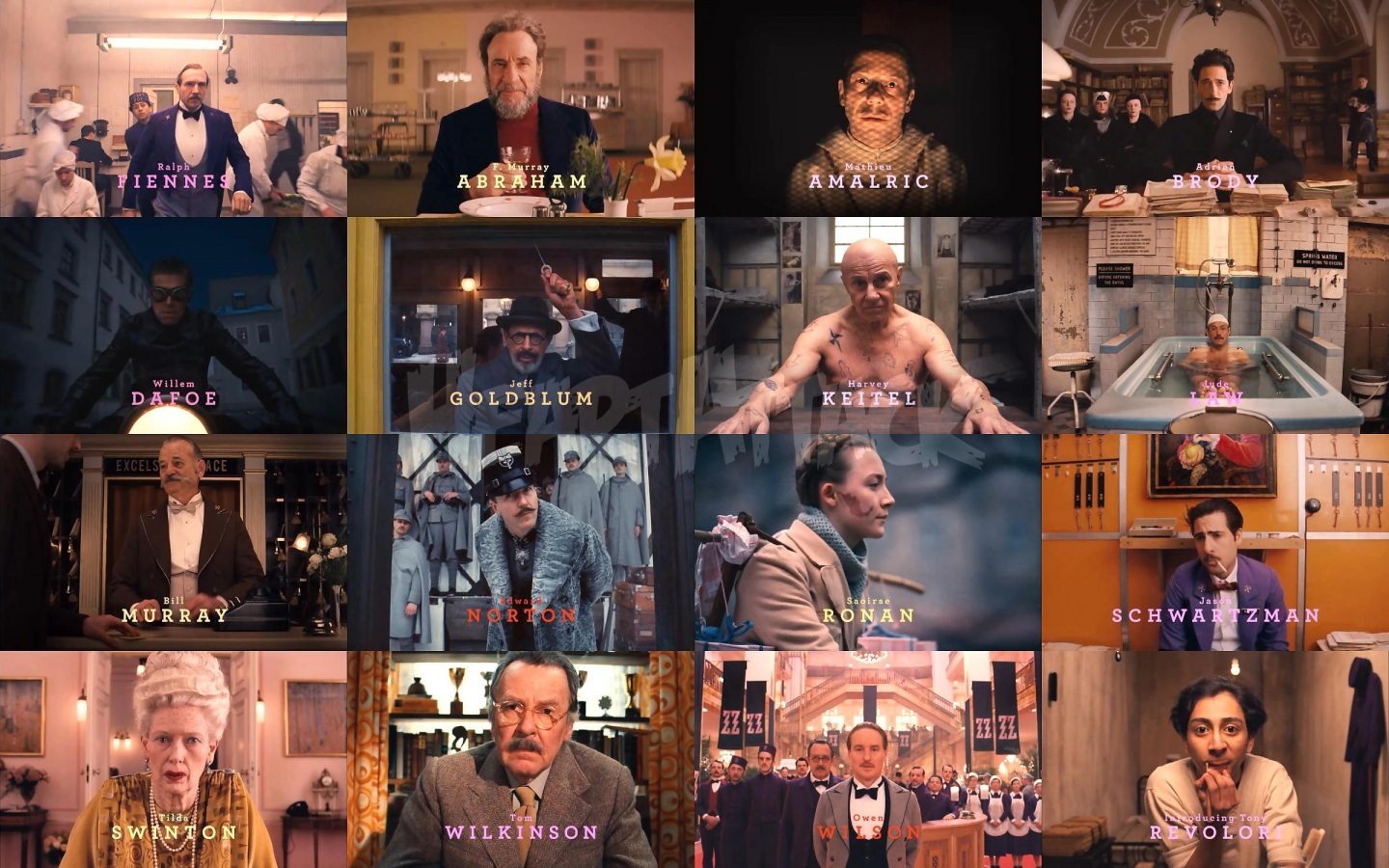
We’ve just seen American director Wes Anderson’s The Grand Budapest Hotel, which was a sumptuous viewing experience and will definitely be on my 2014 list of top films.

Mr. Peabody thought the film was ‘a love letter to Europe’, which is an excellent summation. Handily for this blog, it’s also a wonderful crime caper, triggered by the murder of a fantastically wealthy 84-year-old aristocrat (‘she was dynamite in the sack, by the way’), who’s played with panache by Tilda Swinton.

There are so many things to love about this film: it’s expertly constructed on four different time levels – the present day, 1985, 1968 and 1932 – which fit snugly inside one another like Russian dolls; it celebrates friendship, loyalty, love, kindness, courtesy, tolerance, multiculturalism and cosmopolitan ‘old’ Europe before the darkness of fascism and then communism falls; the characterisation is marvellous, especially of concierge M. Gustave (Ralph Fiennes) and bellboy Zero Moustafa (Tony Revolori/F. Murray Abraham); it shows the importance of writers as chroniclers of memories and history, and the power of literature down the generations; it’s quirky, funny, and profoundly moving; it features a wonderful ensemble cast and is a visual feast from start to finish.

Two extra tidbits. It was filmed largely in Berlin, in and around the famous Babelsberg Studios, and premiered at the Berlin Film Festival, where it won the Silver Bear Grand Jury Prize. It’s loosely inspired by the life and works of Austrian-Jewish writer Stefan Zweig (see a marvellous interview with Anderson discussing this aspect of the film).

Wes Anderson is at the top of his game and has delivered an assured, masterfully crafted work of genius. There. Now go see it if you haven’t already! The official trailer is here.

The-Grand-Budapest-Hotel-Wes-Anderson-01-personnages


Spring crime reading: World Noir series

Spring has sprung here in Wales, and we’ve already had a few sunny days to reacquaint ourselves with the pleasures of reading outside in the garden, park, or by the sea. Bliss.

Left: one of my favourite reading benches in Tenby, Wales.

I’ve been getting on well with my research (more on that later), and in my spare time have been catching up with new releases in the ‘World Noir’ series from Europa Editions in New York. There are around 20 titles available from all around the globe (see below), of which I’ve now sampled three from France: Jean-Claude Izzo’s Total Chaos (translated by Howard Curtis, originally published 1995); Philippe Georget’s Summertime, All the Cats are Bored (translated by Steven Randell, first published 2009), and Jean-Denis Bruet-Ferreol’s (aka Mallock) The Cemetery of Swallows (Steven Randell again, first published 2012).

Image courtesy of World Noir / Europa Editions

Izzo’s Total Chaos – ‘This first installment in the legendary ‘Marseilles Trilogy’ sees Fabio Montale turning his back on a police force marred by corruption and racism and taking the fight against the mafia into his own hands’. Beautifully written, it’s also the story of three boyhood friends – Ugo, Manu and Fabio – and the pursuit of justice in a tough, imperfect world. The novel has a very masculine feel, with women relegated to the role of victim, mother figure or prostitute-with-heart-of-gold, but I can forgive this, because it’s so very good, especially in its exploration of the migrant experience. I’m keen to get my hands on the other two now.

Georget’s Summertime – ‘It’s the middle of a long, hot summer on the French shore and the town is full of tourists. Out of the blue a young Dutch woman is brutally murdered and another disappears without a trace. Gilles Sebag finds himself thrust into the middle of a diabolical game. If he intends to salvage anything he will have to forget his suspicions of his wife’s unfaithfulness, ignore his heart murmur, and get over his existential angst’. Like Total Chaos, this novel quickly immerses the reader in its Mediterranean setting, while drawing the reader into a complex and compelling police investigation. See Bernadette’s excellent review over at Reactions to Reading

Mallock’s The Cemetery of Swallows: ‘One day, Manuel Gemoni travels to the other end of the world to kill an old man. Manuel can only explain his bizarre actions by saying “I killed him because he had killed me.” Unable to comprehend why an ordinary family man would go to such lengths to murder a man he didn’t know, Police Commissioner Amédée Mallock decides to investigate. In order to save Manuel, Mallock must traverse the harsh tropical jungles of the Dominican Republic and the snow-covered streets of Paris’. I’ve just started this one, and am enjoying the intriguing nature of the case, the characterization of the investigator and the Dominican setting. There is a hint – just a tiny, subtle hint – of Vargas, but with the quirkiness dialed down. 

In sum: this is a quality series, showcasing the best of classic and contemporary noir, and we are promised another three to four titles each season. It could be time to hide the credit card, especially as the novels are so beautifully presented.

Thanks to Europa Editions for sending me these review copies from the World Noir series

German crime research update: I’ve had a fascinating time looking at crime fiction under National Socialism. To my surprise, there was lots produced between 1933 and 1945, and it wasn’t greatly censored until 1939, when authors were instructed to produce crime novels featuring policeman as heroes of the state. However, only a few overtly referenced Nazi ideology, which suggests that crime fiction was viewed more as a benign form of popular entertainment than as a tool for indoctrination. The research carried out by Carsten Würmann has been invaluable for getting an insight into this period.

I’ve also been delving into the Soziokrimi (social crime novel) or ‘new German crime novel’, which emerged in the late 1960s, and was influenced by both the student movement and Swedish writers Sjöwall and Wahlöö. There are some very interesting texts that explore the social causes of crime and the negative impact of capitalism on society. While some are quite earnest, others use humour to get their message across: Horst Bosetzky’s 1972 Einer von uns beiden (One of the Two of Us), depicts a blackly comic battle of wits between a smug, middle-class professor and the working-class student trying to blackmail him. The 1974 film adaptation was quite successful, and can be seen in German on YouTube here. Jürgen Prochnow, the actor playing Ziegenhals, went on to star in 1981’s Das Boot. 


Please do not adjust your sets

In a change to my normal academic routine, I’m embarking on research leave for a whole, glorious semester. The chance for this kind of leave comes around every three to four years, and is really invaluable, as it provides time to build up some proper momentum – in my case for writing up research on German and international crime fiction.

I’ll be focusing on two key projects. The first is a book, Detecting the Past: Representations of National Socialism and its Legacy in Transnational Crime Fiction. As the title suggests, it will explore how crime writers have depicted the Nazi period and its post-war legacy since 1945, exploring themes such as criminality, morality, justice, memory and guilt in larger historical, political and social contexts. One key area of interest is how ‘Nazi-themed crime fiction’ reflects the work of historians on the period. A recent example is David Thomas’ Ostland (Quercus, 2013), which draws on perpetrator studies by historians such as Christopher R. Browning to create a portrait of an ‘ordinary man’, police detective Georg Heuser, who comes to play an active part in the Holocaust. A compelling ‘psychological thriller’, the novel is also a sobering depiction of the mechanics of the Holocaust, and of the attempts to bring perpetrators to justice in the 1960s. It’s an excellent example of how history and the findings of historians can be made accessible to a wider public by harnessing the conventions and popularity of the crime genre. Incidentally, details of the 150 primary texts I’m working on can be found here – a number of which have been discussed on this blog over the past two years.

European Crime Fictions: Scandinavian Crime Fiction

My second project is to finish editing Crime Fiction in German, a volume of essays for the University of Wales Press, which will act as an introduction to the subject for an English-language audience. As well as exploring the development of crime fiction in Germany, Austria and Switzerland from the nineteenth century onwards, the volume examines German-language crime from a number of different angles: the crime fiction of the former GDR; regional crime fiction; women’s crime fiction, historical crime fiction; Turkish-German crime fiction; and the enduring popularity of TV series such as Tatort (Crime Scene). It’s the first time this kind of comprehensive overview will have been published in English, which is very exciting. The volume will join others in UWP’s European Crime Fiction series, such as French Crime Fiction (2009), Scandinavian Crime Fiction (2011) and Italian Crime Fiction (2011).

Focusing my energies on academic writing means that I’ll be blogging a little less than I usually do over the next few months. But I’ll still be popping up with recommendations now and then, so please do not adjust your sets! And normal service will most definitely be resumed…

GDR Glossary for Simon Urban’s Plan D

Here’s an East/West German glossary that might come in handy when reading Simon Urban’s alternative history Plan D. Just dip in as and when you fancy (no plot spoilers…).

This glossary is a companion to my review of Plan D, available here.

plan-d
*

The German Democratic Republic (die Deutsche Demokratische Republik) was a communist state, also known as East Germany, which existed for just over forty years between 1949 and 1990, and formed part of the Eastern Bloc during the Cold War. In Plan D, set in 2011, the GDR still exists. The novel presents us with an alternative history of the past two decades and shows us an East Germany that is now sixty-two years old.

Reunification (die Wiedervereinigung): the process by which East and West Germany became a single German state in 1990 following the collapse of the GDR in 1989. In Plan D, reunification never took place. Instead, the novel’s characters refer to ‘Wieder-belebung’ or ‘Revitalisation’, a moment of political rebirth around 1990 that set the GDR on a modernised course – the ‘Neuausrichtung’ or ‘New Direction’.

The Berlin Wall (die Berliner Mauer) was erected by East Germany in 1961 to stop its citizens, especially young skilled labourers, leaving for democratic, capitalist West Germany. It was termed an ‘antifaschistische Schutzmauer’ (anti-fascist protective wall) by the authorities to convince East Germans that the state was trying to stop fascists from getting in, rather than East Germans from getting out. In reality, the Berlin Wall fell on 9. November 1989, but in the 2011 of Plan D it still stands and is referred to as an ‘anti-capitalist protective wall’.

This cross-section shows that the Berlin Wall was eventually made up of a series of fortifications on the East German side. East Berlin is on the far right (1) and West Berlin is on the far left (13). Anyone trying to escape to the west ran a high risk of being caught in the ‘Todesstreifen’ (death strip) in the middle.

Republikflucht or ‘flight from the republic’ was made a criminal offence by the East German state in 1957 to halt the exodus of its citizens. Those caught were likely to receive a prison sentence and have limited future prospects in GDR society. Travel permits were tightly controlled.

Die Volkspolizei or ‘VoPo’ was the East German People’s Police, which had close links with the Stasi. In Plan D, Martin Wegener holds the rank of Hauptmann or captain in the Köpenick criminal police department (which appears to be a nod to the famous figure ‘der Hauptmann von Köpenick’ and his battles with kafkaesque bureaucracy; a production of Zuckmayer’s famous play recently ran at the National Theatre in London).

The Stasi (Ministerium für Staatssicherheit / Ministry for State Security) or state security service (Staatssicherheitsdienst) had its headquarters in Normannenstrasse in Berlin (now a museum). Established in 1950, the Stasi’s remit was to stamp out internal opposition to the state, and it specialised in forcing compliance through a range of psychological techniques. Alongside its own operatives, many ordinary citizens were pressurised/bribed/blackmailed into becoming so-called IMs (‘inoffizielle Mitarbeiter’ or ‘unoffical colleagues’), reporting on work colleagues, neighbours, family and friends. Today, around 111 kilometres of Stasi files are held in official archives, and can be accessed by the public. In Plan D, the activities of the ‘old’ Stasi were officially curbed as part of the reforms carried out during ‘Revitalisation’.

Wolf Biermann’s ballad ‘The Stasi is my Eckermann’ (‘Die Stasi ist mein Eckermann’). The songwriter Wolf Biermann, one of the GDR’s most famous political dissidents, was the subject of extensive Stasi surveillance and was stripped of his GDR citizenship in 1976 while on tour in West Germany. The ballad, written in 1974, is referred to by Martin in Plan D. Its first two verses translate as follows (listen to the original here):

biermann

Wolf Biermann in concert in 1976

I feel a common humanity / With the poor Stasi dogs / Required to sit through snow and downpours of rain / Tediously listening to me through the / Microphone they have installed / Which catches every sound / Songs, jokes and soft curses / Sitting on the toilet and in the kitchen. / Brothers from state security – you alone / Know all my troubles.

You alone can attest / How my whole human effort / Is committed with passionate tenderness / And zest to Our Great Cause. / Words which otherwise would be lost / Are captured firmly on your tapes / And – I’m sure of it – now and again / You sing my songs in bed. / I sing my gratitude to you / Stasi is my Ecker- / Stasi is my Ecker- / Stasi is my Eckermann.

[Johann Peter Eckermann was a poet whose self-appointed task was to record the words of the famous German author Johann Wolfgang Goethe for posterity].

The Invisible Cross-hairs (Das unsichtbare Visier), whose groovy theme tune features as a mobile ringtone in Plan D, was an East German TV series that ran from 1973 to 1979, produced in conjunction with the Ministry for State Security. The central protagonist is Werner Bredebusch, a Stasi agent operating abroad under the alias of Achim Detjen – East Germany’s own James Bond! Ironically, the actor playing Bredebusch, Armin Mueller-Stahl, got into hot water with the state when he spoke out in support of Wolf Biermann in 1976.

Socialist Unity Party (Sozialistische Einheitspartei or SED): the only political party that mattered in the GDR, which shaped all aspects of political and social policy according to communist principles … and the wishes of the Soviet Union. It is still the dominant political party in Plan D.

The Palace of the Republic (der Palast der Republik) was the seat of the East German Volkskammer or People’s Chamber – the heart of GDR government – and doubled as a cultural centre. It was built in the 1970s, on the site of the historic Stadtschloss or Berlin City Palace, which was badly damaged in the Second World War and was demolished by the East German authorities in 1950. Following the Palace of the Republic’s own demolition in 2008 due to high levels of asbestos, a reconstruction of the Berlin City Palace has begun (criticised by some as a deliberate attempt to erase the GDR past). In Plan D, the Palace of the Republic has survived and remains a potent symbol of the GDR state. The national emblem is visible in the picture below: a hammer and compass surrounded by a garland of rye (to represent the workers, intelligensia and farmers respectively).

The Trabant (‘Trabi’) and Wartburg were GDR makes of car (see foreground of image above), for which waiting lists of over a decade were not uncommon. They are still around in Plan D, along with a new model, the Phobus, which runs on rapeseed oil.

Walter Ulbricht was General Secretary of the SED from 1950 to 1971 and Chairman of the State Council (effectively GDR head of state) from 1960 to 1963.

Erich Honecker was General Secretary of the SED from 1971 to 1989 and Chairman of the State Council from 1976 to 1989. His wife Margot was also an influential political figure. In the German original of Plan D, the character of the former head of state is named Erich Honecker. In the English translation, the character of the former head of state is named Heinrich Stangier.

Honecker and top brass at the 1971 SED Party Conference. Marx, Engels and Lenin look moodily into the distance.

Egon Krenz was the last GDR head of state for three months in 1989. In the German original of Plan D, the character of the current head of state is named Egon Krenz. In the English translation, the character of the current head of state is named Hans-Walter Moss.

Erich Mielke was head of the Stasi between 1959 and 1989. Otto Schily was German Federal Minister of the Interior from 1998-2005. In the German original of Plan D, Erich Mielke’s role as head of the Stasi is taken over in 1989 by a character named Otto Schily. In the English translation, Erich Mielke’s role is taken over by a character named Uwe Speckmann.

Oskar Lafontaine was the West German Social Democratic Party (SPD) candidate for Chancellor in the historic German federal elections of 1990. His opponent, CDU politician Helmut Kohl, triumphed and became the first Chancellor of the reunited Germany. In Plan D, Oskar Lafontaine is the name of the left-leaning Chancellor of West Germany in 2011.

With exquisite humour, the novel is dedicated to Günter Schabowski, the SED spokes-man who inadvertantly triggered the ‘early’ fall of the Berlin Wall when answering a press conference question on 9 November 1989.

GDR brands mentioned in the novel include Florena Deodorant, KARO Cigarettes, Goldkrone Schnaps, Club Cola and Nautik soap. Delikat was a chain of state-owned ‘luxury’ shops for East Germans; Intershop was a chain of state-owned shops that targeted foreigners in order to encourage a flow of hard currency (primarily the West German Deutschmark) into East Germany.

Solyanka is a spicy-sour soup, originating from Russia, that was a staple of GDR cuisine. Pictures and recipe (in German) available here.

Aktuelle Kamera was the official East German TV news programme, which delivered the government’s worldview to GDR citizens every evening (watch a clip, with a *gripping* report of Honecker’s state visit to Finland at 2.18 minutes). Der Spiegel was a West German (now German) news magazine, known for its political and investigative journalism.    

Further reading

Mary Fulbrook, History of Germany 1918-2000: The Divided Nation, 3rd edition (Blackwell, 2008). Fulbrook is a highly respected historian who has written a number of excellent books on twentieth-century Germany.

Mary Fulbrook, The People’s State: East German Society from Hitler to Honecker (Yale University Press, 2008)

Frederick Taylor, The Berlin Wall: 13. August 1961 – 9. November 1989 (Bloomsbury 2009). Political, historical and social history of the Berlin Wall and the divided Berlin.

Anna Funder, Stasiland: Stories from Behind the Berlin Wall (Granta 2011 [2003]). Gripping exploration of the role of the Stasi in the GDR and the impact of its activities on ordinary people.    

Jana Hensel, After the Wall: Confessions from an East German Childhood (Public Affairs 2008). A thoughtful memoir of childhood and adolescence; original German title Zonenkinder (Rowohlt 2002).

#38 / Simon Urban, Plan D

Simon Urban, Plan D (German original published by Schoeffling, 2011; English translation by Katy Derbyshire for Harvill Secker, 2013)  4 stars

plan-d

Opening line: Wegener undid the flies of his cords, pulled out his p*nis with two fingers and relaxed.

It’s 2011 and the Berlin Wall is still standing. Welcome to the alternative world of Plan D, by German writer Simon Urban, in which the 1990 reunification of Germany never took place, East and West Germany remain uneasy neighbours, and fifty-six year-old East German Volkspolizei (People’s Police) captain Martin Wegener is about to embark on the strangest investigation of his career.

Called to a crime scene on the outskirts of East Berlin, Wegener finds an elderly man hanging from a pipeline that exports gas from Russia across the German-German border. It looks like a murder with political dimensions, making the case ultra-sensitive for all concerned, and to top it all, suave West German police detective Richard Brendel is attached to the investigative team, to help resolve the case ahead of some important East-West talks. That’s when the fun really begins.

The first duty of any alternative history is to feel credible, and Plan D very successfully evokes a jaded East Germany that is now over six decades old and teetering on the edge of bankruptcy. The novel shows how the East German dictatorship and its relationship with West Germany might plausibly have evolved in modern political contexts, and also stresses the bleakness of everyday East German life, with the activities of the Stasi (the East German security police) continuing to cast a lengthy shadow. In this dystopian world, there’s room neither for Ostalgie – the nostalgia for life in East Germany that arguably marks films such as Goodbye Lenin! (2003) and Sonnenallee (1999)nor for the soft-hearted Stasi operative of Das Leben der Anderen (The Lives of Others, 2006). Instead, we’re shown the stifling confinement of the dictatorship and the impossibility of total trust between individuals, with Wegener taking on the role of the ‘distrustful detective’ forced to embark on a journey into the heart of darkness. More broadly, the novel draws on historican Eric Hobsbawn’s vision of the 20th century as an age of ideological extremes, with the former Nazi Reichsbank now housing the state’s SED Central Committee (which it really did), and the depiction of Wegener’s former colleague Früchtl as a former-Nazi-turned-Communist-policeman who disappeared in shady circumstances in 2010.

The striking design of Plan D’s German cover

The novel combines hard-boiled, noir humour (shades of Philip Kerr’s detective Bernie Gunther) and an exuberant, satirical writing style with elements of the grotesque (a nod to German writers such as Günter Grass and Edgar Hilsenrath). Hats off to translator Katy Derbyshire for communicating the original style with such flair. Urban also acknowledges the American writer Michael Chabon at the end of the book, and I’m guessing that The Yiddish Policeman’s Union was a particular influence, as its crime narrative is also set in an alternative post-war era. Surprisingly, however, there’s no mention of Robert Harris’s 1992 Fatherland, the gold-standard alternative history in which Hitler’s Germany is shown to have won the Second World War. In common with Fatherland, Plan D opens with the murder of an elderly man with a political past, prompting the investigator to search for a deeper truth, which in turn leads to major revelations about the state. For me, the influence of the former is very clear – and is a welcome one. (For info, an article in which I examine Fatherland in detail has just been published in the journal Comparative Literature Studies – more on that soon.)

There was only one aspect of Plan D that left me feeling uncomfortable, and that was the highly s*xualised depiction of the character Karolina. I’ve come to the conclusion that this is meant to be understood symbolically, but the jury’s still out a little for me. The novel is also extremely long. I’m not sure whether this is actually a drawback: while the manuscript might have benefited from a little trim, for this reader the 500 plus pages whizzed by.

Overall, I loved Plan D. For me, a significant portion of reading pleasure came from my prior knowledge of East Germany, which helped me to understand the novel’s in-jokes and biting satire in a way that those unfamiliar with the history of East and West Germany might not. So that everyone can join in the fun and appreciate the genuine wit and clever-ness of the novel, I’m taking the unusual step of publishing a companion post – a GDR glossary for Plan D. The theme tune to the ‘East German James Bond’ TV series is particularly worth a listen. Viel Spass! Enjoy!

My thanks to Harvill Secker for providing a review copy. The novel is published in all formats on 20th June.

Mrs. Peabody awards Plan D an ambitious, absorbing and entertaining 4 stars.

Creative Commons License

.