Theakston File 3: Camilla Läckberg interview with Mrs. P. (Part 2) on The Hidden Child

Part 2: In which Camilla Läckberg (CL) and Mrs. Peabody (MP) discuss the author’s fifth novel, The Hidden Child – its origins, its impact, its depiction of wartime Sweden and Norway – as well as the the process of historical research, and why Swedish crime writers are still drawn to the subject of the Second World War.

I was particularly keen to discuss this novel with the author, because it forms part of the corpus for my academic research on Nazi-themed crime novels (crime novels that engage with the Nazi period or its post-war legacies).

SPOILER ALERT: If you’ve not yet read The Hidden Child, you might wish to come back to this interview at a later point, as it gives away major details about the plot. 

MP: Can I come on to The Hidden Child, in which you explore the legacy of the wartime past?

CL: They’re starting to film it in August for the cinema. I think it’s going to be great.

MP: I can imagine – it has lots of ingredients that would work very well. So what was it that drew you to the topic, because quite a few Swedish writers and Scandinavian writers do go back to look at the legacy of that past.

CL: Well, it actually started with an email from a reader, who thanked me for the books, and then said, ‘Did you know that there were lots of exciting activities going on in the area [around Fjällbacka, the coastal village north of Göteborg where the novels are set] during the Second World War? And I was like, ‘no, I never heard about that’. So I started doing some research and I found out about the smuggling, and the boats going back and forth [between Sweden and Nazi-occupied Norway], people fleeing over the border… And I thought ‘Wow!’, and the ideas started coming. Also, when I’d started writing about Elsy [Erica’s mother], who was already dead in the first book, I only knew that she had been cold with her daughters, but I didn’t know why. After four books, I still didn’t have a clue why. But when I started researching and started working on the idea of ‘the hidden child’, it literally dropped in my lap – Elsy’s whole story. It was one of those magical moments you have as a writer, when it’s like someone is telling you … I suddenly knew everything about  what had happened to her; why she was the way she was. That was fantastic. So that book is very special to me for that reason, because I was basically ‘told’ Erica’s mother’s story.

MP: And it’s a very moving book, I think, as well.

CL:  I had another very moving moment when it came to that book, actually. A year after it had come out in Sweden, I was doing a photo shoot for a cover, and there was this make-up artist, a woman who was around forty, forty-five. When we were alone for a few minutes, she asked me ‘How did you do your research into the Norwegian resistance and the people at Grini [Nazi concentration camp in Norway that held a number of political prisoners]? Did you know anyone who was there?’ No I didn’t; I researched through books and accounts that were on the internet by people who were there, but I hadn’t met one. And then she told me that her mother was from Norway: she had been part of the Norwegian resistance during World War Two, had fled from Norway, ended up in Sweden, and had never talked about her experiences with her children. But when she had read The Hidden Child, she got the children together and said, ‘read this, this is my story’. And then she talked about it: she was 19 when she was in the resistance and was put in Grini …. That was a special moment, because you guess so much. When you’ve done your research you have to guess a lot and fill in the blanks from your own fantasy. Sometimes you get it right, sometimes you probably don’t, but those moments when you understand ‘I got that right’ – that’s fantastic.

MP: Can I ask you about the depiction of the main characters and their relation to the conflict? Because I think that you do something very interesting there – there’s a sort of twist.

CL: Hmmm. What do I do?!

MP: Well, you have a murder victim, who is supposedly a Norwegian resistance fighter, who then turns out to have a very different background – his father was an SS-officer and he also served in Grini. And the murderer is the Swedish resistance fighter, who was a prisoner in the camp. So it seems to me that there’s something complex going on there in terms of how you’re looking at the categories of ‘perpetrator’ and ‘victim’…

CL: It’s all about playing with the ‘good’ and ‘bad’; who’s ‘good’ and who’s ‘bad’? If you do good your whole life, can that compensate for then doing something bad once in your life? And on the other hand, if you’ve done a lot of bad things, can you compensate by leaving them behind, or do you have to carry them with you? Can you turn over a new leaf? I love playing with those things. And also when it comes to murderers, I think it’s so much more interesting when good people do bad things, than when bad people do bad things. What can trigger a basically good person to do something bad? And that’s so much the case in that book – he [the murderer] has lived his whole life doing good things… But that’s also a question: for whom did he do those things? Was it for his own ego or was it out of true conviction? You can always play with those things as well.

MP: It seemed to me that there was a real complexity about the position of the victim and the perpetrator / the murderer and the victim. There’s a trading of places and what you end up with is very much a grey on grey [CL: yes], rather than a black and white morality [CL: yes], which leaves some questions in the mind of the reader… Were you looking for that complexity?

CL: Yes, hmmm, it’s the same thing again [see CL’s comments in part 1 about the inclusion of ‘issues’ in her crime novels]. I don’t think about it when I write it. I just … go along and tell the story. It’s only afterwards that I can see the patterns. It’s like when I wrote The Stonecutter: I wrote the whole book, and when I read the manuscript through to start editing, I was like ‘oh my goodness, there’s a theme in here that I didn’t know was here’ – about what makes a good mother and motherhood. I don’t realise those things while I write. But I guess it’s part of the structure for the book. It’s like scaffolding and I don’t see the scaffolding until I take a few steps back and look at the whole.

Original Swedish cover/title (translates as The German Child)

MP: When you were writing about this controversial past in The Hidden Child  – one that still has resonance in the present – were you ever anxious? You’re obviously portraying something that is quite delicate. Was there a particular kind of caution when dealing with that subject matter, or did you just dive in?

CL: Just dove in, I think. I don’t think there’s anything that I write about that I’m afraid of approaching. The only thing I’m afraid of writing is sex scenes. That’s mainly because I picture my mother and my mother-in-law reading the books and their imagination running wild, so I can’t bring myself to do it! But that’s the only thing that I’m afraid of writing.

MP: It seems like another key theme in that novel was one of trauma: Elsy’s trauma and then the way that trauma has knock-on effects and is communicated down a generation…

CL: I think that theme is in all my books, and especially the eighth one, The Angel Maker. Do you know what an ‘angel maker’ is? It was a Swedish term common in Norway and Denmark as well, that described women in the late 1800s and early 1900s…. If you had a child out of wedlock, and you couldn’t take care of it, you could pay a woman a lump sum to take the baby, and what happened sometimes was that the women thought, ‘OK, I’ve got the money and this baby is only going to cost me from this point on…’. So there are a few court cases where women were found to have killed eight or ten babies. I start the story with a woman who is an ‘angel maker’ being arrested and they discover bodies buried in the ground in the basement. And that then follows as a dark cloud over her daughter, over her grand-daughter and the next generation after that. I love that theme; it recurs in my books.

MP: You’re always very concerned about the human implications of acts, whether of criminal acts or…

CL:  It’s all about the characters for me. It’s the characters that make the crime plot, not the other way around. I don’t form the crime plot and then add the characters. I have a murderer and a motive and then I make the characters start doing things and that creates the plot.

MP: You mentioned some of the research that you undertook for The Hidden Child. Did you look at historical studies?

CL: I borrowed books about the Second World War in the area, because that’s what I was interested in. And then of course I always have to do research depending on where the story takes me. The story took me to Grini, and then it took me on the trains to the concentration camps in Germany, so then I had to do research about the camps and ended up with the ‘white buses’ going to Sweden [programme set up in 1945 by the Swedish Red Cross and Danish government to transport concentration camp inmates from Nazi-controlled areas to Sweden]. So I had to do more and more. I don’t do this amount of research, then I’m done and I write the book. I start at one end and then I discover that ‘I don’t know anything about the part I’m going to write now – I’m going to do some research’. So it’s a continuous process all through the book.

MP: When you’re dealing with that kind of historical event, is historical authenticity important?

CL: Well, I’m not a historian, so I will never get it absolutely right. If I were to get it absolutely right I’d spend five years doing research for every book… And then I’d probably write a thesis instead which would be really boring, compared to a crime novel [ironic laughter from Mrs. P, who once spent five years writing a boring thesis]. I mean I do think that I get it pretty right, but I can’t say that I’ve got all the details right.

MP: But again you were talking earlier about scaffolding in terms of plot; there’s historical scaffolding as well that you can make sure…

CL: I make some markers, and I drop some details, and I let the reader fill in the blanks. I don’t have to describe every detail of what a person was wearing in the 1800s. I can mention a few details; I can mention a dinner; but I don’t have to describe that in the 1800s they were eating this and this and this. But I also happen to have a father-in-law who’s a historian, so I always give him the manuscript and say, ‘please come back to me when you’ve read it and we can discuss the details’. So he always has a lot of good input.

MP: That’s very handy.

CL: Yes, I know! A police officer husband and a historian father-in-law: that’s two for the price of one. If only my mother-in-law had been a forensics expert. That would have been perfect!

MP: One last question… I’m really interested that there are lots of Scandinavian writers who are still bringing in the legacy of the Second World War into their crime novels. Is that legacy still a point of public discussion in Sweden? For example, that there were Swedish nationals who went to fight for the Germans.

CL: It’s brought up once in a while and the fact that we were not neutral is now established. We don’t pretend that we were neutral any more. And also I think there are several reasons why it keeps coming back: it’s a very fascinating war, and it’s also visually a very striking war – for example, the swastika symbol. So it’s easy to picture it. And it was so big in every way. I think that intrigues us as crime writers, because it’s the epitome of human evil. I mean, it’s evil. And also I think it’s still up for debate because of the fact that we now have – and I think it’s a disgrace – a nationalist party in Sweden as part of the government [the Sverigedemokraterna or Sweden Democrats].  And I’m so embarrassed that people actually voted for them. I’m horrified that we’re starting to forget. History repeats itself.

21 July 2012 in the Library, Old Swan Hotel, Harrogate.

Extra links:

Part 1 of this interview

Camilla Läckberg’s website

Jo Nesbo interview with Mark Lawson in which he discusses his family’s wartime past and its impact on the Harry Hole novel The Redbreast

Creative Commons License

.

Theakston File 2: Camilla Läckberg interview with Mrs. Peabody (Part 1)

Part 1: In which Camilla Läckberg (CL) and Mrs. Peabody (MP) discuss reasons for writing crime fiction, the flexibility of the genre, secrets from the past, bad guys getting their comeuppance, fusing the domestic with the grisly, and favourite authors.

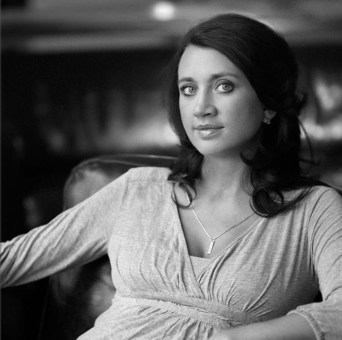
Camilla Läckberg (copyright of the author)

MP: So if it’s alright with you, I’ll start by asking some general questions. What was it that drew you to crime fiction in particular?

CL: I never even thought about writing anything else. I’ve always been in love with crime fiction ever since I was little, so if I was ever going to write, it was going to be crime fiction.

MP: So you had a history of reading crime fiction?

CL: Oh yes. It started when I was seven with finding Death on the Nile on my father’s bookshelf. I absolutely fell in love with the Agatha Christie books, so I read all those, and I continued on, reading both crime fiction for youth, like the Enid Blyton books, but also more adult crime fiction.

MP: And was it mainly British and American crime fiction?

CL: Mainly British; some American writers as well, but mainly British. I always loved the British school of crime writing … And I’m not only saying that because I’m here!

MP: No, no, understood! Do you think that the crime genre offers you particular opportunities as a writer? I mean I’m coming at the question in a slightly different way, but what is it about the genre that attracted you – not as a fan, but as a writer?

CL: Well, I’m going to steal a quote from a Swedish colleague of mine, Håkan Nesser [author of the Van Veeteran and the Barbarotti crime series]. He once said that a murder is such a wonderful hook to hang a story on – because you have this natural element of drama in the whodunit question, but then you can add everything else that there is in other kinds of literature: you can add love, and everyday life, and humour, and sex … You can add anything. So in my world, crime fiction has more, because you can add all that in as well, and have a very exciting drama going on.

MP: So it’s formula fiction, but you’re saying that there is a flexibility as well…

CL: Yes, that’s why we [authors] all have different styles; we approach the task of writing crime fiction in different ways. I mean, we’re not much alike in the way that we tell our stories.

MP: Yes, that’s true – there’s lots of variety. One thing I’ve noticed is that many of your novels unearth a long-hidden secret from the past. Was that always an important theme for you, or was that something that simply developed as the series went on? I think there are four or five of your novels where you see this…

CL: Yes, actually it’s in all the novels. I did it that way in the first story, and then I did it again in the second and the third, and by that time I started realising that ‘oh! there’s a pattern here’. I probably like to tell a story this way, and when I myself try to analyse why, I think it’s because to me, even if you look at real crime, it’s really difficult to understand it and to explain it just by looking at the present. You always have to go back, to look at the person who did it, and how his or her life was. How was the upbringing, how was the childhood, the parents? Maybe you have to go back to the grandparents or even further back to understand the sequence of events that led up to the moment where someone was capable of doing that. And that’s why I tell my stories this way, because I want to explain the motive and the murderer and what happens. And in doing that I have to go back in time. But it varies how far back I need to go.

MP: Yes, and sometimes you’re going back and then bringing in a historical element as well…

CL: Yes.

MP: … which is interesting. Is there a ‘return of the repressed’ idea in there as well? The idea that there might be a secret in the past that people have been silent about…

CL: I think secrets are more common than we think. Most people have secrets. They’re big or they’re small or they’re in-between, but most people have secrets. There are things we don’t tell our husbands or wives or parents or children or friends or that we don’t tell at work. We keep secrets. And sometimes that’s OK and works out, but sometimes that has consequences. A small secret can turn into a big one…

The first novel in the series

MP: And is justice another theme that you’re interested in? I mean the way that you’re describing it, you’re very, very interested in the ‘why’, in the motivation, in looking at the psychology that leads up to the crime. Is justice a concern as well – what happens afterwards?

CL: Yes, I don’t like it when the bad guy gets away. I think there should be a punishment. I’m a bit Greek that way with the whole revenge thing. I do like a happy ending, which in crime fiction is that the killer is caught and punished. I don’t like having endings where the killer gets away. That doesn’t sit well with me.

MP: So there needs to be a proper closure at the end of the novel?

CL: Yes. I can still get annoyed with real life cases when you know that the bad guy … like the OJ Simpson case. That really annoys me. It disturbs the hell out of me. I don’t like that in my books either.

MP: Can I ask you a little about your main protagonists Erica and Patrik? I think that’s such a clever pairing, because they give you so much flexibility – having Patrik as a formal police investigator alongside Erica, who has a connection to crime through her writing, but is a kind of amateur sleuth. Did she come first or did you plan the two of them together?

CL: No, the thing was that I didn’t want to write a police novel, because I thought there are so many crime books with police investigations, so I wanted to do something different. And then I thought, I want to have a woman as a heroine, and I thought about what kind of job she could have so she could go around investigating murders. And a lot of jobs were already taken or I didn’t know anything about them, so an author came as a natural idea; that’s how I created her. But when I started writing about her, I quickly discovered that it’s pretty darn hard to write about someone not connected to the police, to police investigations, so I thought, hmmm, I need to create some kind of police officer here. And then a love interest was the kind of obvious thing to think of. So from the beginning – I love it now – but from the beginning it was a little bit with regret that I … that I thought I have to include police officers as well. But I love it now. I love my police officers and I love Erica and Patrik, so I’m happy it turned out that way … but it wasn’t meant to be from the beginning.

MP: No, but you’ve created something unusual there…

CL: I’ve included so much of their everyday life, which was taking a risk, because I didn’t know if people would like to hear about the little things happening in their life, which are big things – getting married, having children – but it’s not unusual drama; it’s drama we all have.

MP: And that was actually my next question. They are depicted as a very ordinary couple; they have universal problems of how to deal with childcare, of how Erica can keep her career on track, and you tackle the difficult subject of postnatal depression.

CL: Which I had myself, so that’s why I wrote about it.

MP: So did you want to incorporate that to raise awareness?

CL: The funny thing is that, no, I never….. I wish I could say, oh, I want to write about this cause or want to change society or want to make people aware of something, but I really don’t – it’s a side-effect. I’m happy when it happens, but I can’t write my books with an agenda. I tell a story, and as a side-effect my own experiences, my own political views and things like that will absolutely appear in the books, but it’s not my agenda. My agenda is to tell a good story and to entertain the reader. Everything else comes as a side-effect, actually.

MP: But at the same time, I was very struck when I first read your work… Um, a lot of women, a lot of female readers will connect with that experience…

CL: And I love when that happens – I love that. I still have mothers coming up to me on the street and saying, thank God I read your book when I had my baby, because I thought I was the only one who felt like this. I love that, but it’s not my agenda. What I do is write about things that are important to me, and that I’ve experienced, that have really had an impact on me, and of course those will also be things that are meaningful to other people, since I’m not unique, whatever my mother tells me! And because I write so much better when I write about things that I’ve experienced, or that upset me or concern me … That’s why I don’t write about global terrorism or spies. Of course I think it’s horrible when there are terrorist acts, but what gets me going is husbands beating their wives, or children not being taken care of – that’s the thing that’s closest to my heart and that’s what I write about.

MP: I understand. One thing I found interesting as well when I first read your books was the strong presence of ‘the domestic’ on the one hand, through Erica and Patrik’s home life, but then, some very explicit descriptions of corpses on the other [laughter] – there is a contrast between those two elements in the books that’s quite striking. And I felt that you were doing something new there…

CL: I think that is the exact success factor of the books: the relationship between Erica and Patrik, and the fact that it’s a mix between the ordinary drama of everyday life and the extraordinary drama of a crime investigation. I think it’s that contrast. And it’s also the contrast between, on the one hand, a scene with a corpse or a very dark scene with a mother grieving her child, and then on the next page it’s Melberg being stupid, and you can laugh a little bit, so it’s all about throwing the reader between different emotions.

MP: And in some ways you might think there’s a risk in doing that as a writer, because those elements are so contrasting, but it really works…

CL: I didn’t sit down and plan to write this kind of crime fiction. I just started writing something the way I would have liked to read it. I write books for one reader and that’s me. I’m very selfish that way. I just write the kind of book I would have loved to read, according to my taste, and it so happens that there are other people who have the same taste. And it was something quite new … It had to do a little bit with the Elizabeth George books. I think I probably got a little inspired there, because I’ve always loved Elizabeth George books. She’s got great crime plots, but the reason why I kept reading them was to see what would happen to Lord Lynley and Lady Helen. So I wanted a strong story about people that you wanted to follow through the books.

MP: Are there any Swedish authors who’ve influenced you or have your main influences come from outside Scandinavia?

CL: It’s difficult for me to say who’s influenced me or not, because I’ve read so … I mean I was such a book nerd when I was growing up and I still am, and 80% of my reading is crime fiction, so I’ve just always read tons and tons and tons of crime fiction, and I’ve probably picked up little pieces here and there from everybody. So it’s hard for me to say specific authors that I’ve been inspired by.

MP: Or are there any that you particularly like at the moment?

CL: Well of the Swedish ones, yes, I’ve got a few favourites: Åsa Larsson for example [author of the Rebecka Martinsson series], and Mari Jungstedt [author of the Knutas / Berg series]. I like Håkan Nesser – he’s fantastic, especially the Barbarotti books. I’m not that keen on Mankell. I loved the first books but then I got a little bit tired of Wallander always being tired and depressed. But I think my number one favourite is probably Åsa Larsson. I think she’s a fantastic writer.

21 July 2012 in the Library, Old Swan Hotel, Harrogate.

Extra links:

Camilla Läckberg’s top 10 Swedish crime recommendations.

Camilla Läckberg’s website

Sarah at Crimepieces also had a very interesting interview with Camilla at Harrogate.

Creative Commons License

.

Theakston File 1: Jo Nesbø, interviewed by Mark Lawson

Mark Lawson’s interview with highly-acclaimed, best-selling Norwegian crime writer Jo Nesbø, creator of the Harry Hole series, was the last event of the Theakstons Crime Writing Festival 2012. Tickets had sold out well in advance and the venue was packed. Mark Lawson, introducing his guest, told us that a Nesbø novel is sold somewhere in the world every 23 seconds.

The following is not designed to be an exhaustive account, but focuses on parts of the interview that stood out for me as particularly interesting.

The interview took place on the first anniversary of the Oslo and Utoya massacres, and Nesbø spoke with eloquence and sensitivity about the impact that these have had on Norway.

Nesbø’s plan when he began writing was a straightforward one: ‘I thought I would come up with a simple story and write it’. It took him all of five weeks. However, when prospective publishers asked how long the novel had taken to complete, he would say over a year.

One reason why the Hole series was published out of sequence in the UK was because the first two novels were set outside Norway. Publishers felt that it would be too confusing to market a novel by a Norwegian author that was set in Australia [as is the case with the first Hole novel Flaggermusmannen – first published in 1997 and due to be published as The Bat by Harvill Secker in October. The title has been adjusted to avoid confusion with the ‘other’ Batman…]. So The Redbreast [the third novel] was the first of the series to be published here.

The character of Harry Hole was not fully developed until The Redbreast: ‘Then I knew who he was’.                                                                                                                                          

There was a fascinating description by Nesbø of how his own family history had shaped the The Redbreast.

When Nesbø was 15, his father had sat him down for a talk. Afterwards ‘I understood why my family was preoccupied with the Second World War’. While his mother and her family had been part of the resistance movement during Nazi occupation [Germany invaded Norway in 1940], his 19-year-old father had volunteered to fight with the Germans on the Eastern Front. When the war ended, he was sentenced to a couple of years in prison for his role in the war.

Nesbø at first found this revelation ‘incomprehensible’, but his father encouraged him to discuss the issue and to ask him any questions that he wanted, and they grew closer as a result.

The Redbreast seeks to understand how a young man like Nesbø’s father came to take the political path he did. On his father: ‘He was a 19-year-old trying to understand the world and what was going on. He was raised in the States and comes back to a Europe that’s almost bankrupt. Germany and Russia are the two strong nations and there is a feeling that you have to choose between them. And so my father made his choice’.

Nesbø wrestled with the fact that his father had been declared a traitor after the war, but his father was OK with the fact that he had been formally punished: ‘Two years in prison was fair for being as wrong as I was’.

Thus: ‘The Redbreast to a large extent is my father’s book’. It’s a story of World War Two and how the individuals involved ‘reflect on their choices’. The characters who serve under the Germans in the novel ‘all have different motives for doing what they’re doing’.

On Norway’s engagement with the past in the post-war period:  After World War Two, Norway wanted to see itself as a nation that fought the Germans, with a strong resistance movement. While there was some resistance, Nesbø felt that ‘it was a bit of a shame for Norway that we didn’t do more to fight the Germans’. Most people didn’t do anything. Only now are young historians rewriting the story. A grey, complex area.

[Note: There’s a BBC World Bookclub programme on The Redbreast in which Nesbø also discusses his complex family background and its relation to the novel – you can listen to it here (55 minutes duration).]

Jo Nesbø

On the influence of Swedish crime writers Maj Sjöwall and Per Wahlöö: all Scandi writers are influenced by them, even if they don’t know it because they’ve been influenced by writers already influenced by them! They are the godparents of Scandi crime.

It was never Nesbø’s agenda to focus on political issues but ‘it’s impossible to write without being political in some ways, simply because as a writer you ‘edit’ the world you see around you’.

[Lawson also alluded to the fact that Radio 4 will be dramatising all 10 of the Martin Beck series as part of a broader focus on European Detectives – see this BBC article for further details].

Film adaptation: the favourite to play Hole in the adaptation of The Snowman, directed by Michael Scorsese, is Leonardo DiCaprio. There is apparently a website where you can bet on who will get the role, and Nesbø himself is a long-shot for the part. He is keeping his distance from the script-writing process.

On Harry Hole’s fate: ‘There will be an end, and there will be no resurrection’ [audible ‘ooooooh’ from the audience].

A droll moment: after we had been told of Nesbø’s talents as a musician, journalist, stockbroker and writer, an author sitting next to me leaned over and whispered incredulously, ‘Is there anything this man cannot do?!’.

Karen has also posted a good write-up of the event at Euro Crime.

UPDATE: James Kidd’s interview with Nesbø, which he carried out at Harrogate, has recently been published in The Independent.

The Theakston Files

I’m just back from four days at the Theakstons Old Peculier Crime Writing Festival, which, as ever, was a wonderful mixture of interviews, panel discussions and a crime-writing knees-up.

Our first evening was very special: we saw Colin Dexter, creator of the Inspector Morse series, honoured with the Outstanding Contribution to Crime Fiction award, and ‘tartan noir’ writer Denise Mina win the Crime Novel of the Year Award for her ‘hugely atmospheric and haunting book’, The End of the Wasp Season.   

Scene of the crime: the ‘chalk outline’ and ‘blood splatter’ that greeted us on arrival at Harrogate Station

As ever, there were a bewildering number of fascinating and (in some cases controversial) sessions to attend over the following three days. Karen from Euro Crime was spotted quietly tapping away on her laptop in the audience, and her notes on a variety of events, including ‘America’s Got Talent’, ‘Writing for Your Life’, ‘Drawing the Line’, ‘Crime in Another Dimension’, and the John Connolly interview are available here. Many thanks, Karen!

This lucky blogger was given the chance to interview four outstanding crime writers –Arne Dahl (Sweden), Camilla Läckberg (Sweden), Stuart Neville (Northern Ireland) and Jason Webster (UK/Spain) – and also had interesting chats with authors Liza Marklund (Sweden), Margie Orford (South Africa) and Antonio Hill (Spain). Norwegian publishing sensation Jo Nesbø‘s wide-ranging discussion with Mark Lawson completed a very satisfying festival that showcased the best of international crime fiction.    

I’ll shortly be posting a series of ‘Theakston Files’ (a nod there to one of my favourite TV detectives), with interview transcripts and notes from the Nesbø session. Hope you enjoy!

Theakstons Old Peculier Crime Writing Festival 2012

I’ll be setting off early tomorrow morning to the lovely spa-town of Harrogate for the Theakstons Old Peculier Crime Writing Festival (19 – 22 July).

The programme is packed with all sorts of wonders, but I’ll be focusing in particular on the wealth of international crime writing talent taking part, including British writers who set their works beyond the UK.

These include the following (and many, many more…)

Harlan Coben (America)

Arne Dahl (Sweden)

Antonio Hill (Spain)

Ryan David Jahn (America)

Camilla Läckberg (Sweden)

Laura Lippman (America)

Liza Marklund (Sweden)

Deon Meyer (South Africa)

Stuart Neville (Northern Ireland)

Margie Orford (South Africa)

Jo Nesbø (Norway)

Jason Webster (England / Spain)

For those of you keen to hear news from the festival as it unfolds, I’ll be tweeting as @Mrs_Pea68, using the hashtag #TOPcrime2012

If you’re at the festival, perhaps see you in Betty’s or at the bar!

Jo Nesbø – upcoming film adaptations

A recent issue of Film3Sixty magazine carries an interesting feature on two upcoming film adaptations of Norwegian crime author Jo Nesbø’s work.

These follow the phenomenal success of 2011’s Headhunters, adapted from Nesbø’s standalone novel of 2008, which was memorably described by Philip French of The Observer as moving ‘with the speed of a demented lemming heading for the cliff-edge of a fjord’.

Oslo-based director Magnus Martens has completed production on Jackpot (based on a Nesbø storyline), which is due for release on 10. August 2012. Martens says in the Film3Sixty piece that his adaptation channels the black comedy of the Coen brothers and films such as Fargo (a comparison I’ve heard from some viewers of Headhunters as well).

And acclaimed American director Martin Scorsese is adapting The Snowman, the seventh in the Harry Hole series, first published in 2007. This will be the first English-language adaptation of one of Nesbø’s books and is being made in conjunction with the British production company Working Title Films.

Nesbø will be appearing at the Theakstons Crime Writing Festival in Harrogate on 22 July (very exciting).

For a recent New York Times article on Nesbø, see here.

Review of Branagh’s Wallander: Episode 1, Series 3 – ‘An Event in Autumn’

I’ve just finished watching Episode 1 of the new Wallander series, ‘An Event in Autumn’, which got proceedings off to a hard-hitting and occasionally heart-stopping start.

It all begins so well! Wallander and his girlfriend have just moved into their dream home together, a fresh start designed to allow him to ‘leave work at the door’. He’s so happy he even smiles! Then Jussi the dog finds a skeleton under the blackberry bushes in the garden and it’s all downhill from there: the corpses pile up, there are scary encounters in poorly lit locations, and the icy winds of winter begin to blow. In sum: the classic, gloomy Wallander we know and love.

I do like Branagh’s Wallander very much (and isn’t Mankell fortunate to have found three such wonderful actors over the years to realise his creation?). The quality of the production, as in earlier series, is extremely high, and is undoubtedly anchored by Branagh’s performance, which allows us a privileged insight into the strengths and weaknesses of Wallander’s character. The frequent, beautiful shots of chilly beaches and bleak landscapes reinforce his nordic / melancholic loneliness perfectly.

For those of you interested in the theme music, it’s by Emily Barker & The Red Clay Halo, and is called ‘Nostalgia‘.

I’m already looking forward to seeing the second episode, ‘The Dogs of Riga’, next week. I’ll be intrigued to see how they adapt a novel originally set during the collapse of communism in the early 1990s.

The Crime Writers’ Association Awards 2012

Last night, the CWA awards for 2012 were announced in London.

Two of the categories were of particular interest to me as a fan of international crime fiction. Firstly (and most obviously), the CWA International Dagger, whose shortlist included three novels from Italy, and one from Norway, Sweden and South Africa respectively. Secondly the CWA Ellis Peters Historical Dagger, whose shortlist featured the Italian crime novel I Will Have Vengeance by Maurizio de Giovanni (Hersilia Press) and Philip Kerr’s Prague Fatale (Quercus), set in Nazi Germany.

The Historical Dagger shortlist was also interesting in terms of highlighting a shift away from  ‘historical crime fiction’ set in the distant historical past (such as Ellis Peters’ famous ‘Brother Cadfael’ series) to crime fiction engaging with twentieth-century history (all but two of the shortlisted novels are set following 1930).

And the winners are…..*drumroll*

CWA International Dagger: The Potter’s Field by Andrea Camilleri               (trans. by Stephen Sartarelli and published by Mantle)

The judges said ‘Camilleri’s Montalbano novels show just how much can be achieved with familiar materials when a writer conveys the sense of life in a recognizable place. He combines characters, plots, and reflections on Italy’s particular social and political problems with wry—but never bitter—satire. In this novel the late-afternoon shadows lengthen; Montalbano is feeling his age.’

Further information about the winner and the other shortlisted novels can be found on the CWA website here.

CWA Ellis Peters Historical Dagger: Icelight by Aly Monroe                              (published by John Murray)

The judges were unanimous in their decision to award Icelight the Historical Dagger, commenting that “this tale of British post-war malaise, the third of Monroe’s Peter Cotton thrillers, is authentically downbeat yet absolutely gripping. Monroe has the young le Carré’s ability to conjure atmosphere and a poetic style worthy of Len Deighton.”

Further information about the winner and the other shortlisted novels can be found on the CWA website here.

Many congratulations to all the CWA winners and I hope everyone had a great night!

#24 / Jim Thompson, The Killer Inside Me

Jim Thompson, The Killer Inside Me (London: Orion, 2006 [1952]). A hard-hitting noir crime novel, whose complex and disturbing portrait of a killer will linger in the mind 5 stars

Opening line: I’d just finished my pie and was having a second cup of coffee when I saw him.

Every now and then, you encounter a crime novel you know you have to read straight away. So it was with Jim Thompson’s classic 1952 American noir The Killer Inside Me, which made it from the Waterstone’s bookshelf to the nice lady at the till and into my eager hands in the space of five minutes.

Lou Ford is Deputy Sheriff of Central City, Texas, population 48,000. While outwardly affable and well-liked, it’s clear from the beginning of his narrative that he’s not all he seems. Lou is suffering from a ‘sickness’, a psychopathic disorder that has lain dormant for a number of years, and his carefully constructed identity as a good-natured and none-too-bright ‘rube’ is designed to render him invisible within mainstream society. When Lou’s ‘sickness’ is reactivated by a chance encounter with prostitute Joyce Lakeland, he’s soon drawn into a series of violent crimes, fuelled by a complex mixture of revenge for past wrongs, his love-hate relationship with a certain ‘type’ of woman, and, increasingly, self-preservation. As suspicions about Lou begin to surface within the community, the novel charts his increasingly desperate attempts to keep control of the unravelling situation and himself.

Thompson creates a powerful first-person narrative that admits the reader into a killer’s highly-disturbed mind, and deftly traces the complexities of its warped logic and self-deceptions. At the same time, the narrative provides a detailed and (for the time) remarkably daring analysis of the origins of Lou’s condition, asserting that nature and nurture have both played a role. The reader is even provided with a clinical diagnosis at the end of the novel, complete with a supporting quote from the work of German psychiatrist Emil Kraepelin, which reiterates this point. While not qualified to judge if the diagnosis offered is medically correct (it may well not be 60 years on), I found the narrative’s refusal to conform to the ‘mad and bad’ model one would expect from 1950s fiction extremely impressive, given the unenlightened attitudes to mental health issues prevalent at the time. One radical suggestion put forward by the novel is that labelling certain types of sexual practice as deviant or shameful won’t help to eliminate them from society, but will cause a severe and damaging backlash instead (the ‘return of the repressed’ writ large). Sexually conservative attitudes and social hypocrisy are figured as a partial cause of Lou’s condition and the behavioural choices he makes in adulthood – an amazingly bold critique to make of small-town America at any point, let alone in the early 1950s.

Thompson deals brilliantly with the challenge of managing the reader’s reactions to the narrator-as-murderer, creating just enough redeeming features to avoid a reductive, one-dimensional portrayal, whilst avoiding the pitfall of generating too much empathy for him or excusing his crimes. It’s an extraordinary authorial feat, one that a lesser writer would not pull off.

The novel was adapted for film in 2010 with Michael Winterbottom directing and Casey Affleck in the main role. It received mixed reviews and generated controversy due to its graphic depiction of violence towards women. I’ve not seen it yet, but can imagine adapting such a book would be hugely tricky, especially when so much of the narrative’s complexity is communicated via Ford’s distinctive first-person voice.

Clearly, The Killer Inside Me will not be everyone’s cup of tea, given its hard-hitting and explicit content. However, if you’re interested in the classics of the genre and haven’t read this novel yet, it could be one for you.

A biography of Jim Thompson is available here.

Mrs. Peabody awards The Killer Inside Me a highly thought-provoking 5 stars.

Creative Commons License

.

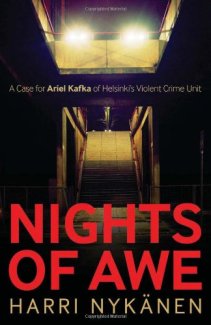
#23 / Harri Nykänen, Nights of Awe

Harri Nykänen, Nights of Awe, translated from the Finnish by Kristian London (London: Bitter Lemon Press, 2012 [2004]). The first in a new series featuring Finnish-Jewish police inspector Ariel Kafka 4 stars

Opening line: Men are born, they live, and they die.

Ariel Kafka, a detective in Helsinki’s Violent Crime Unit and one of only two Jewish policemen in Finland, is called to investigate the deaths of two Arabs in the Linnunlaulu area of the city. As the case unfolds over the Days of Awe, the ten days of repentance leading up to Yom Kippur, Kafka is faced with the unwelcome possibility that the crimes have a Jewish dimension, in the shape of Israeli / Mossad involvement.

The main strength of this Finnish crime novel for me was the wonderfully realised and very likeable investigative figure of Ariel Kafka. Nykänan succeeds in creating a rounded first-person narrator with a distinctive Finnish-Jewish voice (surely a first), which draws entertainingly on the wise-cracking archetype of the hard-boiled detective. The following quote illustrates how nicely these elements are blended together:

‘It wasn’t the first time I had been asked this question [You’re Jewish and you’re a cop?]. People seemed to have a strong belief that Jews have some secret, Old Testament-based motive for not joining the police force. In reality there was only one reason: the lousy pay.’ 

Nykänen, a former crime journalist, uses the narrative to explore Kafka’s triple identity as Finn/Jew/cop, and the tensions generated when these different elements come into conflict with one another. We’re also given a strong sense of the Jewish community in Helsinki (there are around 1500 Jews currently living in Finland), and its efforts to uphold Jewish traditions. The novel reminded me a little of the Rabbi Small series in its descriptions of Jewish life and religious debates (such as the question of  whether women should be accepted as part of the minyan – the quorum necessary to allow public worship). There are also interesting reflections on the way that the legacy of the Holocaust has shaped individuals and families, and the difficulties that ‘diasporic’ Jews have taking a position in relation to the politics and actions of the Israeli state.

Intriguingly, as a Jewish Chronicle article by Jenni Frazer reveals, Nykänen is not himself Jewish, but carried out extensive research for the novel, including discussions with Dennis Paderstein, a Finnish-Jewish chief inspector in Helsinki. The author views the Finnish-Jewish community as being ‘very small, but important’, and in many ways the novel is a celebration of its continued existence.

Less successful, perhaps, is the novel’s rather convoluted plot, which lost me in a number of places as the body count rose, although it did make a kind of sense in the end. In spite of this weakness, I would gladly read others in the series. There are apparently three more (Ariel and the Spiderwoman, Behind God’s Back and Holy Ceremony), which have already been translated into German. Hopefully, more English translations will follow soon.

Mrs. Peabody awards Nights of Awe a slightly flawed but highly entertaining 4 stars.

See also my earlier post on an intriguing trio of Jewish detectives.

Creative Commons License

.