In Cold Blood: CultureCritic Guest Guide to Wintry Crime Fiction

The good people over at CultureCritic recently invited me to contribute a piece to their fabulous blog. The result is a guest guide to ‘wintry’ crime and the role of chilly settings in five of my favourite novels.

  • Jan Costin Wagner, The Winter of the Lions (German author; Finnish setting; 2011)
  • Leif G. W. Persson, Between Summer’s Longing and Winter’s End (Swedish author; Swedish setting; 2010)
  • A.D. Miller, Snowdrops (British author / Russian setting / 2011)
  • Julia Keller, A Killing in the Hills (US author / Appalachian mountain setting / 2012)
  • MJ McGrath, White Heat (UK author; Arctic Circle setting; 2011)

Many thanks to CultureCritic for the invitation; it was fun to do!

If you’re not yet familiar with the CultureCritic blog, do pop over: you’ll find all the latest on film, music, books, exhibitions, theatre, opera, dance and more…. It’s a regular smörgåsbord of cultural delights.

Mrs. Peabody puts her feet up … with a good book

This blog will take a break for the month of August – during which time Mrs. P. hopes to enjoy the company of her family (most likely in a fair bit of British rain) and some tranquil reading in a seaside setting, together with 150,000 gannets.

Mrs. P’s summer reading, currently gathered in an unsteady pile by the side of the suitcase, looks something like this:

Sofi Oksanen’s Purge (Atlantic 2011 [2008] – Finnish/Estonian]

John le Carré’s The Secret Pilgrim (Penguin 2011 [1991] – the final Smiley novel)

Giorgio Scerbanenco’s A Private Venus (Hersilia Press 2012 [1966] – Italian noir)

Jason Webster’s A Death in Valencia (Chatto & Windus 2012 – British/Spanish)

Reginald Hill’s On Beulah Height (Harper 2009 [1998] – British)

Perfect combination… (copyright Lizzy Siddall)

and finally a rogue book that isn’t crime (gasp):

Jeanette Winterson’s Why Be Happy When You Could be Normal (Vintage 2012).

The Kindle’s also coming along, in case that lot’s not quite enough!

Wishing you all lots of lovely summer reading, hopefully with a bit of sunshine thrown in…

#23 / Harri Nykänen, Nights of Awe

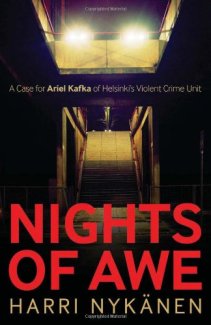
Harri Nykänen, Nights of Awe, translated from the Finnish by Kristian London (London: Bitter Lemon Press, 2012 [2004]). The first in a new series featuring Finnish-Jewish police inspector Ariel Kafka 4 stars

Opening line: Men are born, they live, and they die.

Ariel Kafka, a detective in Helsinki’s Violent Crime Unit and one of only two Jewish policemen in Finland, is called to investigate the deaths of two Arabs in the Linnunlaulu area of the city. As the case unfolds over the Days of Awe, the ten days of repentance leading up to Yom Kippur, Kafka is faced with the unwelcome possibility that the crimes have a Jewish dimension, in the shape of Israeli / Mossad involvement.

The main strength of this Finnish crime novel for me was the wonderfully realised and very likeable investigative figure of Ariel Kafka. Nykänan succeeds in creating a rounded first-person narrator with a distinctive Finnish-Jewish voice (surely a first), which draws entertainingly on the wise-cracking archetype of the hard-boiled detective. The following quote illustrates how nicely these elements are blended together:

‘It wasn’t the first time I had been asked this question [You’re Jewish and you’re a cop?]. People seemed to have a strong belief that Jews have some secret, Old Testament-based motive for not joining the police force. In reality there was only one reason: the lousy pay.’ 

Nykänen, a former crime journalist, uses the narrative to explore Kafka’s triple identity as Finn/Jew/cop, and the tensions generated when these different elements come into conflict with one another. We’re also given a strong sense of the Jewish community in Helsinki (there are around 1500 Jews currently living in Finland), and its efforts to uphold Jewish traditions. The novel reminded me a little of the Rabbi Small series in its descriptions of Jewish life and religious debates (such as the question of  whether women should be accepted as part of the minyan – the quorum necessary to allow public worship). There are also interesting reflections on the way that the legacy of the Holocaust has shaped individuals and families, and the difficulties that ‘diasporic’ Jews have taking a position in relation to the politics and actions of the Israeli state.

Intriguingly, as a Jewish Chronicle article by Jenni Frazer reveals, Nykänen is not himself Jewish, but carried out extensive research for the novel, including discussions with Dennis Paderstein, a Finnish-Jewish chief inspector in Helsinki. The author views the Finnish-Jewish community as being ‘very small, but important’, and in many ways the novel is a celebration of its continued existence.

Less successful, perhaps, is the novel’s rather convoluted plot, which lost me in a number of places as the body count rose, although it did make a kind of sense in the end. In spite of this weakness, I would gladly read others in the series. There are apparently three more (Ariel and the Spiderwoman, Behind God’s Back and Holy Ceremony), which have already been translated into German. Hopefully, more English translations will follow soon.

Mrs. Peabody awards Nights of Awe a slightly flawed but highly entertaining 4 stars.

See also my earlier post on an intriguing trio of Jewish detectives.

Creative Commons License

.

An intriguing trio of Jewish detectives

When reading lots of books randomly in quick succession, I often find that they form themselves into little groups in my mind. This was recently the case with Tom Franklin’s Crooked Letter, Mala Nunn’s A Beautiful Place to Die and Peter May’s The Blackhouse, which had lots of interesting connections (see previous post). Now another three novels have gravitated towards one another, and this time the common denominator is their innovative treatment of the Jewish detective.

It all started on a long train journey from Manchester, which thanks to double engine failure took twice as long as scheduled. While the delay was annoying, it supplied me with some extra reading hours, which I used to start the first of the Rabbi Small novels by Harry Kemelman. By the time I got home, I’d pretty much finished it, and was eyeing up another novel high on my TBR list, Harri Nykänen’s Nights of Awe. Then it was straight to my bookshelf to pull down an old favourite, Michael Chabon’s The Yiddish Policeman’s Union

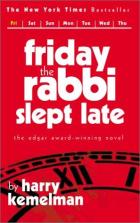
There are eleven novels in the Rabbi Small series, the first of which, Friday the Rabbi Slept Late, was written in 1964. The rabbi has not long arrived in the seashore town of Barnard’s Crossing when he’s pulled into the case of a young girl murdered near the synagogue. As much as anything, the novel is a study of small-town America, exploring the tensions between the quiet Talmudic scholar and his congregation, whose main goal is to be financially and socially successful. Some of its members don’t think much of Small, but it turns out that his training as a rabbi is extremely valuable to their Jewish community, especially when it comes to proving that the murder wasn’t committed by one of them.

As Kemelman has Small explain: ‘In the old days, the rabbi was hired not by the synagogue but by the town. And he was hired not to lead prayers or to supervise the synagogue, but to sit in judgement on the cases that were brought to him […]. He would hear the case, ask questions, examine witnesses if necessary, and then on the basis of the Talmud, he would give his verdict’. This background places Small in the perfect position to help with the murder case – and is a wonderfully original premise for a detective.

Pulitzer prize-winning Michael Chabon is one of the world’s finest writers in my view: an incredibly inventive and original author whose use of language makes me swoon. The Yiddish Policeman’s Union, published in 2007, is his homage to the hard-boiled detective genre, featuring world-weary P.I. Meyer Landesman. But what’s most extraordinary about this novel is its audacious starting point: it’s set in an alternate present in which 3 million Jews escaped the Holocaust through a resettlement programme to Alaska (an actual idea suggested in 1940 by US politician Harold Ickes). They are the ‘Frozen Chosen’, but now face a problem because their lease on the Federal District of Sitka is up. The Independent on Sunday called it ‘a dazzling, individual, hyperconfident novel. Only a shmendrik would pass it up’. I concur.

I’ll be reviewing this extraordinary crime novel in more detail in another post, but if you’re interested in learning more, Patricia Cohen’s New York Times article on the author’s visit to the real Sitka makes for a fascinating read.

 Nights of Awe

Last but not least is Harri Nykänen’s Nights of Awe, a Finnish police procedural just out with Bitter Lemon Press. Set during the ‘Days of Awe’ that lead up to Yom Kippur, it features Ariel Kafka, inspector in the Violent Crime Unit of the Helsinki police and one of only two Jewish policemen in Finland. I haven’t read this novel as yet, but purchased the book on the strength its unusual detective and the reviews I’ve seen for it (see for example Bernadette’s at Reactions to Reading and Norman’s at Crime Scraps Review).

What links these novels for me is their highly original approach to the figure of the Jewish detective (a Finn / a rabbi / someone who only exists because the author has rewritten history) and the innovative contexts in which they are situated (small-town America, Alaska and Finland). This kind of inventiveness, when teamed with excellent writing, is an unbeatable combination for me.

I’m very much looking forward to reading Nights of Awe now and will report back in due course!

Would the real Finland please stand up?

Finland, Finland, Finland
The country where I want to be
Pony trekking or camping
Or just watching TV
Finland, Finland, Finland
It’s the country for me

You’re so near to Russia
So far from Japan
Quite a long way from Cairo
Lots of miles from Vietnam

Monty Python, ‘Finland Song’

My first youthful awareness of Finland came via the affectionate musical tribute by the Monty Python team. A keen ‘Fin-o-phile’ ever since, I’ve very much enjoyed reading crime novels set amongst its ‘mountains so lofty’ and ‘treetops so tall’. Along the way, via the novels of Jan Costin Wagner, I’ve developed an image of the country in line with Nordic writers such as Indridason (Iceland): freezing cold, austerly beautiful, and as melancholy as can be. This brief excerpt from Costin Wagner’s Winter of the Lions illustrates the point: ‘Then he got to his feet, walked down the dimly lit corridor and through the driving snow to his car. He drove to Lenaniemi. As the ferry made the crossing, he stood by the rail in the icy wind’ (… before visiting his wife’s grave and keeping a late-night appointment with a bottle of vodka). 

However, I’ve just had an interesting reading experience that’s challenged this romantic-melancholic view of Finland. Having finished – and very much enjoyed – Costin Wagner’s Winter of the Lions (see review here), I embarked on James Thompson’s Snow Angels (HarperCollins 2010), another police procedural, set in northern Finland (Lapland), which presents a much grittier image of a country characterised by high rates of violent crime: ‘Per capita, our murder rate is about the same as most American big cities. The over-whelming majority of our murders are intimate events. We kill the people we love, our husbands and wives, brothers and sisters, parents and friends, almost always in drunken rages’. The kaamos, the ‘darkness’ that falls over the land for long winter months, is shown to trigger high levels of depression, drinking, violence and suicide, and the way that it’s depicted here moves well beyond melancholy to something altogether darker.   

These divergent depictions of Finland ‘clashed’ for me as a reader, particularly as I read the novels more or less one after the other. Much of that sense of disjunction lay in the very different tone of the novels, which in turn reflected the contrasting literary traditions in which the authors had chosen to locate themselves. Costin Wagner (German with a Finnish wife) draws heavily on the model of Nordic crime established by writers such as Sjowall and Wahloo, Mankell, and Indridason (which reveals the underbelly of society, but has a highly controlled, pared-down style, and an introverted and melancholic feel). In contrast, Thompson (American with a Finnish wife) has channelled the grit and tone of the American thriller to create a hybrid text which his publicity blurb describes as ‘nordic noir’. It’s an often engaging, but very hard-hitting first-person narrative with frequent, extreme depictions of violence (a topic for another post another time).

The contrast between these texts and their depictions of Finland acts as a useful brake for those of us who might unquestioningly accept the portrait of any given country in a crime novel – or indeed any novel – as ‘real’ or ‘authentic’ (literature as travel guide). It’s a timely reminder of an obvious point: that authors provide representations of countries in their novels, which are often very beguiling or sell well in the literary marketplace, but which may or may not be accurate in the eyes of their citizens. And it’s not necessarily a case of ‘would the real Finland please stand up’: some Finns might identify more strongly with Costin Wagner’s portrayal of Finland than Thompson’s, or vice versa, or even think that both have validity. 

A final thought: how intriguing that neither author is Finnish by birth. Given this, one could argue that neither has a true ‘native’ insight into Finnish society, although the counter-argument that the ‘outsider’ can often see you more clearly than you see yourself could equally be applied. In the case of Costin Wagner and Thompson, it would perhaps be more accurate to speak of a complex ‘insider-outsider’ status, as foreigners who have married Finns, lived in the country for a number of years and learned the language (respect!). This dual status grants the authors a highly valuable perspective from which to write about Finland, albeit in strikingly different ways.

Creative Commons License

 
.

#18 Jan Costin Wagner / The Winter of the Lions

Jan Costin Wagner, The Winter of the Lions, translated from German by Anthea Bell (London: Harvill Secker, 2011 [2009]). The third novel in the beguiling Kimmo Joentaa series. 4 stars

 Opening sentence:  Kimmo Joentaa had been planning to spend the last hours of Christmas Eve on his own, but it didn’t turn out like that.

I was given a copy of The Winter of the Lions by my lovely brother for Christmas (following a sisterly nudge in the right direction) and it proved to be the perfect festive read, as the novel’s action begins on 24th December and ends on New Year’s Eve. The evocative cover, with its snowy Finnish birches, also made the novel an attractive winter gift.

Regular readers to this blog will know that I’m a firm fan of of the Kimmo Joentaa series, which, intriguingly, is set in Finland but is authored by a German whose wife is Finnish. The novels are suffused with nordic melancholia, and are in large measure a study of grief, as the first novel, Ice Moon, opens with the death of Detective Joentaa’s young wife. Thus, while each book contains a discrete police investigation, collectively they trace the arc of Joentaa’s grief and the slow process by which he comes to terms with his loss. The Winter of the Lions, set around three years later, sees him embarking on a fragile and rather unconventional new relationship with a women he meets through his duties as a policeman.

One of the big strengths of the series is its focus on the characters within the police team, in a way that’s reminiscent of Scandinavian writers such as Sjowall & Wahloo and Mankell. Joentaa isn’t the only team member with problems, and there are some very human depictions of individuals trying to juggle the demands of their professional lives with the stresses and strains of life beyond the office. In this novel, however, the team also has to deal with the collective trauma of one of their own being murdered. Forensic pathologist Patrik Laukkanen is found dead on a snowy cross-country ski trail in the forest, the victim of a frenzied knife attack. Soon afterwards, another man is found stabbed, and when the link between the two victims is established it proves to be a strange one: both were guests on the popular Hamalainen talk show. As the front cover tantalisingly points out, ‘careless talk costs lives’…

As in previous Joentaa novels, sections of the narrative are written from the murderer’s point of view, and we gradually build up a picture of their character and the circumstances that have led them to commit their crimes. The murderer in The Winter of the Lions is portrayed with sensitivity and a degree of sympathy, although the consequences of his/her crimes for the families of the victims are also carefully spelled out. Here, again, trauma and grief are key themes, and as in Ice Moon, there are some intriguing similarities between the murderer and the investigator whose job it is to track him/her down.

I enjoyed The Winter of the Lions almost as much as the previous two Joentaa novels (although I missed the presence of Ketola, Joentaa’s former boss), and will certainly be back for more. At the end of this third book, I realise that the value of the series lies less for me in the plot or investigative process and more in the novels’ use of the crime genre to explore human reactions to death, trauma and loss. Melancholy and beguiling, these novels are a wintry treat of the highest order.

For other Mrs P. posts on the Joentaa series see Ice Moon and Silence.

The first few chapters are available via the Random House website.

Incidentally, Silence was made into a German film in 2010 (entitled Das letzte Schweigen [the final silence]. You can see the trailer here, which looks great and makes wonderful use of the Finnish *summer* landscape (for a change). It’s in German, but don’t let that put you off!

Mrs Peabody awards The Winter of the Lions a snow and vodka fuelled 4 stars.

Creative Commons License
.

#9 Jan Costin Wagner / Silence

Jan Costin Wagner, Silence, translated from the German by Anthea Bell (London: Vintage 2011 [2007]). The second novel in the Kimmo Joentaa series. An absorbing police procedural and a sensitive portrayal of grief  5 stars


Opening sentence: The time came when they got into the little red car and drove away.

I wrote a short but enthusiastic post on Jan Costin Wagner’s Ice Moon back in March. While German by nationality (and writing in German), Costin Wagner is an honorary Finn by marriage, and appears to have acquired the stylistic DNA of nordic crime in the process. His police detective Kimmo Joentaa convincingly goes about his business in and around the Finnish city of Turku, and little within the narrative hints at the fact that its author was actually born and brought up in Frankfurt, nearly 1500 kilometers to the south-west.

Silence is the second in the Kimmo Joentaa series. The first, Ice Moon, depicted the harrowing weeks following the death of Kimmo’s young wife Sanna, and his desperate attempts to manage his grief by throwing himself into police-work. Silence is set a year or so later, and continues the sensitive exploration of Kimmo’s grief, as well as other kinds of grief felt by those around him, such as the parents of those who have disappeared or been murdered, or the former work colleague trying to communicate with his gravely troubled child.

When I’ve read an outstanding first novel, I’m often a bit wary of reading the second in the series, in case it doesn’t live up to the high standards of its predecessor. But Silence does a fantastic job of picking up the threads of Ice Moon, while developing the characterisation of the investigative team and providing the reader with an aborbing new crime narrative. In particular, the developing relationship between Joentaa and his recently retired and rather curmudgeonly boss, Ketola, is very nicely handled.

The novel’s investigation centres on the sudden disappearance of a teenager on her way to volleyball practice. The girl’s bicycle is found in exactly the same spot where another girl was attacked and murdered thirty-three years earlier, raising the possibility of a belated copy-cat killing. The cold case, in particular, has haunted Ketola, who was involved in the original investigation at the beginning of his career, and who now employs some rather unorthodox methods in his attempts to uncover the truth. In common with Ice Moon, the narrative also shows events from the perspective of the perpetrator, allowing readers to gain insights into the circumstances of the crime that are denied even Joentaa and Ketola. By employing this dual narrative structure, the novel succeeds in both satisfying the reader and in providing a thoughtful, nuanced, and rather disturbing conclusion to the case.

The third novel in the series, The Winter of the Lions, has just been published in translation by Vintage.

Mrs. Peabody awards Silence a classy 5 stars.

Germany meets Finland: Jan Costin Wagner’s Ice Moon

Things have (ahem) been somewhat biased towards Danish and Scandinavian crime fiction in the last few posts. So I’m trying to broaden my horizons by means of a German crime novel by Jan Costin Wagner. But wait…his wife’s Finnish and the book’s set in Finland? So much for weaning myself off Nordic crime.

First line: Kimmo Joentaa was alone with her when she went to sleep.

I hadn’t heard of Costin Wagner before, but really liked Ice Moon (Eismond), his second novel, which features the young Finnish policeman Kimmo Joentaa. The novel opens with the death of Joentaa’s wife after a long illness, and in many ways is a study of grief that happens to be woven into a murder investigation. Each of the victims has been smothered in their sleep, and Joentaa becomes fascinated by these ‘eerily tranquil’ killings, while trying to absorb the loss of his own wife.

The novel’s nicely written, with a characteristic Nordic feel, and the both the investigator and the murderer’s story are explored with sensitivity. The Independent on Sunday described the book as ‘intriguing and touching’, which is spot on. A lovely little read.

Ice Moon is published in translation by Vintage Books (2006), and you can read the first few chapters online here.