#3 Davidsen / The Woman from Bratislava

Leif Davidsen, The Woman from Bratislava, trans. from the Danish by Barbara J. Haveland (London: Arcadia Books 2010 [2001]). An ambitious thriller that explores the legacy of the Second World War, but doesn’t quite live up to its early promise. 3 stars

The Woman from Bratislava (Eurocrime)

 Opening sentence: It was a story often used by security-cleared lecturers in the civilian branch of FET, by serving officers of a certain rank and other trusted members of PET when briefing new volunteers on the special conditions under which the secret services had to operate in a post-communist world.

As I’ve noted in a previous post, Davidsen has been described as ‘one of Denmark’s top crime writers’ (The Sunday Times). As a former journalist specializing in Russian and Eastern European affairs, he tends to use the crime/thriller format to explore larger political and historical issues – in the case of The Woman from Bratislava, the legacy of the Second World War, set against the backdrop of the Bosnian War and the collapse of communism in the 1990s.

More specifically, the novel uses the story of a rather unusual family as a means of approaching the complex history of Danish involvement in the Second World War. In the post-communist Bratislava of 1999, middle-aged Danish lecturer Teddy Pedersen is approached by Mira, an Eastern European woman who claims to be his half-sister. She reveals that their Danish father, a former Waffen-SS officer, had not died in 1952 as Teddy had been led to believe, but had gone on to lead a secret second life in Yugoslavia. Shortly afterwards, Teddy’s Danish sister Irma is arrested on suspicion of being a former Stasi (East German) agent, one who has possible links to ‘the woman from Bratislava’. The novel explores the father’s influence on the political development of both sisters – and via them the lingering legacy of fascism in post-war Europe. If you haven’t spotted it already, Irma and Mira are anagrams of one another, which I *think* is supposed to indicate how inextricably intertwined their fates are. Or something profound, at any rate.

This is a very ambitious novel, but one that I felt over-reached itself in places. Davidsen chooses to focus on an extremely controversial bit of Denmark’s wartime past, namely the role of thousands of Danes who fought for the Nazis as members of the Danish Legion and Waffen-SS. The author attempts to provide a 360-degree examination of this historical moment, highlighting on the one hand the war-crimes committed by these young Danes in the service of Nazi ideology, and on the other, the hypocrisy of the Danish government, who in 1941 ‘blessed’ their departure for war, only to treat them as ‘pariahs and outcasts’ when Germany was defeated in 1945 (p.100). (Denmark is shown white-washing its wartime history, recasting its years of occupation by the Germans as a period of heroic resistance, and developing a strategic amnesia to cover the less savory aspects of that past).

In some respects, I admire Davidsen’s bravery in taking on such a controversial subject, and in trying to provide a rounded discussion of how these ‘Nazi Danes’ should be viewed. But at times, I felt that the exploration of their actions needed to be more nuanced, and I wasn’t able to follow the reasons why certain individuals felt moved to defend the Waffen-SS father, or to consider his post-war treatment unjust. It’s possible that Davidsen is trying to critique these characters’ blindness to the father’s criminal wartime activities (a form of misguided love or loyalty), but I’m not entirely convinced that this is the case. At certain points, there’s also a casual, problematic elision of fascism and communism, which rather confusingly leads communist characters to exhibit fascist sympathies and/or sympathy for fascists.

As if all of this were not enough, there’s an overarching thriller/espionage plotline involving the downing of a NATO fighter plane over Yugoslavia, which ends in a (for me largely incomprehensible) twist. It was all a bit too much for this simple reader.

Summary: There’s much to admire about the ambition and scope of this thriller, but its constituent parts do not add up to a satisfactory whole. It may be best suited for readers with an interest in the legacy of the Second World War and the Cold War.

Mrs. Peabody awards The Woman from Bratislavia a rather wobbly 3 stars.
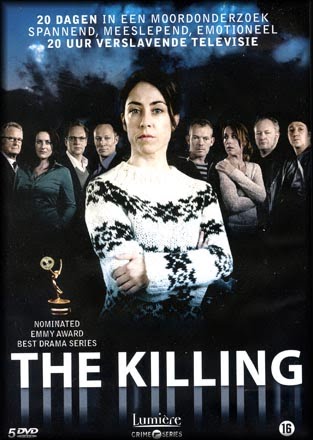
BBC4’s The Killing Series 1 – review of outstanding new crime drama from Denmark

I’ve just finished watching the first two episodes of the Danish crime drama The Killing on BBC4, and it’s so exceptional I felt I had to blog it straightaway.

Forbrydelson / The Killing is an outstanding, powerful, grown-up drama that seeks to show not just the criminal investigation of a murder, but the devastating effect that the crime has on the victim’s family and friends. Part police-procedural, part family drama, part political drama, it chronicles a 20-day police investigation in 20 episodes, allowing for events to unfold realistically from different points-of-view. It’s extremely moving, particularly in its depiction of parental grief, with outstanding acting all round: I don’t mind admitting that I shed a tear or two (and as Mr. Peabody will tell you, this is a rare event indeed – I’m usually tough as old boots).

The police investigator in charge is Sarah Lund (played by the excellent Sofie Gråbøl), who is sucked into the case on what should be her last day before taking a new job in Sweden. What an absolute joy this character is: a confident, intelligent, nicotine-gum-chewing policewoman who is *extremely* good at her job. The camera often simply lingers on her looking / seeing / thinking things through / making links / understanding (a nod to the trope often present in hard-boiled crime fiction of the ‘power of the investigative eye’). The contrasts between Lund’s methods of investigation and those of her male co-investigator are highlighted throughout (sometimes to droll comedic effect): the implication is that the different policing styles are firmly gendered, and the ‘male’ style does not come off well at all. 

A small, but lovely detail is that Lund wears the same rather tatty-looking jumper throughout the first two days of the investigation (as seen above). Fashion statements are pretty much bottom of the to-do-list, which is extremely refreshing.

I haven’t seen a crime drama this powerful since watching the TV adaptation of David Peace’s Yorkshire Noir quartet – 1974 / 1977 / 1980 / 1983. I would highly recommend The Killing – it’s a significant cut above your average crime series, and was rightly lauded in Denmark where it first appeared in 2007. Fantastic Danish crime drama: who knew?

Well done (again) BBC4 – going great guns on international crime. Both episodes are available on iplayer: catch up while you have the chance and tune in next week for episode 3. I’ll definitely be there.

11 Feb: Rog has posted an audioclip of The Killing‘s theme tune (by Neptun) in the comments section below.

12 Feb: Tweet reviews

punkcinema1 – The Killing is brilliant TV. Best thing made by Denmark since Lego.

richvoorwerp – Imagine a 20 episode, complex, tightly scripted, beautifully acted, crime drama produced by British TV. The Danes can do it.

rosemarymaddy – Going to watch The Killing on BBC iplayer. If you haven’t seen it yet, and you like gritty, intelligent, crime drama, why not take a look?

If you’d like to leave a comment, please make sure there are no spoilers that might interfere with the enjoyment of others still catching up 🙂

BBC4 New Danish crime series – ‘The Killing’

News comes to me via the wondrous Euro Crime blog of a new Danish crime series, The Killing, that’s due to start on BBC4 this Saturday, 22 January (two episodes back to back at 9.00pm and 10.00pm).

  • 20 episodes – one for each of the 20 days of the case (a bit like 24, but days instead of hours, if you see what I mean)
  • Features a female head of investigations, Inspector Sarah Lund (big cheer!)
  • Police procedural (shades of Wallander, perhaps?)
  • Originally shown in 2007 on Danish TV, where it was a big hit.
  • Received a nomination for International Emmy for best Best Drama.

Sounds very promising.

Euro Crime carries the BBC4 press release here, which gives some details about the story-line (no major spoilers though).

[See also my review of the first two episodes in a later post – link on right hand menu]

Danish crime: The Woman from Bratislava

One of the crime novels waiting for me under the Christmas tree was Leif Davidsen’s The Woman from Bratislava (2001). I’d been eyeing this one up for a while, and was very pleased that Santa had been clever enough to bring it along.

The Woman from Bratislava (Eurocrime)

I’ve not read any Danish crime fiction since Peter Hoeg’s Miss Smilla’s Feeling for Snow (1992), but Davidsen, described by The Sunday Times as ‘one of Denmark’s top crime writers’, seems like a good author to try out. He’s a former journalist who specialised in Russian and Eastern European affairs, and has a particular interest in the legacy of the Second World War and the Bosnian conflict. He tends to use the crime/thriller format to explore larger political and historical issues, which immediately draws me to his work. In The Woman from Bratislava, a middle-aged Danish lecturer receives a visit from an Eastern European woman who says she’s his half-sister. Their father, a former SS officer, had been declared dead in 1952, but in fact went on to live a second, secret life. Oh, and his other sister is a possible Stasi agent… 

All this before the first murder takes place :O

So far I’ve only read the prologue, but was gripped by its fusion of European history, secret service intrigue and dry humour. I’m hoping that the rest of the novel lives up to this early promise and will report in due course.

The Woman from Bratislava is published by EuroCrime, an imprint of Arcadia. Their website is one of my favourite places to browse for new crime fiction in translation (when I looked in today there were Norwegian, Swiss, French, Spanish and Greek novels on offer – and that was just the first page).

See later post for a full review of The Woman from Bratislava