This, that and the other…

This … is an interview with Jo Nesbo by James Kidd, which appeared in The Independent over the weekend. Topics covered include Anders Breivik, Nesbo’s father and the publication of the old/new Harry Hole novel The Bat. The interview was carried out following Nesbo’s sell-out appearance at the Theakstons / Harrogate Crime Writing Festival in July.

That is another interview by Kidd (and now I’m really jealous) of Henning Mankell, on the publication of his novel The Shadow Girls (originally published in Sweden in 2001). While not crime fiction, the social critique that’s found in Swedish crime writing in general and Mankell’s works in particular is very much evident in this work.

The other … is a provocative piece by American mystery editor Otto Penzler in Publishers Weekly, entitled ‘Why the Best Mysteries are Written in English’. A number of arguments are put forward by Penzler (albeit not always with total clarity) to justify this grand assertion, and a lively set of responses have now accrued in the comments section, which make for an entertaining read.

Theakstons Old Peculier Crime Writing Festival 2012

I’ll be setting off early tomorrow morning to the lovely spa-town of Harrogate for the Theakstons Old Peculier Crime Writing Festival (19 – 22 July).

The programme is packed with all sorts of wonders, but I’ll be focusing in particular on the wealth of international crime writing talent taking part, including British writers who set their works beyond the UK.

These include the following (and many, many more…)

Harlan Coben (America)

Arne Dahl (Sweden)

Antonio Hill (Spain)

Ryan David Jahn (America)

Camilla Läckberg (Sweden)

Laura Lippman (America)

Liza Marklund (Sweden)

Deon Meyer (South Africa)

Stuart Neville (Northern Ireland)

Margie Orford (South Africa)

Jo Nesbø (Norway)

Jason Webster (England / Spain)

For those of you keen to hear news from the festival as it unfolds, I’ll be tweeting as @Mrs_Pea68, using the hashtag #TOPcrime2012

If you’re at the festival, perhaps see you in Betty’s or at the bar!

#24 / Jim Thompson, The Killer Inside Me

Jim Thompson, The Killer Inside Me (London: Orion, 2006 [1952]). A hard-hitting noir crime novel, whose complex and disturbing portrait of a killer will linger in the mind 5 stars

Opening line: I’d just finished my pie and was having a second cup of coffee when I saw him.

Every now and then, you encounter a crime novel you know you have to read straight away. So it was with Jim Thompson’s classic 1952 American noir The Killer Inside Me, which made it from the Waterstone’s bookshelf to the nice lady at the till and into my eager hands in the space of five minutes.

Lou Ford is Deputy Sheriff of Central City, Texas, population 48,000. While outwardly affable and well-liked, it’s clear from the beginning of his narrative that he’s not all he seems. Lou is suffering from a ‘sickness’, a psychopathic disorder that has lain dormant for a number of years, and his carefully constructed identity as a good-natured and none-too-bright ‘rube’ is designed to render him invisible within mainstream society. When Lou’s ‘sickness’ is reactivated by a chance encounter with prostitute Joyce Lakeland, he’s soon drawn into a series of violent crimes, fuelled by a complex mixture of revenge for past wrongs, his love-hate relationship with a certain ‘type’ of woman, and, increasingly, self-preservation. As suspicions about Lou begin to surface within the community, the novel charts his increasingly desperate attempts to keep control of the unravelling situation and himself.

Thompson creates a powerful first-person narrative that admits the reader into a killer’s highly-disturbed mind, and deftly traces the complexities of its warped logic and self-deceptions. At the same time, the narrative provides a detailed and (for the time) remarkably daring analysis of the origins of Lou’s condition, asserting that nature and nurture have both played a role. The reader is even provided with a clinical diagnosis at the end of the novel, complete with a supporting quote from the work of German psychiatrist Emil Kraepelin, which reiterates this point. While not qualified to judge if the diagnosis offered is medically correct (it may well not be 60 years on), I found the narrative’s refusal to conform to the ‘mad and bad’ model one would expect from 1950s fiction extremely impressive, given the unenlightened attitudes to mental health issues prevalent at the time. One radical suggestion put forward by the novel is that labelling certain types of sexual practice as deviant or shameful won’t help to eliminate them from society, but will cause a severe and damaging backlash instead (the ‘return of the repressed’ writ large). Sexually conservative attitudes and social hypocrisy are figured as a partial cause of Lou’s condition and the behavioural choices he makes in adulthood – an amazingly bold critique to make of small-town America at any point, let alone in the early 1950s.

Thompson deals brilliantly with the challenge of managing the reader’s reactions to the narrator-as-murderer, creating just enough redeeming features to avoid a reductive, one-dimensional portrayal, whilst avoiding the pitfall of generating too much empathy for him or excusing his crimes. It’s an extraordinary authorial feat, one that a lesser writer would not pull off.

The novel was adapted for film in 2010 with Michael Winterbottom directing and Casey Affleck in the main role. It received mixed reviews and generated controversy due to its graphic depiction of violence towards women. I’ve not seen it yet, but can imagine adapting such a book would be hugely tricky, especially when so much of the narrative’s complexity is communicated via Ford’s distinctive first-person voice.

Clearly, The Killer Inside Me will not be everyone’s cup of tea, given its hard-hitting and explicit content. However, if you’re interested in the classics of the genre and haven’t read this novel yet, it could be one for you.

A biography of Jim Thompson is available here.

Mrs. Peabody awards The Killer Inside Me a highly thought-provoking 5 stars.

Creative Commons License

.

An intriguing trio of Jewish detectives

When reading lots of books randomly in quick succession, I often find that they form themselves into little groups in my mind. This was recently the case with Tom Franklin’s Crooked Letter, Mala Nunn’s A Beautiful Place to Die and Peter May’s The Blackhouse, which had lots of interesting connections (see previous post). Now another three novels have gravitated towards one another, and this time the common denominator is their innovative treatment of the Jewish detective.

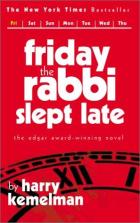
It all started on a long train journey from Manchester, which thanks to double engine failure took twice as long as scheduled. While the delay was annoying, it supplied me with some extra reading hours, which I used to start the first of the Rabbi Small novels by Harry Kemelman. By the time I got home, I’d pretty much finished it, and was eyeing up another novel high on my TBR list, Harri Nykänen’s Nights of Awe. Then it was straight to my bookshelf to pull down an old favourite, Michael Chabon’s The Yiddish Policeman’s Union

There are eleven novels in the Rabbi Small series, the first of which, Friday the Rabbi Slept Late, was written in 1964. The rabbi has not long arrived in the seashore town of Barnard’s Crossing when he’s pulled into the case of a young girl murdered near the synagogue. As much as anything, the novel is a study of small-town America, exploring the tensions between the quiet Talmudic scholar and his congregation, whose main goal is to be financially and socially successful. Some of its members don’t think much of Small, but it turns out that his training as a rabbi is extremely valuable to their Jewish community, especially when it comes to proving that the murder wasn’t committed by one of them.

As Kemelman has Small explain: ‘In the old days, the rabbi was hired not by the synagogue but by the town. And he was hired not to lead prayers or to supervise the synagogue, but to sit in judgement on the cases that were brought to him […]. He would hear the case, ask questions, examine witnesses if necessary, and then on the basis of the Talmud, he would give his verdict’. This background places Small in the perfect position to help with the murder case – and is a wonderfully original premise for a detective.

Pulitzer prize-winning Michael Chabon is one of the world’s finest writers in my view: an incredibly inventive and original author whose use of language makes me swoon. The Yiddish Policeman’s Union, published in 2007, is his homage to the hard-boiled detective genre, featuring world-weary P.I. Meyer Landesman. But what’s most extraordinary about this novel is its audacious starting point: it’s set in an alternate present in which 3 million Jews escaped the Holocaust through a resettlement programme to Alaska (an actual idea suggested in 1940 by US politician Harold Ickes). They are the ‘Frozen Chosen’, but now face a problem because their lease on the Federal District of Sitka is up. The Independent on Sunday called it ‘a dazzling, individual, hyperconfident novel. Only a shmendrik would pass it up’. I concur.

I’ll be reviewing this extraordinary crime novel in more detail in another post, but if you’re interested in learning more, Patricia Cohen’s New York Times article on the author’s visit to the real Sitka makes for a fascinating read.

 Nights of Awe

Last but not least is Harri Nykänen’s Nights of Awe, a Finnish police procedural just out with Bitter Lemon Press. Set during the ‘Days of Awe’ that lead up to Yom Kippur, it features Ariel Kafka, inspector in the Violent Crime Unit of the Helsinki police and one of only two Jewish policemen in Finland. I haven’t read this novel as yet, but purchased the book on the strength its unusual detective and the reviews I’ve seen for it (see for example Bernadette’s at Reactions to Reading and Norman’s at Crime Scraps Review).

What links these novels for me is their highly original approach to the figure of the Jewish detective (a Finn / a rabbi / someone who only exists because the author has rewritten history) and the innovative contexts in which they are situated (small-town America, Alaska and Finland). This kind of inventiveness, when teamed with excellent writing, is an unbeatable combination for me.

I’m very much looking forward to reading Nights of Awe now and will report back in due course!

#22 Tom Franklin / Crooked Letter, Crooked Letter

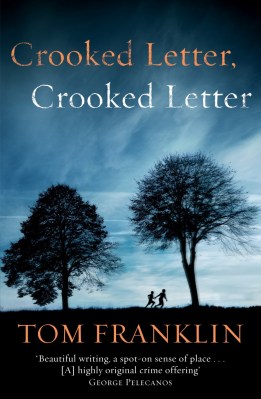
Tom Franklin, Crooked, Letter, Crooked Letter (London: Macmillan, 2011 [2010]). A compelling crime novel that explores the far-reaching legacy of an unsolved crime in America’s Deep South 4.5 stars

Opening line: The Rutherford girl had been missing for eight days when Larry Ott returned home and found a monster waiting in his house.

Crooked Letter, Crooked Letter is a complex, many-layered novel that explores the relationship between an impoverished black boy and awkward white boy in the 1970s, an unsolved crime and the cumulative effect of its poisonous legacy over twenty-five years, and the intricate workings of small-town prejudice.

When Cindy Walker disappears in 1982, suspicion falls on oddball teenager Larry Ott, the last person seen with her at a drive-in movie that fateful night. While nothing is ever proved, the 500 residents of Chabot in Mississippi draw their own conclusions, condemning Larry to a lonely life of almost total social exclusion, waiting for out-of-town customers at the family garage who seldom come. When college student Tina Rutherford goes missing twenty-five years later, negative assumptions are once again swiftly made, placing Larry’s life at risk. It’s up to Silas Jones, who escaped the rural black poverty of Chabot through baseball, but is now back as its sole law enforcement officer, to investigate the truth of what happened to Cindy and Tina. This process is one that will lead him to examine his own uneasy friendship with Larry during their childhood, and to confront the complexities of their unresolved past.

The novel is an extremely well-written and satisfying read, with chapters switching between the present-day investigation and the past, and alternating between Larry’s and Silas’s points of view. Both of these characters are skilfully drawn, as is the setting of Chabot and the steamy landscape of the Deep South (‘he smelled the hot after-rain and listened to the shrieking blue jays, alone at the edge of a wall of woods, miles from anywhere…’). Most impressive, however, is the dissection of the repurcussions that one set of events can have down the years, and the central question the novel poses of how far individuals and communities can make amends for past errors or moral failures.

Of the crime novels I’ve read recently, Crooked Letter forms part of a loose trilogy in my mind with Malla Nunn’s A Beautiful Place to Die (reviewed here) and Peter May’s The Blackhouse (not yet reviewed). Each has a wonderful sense of place (the Deep South, South Africa and the Isle of Lewis respectively) and successfully depicts small but socially complex communities. While Franklin and Nunn’s novels both explore tensions within racially-divided communities, Franklin and May’s novels can be viewed as coming-of-age stories, whose investigators are forced to re-examine pasts they had long packed away. Of the three novels, Crooked Letter is the one I enjoyed most fully: although the other two were fulfilling reads in a number of respects, they were slightly let down in my view by excessively melodramatic endings.

Further information about Tom Franklin (who was born in small town very much like Chabot) is available here. You can also read the first three chapters of the novel here.

Mrs. Peabody awards Crooked Letter, Crooked Letter a highly satisfying 4.5 stars.

Creative Commons License

.

Would the real Finland please stand up?

Finland, Finland, Finland
The country where I want to be
Pony trekking or camping
Or just watching TV
Finland, Finland, Finland
It’s the country for me

You’re so near to Russia
So far from Japan
Quite a long way from Cairo
Lots of miles from Vietnam

Monty Python, ‘Finland Song’

My first youthful awareness of Finland came via the affectionate musical tribute by the Monty Python team. A keen ‘Fin-o-phile’ ever since, I’ve very much enjoyed reading crime novels set amongst its ‘mountains so lofty’ and ‘treetops so tall’. Along the way, via the novels of Jan Costin Wagner, I’ve developed an image of the country in line with Nordic writers such as Indridason (Iceland): freezing cold, austerly beautiful, and as melancholy as can be. This brief excerpt from Costin Wagner’s Winter of the Lions illustrates the point: ‘Then he got to his feet, walked down the dimly lit corridor and through the driving snow to his car. He drove to Lenaniemi. As the ferry made the crossing, he stood by the rail in the icy wind’ (… before visiting his wife’s grave and keeping a late-night appointment with a bottle of vodka). 

However, I’ve just had an interesting reading experience that’s challenged this romantic-melancholic view of Finland. Having finished – and very much enjoyed – Costin Wagner’s Winter of the Lions (see review here), I embarked on James Thompson’s Snow Angels (HarperCollins 2010), another police procedural, set in northern Finland (Lapland), which presents a much grittier image of a country characterised by high rates of violent crime: ‘Per capita, our murder rate is about the same as most American big cities. The over-whelming majority of our murders are intimate events. We kill the people we love, our husbands and wives, brothers and sisters, parents and friends, almost always in drunken rages’. The kaamos, the ‘darkness’ that falls over the land for long winter months, is shown to trigger high levels of depression, drinking, violence and suicide, and the way that it’s depicted here moves well beyond melancholy to something altogether darker.   

These divergent depictions of Finland ‘clashed’ for me as a reader, particularly as I read the novels more or less one after the other. Much of that sense of disjunction lay in the very different tone of the novels, which in turn reflected the contrasting literary traditions in which the authors had chosen to locate themselves. Costin Wagner (German with a Finnish wife) draws heavily on the model of Nordic crime established by writers such as Sjowall and Wahloo, Mankell, and Indridason (which reveals the underbelly of society, but has a highly controlled, pared-down style, and an introverted and melancholic feel). In contrast, Thompson (American with a Finnish wife) has channelled the grit and tone of the American thriller to create a hybrid text which his publicity blurb describes as ‘nordic noir’. It’s an often engaging, but very hard-hitting first-person narrative with frequent, extreme depictions of violence (a topic for another post another time).

The contrast between these texts and their depictions of Finland acts as a useful brake for those of us who might unquestioningly accept the portrait of any given country in a crime novel – or indeed any novel – as ‘real’ or ‘authentic’ (literature as travel guide). It’s a timely reminder of an obvious point: that authors provide representations of countries in their novels, which are often very beguiling or sell well in the literary marketplace, but which may or may not be accurate in the eyes of their citizens. And it’s not necessarily a case of ‘would the real Finland please stand up’: some Finns might identify more strongly with Costin Wagner’s portrayal of Finland than Thompson’s, or vice versa, or even think that both have validity. 

A final thought: how intriguing that neither author is Finnish by birth. Given this, one could argue that neither has a true ‘native’ insight into Finnish society, although the counter-argument that the ‘outsider’ can often see you more clearly than you see yourself could equally be applied. In the case of Costin Wagner and Thompson, it would perhaps be more accurate to speak of a complex ‘insider-outsider’ status, as foreigners who have married Finns, lived in the country for a number of years and learned the language (respect!). This dual status grants the authors a highly valuable perspective from which to write about Finland, albeit in strikingly different ways.

Creative Commons License

 
.

In Praise of Columbo

In a mad moment before Christmas, I bought a boxset of the entire 10 series of Columbo (including the original TV pilots), and have had a lovely time since then reliving the days of my youth, when this programme was a staple of our family’s TV viewing.

In total, Columbo was on screen for an amazing 35 years between 1968 and 2003, and has held up remarkably well given its age – a tribute to the brilliance of the show’s two big concepts (the character of Columbo and the ‘inverted mystery’ formula), and its high production values.

Just one more thing...

In Lt. Columbo of the LAPD, writers Richard Levenson and William Link created a unique police detective, who was wonderfully realised by Falk. Seemingly bumbling, incompetent and dishevelled (looking like ‘an unmade bed’ in his crumpled mac), his razor-sharp intellect was always fatally underestimated by the murderer, who believed that he or she had committed the perfect crime. Interestingly, and in contrast to investigators in other American police procedurals such as Starsky and Hutch or Cagney and Lacey, Columbo is shown operating largely on his own – we never see a police-partner, Columbo’s superiors, or any action at the police precinct. He’s actually a very clever fusion of policeman (title and frequently flashed badge), private eye (his appearance and constant snooping),  and ‘Golden Age’ detective (his unerring ability to solve the murder, typically committed in the L.A. equivalent of an English country house).  

This wonderful character was then combined with the innovative ‘inverted mystery’ formula to produce a highly addictive show. Each episode opened with a 10 to 15 minute section showing an individual carrying out a murder, thereby inverting the usual ‘who-dunnit’ formula and making the viewer an eye-witness to the detail of the crime. The focus of the rest of the episode was on how Columbo solved the murder and furnished proof of the culprit’s guilt, so that justice could be served. Dogged and persistent, Columbo would seize on any ‘loose ends’ in the case (e.g. why was the victim’s car radio tuned to a classical station when he was a country music fan?) and return again and again to probe the suspect’s story until the truth was finally revealed.

As Andrew Donkin notes in the sleeve notes for my Playback/Universal Columbo boxset, ‘this structure made the show particularly hard to write for, as the ending had to justify the time invested by the audience who already knew the answer [of the murderer’s identity]’  (p.2). A particular challenge was keeping the episodes fresh: while there’s a great deal of pleasure to be derived from the repetitive structure of the show, and the reassuring certainty that Columbo will always nail the criminal, there’s also a risk that the audience will get bored. This was countered in a number of ways: episodes that played with the formula and audiences expectations (such as ‘Double Shock’, which featured twins as suspects); a steady stream of top writing and directing talent, included Steven Bochco and Steven Spielberg (the latter was responsible for the first ever episode, ‘Murder by the Book’, in which a crime writer bumps off his writing partner), and, of course, the numerous, fabulous guest stars who appeared throughout the many years of the show.

The guest stars are a particular pleasure to watch now. Given that Columbo was essentially a two-hander between Peter Falk and the murderer, who was carted off to prison at the end of each episode, there was ample opportunity for often incredibly famous actors to shine in the latter role. Drawn to the show by its quality, the chance to play a gloriously villainous character, and to hog the limelight before Columbo’s entrance, they included (in no particular order):

* Ray Milland * Johnny Cash * Leonard Nimoy * Martin Landau * Vincent Price * Martin Sheen * Ida Lupino * Donald Pleasance * Robert Culp * Dick van Dyke * Patrick MacGoohan * Robert Vaughn * Janet Leigh * William Shatner * Faye Dunaway * Rue McClanahan * Blythe Danner * John Cassavetes * Valerie Harper * Ricardo Montalban *

Peter Falk with guest star William Shatner (aka Captain Kirk)

The other aspect of the show I sneakingly enjoy is its class dynamic: the murderers are typically ultra-affluent, well-educated, oh-so-arrogant types, who are brought low by a scruffy police detective from a humble background. This is not to say that Columbo delivers a detailed social critique of American society (the visually stunning upper-class settings are homage to Agatha Christie as much as anything else), but there’s a sustained contrast between the intelligence, abilities and moral goodness of the hard-working ordinary man and the greed, decadance and arrogance of the super-rich (apologies to any wealthy, morally-upright philanthropists who may be reading!). Notably, it’s the villain’s snobby assumption that Columbo could not possibly pose a threat to them that proves to be their undoing. Columbo frequently makes the point that he’s accumulated skills and experience from the hard graft of hundreds of investigations, whereas the murderer has only ever carried out one crime. They really don’t stand a chance.  

Peter Falk died last year at the age of 83. I will always be deeply, DEEPLY envious of Mr. Peabody, who as a young man on his first trip to America in the 1980s, encountered Falk in the elevator of a hotel in Florida where Columbo was being filmed. Seeing that he’d been recognised, the great actor leaned over, shook hands with the star-stuck teenager, and breathed the immortal line….. ‘How ya doin’, kid?’. 

Just how good is that?!

If you’re a fan of Columbo you might be interested in The Ultimate Columbo website – a treasure trove of information about the programme, its actors and individual episodes.

*****

Thanks to Norman, who has just made me aware of a fascinating intertextual link, namely that the figure of Columbo was partially based on the character of Porfiry Petrovich from Dostoyevsky’s Crime and Punishment. Judith Gunn, in her post on the author, examines the the similarities between the two (and the narrative frameworks of both texts), which are striking and persuasive.

#17 Sam Hawken / The Dead Women of Juárez

Sam Hawken, The Dead Women of Juárez (London: Serpent’s Tail, 2011). An outstanding crime novel set in the corrupt Mexican border city of Juárez, infamous for its high rate of ‘feminicidios’ (female homicides)  5 stars

 Opening sentence:  Roger Kahn wrote, ‘Boxing is smoky halls and kidneys battered until they bleed,” but in Mexico everything bled in the ring.

The Dead Women of Juárez is one of those crime novels that transcends genre and can be thought of, quite simply, as an excellent piece of writing. Set in the Mexican border city of Juárez, just across from El Paso, Texas, it draws on the legacy of American writers such as Hemingway to explore in succinct, precise, but highly evocative language the brutalising nature of life in Juárez, and the violence and corruption that pervade its politics and policing.

Ciudad Juárez is arguably the perfect place to set a crime novel, given its dubious real-life distinction of being the murder capital of the world. But Hawken chooses to focus on one specific group of the city’s murder victims, namely the 400 women killed there since 1993, and the estimated 3000 (that’s three thousand) women who have simply disappeared and are presumed dead – the victims of sexual attacks and ‘femicide’.

The novel explores the abject failure of the authorities to deal with the feminicidios, and the toll that the murders take on the women’s families, from the perspective of two highly damaged individuals: Kelly Courter, a washed-up American boxer reduced to the role of punchbag for talented younger fighters in the ring, and Raphael Sevilla, a narcotics investigator jaded from his many years on the police-force, who is hiding a serious drink problem. The link between the two is Paloma Esteban, Courter’s on-off girlfriend, the sister of a local drug dealer Sevilla is trying to nail, and a campaigner for the group Mujeres Sin Voces (Mothers without Voices), which seeks justicia (justice) for Juárez’s victims of femicide. When yet another woman goes missing, Courter and Sevilla find themselves drawn into an investigation that will radically change both of their lives.

As well as being a hard-hitting crime novel, and a scathing critique of power, corruption and misogyny, The Dead Women of Juárez offers readers an eye-opening depiction of contemporary Mexican society, whose impoverished majority endure punishing and poorly-paid working conditions in the maquiladoras – factories that turn out consumer goods for American companies. While only a stone’s throw away from America, the workers of Juárez may as well inhabit a different planet, given the disjunction between their lives and those of more affluent U.S. citizens living a few miles away. On another level, the novel also functions as a study of failed masculinity, through the symbolic figure of the boxer who undergoes a series of highly bruising rounds with life. The characterisation of Courter is superb, as is that of Sevilla, and the novel is worth reading for these two nuanced and very human portraits alone.

I especially like the way this book openly identifies itself as a campaigning crime novel (one of its key sources is Teresa Rodriguez’s journalistic study The Daughters of Juarez). In his afterword, Hawken states that his aim was to ‘shine a light on these femicides’ and the state’s failure to respond adequately to the epidemic of violence against women. Only a handful of cases have ever reached court, which is extraordinary given the scale of the murders and disappearances. (Imagine for a second how we would feel if the same were happening in the British city of Birmingham, which like Juárez has a population of around one million people…). An additional problem is that the murders have been overshadowed by the drug wars in the area, in spite of the work carried out by Amnesty International  and women’s groups such as Voces sin Echo (Voices without an Echo) and Las Mujeres de Negro (Women in Black). Hawken emphasises the importances of securing justice for the women before the law (providing an interesting contrast to the way that justice is depicted in the narrative), and his novel is a great example of how the crime genre can be harnessed to raise awareness of real crimes and miscarriages of justice.

The Dead Women of Juárez was shortlisted for the CWA New Blood Dagger 2011, which means that this highly accomplished piece of work is – remarkably – Sam Hawken’s debut novel. Beautifully written and with a tremendous sense of place, it stands head and shoulders above many others in its field. Along with Ernesto Mallo’s Needle in a Haystack and Jussi Adler-Olsen’s Mercy, it is one of my stand-out crime novels of the year.

Mrs Peabody awards The Dead Women of Juárez a superlative 5 stars.

Creative Commons License
.