Please do not adjust your sets

In a change to my normal academic routine, I’m embarking on research leave for a whole, glorious semester. The chance for this kind of leave comes around every three to four years, and is really invaluable, as it provides time to build up some proper momentum – in my case for writing up research on German and international crime fiction.

I’ll be focusing on two key projects. The first is a book, Detecting the Past: Representations of National Socialism and its Legacy in Transnational Crime Fiction. As the title suggests, it will explore how crime writers have depicted the Nazi period and its post-war legacy since 1945, exploring themes such as criminality, morality, justice, memory and guilt in larger historical, political and social contexts. One key area of interest is how ‘Nazi-themed crime fiction’ reflects the work of historians on the period. A recent example is David Thomas’ Ostland (Quercus, 2013), which draws on perpetrator studies by historians such as Christopher R. Browning to create a portrait of an ‘ordinary man’, police detective Georg Heuser, who comes to play an active part in the Holocaust. A compelling ‘psychological thriller’, the novel is also a sobering depiction of the mechanics of the Holocaust, and of the attempts to bring perpetrators to justice in the 1960s. It’s an excellent example of how history and the findings of historians can be made accessible to a wider public by harnessing the conventions and popularity of the crime genre. Incidentally, details of the 150 primary texts I’m working on can be found here – a number of which have been discussed on this blog over the past two years.

European Crime Fictions: Scandinavian Crime Fiction

My second project is to finish editing Crime Fiction in German, a volume of essays for the University of Wales Press, which will act as an introduction to the subject for an English-language audience. As well as exploring the development of crime fiction in Germany, Austria and Switzerland from the nineteenth century onwards, the volume examines German-language crime from a number of different angles: the crime fiction of the former GDR; regional crime fiction; women’s crime fiction, historical crime fiction; Turkish-German crime fiction; and the enduring popularity of TV series such as Tatort (Crime Scene). It’s the first time this kind of comprehensive overview will have been published in English, which is very exciting. The volume will join others in UWP’s European Crime Fiction series, such as French Crime Fiction (2009), Scandinavian Crime Fiction (2011) and Italian Crime Fiction (2011).

Focusing my energies on academic writing means that I’ll be blogging a little less than I usually do over the next few months. But I’ll still be popping up with recommendations now and then, so please do not adjust your sets! And normal service will most definitely be resumed…

Apocalyptic crime fiction from America and Finland

I’ve just finished reading Finnish crime author Antti Tuomainen’s The Healer, which was a gripping and quietly powerful read.

Set in an unspecified future where climate change is causing profound damage and mass migration to the safe haven of the north, the narrative follows the search of poet Tapani Lehtinen for his journalist wife Johanna. She has vanished, apparently without trace, while reporting on a series of murders by the self-styled ‘Healer’, an activist targeting those he deems responsible for the environmental catastrophe. Part crime, part love-story and part dystopian fiction, this is an unusual novel that will hopefully be followed by a sequel. I particularly enjoyed its measured pacing and stylistic precision, which in keeping with its narrator has a distinctly poetic feel – beautifully translated by Lola Rogers. It won the Clue Award for Best Finnish Crime Novel in 2011, and has just been published in paperback by Vintage. It’s also one of the submissions for the 2014 Petrona Award.  

Along with other reviewers such as Bernadette and Sarah, The Healer reminded me of Ben Winters’ excellent pre-apocalyptic crime novels, The Last Policeman and Countdown City, which are set in the States prior to an asteroid strike. The three novels explore similar, fascinating questions. What happens to social structures, but particularly to law and order when society begins to collapse? Why bother to investigate crimes or fight for justice (or write poetry) when everyone’s going to die anyway? And how do individuals respond when making moral choices in extreme circumstances? While all of this sounds pretty depressing, there is also a hopefulness to these narratives, which as Bernadette notes in her review of The Healer, makes them curiously uplifting reads.

I have to confess that I’m getting quite fond of apocalyptic crime. Here are the ones I’ve read recently (all good) and another I found while nosing around on the web. There do seem to have been quite a few published in the last couple of years, which suggests that they could be the product of a global zeitgeist. Reading The Healer while extreme weather hit UK shores and the US experienced a severe cold snap certainly added to my appreciation of the climate change theme.

Ioanna Bourazopoulou, What Lot’s Wife Saw (Greece / Black and White Publishing, 2013)

Quinn Fleming, DMQZ (USA / ebook, 2013 – still to read)

Hugh Howey, Wool (USA / Century, 2013)

Antti Tuomainen, The Healer (Finland / Harvill and Secker, 2013)

Ben H. Winters, The Last Policeman (USA / Quirk, 2012)

Ben H. Winters, Countdown City (USA / Quirk, 2013)

Reminder: The Bridge 2 and Hinterland air this Saturday 4 January

A quick reminder that this Saturday is a bumper one for crime fans, with the start of not just one but two cracking crime series on the BBC.

On BBC Four from 21.00 to 23.00, we have the first two episodes of The Bridge 2, the Danish-Swedish co-production that attracted considerable praise in the UK when the first series aired in 2012. You’ll find further details about Bron/Broen 2 over at The Radio Times website – and here’s a bit of what they have to say about it:

>> In a thrilling opening sequence, a cargo vessel wanders from a shipping lane to head directly for the gigantic Øresund Bridge linking Denmark and Sweden. Despite frantic radio pleas from the coastguard, there is no word from the ship as it crashes into the structure that spans a mass of chilly, lonely water. Yes, The Bridge is back. After nearly two years in “real time” and precisely 13 months in fictional time, the cult Scandi thriller’s brilliant cop partnership of Saga Noren and Martin Rohde returns. <<

An amusing clip of Saga and Martin’s reunion is available on the BBC4 website here – isn’t it great to see them together again?

And lest you’ve forgotten, here’s the wonderful title sequence, featuring the song ‘Hollow Talk’, by The Choir of Young Believers. Marvellous stuff.

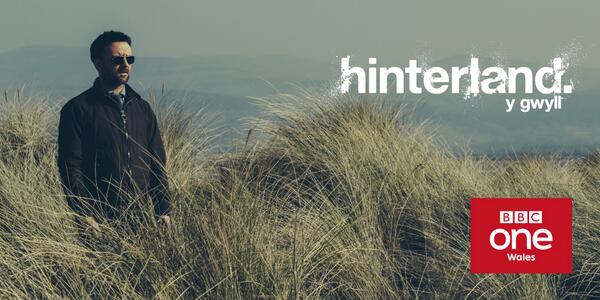
Meanwhile, over on BBC One Wales from 21.30 to 23.05, we see the start of the gripping Welsh crime drama Hinterland, which aired a little while back in a Welsh-language version and will now be shown again in a bilingual version. I am SO pleased that both English and Welsh feature (the latter with subtitles), as this accurately reflects life in Wales, where you hear speakers hopping from one language to the other all the time.

This is what the BBC has to say on the decision to film in both languages (full press release available here):

>> The special adaptation of the drama for BBC One Wales will feature dialogue in both English and Welsh – the first time both languages have played a prominent role in a drama series broadcast by the BBC. The Welsh-language elements of the programme will have on-screen subtitles.

Starring Richard Harrington, Hinterland has already attracted critical acclaim for its brooding portrayal of police life in west Wales. The Guardian said “fans of washed-out noir are going to love this for its slow, confident pacing, attention to detail and Harrington’s engrossing performance.”

The new series follows a commitment made by BBC Cymru Wales Director, Rhodri Talfan Davies, at the Celtic Media Festival in April to better reflect Welsh language life and culture on BBC One Wales. At the time, he said: “I think we have to spend more time finding bridges that can connect different audiences to cultures, view-points and experiences they might not normally encounter. On BBC One Wales I want us to think creatively about how we allow Welsh language voices and experiences to be heard and experienced a little more.” <<

For my take on the Scandi-influenced, Welsh-language original Y Gwyll, including a spoiler-free review of the first episode, see here. Further details are available in The Radio Times.

The eagle-eyed among you will have spotted that these two programmes clash… Set those recorders now – neither should be missed!

Out with the old, in with the new. Happy 2014!

HAPPY NEW YEAR!

I always love those quiet days between Christmas and New Year. They’re the perfect time for reading, and – for the bloggers among us – provide a great chance to tie up loose ends and plan ahead.

Some loose ends now neatly tied up in a bow:

  • I took part in two reading challenges last year, the 2013 Global Reading Challenge and the 2013 Translation Challenge. I completed both, and enjoyed the global challenge in particular, as it made me reflect on the geographical distribution of my reading (somewhat biased towards Europe and the US). You can see which books I read for the challenges here.
  • I’ve managed to finish my two Christmas reads, which complemented one other very well. Patricio Pron’s My Father’s Ghost is Climbing in the Rain is a literary memoir exploring a father-son relationship and the legacy of Argentina’s military dictatorship. It’s an interesting read, but took a little while to get going (it would probably benefit from a second reading, as the significance of earlier sections becomes clearer in the light of later ones). While not a crime novel, criminality is a key theme and the genre is frequently referenced, albeit in slightly contradictory ways. For example, the narrator comments: ‘I understood for the first time that the children of young Argentines in the 1970s were going to have to solve our parents’ pasts, like detectives, and that what we were going to find out was going to seem like a mystery novel we wished we’d never bought’ (p.152). But then a little later it’s suggested that exploring ‘social crime […] through the artifice of a detective novel’ is inadequate, because ‘the resolution of most detective stories is condescending, no matter how ruthless the plotting, so that the reader, once the loose ends are tied up and the guilty finally punished, can return to the real world with the conviction that crimes get solved and remain locked between the covers of a book, and that the world outside the book is guided by the same principles of justice as the tale told inside and should not be questioned’ (p.153). Of course that’s not always the case: lots of contemporary crime authors have pushed the boundaries of the genre to explore the absence of justice for state crimes. I wonder if Pron has read Ernesto Mallo’s outstanding 2006 crime novel Needle in a Haystack (see my review here), which examines the same historical period? It’s precisely the lack of a resolution/punishment for the crimes committed by the junta that gives the narrative its power.

  • My other Christmas novel was Jan Costin Wagner’s Light in a Dark House (Harvill Secker 2013), the fourth in the German/Finnish Kimmo Joentaa series, which was an excellent read. Even though each installment is made up of quite similar elements, the quality of the characterisation and narrative construction is such that they never appear formulaic. The starting points in Light in a Dark House are the disappearance of Kimmo’s secretive on-off lover, and the murder of a nameless, comatose woman in a hospital. Intriguingly, the only clue left by the murderer is ‘lacrimal fluid’, or tears.
  • And the connections between the two? The legacies of past violence, unresolved traumas, and the damaging effects of silence. These issues are presented quite differently in each, which makes them an interesting pair to read together.

Looking ahead:

  • Santa was kind enough to bring me a number of crime novels, including Gillian Flynn’s Sharp Objects (Phoenix 2007), Eduardo Sacheri’s The Secret in their Eyes (Other Press 2005/2011) and John le Carré’s A Delicate Truth (Viking 2013). I’m going to make the Sacheri my first crime novel of 2014, as I enjoyed the Oscar-winning film adaptation of 2010, and am keen to read the original novel. That’ll keep me going on my Argentinian reading path as well for now.
  • As a 2014 Petrona judge, I need to pick up the pace of my reading. Thus far I’ve read 20 of the submissions, which means I have rather a lot to go. (This is by way of a confession to Karen, Barry and Sarah, but I will get cracking now, promise…once I’ve read the Sacheri, that is).
  • More generally, 2014 is going to be different compared to other years, as I’m on research leave for a semester from the end of January *happy face*. More on my plans for that interlude another time…

Wishing you all a great start to the year and many hours of good reading!