Jakob Arjouni event / A trip to Swansea Library / Maigret

News of an event tomorrow night that will be of particular interest to those in London:

No Exit Press, together with Pancreatic Cancer UK, is hosting an event at Daunts Books (112-114 Holland Park Avenue, London, W11 4UA) on Tuesday 26th November, 18:30-21:00, to celebrate the life of German author Jakob Arjouni (1964-2013) and to raise funds for research into pancreatic cancer (http://www.pancreaticcancer.org.uk/). Barry Forshaw will be hosting and there’ll be German food and drink available. Entry is free.

The event will also launch Arjouni’s fifth and final Kayankaya novel, Brother Kemal. Regular readers of this blog will know that I’m particularly fond of the first in the series, Happy Birthday Turk!, which was an absolutely ground-breaking German crime novel back in the 1980s – see my earlier post here. I can also thoroughly recommend Brother Kemal, which provides a wonderful conclusion to the Kayankaya series.

In other news, I’ve been down to my local library to stock up on some crime fiction! I’m particularly blessed that Swansea Central Library is on my doorstep, which has an impressive range of crime fiction, including lashings of international crime. I came away with a satisfying selection including the first Arabic detective novel in English translation (Abdelilah Hamdouchi’s The Final Bet), some Spanish crime (Eugenio Fuentes’ At Close Quarters) and M.J.McGrath’s second Arctic novel, The Boy in the Snow. I’ve now read the first two, which were both excellent in their own ways, and am looking forward to meeting Edie Kiglatuk again soon.

Aside from the quality of these novels, it’s been a relief to read some crime that doesn’t open with the gruesome murder of a young woman. All too many of the novels sent to me by publishers begin with blurbs such as the following: ‘the body of a young woman is found carved up and buried in a forest glade’ / ‘a young woman is discovered in her apartment bound and gagged, the victim of an extraordinarily brutal attack’ / ‘a young woman has been brutally killed, her body abandoned in a car boot as a warning to others’ / ‘a young girl has been brutally murdered, her body arranged in bed with her hands over her eyes’. And so on… There does seem to be a depressing pattern here of an opening set piece featuring a young, sadistically brutalised female, and I’m getting pretty fed up with the gratuitousness of it all. I think a few more trips to the library are in order soon.

And finally… I’ve set up a new Maigret tab on the main menu of the site, where I’ll post mini-reviews of Simenon’s 75 Maigret novels as they are reissued by Penguin once a month. The idea is to build up a nice record / resource over time, and to track interesting developments in the series. It’s a (very) long-term reading challenge, which you are most welcome to join – either for the whole or for part of the way.

Arnaldur Indriðason’s Strange Shores / Iceland Noir

So I’ve finally read Arnaldur Indriðason’s Strange Shores (Harvill Secker), possibly the last novel in the Inspector Erlendur series, in which our favourite Icelandic detective heads back to his abandoned childhood home to face the trauma that has shaped his life – the disappearance of his little brother Bergur in a snowstorm when he was eight years old. While there, Erlendur also starts to dig into another unresolved story: that of Matthildur, a young wife who set off across the frozen fjords one day in 1942 and was never heard of again. The two cases are entwined throughout this absorbing narrative, and cuminate in a powerful and and thoroughly moving ending.

What a fine series this is: while consistently delivering satisfying police procedurals, Indriðason has provided his readers with wonderfully realised investigative figures, and with an insightful portrait of a rapidly changing Iceland (and all the good and bad such transformation entails). He also very effectively explores profound themes such as grief and loss. On re-reading my earlier review of The Draining Lake I found I had written that Indriðason’s sensitive treatment of ‘the missing’ – and of the impact of losing someone without knowing their final fate – lifted the novel above many others in the genre. The same remains true of Strange Shores.

If you’d like to know more about the novel, I recommend heading over to Raven Crime Reads, where you’ll find an excellent review. But if you’ve not yet read all the others in the series, it might be best to do so first…

Those with Erlendur withdrawal symptoms will be glad to know that Indriðason has written a prequel set in 1974 entitled Reykjavikurnaetur (Reykjavik Nights), which was published in Iceland last year. Hopefully it will be translated into English soon. Indriðason’s latest novel is called Skuggasund (Shadow Channel), and won this year’s Spanish RBA crime fiction prize. Many thanks to Quentin Bates, author of the marvellous Gunna crime series, for passing on this cheering information.

And speaking of Arnaldur and Quentin… This week sees a very special event taking place in Reykjavik for the first time – the crime convention ICELAND NOIR – which both writers will be attending, as well as a host of other Icelandic, Scandi and British authors. It looks like it’s going to be an absolutely fantastic few days, and I am deeply, deeply jealous of all who will be there. Please tweet and blog LOTS so we can take part vicariously.

Iceland Noir Poster

New MURDER anthology / Making an impact…with kittens

Exciting news! Margot Kinberg at Confessions of a Mystery Novelist has just announced the publication of a new crime anthology.

In a Word: Murder is a tribute to the late Maxine Clarke, crime blogger extraordinaire, and features stories set in the worlds of writing, editing, reviewing and blogging. Treats include the murder of a true-crime magazine editor, a life-or-death short story competition and a deadly literary festival. Deliciously wicked stuff!

in-a-word-murder-cover

Go on…you know you want to…!

Proceeds will go to the Princess Alice Hospice and can be purchased here. I’ve already got my copy and am keen to get reading.

There’s also been a bit of excitement here at Mrs. Peabody Investigates. As many of you know, I’m an academic by trade, and have used the blog to discuss my research on crime fiction, and to promote debate about this very rich literary genre. As a result of the blog’s success, it’s become a university ‘impact case study’, exploring the reach and significance of academic work in the public realm. Remember that survey that I asked you to fill out a little while back? The one with the kittens? That was me trying to find out how much the blog had benefited you as blog users, in terms of widening or changing your reading habits, or making you think more deeply about crime fiction. And the response, from 188 of you, was truly fantastic.

So the excitement today is that Mrs. Peabody Investigates features in The Guardian newspaper in an article about impact. It’s a discussion piece, but might be of interest in terms of seeing how Mrs P fits into my academic life. Please note the bit where I say that ‘making research more accessible to the public also helps to enrich it, by bringing in new voices’. Those voices are yours, and have most definitely had a beneficial impact on my own research. I learn a huge amount from you all the time, which creates a very virtuous circle indeed.

Time for a celebratory kitten!

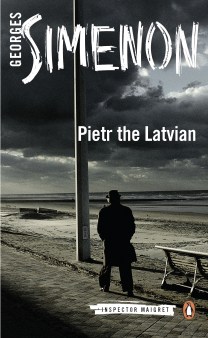
The very first Inspector Maigret novel: Pietr the Latvian

A little while ago, I reported that Penguin were publishing all 75 of Georges Simenon’s Inspector Maigret novels – in their original order and with new translations – at the rate of one a month, starting in November with Pietr the Latvian. Their press release states that this is ‘part of Penguin Classics long-term project to bring Simenon’s writing to a British audience’ – a laudable aim given his output of over 400 novels and short stories, and his status as a literary giant in Europe.

Penguin kindly sent me a copy of Pietr the Latvian, beautifully translated by David Bellos, which I very much enjoyed reading over a rainy weekend. Originally published in 1930, the novel felt a little old-fashioned in some respects, but remarkably modern in another:

  • There were moments when I had to take a deep breath due to the novel’s negative depiction of Jewish characters and its essentialist approach to issues such as race. Anti-Semitism and biological determinism were common in the 1930s, and might not have stood out for readers of the time, but of course they do now. And the fact that the book was published in the same decade that National Socialism took hold in Germany is a sobering one. I did find that there was somewhat more nuance towards the end of the novel, so I’ll be interested to see how these elements are handled later in the series…
  • But one very pleasant surprise was the highly European feel of the novel. Right at the beginning, Pietr the Latvian is identified as a major criminal being tracked by the ICPC or International Criminal Police Commission, based in Vienna, which ‘oversees the struggle against organised crime in Europe, with a particular responsibility for liaison between the various national police forces on the Continent’ (p.1). Sounds a lot like more modern organisations such as Interpol or Europol, doesn’t it? And in the course of the first four pages, Maigret is shown reading telegrams from Krakow, Bremen, the Netherlands, Brussels and Copenhagen, moving effortlessly between languages as he checks the progress of Pietr across Europe to his own juristiction of Paris.

Up until now, I’ve associated this kind of ‘Eurocrime’ feel with novels written after the collapse of communism in 1989, such as Henning Mankell’s The Dogs of Riga and Arne Dahl’s more recent Opcop/Europol series, which thematise the rise of organised crime across European borders, and the need for coordinated pan-European policing. But now I can see that these constitute just one phase of the ‘European crime novel’, and a late-ish one at that. Simenon’s Maigret debut was already on the case in 1930, and that means others from that time and beyond are likely to address similar themes. I’m already looking forward to finding them for the Euro strand of my research: as always, suggestions gratefully received!

The second Maigret novel, The Late Monsieur Gallet, will be out in December. I can already feel a little prickle of addiction, which is no doubt exactly what the good people at Penguin intend… The book covers, by the way, are by Harry Gruyeart, a Magnum photographer. This is undoubtedly going to be a gorgeous-looking series.