
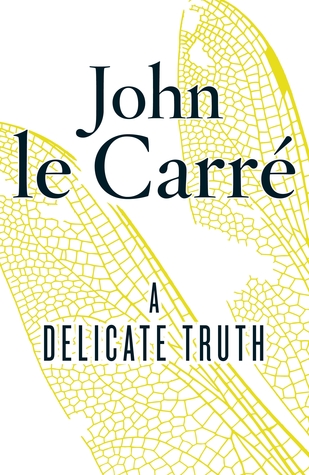
Today, 25th April, sees the publication of John le Carré’s new espionage novel, A Delicate Truth, which has already garnered excellent reviews (see for example Mark Lawson in The Guardian). Set in 2008 and 2011, it explores shady Whitehall operations against the background of the Bush-Blair era and the ‘war on terror’, and is being viewed as a stunning return to form.
In the run-up to publication, le Carré has also been marking the 50th anniversary of The Spy Who Came in from the Cold (1963). In a piece for The Guardian on 13. April, he explores the personal and historical contexts in which this ground-breaking novel was written, and the frustration he experienced at being ‘branded as the spy turned writer’; the author of ‘anti-Bond’ novels that critics erroneously insisted on regarding as spying handbooks.
Given all the above, it seems like an apt moment to try to sum up what makes le Carré such a wonderful and important writer. Here is my personal appreciation, in random top 10 form:

One of the many covers for The Spy – showing the barbed wire that divided East and West in front of the Brandenburg Gate in Berlin
I love John le Carré’s works because…
1. …the author and his creation George Smiley are linguists. Le Carré studied German literature for a year at the University of Bern, and graduated with first-class honours in modern languages from Oxford. Most of his spies are linguists, and the most famous of them all, George Smiley, studied Baroque German literature and was destined for academia until the British Secret Service came knocking (in the shape of the brilliantly named ‘Overseas Committee for Academic Research’). The profession of intelligence officer offers Smiley ‘what he had once loved best in life: academic excursions into the mystery of human behaviour, disciplined by the practical application of his own deductions’ (Call for the Dead, Penguin 2010, p. 2). And languages still really matter. Smiley’s ability to speak fluent German plays a vital role in Smiley’s People when he gathers intelligence in Hamburg, the city where he spent part of his boyhood, as well as a number of years ‘in the lonely terror of the spy’ during the Second World War. Le Carré says of him that ‘Germany was his second nature, even his second soul […] He could put on her language like a uniform and speak with its boldness’ (Sceptre 2011, pp. 252-3). This author’s world, then, is overwhelmingly multilingual, multicultural and international. Monoglot Brits need not apply…
2. …they so effectively evoke Germany during the Cold War. The frequent use of a German setting was practically inevitable given le Carré’s education, his membership of the British Foreign Service in West Germany (as Second Secretary in the British Embassy in Bonn and Political Consul in Hamburg, which provided cover for his MI6 activities), and the timing of his stay between 1959 and 1964 at the height of the Cold War. Berlin was the frontline of the ideological battle between the Eastern and Western blocs, and le Carré says in an afterword to The Spy Who Came in from the Cold that ‘it was the Berlin Wall that got me going, of course’ (Penguin 2010, p. 255). Le Carré’s first novel, Call for the Dead, was published in 1961, the year the Wall went up, and, along with a number of his other novels, is partially set in East/West Germany (see list below). The most memorable for me are The Spy Who Came in from the Cold (1963) and Smiley’s People (1979), both of which feature dénouements involving Berlin border crossings and evoke the Cold War tensions of that time and place perfectly.
3. …as someone who teaches in this area, I appreciate le Carré’s sophisticated understanding of 20th-century German and European history. This is evident in his recent Guardian piece, where he references the complexities of Allied intelligence operations in Cold War West Berlin, including the pragmatic but unethical protection of former Nazis, because they were viewed as valuable in the fight against communism. The difficult legacy of National Socialism in post-war Germany is most closely examined in his 1968 novel A Small Town in Germany (and forms part of the corpus for my own research on crime that engages with the Nazi period).

4. …as someone who reads and researches lots of historical fiction, I admire le Carré’s ability to communicate complex histories to a mass readership in intelligent and entertaining espionage novels. This isn’t something that many authors can do well; le Carré is one of the best.
5. …their narratives reveal a deep engagement with moral questions. A fascination with the themes of loyalty and betrayal – in relation to both individuals and ideologies/states – is particularly visible in the Cold War ‘Karla Trilogy’ (Tinker Tailor Soldier Spy 1974; The Honourable Schoolboy 1977; Smiley’s People 1979), which in turn forms part of the eight-novel Smiley collection. What’s had the greatest impact on me as a reader, though, is the critique of how the intelligence services (on either side of the ideological divide) are willing to sacrifice the individual for the ‘greater good’, and the recognition of the immorality of this act. Le Carré’s third and fourth novels – The Spy Who Came in from the Cold (1963) and The Looking Glass War (1965) – are extremely powerful in this respect, as they recount the tragic tales of those who become pawns in larger political chess games. Incidentally, I’ll bet my maximum bet of 10p that the figure of Avery in the latter novel most accurately embodies the professional and moral disillusionment that led Carré to leave the Service. The central question for this author was and continues to be: ‘how far can we go in the rightful defence of our western values, without abandoning them on the way?’ (see Guardian piece).
6. …their characters are fantastically drawn. Aside from the masterpiece of Smiley, the dumpy, middle-aged, unassuming, sharp-as-a-tack intelligence genius, who could forget Control, Connie Sachs, Toby Esterhase, Peter Guillam, Ricky Tarr, Jerry Westerby, Bill Haydon and Jim Prideaux? All are so beautifully depicted that you feel they are living, breathing people.

Kathy Burke as Connie Sachs in Tinker Tailor Soldier Spy (2011)
7. …you won’t find more perceptive writing anywhere. In German one would say that le Carré is ‘wach’: he is awake. He really SEES the world around him and has a deep understanding of how its political and power structures work, and how individuals get tangled up in them.
8. …they have given us wonderful TV and film adaptations, featuring great actors such as Alec Guinness and Richard Burton (whose diaries happen to rest at my own institution, Swansea University). See here for my film review of the 2011 adaptation of Tinker Tailor Soldier Spy with Gary Oldman.

Alec Guinness as Smiley, retrieving a clue in Smiley’s People (1982)
The man sees everything….
9. …they are so often top-quality. One of my own later favourites is 2001’s The Constant Gardener – a brilliant exploration of pharmaceutical corruption for commercial gain in the developing world. And now, at the age of 81, it looks like he’s done it again with A Delicate Truth. Mark Lawson, in his review, writes that ‘le Carré has a strong claim to be the most influential living British writer’ and that he ‘is back at full power with a book that draws on a career’s worth of literary skill and international analysis’. ‘No other writer has charted – pitilessly for politicians but thrillingly for readers – the public and secret histories of his times, from the second world war to the ‘war on terror’.
10. Last but not least, le Carré is a true friend of languages, and has been extremely generous in using his influence to promote language learning in the UK – for which I as a German studies lecturer am deeply grateful. He was deservedly awarded the Goethe Medal in 2011 for ‘outstanding service for the German language and international cultural dialogue’.
All of which leads me to say how much I’m looking forward to reading A Delicate Truth. Further information about the novel is available at le Carré’s website (including an audio excerpt and the first chapter). The novel begins with a quote from Oscar Wilde: ‘If one tells the truth, one is sure, sooner or later, to be found out’. Something every spook needs to remember…
Le Carré novels that reference the German-speaking world/history
Call for the Dead (Smiley’s German links; Nazi past; East Germany)
The Spy Who Came in From the Cold (Nazi past; divided Berlin; East Germany)
The Looking Glass War (East and West Germany)
A Small Town in Germany (Nazi past; Bonn, West Germany)
Smiley’s People (Hamburg, West Germany; Bern, Switzerland; divided Berlin)
The Perfect Spy (German at Oxford; Vienna and Berlin)
The Secret Pilgrim (diverse, including East Berlin, Hamburg, Munich, Zurich)
Absolute Friends (West Germany, East Germany)
A Most Wanted Man (Hamburg, Germany)
Our Kind of Traitor (Switzerland).




 Mrs. Peabody Investigates