#28 / Jussi Adler-Olsen, Disgrace

Jussi Adler-Olsen, Disgrace, translated from the Danish by Kyle Semmel (London: Penguin, 2012). A second, rather lacklustre outing for Carl Mørck of Department Q        2.5 stars

Opening line: Another shot echoed over the treetops.

Mercy, the first novel in the Danish ‘Department Q’ series, was one of my top reads of 2011 and I was very much looking forward to reading this follow-up. However, as is sometimes the way with that tricky second novel, Disgrace didn’t quite live up to the brilliance of its predecessor, and is ultimately an uneven read.

While the cold-case format and the conflicted figure of police detective Carl Mørck remain engaging, the depictions of the suspects in the twenty-year-old murder of two teenagers are disappointingly one-dimensional and let the novel down. Spoiled, fabulously wealthy individuals, they’re shown using money and social status to indulge their sadistic desires in a number of over-the-top, yet yawningly predictable ways. Having failed to accept them as realistic depictions, I tried viewing them as representative of a larger malaise within Danish society or the product of capitalism gone mad – but didn’t feel that either of these readings worked particularly well either.       

A rare exception to the novel’s monochrome characterisations is the figure of Kimmie, the only girl to have been part of the group, whose more complex psychological profile allows us to understand the origins of her behaviour, and her reasons for choosing to live rough in the present. Her status is that of both abuser and abused, and her representation raises some interesting questions about gender and power relations. In this respect, the novel links back positively to Mercy, whose core strength was the strong depiction of its central female protagonist Merete.

I’m still keen to read the next instalment in the series, as the concept of a cold-case Department Q led by maverick detective Mørck has plenty of potential. However, if the third novel is closer to Disgrace than Mercy as a reading experience, I may call it a day. Either way we’ll be hearing more of the series shortly, as according to the publisher, both the first and second novels are to be adapted by the makers of the Stieg Larsson films.

You can read an extract from Disgrace here.        

Mrs. P’s review of Mercy is available here.

Thanks to Penguin for providing Mrs. Peabody Investigates with a review copy. 

Mrs. Peabody awards Disgrace an underwhelmed 2.5 stars.

Creative Commons License

.

The Killing 3: Lund is back…one last time

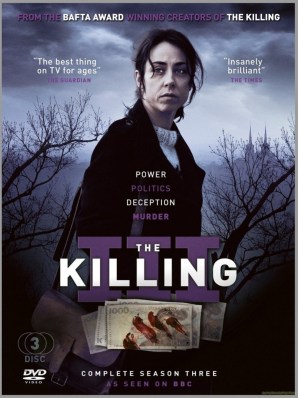
Watching the opening of The Killing 3 tonight was a bitter-sweet experience. On the one hand, there was the delight of seeing ‘our Sarah’ again and hearing that oh-so-evocative theme tune, and on the other, a sense of melancholy, because this is really it – the final series – as director Søren Sveistrup has repeatedly stressed in interview.

Cover of the Series 3 DVD, due out mid-December

Warning: slight spoilers below

In the previous two series of The Killing, Sarah Lund has faced a stark choice between the conventional happiness provided by a strong family life and her commitment to the role of police detective, one that ultimately alienated everyone around her, leaving her painfully isolated. Viewer reactions to Lund’s professional tenacity have sometimes been divided between admiration (without her, cases wouldn’t have been solved), and criticism for neglecting her family (in particular her son). These reactions have in turn generated some interesting discussion about gender stereotypes, especially as Sofie Gråbøl, the actress playing Lund, has said that the key to her characterisation was ‘acting like a man’.

When we meet Lund at the beginning of Series 3, it looks like she’s opting for happiness: after 25 years on the force she’s completed her fair share of murder investigations, and is moving sideways into a comfortable desk-job at the OPA (Operational Planning and Analysis unit). She’s trying to make time for herself (gardening! cooking! a funky new jumper!) and to repair her relationship with her son Mark. Of course, we know it can’t last – seeing Sarah cook a tasty Stuvet Oksekød doth not a riveting crime series make. And so, when a man’s dismembered body is found by the Copenhagen docks ahead of a visit by the Danish prime minister, it’s clear that she’ll soon be back to her old investigative ways. And when she is, we’re treated to a heady (and topical) brew of big business, politics, kid-napping and murder that’s gripping to watch. I already have a bit of a theory, which I’m writing on a bit of paper to be unfolded only after episode 10…

To be honest, though, I’m a little fearful for Lund. After the traumas sustained in the last two investigations, I’m not sure she can survive a third intact, either physically or mentally. I’m also a bit worried that director Søren Sveistrup will send her off with a bang that’s way too literal for my liking at the close of the series. Lund’s death in service would in many ways be a fitting and logical end to her unswerving dedication to the job, which takes her into dangerous situations and annoys some exceedingly nasty people. But I would really rather that didn’t happen to our girl.

On a lighter note, I settled down on the sofa this evening for a highly enjoyable game of  ‘Forbrydelsen Bingo’. I can report that I put a cross in a grand total of 7 of my boxes. I’ll hang on to my sheet to see if I can cross off the other 5 next week.

Finally … here’s a whole heap of marvellous links for your delectation

Episodes 1 will be repeated on Monday 19. November at 11.25pm, with episode 2 following on Tuesday 20. at 11.25pm. Both are also available on BBC iPlayer.

I’d love to hear your thoughts on the beginning of the series, but please try to avoid big spoilers so that we protect the enjoyment of those still to watch 🙂

Update: there are a few spoilers in the comments below, so please look away if you haven’t yet watched!

It’s time for ‘The Killing 3’ Bingo!

So it’s T-minus two hours. Tonight sees the start of Forbrydelsen / The Killing 3 at 9pm on BBC4 – the long, long wait of dedicated British fans is nearly over.

If you have loyally accompanied Sarah Lund from the start of her journey in the amazing opening episodes of series one, then you might like to join me this evening in a game of ‘The Killing 3’ Bingo, which pays affectionate tribute to some of the hallmarks of this exceptional crime drama. Enjoy!

(I might add that I’ve had to employ some Lund-like doggedness to import this table into WordPress via Word, Paint and Flickr. My reward is an *extra-large* glass of wine with tonight’s episodes.)

Update: By the end of episode 2, I had 7 boxes crossed and by the end of episode 4, 11 boxes 🙂 Just one to go…

Jakob Arjouni’s Turkish-German Kayankaya series

I was delighted to hear that Jakob Arjouni’s Turkish-German investigator Kemal Kayankaya was going to feature on the Radio 4 ‘Foreign Bodies’ series, and to contribute a bit to the episode in question, as it gave me an excellent chance to re-read the Kayankaya novels and to get my hands on the latest instalment, Brother Kemal, published in Germany just this year.

In order of appearance, they are:

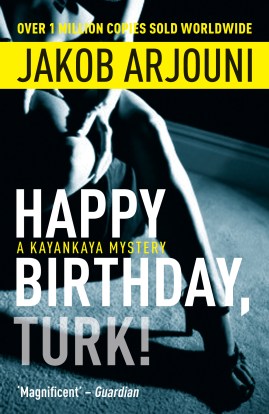
  1. Happy Birthday, Türke / Happy Birthday Turk (1985)
  2. Mehr Bier / More Beer (1987)
  3. Ein Mann, ein Mord / One Man, One Murder (1991)
  4. Kismet / Kismet (2001)
  5. Bruder Kemal / Brother Kemal (2012)

Blue Night 4 Arjouni

The first time I came across Kayankaya was in 1988, in the ‘foreign literature’ section of Borders on Oxford Street in London. The novel was Happy Birthday, Turk, which had been published in Germany in 1985, and had become a surprise critical and commercial hit. It was written by debut author Jakob Arjouni at the tender age of just nineteen.

It’s hard to overestimate how ground-breaking the figure of the Turkish-German P.I. Kemal Kayankaya was in the West Germany of the 1980s, when public attitudes towards the migrant workers who had helped to rebuild post-war Germany were deteriorating (‘job done, now please go home’). Asking German readers to identify with the likeable, wise-cracking, football-and-pickled-herring-loving Kayankaya directly challenged the dominant stereotype of ‘the Turk’ as a kebab-shop owner, rubbish collector or criminal who was poorly integrated into society and spoke only broken German. Kayankaya, the child of a Turkish migrant worker, is depicted as highly articulate, confident in his professional abilities, and – exceptionally for the time – as the holder of a West German passport, courtesy of his adoption by a German couple after his parents’ death. His characterisation thus deliberately up-ends the average German reader’s perception of what a Turkish person living in Germany ‘is like’, and confronts essentialist notions of German national identity. A Turkish-born person with a German passport? A Turkish-German citizen? Really?

Kayankaya’s early investigations, which fuse parts of the American hard-boiled tradition with the German Sozio-Krimi (sociological crime novel) of the 1970s, are used to expose the corruption of the state and to reveal the racism at the heart of West German society – the lingering legacy of National Socialism. The tables are thus deftly turned by Arjouni: the focus is on German criminal activity, and the crimes of Turks and other minorities are shown in the larger context of the unequal power-relations that exist within the state (for example, a ‘bad’ Turk is shown having been blackmailed into dealing drugs by corrupt police officers who threaten him with deportation should he not comply).

DVD cover of the film adaptation of Happy Birthday Turk (1991)

There’s also plenty of wise-cracking, acerbic humour. In fact, wit and sarcasm are shown to be key weapons when dealing with the tedious, casual racism the P.I. encounters as he goes about his daily business in Frankfurt.

Thus we are treated to the following classic exchanges:

  • German woman to Kayankaya: ‘You speak really good German!’
  • Kayankaya to German woman: ‘Thanks (long pause). You too’.

And…

  • German bureaucrat to Kayankaya: ‘Name?’
  • Kayankaya: ‘Kayankaya’.
  • German bureaucrat: ‘Spelling?’
  • Kayankaya: ‘Pretty good. Though I do have a little trouble with those foreign words’.

The Kayankaya novels are not necessarily perfect, but Kemal Kayankaya remains a ground-breaking investigative figure in the history of European crime fiction. A thoroughly original creation, he is used to raise some genuinely troubling questions about dominant social attitudes towards minorities. Many of the points the novels raise about social exclusion and about the uneven distribution of justice within society remain as pertinent today as in the 1980s.

Later novels in the series, as the ‘Foreign Bodies’ episode shows, engage with the seismic changes in Europe following the collapse of communism in 1989/90, and, most recently, with the tensions caused by Islamic fundamentalism (Brother Kemal).

You can listen to the ‘Foreign Bodies’ episode about Kemal Kayankaya, which features an interview with the author Jakob Arjouni, on BBC Radio iPlayer.

Image for PI Kemal Kayankaya

Theakston File 4: Jason Webster interview with Mrs. P.

If you tuned in to the 8th episode of the Radio 4 ‘Foreign Bodies’ series on Wednesday, you’ll have heard crime authors Jason Webster and Antonio Hill in animated discussion with Mark Lawson about Manuel Vázquez Montalbán’s investigator, Pepe Carvalho.

Listening to the episode, I realised now was the time to post my interview with Jason Webster at the 2012 Harrogate Crime Writing Festival. Key areas explored with the author of the ‘Max Cámara’ series, which is set in Valencia, include the legacy of the Spanish Civil War and the influence of Vázquez Montalbán.

Mrs. Peabody (MP): You’re a very versatile author: you started out as a travel writer, examining the history and culture of Spain, before turning your hand to crime fiction. Could you say a little bit about what led you to crime?

Jason Webster (JW): I suppose in some ways writing crime allows me to keep exploring Spain – this massive country that I’m really fascinated by – and has become an extension of the travel books, because the ‘I’ of the narrator in the travel books isn’t a million miles away from a detective: it’s exploration, it’s questioning, it’s looking for clues. And often there was a quest format in my previous books, so my writing has rolled on quite easily from those into crime.

MP: Are you able to take some of the material from those earlier books and incorporate it into your crime novels – say about flamenco or bull-fighting or Spain’s historical past?

JW: Definitely the past – the Spanish Civil War. I draw on that quite heavily for the third Max Cámara book, The Anarchist Detective, which will be coming out next year. So there’s a lot about this dark, dirty legacy of the Civil War – stuff that lots of people in Spain don’t want to talk about. Flamenco a little bit as well. Max likes flamenco so that fits, but it hasn’t played a huge part yet in any of the books.

MP: And do you think the crime genre is particularly suited to tackling subjects like the Spanish Civil War and the legacy of the past?

JW: Yes, absolutely. I mean there’s this largely untold violent history and lots of old wounds which haven’t healed. You have to remember that the families of those who were killed by Franco’s troops couldn’t mourn their dead. Anybody who was on the other side – on Franco’s side – and was killed or wounded – their stories were glorified for years and years. And when Franco died there was this period called ‘the pact of silence’ [pacto de silencio]. During ‘the transition’ [from Franco’s dictatorship to democracy] everybody agreed that you ‘don’t mention the war’… because that’s the only way we’ll get out of the dictatorship and move into democracy. But about eight years ago people started to ask – ‘hang on, what did happen to grandpa?’. So the grandchildren of the people who had suffered during the Civil War were saying, ‘well actually, I want to know’. And that opened up a can of worms, because a whole section of Spanish society – the political right, essentially – just didn’t want to go there. So there are a lot of untold stories, a lot of unhealed wounds, and a legacy of violence.

It’s perfect for writing crime, I think, because there are a lot of secrets … And in a sense there’s a long tradition dating back from the period of ‘the transition’ – just before Franco dies and just afterwards – of great Spanish crime writers like Vázquez Montalbán writing very much from a political point of view. They want to talk about what’s going wrong in Spain, and finally can publish their books once Franco dies, when the dictatorship is over and censorship has come to an end. So that’s very much part of the tradition of Spanish crime writing.

MP: Do you see yourself now as part of that tradition?

JW: In some ways, sure. Vázquez Montalbánwas definitely an inspiration, and the name that I gave Max Cámara…I was thinking of two things, really. I was thinking of Christopher Isherwood and ‘I am a camera’: ‘cámara’ means ‘camera’ in Spanish and it’s a perfectly legitimate surname as well. And this gives us a handle on Max’s character – he observes, he waits, he doesn’t really jump to conclusions. But I was also thinking of Vázquez Montalbán when he was writing under Franco and had been thrown in jail and had to write under a pseudonym – one of the pseudonyms he used was ‘Sixto Cámara’. So there’s a sort of homage to that, to Vázquez Montalbán…

MP: Can I take a tiny detour to your third book, Guerra: Living in the Shadows of the Spanish Civil War. What prompted you to write it?

JW: I was talking to one of the locals near where we live, which is in the middle of nowhere, off the grid. We were just chatting away, when she started telling me some things about the Civil War and took me to a place where she said there was a massacre, in around ’38 – so getting towards the tail end of the war, just as Franco was moving south towards Valencia. And she had seen this happen as a young girl – these bodies being buried. I’d sort of heard about this and it was about the time when it was starting to come out – these mass unmarked graves dotted around the country where people who had died at the hands of the Francoists were just buried… There was no commemorative plaque, there was no gravestone, no one had been allowed to mourn, the dead were buried there for years and years. And you know, death is important in Spain; it’s a culture where you seriously mourn the dead, and so for a whole side of the country not to have been able to mourn their dead… that’s a big deal.

I think a lot of people are just hoping that that generation– anyone who lived through that, anybody who suffered – will just die and then we can all forget about it. But there are quite a lot of people who are trying to recreate the oral history from the time – not let it just slip away. Paul Preston [the historian] and I have met on a number of occasions … and the book that he’s written on the ‘Spanish Holocaust’ is a very interesting one with a very interesting title… He’s deliberately being controversial. And he’s doing that because he’s making a statement about contemporary Spain as much as he is about the past. There are lots of Spaniards who don’t accept what happened. And they say we should just ‘turn the page’. But how are you going to get over the wounds unless you confront the past?

MP: It’s the classic model of the repressed, isn’t it?

JW: Yes, absolutely. Spanish society is still very much divided and this is what forms the backdrop to my second novel, A Death in Valencia. I’m trying to look at these massive divisions that split Spain apart still, eighty years after the Civil War.

MP: You build that history into your crime fiction through the figure of the grandfather, Hilario. He’s somewhat disapproving that his grandson Max chose to join the police.

JW: That deep paradox goes to the heart of who Max is, and I bring this to the fore in the third novel, The Anarchist Detective. Max comes from an anarchist family; he is essentially an anarchist himself, but an anarchist in the broad sense of the word. At the same time he’s an agent of the state, and of state authority, so how does that work? How does he square that circle? In some ways, what I’m doing in the second book, A Death in Valencia, is showing a breakdown in his character, because of this contradiction, whereas in the third book, he kind of resolves that paradox within himself.

MP: Do you think it’s helpful that you speak Spanish? I notice from having read some of A Death in Valencia ­that you include Spanish proverbs [refranes] in their original form, perhaps as a way of communicating with readers who are non-Spanish speakers – imparting the culture and giving us a flavour of the language as well. Is that a deliberate strategy?

JW: I think so. The problem is that it’s hard for me to put myself in the position of not knowing Spanish. Sometimes I’m just writing and there are certain phrases which I just think are so wonderful that I want to put them down in English. The proverbs are there because they are an important part of Max’s character. The Spanish are very, very proud of their proverbs, and it’s one of the things I love about Spain. It’s not Spanish intellectual culture that gets me going in the morning, it’s this intuitive side to the country and to the culture – and I see that in the proverbs. Essentially, there’s a deep wisdom that you feel has been passed on for centuries, by word of mouth – it’s an oral tradition. And I love that, so I did want to get that across in the novels.

MP: What do you think the Spanish would make of your crime novels?

JW: The first one, Or the Bull Kills You, might wind some people up because it’s about bull-fighting, but the second and the third ones don’t deal with so-called Spanish stereotypes, so they might be more acceptable. Basically, don’t talk about anything they term ‘el folklórico’ – flamenco, bull-fighting, all that kind of stuff that the Franco regime tried to promote in the 1950s and 1960s to get tourists to come over. It’s what they consider to be the backward side of their culture and they don’t want to perpetuate the image that that’s all Spain is about. But the Spanish Civil War is a legitimate topic for foreigners to discuss…. It’s complicated!

Interview carried out at the Old Swan Hotel, Harrogate, 20 July 2012

You can still listen to the ‘Foreign Bodies’ episode on Montalbán’s Pepe Carvalho via BBC iPlayer.