Friday snippets: ‘Death of the remake?’ and ‘Once upon a Time in Anatolia’

FRIDAY SNIPPET 1

An article by Charles Gant in today’s Guardian asks ‘Is the Hollywood remake dead?’. In it he explores why some English-language remakes (most notably of the Swedish film The Girl with the Dragon Tattoo) are not fairing as well as expected at the box office, and highlights the increased success of foreign-language films in recent years. Gant quotes Marianne Gray, a producer with Yellow Bird Films, who feels ‘everything is getting more global, and audiences are more accepting of subtitles’, but goes on to argue that there’s a bigger factor at play here as well. Put simply, ‘films are succeeding because of their foreignness, not in spite of it’; their unique selling point is authenticity, with audiences keen to sample ‘authentic originals’ rather than commercially-driven copies.

Good marketing tactics don’t hurt either, of course. The Norwegian adaptation of Jo Nesbo’s Headhunters opens in cinemas this Good Friday, a release date that proved highly profitable for Tomas Alfredson’s Swedish film Let the Right One In back in 2009.

The article raises some other interesting questions, such as why English-language remakes are considered necessary in the first place, and is well worth a read.

FRIDAY SNIPPET 2

Critics seem to be unanimous in their praise of Nuri Bilge Ceylan’s Once Upon a Time in Anatolia (Bir zamanlar Anadolu’da): ‘a carefully controlled masterpiece’  (French / Observer); ‘completely gripping…an astonishing crime procedural’ (Quinn / Independent); ‘murder mysteries rarely run so deep’ (Calhoun / Time Out). It also won the Grand Prize at the 2011 Cannes Film Festival.

The more I read about this film, the more I want to see it, and the more frustrated I become at its apparently limited distribution in the UK. I’d love to see it in on the big screen in the cinema, but may have to wait for the DVD *sigh*

Here, in any case, is a tantalising synopsis from the Cinema Guild film website:

‘In the dead of night, a group of men – among them a police commissioner, a prosecutor, a doctor and a murder suspect – drive through the Anatolian countryside, the serpentine roads and rolling hills lit only by the headlights of their cars. They are searching for a corpse, the victim of a brutal murder. The suspect, who claims he was drunk, can’t remember where he buried the body. As night wears on, details about the murder emerge and the investigators’ own secrets come to light. In the Anatolian steppes nothing is what it seems; and when the body is found, the real questions begin’.

Read Anthony Quinn’s 5 star review of the film in The Independent here (no major spoilers).

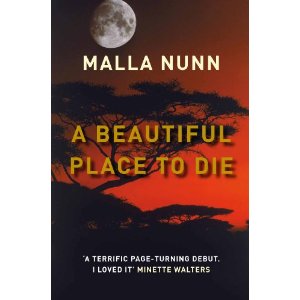
#20 Malla Nunn / A Beautiful Place to Die

Malla Nunn, A Beautiful Place to Die (London: Picador, 2010). An intriguing debut novel set in 1950s South Africa as apartheid is taking hold 4 stars

 Opening sentence:  Detective Sergeant Emmanuel Cooper switched off the engine and looked out through the dirty windscreen.

I’ve been looking for a good crime novel to sink my teeth into, and this one stood out from the crowd as I was browsing online recently. A Beautiful Place to Die is the debut crime novel by Malla Nunn, an Australian-based but Swaziland-born author, and is the first of the Emmanuel Cooper series, set in 1950s apartheid South Africa. It was awarded the Australian ‘Sisters in Crime Davitt Award for Best Adult Crime Novel’ and was shortlisted for the American Edgar Awards (‘Best Novel’ category).

The book opens in September 1952 with the discovery of a murdered police captain, Willem Pretorius, in a river by the South African settlement of Jacob’s Rest, near the Mozambique border. Detective Emmanuel Cooper is called in to investigate, and soon realises that the case is extremely sensitive, as Pretorius is a well-connected Afrikaaner within the powerful National Party movement, and Security Branch investigators are poised to take political advantage by framing a black communist for the crime. It quickly becomes clear that getting to the bottom of this murder will place a number of individuals, including Cooper himself, in a great deal of danger.

For me, the great strength of this novel was the way it used the crime narrative to illustrate the socially divisive and destructive effect of the racial segregation laws, introduced by the Nationalist government from 1948 onwards. Cooper, who served in Europe during the Second World War, notes despondantly that ‘eight years after the beaches of Normandy and the ruins of Berlin, there was still talk of folk-spirit and race purity out on the African plains’. Ironically, apartheid was gearing up for four decades of oppression at practically the same time as German fascism in Europe was defeated.

The novel convincingly captures the tensions apartheid generates within Jacob’s Rest, as well the inevitable tangles that its simplistic racial categorisations bring about: the dedicated Volk ideologue who furtively thinks of himself as part-Zulu; fair-skinned children of black and white parents who ‘pass’ illegally as whites; illicit liasons between white men and black women that fall foul of the Immorality Act because no law can successfully control desire. The novel also has interesting points to make about the gendered power-dynamics of interracial relationships, and the limited options open to black women being pursued by white men.

While I felt the first half of the book was extremely well-written, with a tremendous sense of place, portions of the second half dipped substantially for me, mainly because the plot became too melodramatic for my taste. In spite of this I still find myself keen to read the second book in the series, due to the depiction of Cooper (a complex, well-drawn investigative figure negotiating a repressive regime), the novel’s successful portrayal of 1950s South Africa, and the fact that the novel lingered in my mind for many days after I’d turned the final page.

The second novel in the series, Let the Dead Lie, was published in 2011. The publisher’s synopsis is available here.

Mrs Peabody awards A Beautiful Place to Die a slightly wobbly but fascinating 4 stars.

Creative Commons License
.

The past is a foreign country; they do things differently there

I went to an extremely good author event yesterday, hosted by the Swansea Historical Association at the city’s Waterfront Museum, on the subject of authenticity in historical crime fiction.

I thought I’d report on a few of the interesting points raised there. At first glance, this might appear to be straying from Mrs P’s declared focus on international crime. However, as the opening line of L.P. Hartley’s The Go-Between tells us, ‘the past is a foreign country; they do things differently there’. If we were plonked down in England during the Elizabethan or even the Victorian era, we’d feel like we’d been transported to another country with a strange language and very different set of political, social and cultural rules. It follows that many of the issues raised when setting crime fiction in a different historical era apply equally to setting crime novels in other countries (and vice versa). And of course some international crime fiction is historical crime fiction too. So perhaps there are some links after all (that’s my argument, in any case, and I’m sticking to it).

The two authors talking about historical crime fiction and the issue of authenticity were Susanna Gregory and Bernard Knight. Both, of course, are very well known, and are perhaps most famous for their mediaeval mysteries – the Matthew Bartholomew series in Gregory’s case, and the Crowner John series in Knight’s (although each has also written novels set in other eras, such as the Restoration and the 1950s).

Mystery in the Minster

Here, in no particular order, are a few of the issues discussed by the authors about the pleasures and pains of writing ‘authentic’ historical crime fiction.

Why choose to write historical crime fiction set in the mediaeval era? Gregory set her first crime novel in 14th-century Cambridge to disguise the fact that she was writing about a political spat taking place at her university at that time – a decision that proved cathartic and led to a second career. Knight came to crime fiction through his army service in Malaya, where he read a series of sub-standard crime novels and decided he could do better. A forensic pathologist by trade, he set his main series of novels in the 12th century as a way of exploring the establishment of the coroner system, but also as a means of escaping the modern forensics of his day job. Both felt that there were advantages to writing on a more distant era (Gregory felt that modern periods were ‘more difficult’ to portray) and that readers were very interested in ordinary people’s lives at the time. Knight had spent a great deal of time poring over mediaeval recipe books in the course of writing the Crowner John series.

Historical authenticity is important. Knight said he had an ‘obsession with getting things right’ even though authors could deploy the excuse that the primary function of a crime novel is to entertain. ‘The story is made up, but the historical matrix in which it is set is as accurate as I can make it’. However, authenticity can ‘make things awkward’ if you suddenly realise that you’ve got a detail wrong in an earlier book.

‘The more you know about any particular period, the more you realise you don’t know’ (SG). Gregory felt that she was engaged in ‘a constant process of learning’ when researching a period, and both authors admitted their fear of making mistakes that are later picked up by readers. In Gregory’s case, someone pointed out that the bronze coin she’d made a clue in one of her plots would only have been in circulation six months after the novel was set. Knight described the moment he realised that the screws securing an item to the wall in his 12th-century setting were only invented in the 14th century.

‘I always walk the territory’ (BK). ‘Me too’ (SG). Both authors stressed the importance of topographical accuracy as a means of adding to the historical authenticity of the text. Examples given were looking at the layout of streets, checking which plants were in bloom during a particular season, and working out how long a trip would take by horse in different weathers. Gregory had once run from one end of Holborn to another in order to time how long this would take a character to do (the publisher obviously also thought this was an important detail as they paid for her travel expenses to find out).

Gadzooks! How strangely thou doth speke! Knight was aware that his use of modern-day English in the Crowner John series was an ‘anacronism right from the very start’, but also that there was ‘no point in making the language authentic because no one would understand’ early-middle English. So this was a limitation he had to accept for very pragmatic reasons, and had an unavoidable impact on the historical authenticity of the text.

Too much of a good thing? Gregory quoted a useful bit of advice she’d been given by another author: ‘The secret isn’t knowing what to put in, but what to leave out’. In her view, writers can overdo the historical aspect of the text – ‘if it doesn’t fit into the plot, leave it out’. Knight also felt that too much detail could render the narrative ‘indigestible’. His strategy was to incorporate historical information into the dialogue between his characters where possible. Another option was for the author to write a historical foreword or postscript.

Is reading historical novels the best way to understand the past? Knight thought historical novels were an ‘easy way to learn about history’, while Gregory saw historical novels as ‘stepping stones’ that could inspire readers to read a serious biography or historical study. But Knight also stressed that crime novels were about entertaining the reader, and that this was perfectly OK – readers who wanted sober histories should read a history book instead.

How do you get into the mediaeval mind? (Question from mediaeval historican in the audience.) Gregory thought this process ‘extremely difficult… I’m not sure that we have’. She also felt the mediaeval world was so alien in terms of its outlook that it would be ‘too offensive’ to present to readers as it really was (rampant sexism, xenophobia and fundamentalist religious views). Knight went a step further, stating that it was ‘impossible to get into the mediaeval mind’, and pointed to the difficulty of communicating the ‘crushing effect of the church’ on 14th-century society. As a writer, he’d also had difficulties dealing with ‘anachronisms in mental attitudes’ (in one draft, he’d depicted Crowner John questioning the hanging a teenager for theft, but was challenged by an editor, who argued that coronors at the time would not have batted an eyelid at such a punishment. She won the day).

The event also provided an insight into two different research and writing methodologies: Knight apparently does his research first and then writes up a manuscript requiring minimal amends, while Gregory writes a first draft in around two weeks, and then goes through a longer process of revisions (a kind of layering process).

Lastly, an anecdote illustrating the power of the publisher: Gregory was told by her commissioning editor that she should produce a new series and that it should be set in Restoration London. When Gregory protested that she didn’t know anything about the era, the publisher retorted ‘go to a library’! The result is her Thomas Chaloner series (looking forward to tucking into Blood on the Strand shortly).

All in all, it was a very convivial and illuminating hour, which renewed my respect for the work of historical crime authors and their impressive commitment to their trade.

HAPPY MOTHER’S DAY 🙂

Edinburgh City Libraries: map of international crime fiction

Courtesy of a retweet by @eurocrime, I happened to see a link to a lovely resource provided by Edinburgh City Libraries via their blog Tales of One City. It’s an interactive map of international crime fiction, entitled, in a stroke of undoubted genius, ‘Around the World in 80 D.I.s’.

Clicking on the map in the post takes you through to a Google-powered world map with 80 book covers sprinkled across it. You can either click on the book of your choice to find out more about it, or browse by country/city and sleuth in the column on the left-hand side. Aside from the usual Scandinavian suspects, novels from less obvious countries are featured such as Laos, Mongolia, Algeria, Greece and Kenya (at least, these are less familiar to me). And it’s great to see that they’ve included some classics as well, like Friedrich Glauser’s Swiss ‘Studer’ novels, written in the 1930s, along with more contemporary writers such as French author Fred Vargas.

Diane Wei Liang's The Eye of Jade: set in Beijing and one of the crime novels featured on the map.

What a wonderful initiative, and a fine example of the kind of contribution our libraries can make in opening up the world of literature to everyone … for free.

14 March 2012  Thanks very much to Maxine for pointing me in the direction of another international crime map, this time from Bitter Lemon Press. Another wonderful resource, and one that readers are invited to add to with further suggestions, providing a whole extra level of interactivity!

Meme me up, Scotty! Autopsy overload!

 Plz doan mak me read no moar autopsy scenez

After catching the bug from Rhian over at It’s a Crime! (or a Mystery…), here’s the first in an occasional series entitled Meme me up, Scotty! The idea is to create a meme that captures, in the purest possible form, a reading moment or reaction on my part.

As you might guess from this lovingly-crafted meme, I’m currently somewhat frustrated by the volume of autopsy scenes I’m made to sit through as a crime reader. I’ve just read three novels in a row that feature long and lavishly-detailed autopsies, and am now a reluctant expert in the grisly protocols involved. However, I have yet to feel that these, or any of the other autopsy scenes I’ve read, contribute significantly to the crime narrative. This may just be a question of taste – there’s certainly an element of subjective judgement involved – but I still can’t help wondering why authors feel they are necessary.

Some theories (from the serious to the silly)

  • They’re just part of the formula for police procedurals, so in they go
  • They show I’ve done my research and am an expert on the detail of policework
  • They mean you can’t mistake my novel for a cosy: it’s gritty and real
  • They confront readers with the reality of violence/crime
  • They confront readers with their own mortality (an existential statement, if you will)
  • The grumpy-yet-erudite pathologist is a winning character 
  • I’ve been told by my publisher that autopsy scenes sell really well
  • We crime authors have a secret autopsy contest: the most gruesome example wins a bottle of Chateau Lafite Rothschild.  

I’d be very interested to hear some reader and author views on this topic.  Do autopsies enhance crime narratives and if so how? Or could we do without them?

I created my meme at the wonderful Cheezburger.com and availed myself of the magnificent lolcat translator. I feel an addiction coming on.

Update: See also the excellent post on the rise of the serial killer (with graph!) over at the Past Offences blog (thanks for the kind mention, Rich.)

#19 Maurizio de Giovanni / I Will Have Vengeance

Maurizio de Giovanni, I Will Have Vengeance: The Winter of Commissario Ricciardi, translated from Italian by Anne Milano Appel (Hersilia Press, 2012 [2007]). An intriguing debut novel featuring the mournful Commissario Ricciardi  4 stars

 Opening sentenceThe dead child was standing motionless at the intersection between Santa Teresa and the museum.   

I Will Have Vengeance: The Winter of Commissario Ricciardi was originally published in 2007 and is the first in a series featuring Luigi Alfredo Ricciardi, Commissario of Police with the Regia Questura di Napoli in 1930s Italy. The series has already been translated into French, Spanish and German, and its fourth installment (Il giorno dei morti / The Day of the Dead) won the prestigious Premio Camaiore in 2011.

Given its setting in the Naples of 1931, nine years into Mussolini’s rule, I expected this book to be an interesting but fairly conventional historical crime novel. From the opening line, however, it’s made clear that this text offers readers something different – an investigative figure able to see the dead and hear their last anguished utterances, which (in some cases) can be used to shed light on the manner and cause of their death.

Opting to employ this kind of narrative device is exceedingly risky and difficult to pull off. However, de Giovanni selects just the right style and tone to allow the reader to suspend disbelief, one that I found a little reminiscent of magical realist authors such as Isabel Allende:

“He saw the dead. Not all of them, and not for long: only those who had died violently, and only for a period of time that revealed extreme emotion, the sudden energy of their final thoughts. He saw them as though in a photograph that captured the moment their lives ended, one whose contours slowly faded until they disappeared” (p. 12).

Ricciardi’s daily exposure to the turbulent emotions of the dead leaves him an introverted, isolated and damaged individual, who is watched over by devoted family servant Rosa at home and by Brigadier Raffaele Maione at work. The original title of the novel, il senso del dolore (which can be translated as ‘a sense of sorrow’ / ‘a sense of pain’), could apply equally to the sorrow radiating from the departed and to its effect on Ricciardi. His is an interesting, nuanced character, imbued with an appealing stoicism when handling a ‘life sentence’ (p. 12) of receiving messages from the restless dead.

So can I Will Have Vengeance also be viewed as a historical crime novel? In many respects, yes. Mussolini’s fascist regime is mentioned very early on, and the social framework within which Ricciardi has to operate is visible throughout the text. For example, Ricciardi is shown musing on the regime’s attitude to crime, which supposedly does not exist within ordered fascist society: ‘No crime, only safety and well-being dictated by the regime. So it was ordained, by decree. Yet the dead kept vigil in the streets, in homes, demanding peace and justice’ (p.99). He is also shown having to manage a demanding superior, Vice Questore Garzo, who is loyal to the regime, albeit for personal gain rather than due to ideological conviction.

However, unlike other crime novels featuring investigators working within repressive regimes, such as Philip Kerr’s Bernie Gunther (Nazi Germany), Tim Robb Smith’s Leo Demidov and William Ryan’s Alexei Korolev (Stalin’s Russia), there is no sustained examination of the moral difficulties encountered by a policeman working in the service of the state and of the political dangers he might face. Ricciardi appears to be largely apolitical, is shielded by his record as an outstanding investigator, and does things ‘his way’ with relative ease when investigating the murder of renowned tenor Maestro Vezzi (a wonderfully drawn character, whose case will delight opera buffs). It will be interesting to see if this portrayal of Ricciardi remains the same in subsequent books within the series, or whether he is shown becoming embroiled in sticky political situations further down the line.

In sum: this is a very enjoyable read, which expertly fuses elements of the historical crime novel with a distinctive, other-worldly dimension, courtesy of its police investigator’s highly unusual abilities. I look forward to reading the other novels in the series soon.

The first chapter of the novel is available on the Hersilia Press website.

With thanks to Hersilia Press for providing me with a proof copy to review.

Mrs Peabody awards I Will Have Vengeance an entertaining, ghostly 4 stars.

Creative Commons License
.