
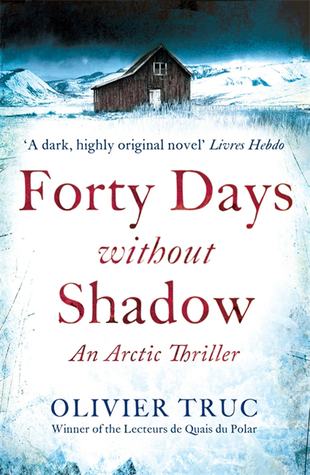
Olivier Truc, Forty Days without Shadow, trans. by Louise Rogers LaLaurie (Trapdoor 2014)
Opening lines: It was the most extraordinary day of the year, pregnant with the hopes of humanity. Tomorrow, the sun would be reborn.
The prize-winning novel Forty Days without Shadow came my way as a submission for the Petrona Award. Although by a French author, it’s eligible due to its Scandinavian setting and its publication in English translation (our slightly quirky rules allow some unusual works to be considered for the prize, which is highly welcome in my view).
The author – journalist and TV producer Olivier Truc – made a documentary in 2008 on the fascinating subject of the Norwegian Reindeer Police (Reinpolitiet), which deals largely with herder disputes, and covers 56,000 square miles of Lapland with just fifteen personnel. Truc paints a wonderful portrait of this highly specialised police force in his absorbing debut novel, and in the process places the Arctic and its indigenous cultures centre stage. In these respects he has a lot in common with British author M.J. McGrath, who successfully deployed the research she carried out for her non-fiction book The Long Exile when creating her ‘Edie Kiglatuk’ series, set in the Canadian High Arctic.

At the start of Forty Days, we see Sámi-Norwegian reindeer policeman Klemet Nango and his young partner Nina Nansen being pulled into the investigation of a theft. A priceless Sámi drum has disappeared from the local museum, and needs to be recovered before a UN conference on indigenous peoples takes place in the region. Shortly afterwards, Sámi herder Mattis is found dead, and ‘Patrol P9’ finds itself grappling with two crimes that could well be interlinked, and whose roots lie in both the recent and more distant past.
The novel uses its criminal investigations as a means of exploring different aspects of Lapland and its history. One fascinating point is that present-day Lapland lies across Norway, Sweden, Finland and Russia (see map below), which on the one hand leads to tensions, but on the other encourages international cooperation. However, those borders are relatively recent – only a few hundred years old – and are insignificant as far as the reindeer are concerned, which follow their usual migratory patterns, blissfully unaware of national jurisdictions. The borders are thus exposed as artificial constructs, imposed by colonising governments out of tune with the natural world, and prone to exploiting the land and its indigenous populations rather than safeguarding them.

The novel brilliantly evokes the winter setting of Lapland – the end of the long darkness of forty days of winter night, and the slow, welcome return of the sun, which shows itself for a scant twenty-seven minutes on its first day back. Through the interactions of various characters – some nuanced and some symbolic – we’re also shown the tensions between Norwegians and Sámi, and the impact of religion, politics and modernisation on the traditional Sámi way of life. Simultaneously entertaining and insightful, with an engrossing plot, this is a cracking debut that illuminates a world most of us know little about. The final section of the novel has shades of Peter Høeg’s Smilla’s Sense of Snow about it too, which is never a bad thing.
As the novel celebrates Sámi culture and present-day efforts to reclaim a Sámi cultural identity, I thought I’d finish by linking to the Sámi allaskuvla or Sámi Educational College, which works with ‘the Sámi community, particularly with young people, to preserve and promote the Sámi language, traditions, occupations, skills and knowledge’, and ‘supports Sámi society’s progress towards equality with the majority society’. It celebrates its 25th anniversary this year.


 Jørn Lier Horst’s The Hunting Dogs (trans. by Anne Bruce, Sandstone Press, 2014) comes to us already garlanded with prizes – it won the 2012 Riverton/Golden Revolver Prize and the 2013 Scandinavian Glass Key. I’m not remotely surprised, as this eighth novel in the William Wisting series (the third to be published in English) is one of the best Scandinavian crime novels I’ve read. Much has been made of Horst’s extensive policing experience, but for me, it’s the fantastic writing, plotting and characterisation that stand out in this novel, which sees Wisting suspended due to irregularities in a past case. Forced to re-investigate the murder of Cecilia Linde from the outside, he is helped by journalist daughter Line to uncover the truth. A top-notch summer read.
 American author Alice Sebold’s The Lovely Bones was published in 2002, but it’s one that I go back to every now and then, because it’s such an original crime novel. Set in the summer of 1973, it’s narrated by Susie Salmon, who’s murdered by a neighbour at the age of fourteen and witnesses the aftermath of the crime from her ‘heaven’. You’d be forgiven for thinking this all sounds horribly mawkish, but the concept is brilliantly pulled off for the most part, and offers a sensitive portrayal of the effects of a murder on the family and friends of the victim. Be warned: when I first read the novel one summer holiday I found it *highly* addictive. It was subsequently made into a film by Peter Jackson (2009), which received mixed reviews.






 Mrs. Peabody Investigates