Film of Jan Costin Wagner’s Silence on BBC4 tonight (Saturday 23 March)

The film adaptation of Jan Costin Wagner’s Silence (see here for Mrs P. book review) will be shown tonight on BBC4 at 9pm. It’s a German production, Das letzte Schweigen (the final silence), directed by Baran bo Odar, and transposes the Finnish action of the novel to small-town Germany (Costin Wagner is himself German, which may have prompted the switch).

The trailer on the TV/Radio Times website looks promising, although it should be noted the film’s subject matter is quite harrowing.

Here’s a portion of the TV/Radio Times review by Trevor Johnston (contains mild spoilers) :

>> Twenty three years after the unsolved murder of a schoolgirl in a wheat field, another young victim goes missing, in this German thriller that surveys the course of justice from various angles. The perpetrator of the first killing is identified in the very first scene, with the key dilemma revolving around his unwitting accomplice, who is so troubled by events that he disappears and keeps his silence over the decades. There’s certainly an involving moral complexity to Baran bo Odar’s film, though at times it does get bogged down trying to keep tabs on the killers, the investigators and the victims’ families across both time frames. Occasional lapses in credibility notwithstanding, it’s still tense and unsettling fare that treads delicately through difficult territory that involves the abuse of children.<< 

Baran bo Odar was listed by Variety Magazine as one of ’10 Directors to Watch’ in 2011. You can read Variety’s profile of him here – with some comment on the film as well.

Update: I’ve just finished watching the film and thought it was a truly excellent adaptation, faithful in almost every respect to the novel, and conveying its central themes of guilt and grief in an extremely effective way. Some terrific acting (especially from Katrin Sass, who also played a mother in Goodbye Lenin) and the cinematography was wonderful too. Top quality, intelligent (and highly unsettling) crime drama.

Leif G.W. Persson’s Linda, As in the Linda Murder

Leif G.W. Persson, Linda, As in the Linda Murder (Linda – som i Lindamordet), trans. from the Swedish by Neil Smith (London: Doubleday, 2013 [2005]). 5 stars

linda

Opening line: It was a neighbour who found Linda, and, all things considered, that was far better than her mother finding her. 

The dedication at the front of Linda, As in the Linda Murder reads ‘for Maj Sjöwall and Per Wahlöö – who did it better than almost anyone’. In this newly-translated novel, first published in 2005, author Leif Persson undoubtedly pays homage to the godparents of the Swedish police-procedural, and in particular to the first in Sjöwall and Wahlöö’s Martin Beck series, Roseanna, published exactly 40 years prior to Linda in 1965. Consider the following:

  • both novels are named after a young female murder victim
  • both open with the discovery of the victim’s body, on 4 July and 8 July respectively
  • both are set outside Stockholm in smaller Swedish cities (Motala and Växjö)
  • both depict the police investigation in exhaustive detail
  • both critique misogynist attitudes in Swedish society and foreground the female victim

However, the lead investigator in Linda, tasked with solving the murder of 20-year-old trainee police officer Linda Wallin one hot summer night, is no Martin Beck. Meet Detective Superintendent Evert Bäckström, also known as ‘that fat little bastard from National Crime’, whose egotistical, sexist, racist, homophobic, vain and supremely-blinkered mind we are invited to see in all its dubious glory. Bäckström is a darkly comic tour-de-force, a monstrous creation who cares solely about his financial interests, maintaining a steady supply of drink, and the welfare of his pet goldfish Egon. His character is used to shine a spotlight on a less-than-heroic side of Swedish policing: while he is busy impeding the progress of the investigation, capable detectives such as Jan Lewin are forced to work around his prejudices and incompetence as best they can.

Thus, while paying tribute to Sjöwall and Wahlöö, Persson stamps his own style on the Swedish police procedural, imbuing it with a highly satirical edge. Other aspects of Roseanna, such the critique of the press’s prurient interest in female murder victims, are also extended further in Linda.

In the context of Persson’s own work, Linda forms a departure from his first two hugely ambitious novels, Between Summer’s Longing and Winter’s End and Another Time, Another Life, which are set against the much larger political and historical backdrop of post-war Sweden and the Cold War. In Linda, the focus is kept deliberately local, with the exploration of the consequences of just one crime, and strongly drawn characters such as detectives Jan Lewin and Anna Holt, as well as the murderer and the victim’s mother. Hats off also to translator Neil Smith, who captures Persson’s dry, satirical tone perfectly.

In sum, Linda is a rich and satisfying read from an author who’s now one of my absolute favourites.

*****

A useful further note from Neil Smith on Persson’s novels – poached with Sarah’s kind permission from the comments of the excellent Crimepieces Linda review  and with a couple of additions from me in square brackets:

Neil says >> As so often happens, Leif’s books are being published in a slightly different order in translation to their original Swedish publication.

The three books Between Summer’s Longing and Winter’s End (Sw. 2002, tr. 2011), Another Time, Another Life (Sw. 2003, tr. 2012), and Free Falling, as if in a Dream (Sw. 2007, tr. 2014), together make up a trilogy entitled ‘the Decline of the Welfare State’.

One of the main characters from that trilogy, Lars Martin Johansson, takes the lead in a later novel, The Dying Detective (Sw. 2010, as yet untranslated) [and appears a bit in Linda as well].

Evert Bäckström [who appears as a secondary character in the ‘Welfare State’ trilogy] is the focus of a further series of books, of which Linda, As in the Linda Murder (Sw. 2005) is the first. He Who Kills the Dragon (Sw. 2008), due to be published in English in October 2013, is the second in the series, and will be followed by Pinocchio’s Nose (not yet published in Sweden). <<

Mrs. Peabody awards Linda, As in the Linda Murder, a wonderfully rich and satisfying 5 stars

With thanks to Transworld for sending me an advance copy of this book.

Creative Commons License

.

International crime drama news from BBC4: Dahl, De Luca, Young Montalbano, The Bridge 2 and more!

I’ve just seen the following on a BBC4 press release and couldn’t resist reporting IMMEDIATELY.

>> BBC Four has announced two exciting additions to an outstanding new year of international drama and film on the Channel: Swedish crime series Arne Dahl and Italian series Inspector Da Luca.

Arne Dahl (a pseudonym of award-winning author Jan Arnald) is based on five of Dahl’s novels, beginning with The Blinded Man. The series revolves around a tight-knit team of elite specialists who investigate the dark side of Swedish society. It is produced by Filmlance International and written by Rolf Börjlind and Cecilia Börjlind.

Inspector De Luca is made by Ager 3/Rai Radiotelevisione Italiana. A four-part crime series based on the novels by Carlo Lucarelli, it is set in and around Bologna during the tumultuous years of Mussolini’s dictatorship. Inspector De Luca is an investigator whose brutal honesty and uncompromising character may help him solve cases, but combined with his love of women, they also conspire to get him in trouble…

Other crime drama and film highlights in 2013 include:

Young Montalbano. Set in the early 1990s and starring Michele Riondino in the title role, Young Montalbano gives an insight into the private life and early crime-fighting career of the idiosyncratic Sicilian detective. This prequel series, also written by Andrea Camilleri, was recently shown to critical acclaim in Italy. (See here for details of the start date of this series.)

The Bridge, Series 2. A rusty old coaster en route in the Öresund sound suddenly veers off course and rams the concrete foundations laid out to protect the Öresund Bridge. The ship is empty – or so it is believed until five people are found chained, cold and exhausted below deck. The unknown victims, of whom three are Swedish and two Danish, are brought to a hospital in Malmö. Without hesitation, Saga Norén (Sofia Helin) from Malmö CID contacts her Danish colleague, Martin Rhode (Kim Bodnia) and their new investigation begins.

Inspector Montalbano. The popular Sicilian detective makes a welcome return in four brand new episodes.

The King Of Devil’s Island. Based on a true story, The King of Devil’s Island tells the unsettling tale of a group of young delinquents banished to the remote prison of Bastøy in Norway. Under the guise of rehabilitation the boys suffer a gruelling daily regime at the hands of their wardens until the arrival of new boys Erling and Ivar spark a chain of events that ultimately ignite rebellion.

Point Blank. In this action-packed French thriller, Samuel Pierret is a nurse who saves the life of a criminal whose gang then take Samuel’s pregnant wife hostage to force him to help their boss escape. A race through the subways and streets of Paris ensues. As the body count rises, Samuel must evade the cops and the criminal underground to rescue his wife <<

I’m so excited I can hardly breathe. Though I’m not sure how to break the news to my family that the telly will be off-limits for most Saturday nights this year.

For the full press release see here (contains info about series 3 of BORGEN as well). There’s also a very atmospheric trailer of all the international drama coming up.

Enjoy!

The Petrona award for best Scandinavian crime novel

The crime blogosphere has been abuzz with news of the freshly established Petrona Award for Best Scandinavian Crime Novel of the Year.

Set up in memory of Maxine Clarke, who blogged as Petrona and was an expert in Scandinavian crime fiction, the award will be presented for the first time at the UK CrimeFest convention this coming May.

The 2013 shortlist has been compiled on the basis of Maxine’s own reviews:

PIERCED by Thomas Enger, tr. Charlotte Barslund (Faber and Faber)
BLACK SKIES by Arnaldur Indridason, tr. Victoria Cribb (Harvill Secker)
LAST WILL by Liza Marklund, tr. Neil Smith (Corgi)
ANOTHER TIME, ANOTHER LIFE by Leif GW Persson tr. Paul Norlen (Doubleday)

enger428586_287692644633128_120240158045045_704808_1282709077_n517CY6O6qWL51Bigz1qx7L._BO2,204,203,200_PIsitb-sticker-arrow-click,TopRight,35,-76_AA300_SH20_OU02_

Submissions are also now being invited for the 2014 award, which will be judged by crime critic Barry Forshaw, Sarah Ward of Crimepieces, and your very own Mrs. P. It’s an honour to have been asked, and I look forward to some lively discussions with my fellow judges! Karen Meek from Eurocrime will be keeping us all in line.

The rules governing eligibility are available on the Petrona Remembered blog. You can also read Petrona’s excellent review of Indridason’s Voices there – fittingly, it’s the inaugural post on the site, and will be followed by more from a variety of contributors.

For a Bookseller piece on the award, see here.

The press on trial: crime fiction and the media

One of my favourite things when reading crime fiction is the random emergence of a theme that links successive books. I experienced this recently with three quite diverse novels from Sweden, America and Australia, all of which focused heavily on the role of the media. None were too flattering of journalists and their trade, using the crime narrative to put the press ‘on trial’.

Leif G.W. Persson’s Linda, as in the Linda Murder (2005), is a recently translated Swedish police procedural that investigates the killing of Linda Wallin, a trainee police-woman at Vaxjo Police Academy. The novel is particularly scathing of the media’s sensationalist depictions of female murder victims, which are designed to generate sales: ‘From trainee police officer Linda Wallin, 20. To the Linda murder […] The Kajsa murder, the Petra murder, the Jenny murder… They had quite simply been transformed from women of flesh and blood into media messages’. This transformation is especially resonant in its original Swedish context, where the victim’s first name forms part of a compound noun that reduces her life to no more than its violent end – in this case, the Lindamordet [‘the Lindamurder’]. In contrast, the narrative notes drily, ‘men’s names were never used as prefixes to the word ‘murder”.

Gillan Flynn’s 2011 novel Gone Girl, a darkly humorous dissection of a marriage gone sour, critiques the media’s damaging influence when reporting criminal cases. Husband Nick Dunne, dealing with the press in the aftermath of his wife’s disappearance, soon discovers how fickle journalists can be: he’s styled as an anxious, bereft husband one minute, and as a sinister-looking potential murderer the next. Before long, he’s forced to hire a savvy lawyer who specialises in manipulating media narratives in his clients’ favour. The truth becomes largely superfluous: expensive lawyers and public opinion appear to count more than any meaningful judicial process (one can’t help thinking of the media circus that was the OJ Simpson case, and of the more recent Pistorius case).

Yvonne Erskine’s 2011 novel The Brotherhood is a 360 degree examination of the events leading up to and following a Tasmanian policeman’s murder. The police are shown having to manage press reactions to the killing from the minute the news gets out, a time-consuming and politically sensitive job, as the main suspect has Aboriginal heritage. We’re also introduced to amoral journalist Tim Roberts, who writes up a potentially damaging story knowing that he might jeopardise the case. Investigative journalism is portrayed here as seedy and self-interested, with no positive contribution to make to society.

Three crime novels obviously don’t make a trend, but I’d be interested to know if there are others that are similarly critical of the media. Of course, some crime novels contain more sympathetic depictions of the press: Stieg Larsson’s Mikael Blomkvist and Liza Marklund’s Annika Bengtzon are two examples of journalists who are given leading investigative roles within crime narratives, and who are depicted as thoughtful practitioners of their trade.

If you think of more, let me know – I’ll compile a list if we gather enough!

Update 3 May 2013: The Guardian has just run a profile of Gillian Flynn (interesting discussion on misogyny and female villains amongst other things, including the press angle). My review on Wendy James’ The Mistake (as recommended by Angela Savage in the comments below), can be read here.

2013 Independent Foreign Fiction Prize longlist has distinctly criminal dimensions

The 2013 Independent Foreign Fiction Prize longlist has just been announced and features a pleasing number of works that draw on crime genre conventions.

The prize was set up in 1990 and ‘honours the best work of fiction by a living author, which has been translated into English from any other language and published in the United Kingdom’. It also makes a point of splitting the £10,000 prize money between the winning author and the translator, which highlights the crucial and often overlooked role of translators in allowing us to access fine international writing.

Four longlisted novels by Dutch, French, Danish and Colombian authors have a ‘criminal dimension’ and are described as follows on the prize and publisher websites:

Gerbrand Bakker’s The Detour (translated from the Dutch by David Colmer / Harvill Secker)

A Dutch woman rents a remote farm in rural Wales. She has fled from an unbearable situation having recently confessed to an affair with one of her students. In Amsterdam, her stunned husband forms a strange partnership with a detective who agrees to help him trace her. They board the ferry to Hull on Christmas Eve. Back on the farm, a young man out walking with his dog injures himself and stays the night, then ends up staying longer. Yet something is deeply wrong. Does he know what he is getting himself into? And what will happen when her husband and the policeman arrive? Gerbrand Bakker has made the territories of isolation, inner turmoil and the solace offered by the natural world his own. The Detour is a deeply moving new novel, shot through with longing and the quiet tragedy of everyday lives.

*****

Laurent Binet, HHhH (translated from the French by Sam Taylor / Harvill Secker)

Two men have been enlisted to kill the head of the Gestapo. This is Operation Anthropoid, Prague, 1942: two Czechoslovakian parachutists sent on a daring mission by London to assassinate Reinhard Heydrich – chief of the Nazi secret services, ‘the hangman of Prague’, ‘the blond beast’, ‘the most dangerous man in the Third Reich’. His boss is Heinrich Himmler but everyone in the SS says ‘Himmler’s brain is called Heydrich’ [Himmlers Hirn heißt Heydrich], which in German spells “HHhH”.

All the characters in HHhH are real. All the events depicted are true. But alongside the nerve-shredding preparations for the attack runs another story: when you are a novelist writing about real people, how do you resist the temptation to make things up? HHhH is a panorama of the Third Reich told through the life of one outstandingly brutal man, a story of unbearable heroism and loyalty, revenge and betrayal.

*****

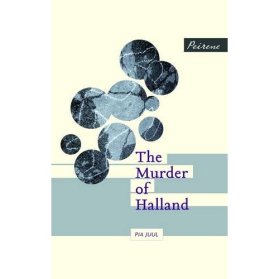
Pia Juul, The Murder of Halland (translated from the Danish by Martin Aitken / Peirine Press)

Denmark’s foremost literary author turns crime fiction on its head. Bess and Halland live in a small town, where everyone knows everyone else. When Halland is found murdered in the main square the police encounter only riddles. For Bess bereavement marks the start of a journey that leads her to a reassessment of first friends, then family.

Why Peirene chose to publish this book: ‘If you like crime you won’t be disappointed. The book has all the right ingredients. A murder, a gun, an inspector, suspense. But the story strays far beyond the whodunit norm. In beautifully stark language Pia Juul manages to chart the phases of bereavement. P.S. Don’t skip the quotes.’ Meike Ziervogel

Maxine Clarke’s review of this novel is available on the Euro Crime blog.

*****

Juan Gabriel Vásquez, The Sound of Things Falling (translated from the Spanish by Anne McLean / Bloomsbury)

No sooner does he get to know Ricardo Laverde than disaffected young Colombian lawyer Antonio Yammara realises that his new friend has a secret, or rather several secrets. When Ricardo is shot dead on a street corner in Bogotá by a guy on the back of a motorbike, Antonio is caught in the hail of bullets. Lucky to survive, and more out of love with life than ever, he starts asking questions until the questions become an obsession that leads him to Laverde’s daughter. His troubled investigation leads all the way back to the early 1960s, marijuana smuggling and a time before the cocaine trade trapped a whole generation of Colombians in a living nightmare of fear and random death. Juan Gabriel Vásquez is one of the leading novelists of his generation, and The Sound of Things Falling, which tackles what became of Colombia in the time of Pablo Escobar, is his best book to date.

*****

The shortlist for the Independent Foreign Fiction Prize 2013 will be announced on 11 April. The full longlist can be found here.

Looking forward to sampling some of these soon!

Welcome to the silo: Hugh Howey’s Wool

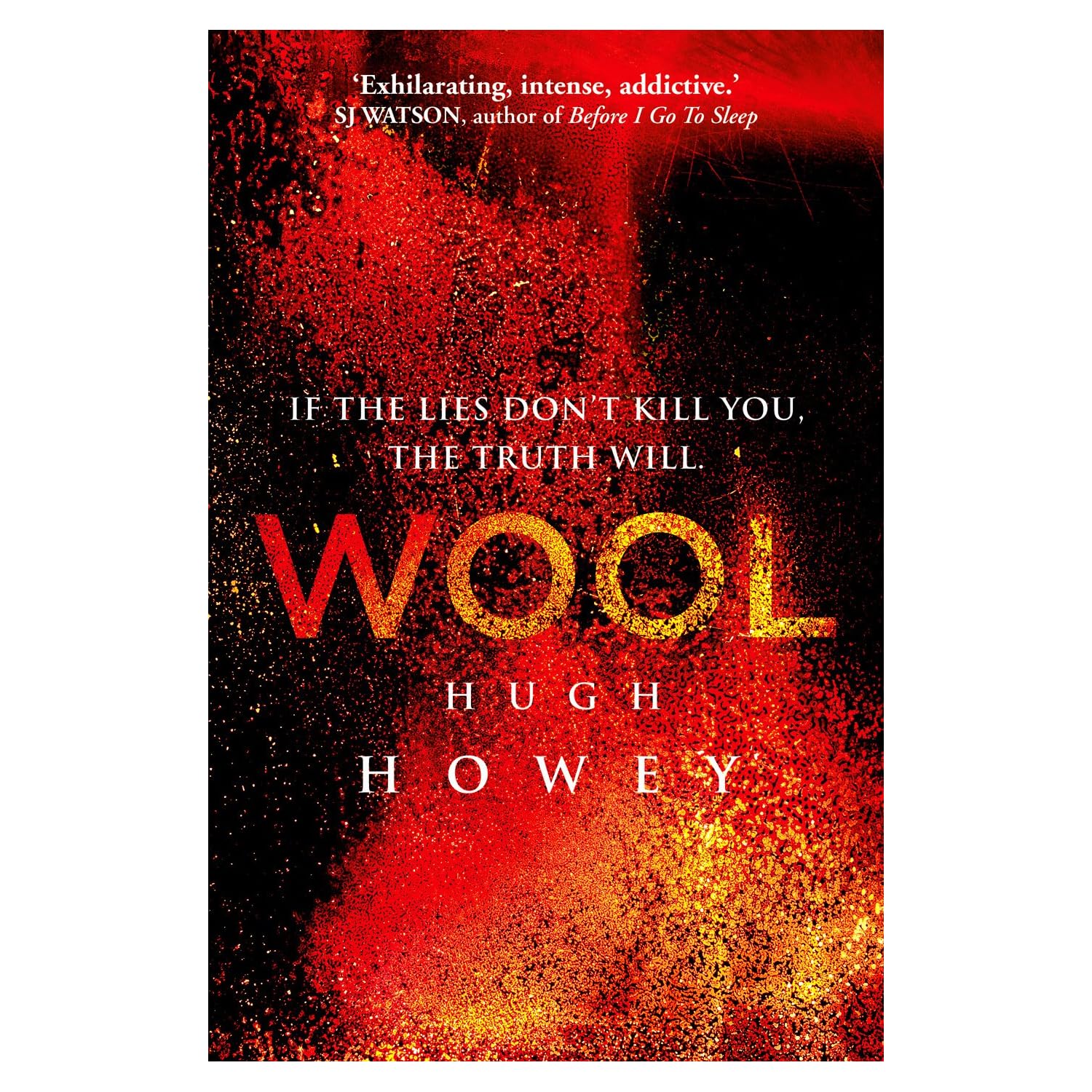
Hugh Howey, Wool (Books 1-5), Century 2013

Opening line: The children were playing while Holston climbed to his death.

Hugh Howey’s Wool is a self-publishing success story that began in 2011 with a standalone on the Kindle Direct Publishing platform. When it took off, ‘quite by accident and all on its own’, Howey added another four interlocking stories, which were gathered in a Wool omnibus and published in hardback earlier this year. The film rights have also been sold. It’s basically every indie author’s dream come true.

Wool transports us to the world of ‘the silo’ – the home of humankind in an apparently ravaged, post-apocalyptic future. The silo is a self-contained community divided into different sectors (such as IT, mechanical, nursery, food farms) that are spread over more than a hundred floors connected by a single, DNA-like spiral staircase. This enclosed world is described in minute detail, down to the sherpa-like silo porters who carry communications and supplies up and down the well-trodden stairs. The only glimpse of the desolate outside world is ‘up top’, on screens that become increasingly grimy until ‘a cleaning’ takes place…

So far, so sci-fi. But what makes Wool really take off for me are the elements of crime fiction woven into the narrative. Firstly, in line with standard crime conventions, there are a number of murders – some obvious and some more subtle – which are investigated with varying degrees of success by characters in the five ‘books’. Secondly, and in common with many other crime novels, there is an exploration of the rules and regulations governing society, and the ways in which crimes are dealt with by the law enforcement system. Except here, of course, we are dealing with the extremely unusual closed community of the silo, which shapes conceptions of criminality and punishment in entirely unprecedented ways.

Royalty Free Spacescape Images | Depositphotos

The biggest crime in the silo – ‘the great offence’ – is ‘expressing any desire to leave’. As soon an individual utters the words ‘I want to go outside’, the law is broken, resulting in a literal expulsion from the community. Once outside, wearing only a protective suit against the toxic elements, he or she is ‘put to cleaning’ – wiping the sensors that give the silo’s inhabitants their view of outside. And all diligently obey this command, although it is initially not clear to us why.

The first book starts with Sheriff Holston – the key figure entrusted with maintaining law and order within the silo – requesting to go outside. And this opening is typical of Wool, which is filled with wonderful plot ideas and scenarios. For why would anyone wish to leave the safety of the silo for the hostile environment outside, let alone the sheriff, who has himself overseen past cleanings, and should know exactly what fate awaits him?

While occasionally a little rough around the edges in terms of its writing and credibility, Wool is a compelling read – a fabulous page-turner that brings a possible future vividly to life, and grapples with big issues such as the rights of the individual, freedom of information, and the power exerted by the state over its citizens. The five interlinked stories detail the lives of several individuals – men and women, young and old – with the standout character of Jules or Juliette quickly becoming my personal favourite.

If you like the idea of a fusion of sci-fi and crime – and a rollicking good story – this is one for you. The energy and freshness of the narrative would undoubtedly also serve it well in the young-adult fiction market, which is where Howey first made his mark.

#32 / Fred Vargas, An Uncertain Place

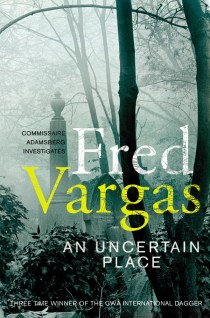
Fred Vargas, An Uncertain Place, translated from the French by Sian Reynolds (London: Vintage, 2012 [2008]). A rather gruesome outing for Commissaire Adamsberg and his team  3.5 stars

Opening line: Commissaire Adamsberg knew how to iron shirts.

Fred Vargas is one of my favourite crime writers, but I always regard her novels as something of a guilty pleasure. By rights, I shouldn’t really like them, as I tend to favour crime novels that engage with history, politics or society (such as Dominique Manotti’s Affairs of State), and which feature grounded, rational policemen (I’m a sensible type at heart). Not novels involving a hunt for a werewolf (Seeking Whom He May Devour), or a Commissaire who wanders aimlessly around Paris using intuition to solve his crimes.

And yet the Adamsberg novels have afforded me more reading pleasure than almost any other crime series I’ve read. This has a great deal to do with the quality of the writing – there’s a reason why Vargas has won the CWA International Dagger three times – and the way in which she uses her medieval historian’s knowledge to take the roman policier in a pleasingly original direction. Add in a large dash of quirky gallic – her police team are eccentrically and extravagently ‘French’ – et voilà, you have a classy, distinctive crime series on your hands that’s mighty hard to resist.

Those who’ve loved previous Adamsberg novels are not likely to be disappointed by An Uncertain Place, as all the usual ingredients are present and correct. For British readers and Anglophiles, there’s also the bonus of an initial stop in London, which includes a splendidly gothic discovery at the entrance of Highgate Cemetery.

So why have I given An Uncertain Place only 3.5 stars?

For me, this crime novel went slightly too far in two respects:

1. It features a truly gruesome murder and crime-scene description. An explanation of the murderer’s rationale and methods are supplied further on in the narrative, but I still found the enormous amount of detail too much to stomach (not helped by the fact that I read the worst bit over lunch).

2. Vargas is usually very skilled at suggesting that other-worldly forces are at work while maintaining a plausible crime narrative in a ‘realistic’ French setting. As in previous novels, the tension between those in the police team who work intuitively and those who rely on logic is thematised (Adamsberg and his disciples are the ‘cloud shovellers’, while Retancourt leads the ‘rational positivist movement’). But Vargas jumps in a clear direction at the end of the narrative, and it was one that left me rather cross. So – with a little sigh – 3.5 it is.

An Uncertain Place was my January read for the 2013 Translation Challenge.

Mrs. Peabody awards An Uncertain Place an enjoyable but slightly infuriating 3.5 stars.

Creative Commons License

.

Saturday smörgåsbord: Richard III, Petrona Remembered and Spiral 4

This week has seen lots of interesting crime news – a veritable smörgåsbord of delights.

The confirmation that the bones found under a Leicester car park are indeed those of King Richard III, has resulted in some knock-on coverage for Scottish crime writer Josephine Tey’s The Daughter of Time. This 1951 classic tops the Crime Writers’ Association list of 100 best crime novels, and shows Inspector Grant ‘re-open’ the case of ‘the princes in the Tower’ whilst laid up in hospital with a broken leg. Can he really prove that Richard is not the callous murderer that history paints him to be…?

An interesting article in the Canadian Globe and Mail explores the value of the novel’s critique of history, and its assertion that many historical narratives are falsely constructed for political ends. Nikolai Krementsov, professor of the history of science and technology at the University of Toronto, gives it to his students to illustrate the difference between primary and secondary sources, and says ‘I know no book that gives such as clear account of what history is and what its function is in society … It should be mandatory reading for historians, investigative journalists and policemen’.

He also points out that Tey is writing at the beginning of the Cold War, a time of enormous political transition when lots of inconvenient wartime facts were in the process of being forgotten. ‘In that atmosphere, she wrote a definitive account, not of Richard III, but of how history can be manipulated’.

This week saw the birth of a new crime fiction blog, Petrona Remembered,  which has been set up in memory of the wonderful crime blogger Maxine Clarke.

The team behind the site aims ‘to develop a resource for current and future fans of the genre and we want you to help us. We’re asking writers, bloggers, readers, translators and anyone else who loves a crime or mystery novel to send us a submission about that book. It can be a review, a pitch, a love letter, a poem or, a video. Or something else entirely. Each week we’ll post a new submission and, over time, this site will become a jumping off point to a world of much-loved crime fiction’.

I personally like the idea of a crime haiku :). Submissions great and small are welcome, and you can find out more here.

A new annual award, The Petrona, for the best Scandinavian crime novel, is also being established. Maxine was particularly partial to some top-notch Scandi crime, so this feels very fitting.

Last but not least, for those of you suffering withdrawal symptoms from Borgen, help is on the way in the form of Spiral series 4. Parisian Captain Laure Berthaud and her colleagues are back as of tonight for 12 gritty episodes, taking over the BBC4 Saturday evening ‘international slot’ from 9.00pm until 11.00pm.

Further information and a clip from the first episode can be found here.

Mrs. Peabody’s 2013 reading challenges

A little late in the day, I’ve been thinking about my reading goals for 2013, and have decided to take part in two challenges.

I’m not normally one for reading challenges, because I already have plenty of ‘performance enabling’ and research targets to meet in my professional life. Adding yet more items to tick off the list hasn’t seemed like a particularly good idea.

However, a combination of factors has drawn me to these challenges:

  1. They will help me broaden my reading in a more directed way.
  2. There are ‘easy’ levels, which look invitingly…easy.
  3. They both look like great fun.

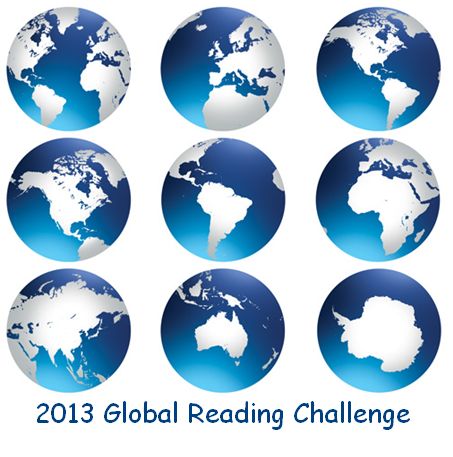
The first is the 2013 Global Reading Challenge

The ‘Easy Challenge’ involves ‘reading one novel from each of these continents in the course of 2013: Africa, Asia, Australasia/Oceania, Europe, North America, South America, and The Seventh Continent (Antarctica or your own ‘seventh’ setting, e.g. the sea, the space, a supernatural/paranormal world, history, the future)’.

You’re also asked to ‘find a country, state or author that is new to you from your own continent’.

If you fancy joining me, you can sign up here via the host blog, Kerrie’s ‘Mysteries in Paradise’. There are links to challenges from past years, so that you can get ideas for reading; other wonderful posts out there will also provide inspiration. For example, there’s a great list of Latin American crime fiction over at ‘Ms. Wordopolis Reads’.

The second is the 2013 Translation Challenge

Hosted by ‘Curiosity Killed the Bookworm’, this challenge is a simple one: you’re asked to read one translated book a month.

You can sign up here. There’s also a handy set of links to publishing houses known for their support of translated crime fiction, to help create a reading list.

Those of you with eagle eyes may have noticed that the challenges overlap – books read for one could very well also be submitted for the other. This is a deliberate strategy on my part: if the nineteen-book total begins to feel unmanagable, I can double up where necessary and still complete them both. This could be viewed as a subtle bit of cheating or as a cunning back-up plan. I prefer the latter interpretation… 🙂

My January book for the Translation Challenge was Fred Vargas’ An Uncertain Place (France) and February’s will be Hakan Nesser’s The Return (Sweden), sequel to the wonderful Borkmann’s Point. I probably won’t be submitting these to the Global challenge though, as I’m on the hunt for something a bit more exotic from Europe. Suggestions welcome!

I’ll be building lists of the books I’ve read for my 2013 challenges here.