Theakston File 3: Camilla Läckberg interview with Mrs. P. (Part 2) on The Hidden Child

Part 2: In which Camilla Läckberg (CL) and Mrs. Peabody (MP) discuss the author’s fifth novel, The Hidden Child – its origins, its impact, its depiction of wartime Sweden and Norway – as well as the the process of historical research, and why Swedish crime writers are still drawn to the subject of the Second World War.

I was particularly keen to discuss this novel with the author, because it forms part of the corpus for my academic research on Nazi-themed crime novels (crime novels that engage with the Nazi period or its post-war legacies).

SPOILER ALERT: If you’ve not yet read The Hidden Child, you might wish to come back to this interview at a later point, as it gives away major details about the plot. 

MP: Can I come on to The Hidden Child, in which you explore the legacy of the wartime past?

CL: They’re starting to film it in August for the cinema. I think it’s going to be great.

MP: I can imagine – it has lots of ingredients that would work very well. So what was it that drew you to the topic, because quite a few Swedish writers and Scandinavian writers do go back to look at the legacy of that past.

CL: Well, it actually started with an email from a reader, who thanked me for the books, and then said, ‘Did you know that there were lots of exciting activities going on in the area [around Fjällbacka, the coastal village north of Göteborg where the novels are set] during the Second World War? And I was like, ‘no, I never heard about that’. So I started doing some research and I found out about the smuggling, and the boats going back and forth [between Sweden and Nazi-occupied Norway], people fleeing over the border… And I thought ‘Wow!’, and the ideas started coming. Also, when I’d started writing about Elsy [Erica’s mother], who was already dead in the first book, I only knew that she had been cold with her daughters, but I didn’t know why. After four books, I still didn’t have a clue why. But when I started researching and started working on the idea of ‘the hidden child’, it literally dropped in my lap – Elsy’s whole story. It was one of those magical moments you have as a writer, when it’s like someone is telling you … I suddenly knew everything about  what had happened to her; why she was the way she was. That was fantastic. So that book is very special to me for that reason, because I was basically ‘told’ Erica’s mother’s story.

MP: And it’s a very moving book, I think, as well.

CL:  I had another very moving moment when it came to that book, actually. A year after it had come out in Sweden, I was doing a photo shoot for a cover, and there was this make-up artist, a woman who was around forty, forty-five. When we were alone for a few minutes, she asked me ‘How did you do your research into the Norwegian resistance and the people at Grini [Nazi concentration camp in Norway that held a number of political prisoners]? Did you know anyone who was there?’ No I didn’t; I researched through books and accounts that were on the internet by people who were there, but I hadn’t met one. And then she told me that her mother was from Norway: she had been part of the Norwegian resistance during World War Two, had fled from Norway, ended up in Sweden, and had never talked about her experiences with her children. But when she had read The Hidden Child, she got the children together and said, ‘read this, this is my story’. And then she talked about it: she was 19 when she was in the resistance and was put in Grini …. That was a special moment, because you guess so much. When you’ve done your research you have to guess a lot and fill in the blanks from your own fantasy. Sometimes you get it right, sometimes you probably don’t, but those moments when you understand ‘I got that right’ – that’s fantastic.

MP: Can I ask you about the depiction of the main characters and their relation to the conflict? Because I think that you do something very interesting there – there’s a sort of twist.

CL: Hmmm. What do I do?!

MP: Well, you have a murder victim, who is supposedly a Norwegian resistance fighter, who then turns out to have a very different background – his father was an SS-officer and he also served in Grini. And the murderer is the Swedish resistance fighter, who was a prisoner in the camp. So it seems to me that there’s something complex going on there in terms of how you’re looking at the categories of ‘perpetrator’ and ‘victim’…

CL: It’s all about playing with the ‘good’ and ‘bad’; who’s ‘good’ and who’s ‘bad’? If you do good your whole life, can that compensate for then doing something bad once in your life? And on the other hand, if you’ve done a lot of bad things, can you compensate by leaving them behind, or do you have to carry them with you? Can you turn over a new leaf? I love playing with those things. And also when it comes to murderers, I think it’s so much more interesting when good people do bad things, than when bad people do bad things. What can trigger a basically good person to do something bad? And that’s so much the case in that book – he [the murderer] has lived his whole life doing good things… But that’s also a question: for whom did he do those things? Was it for his own ego or was it out of true conviction? You can always play with those things as well.

MP: It seemed to me that there was a real complexity about the position of the victim and the perpetrator / the murderer and the victim. There’s a trading of places and what you end up with is very much a grey on grey [CL: yes], rather than a black and white morality [CL: yes], which leaves some questions in the mind of the reader… Were you looking for that complexity?

CL: Yes, hmmm, it’s the same thing again [see CL’s comments in part 1 about the inclusion of ‘issues’ in her crime novels]. I don’t think about it when I write it. I just … go along and tell the story. It’s only afterwards that I can see the patterns. It’s like when I wrote The Stonecutter: I wrote the whole book, and when I read the manuscript through to start editing, I was like ‘oh my goodness, there’s a theme in here that I didn’t know was here’ – about what makes a good mother and motherhood. I don’t realise those things while I write. But I guess it’s part of the structure for the book. It’s like scaffolding and I don’t see the scaffolding until I take a few steps back and look at the whole.

Original Swedish cover/title (translates as The German Child)

MP: When you were writing about this controversial past in The Hidden Child  – one that still has resonance in the present – were you ever anxious? You’re obviously portraying something that is quite delicate. Was there a particular kind of caution when dealing with that subject matter, or did you just dive in?

CL: Just dove in, I think. I don’t think there’s anything that I write about that I’m afraid of approaching. The only thing I’m afraid of writing is sex scenes. That’s mainly because I picture my mother and my mother-in-law reading the books and their imagination running wild, so I can’t bring myself to do it! But that’s the only thing that I’m afraid of writing.

MP: It seems like another key theme in that novel was one of trauma: Elsy’s trauma and then the way that trauma has knock-on effects and is communicated down a generation…

CL: I think that theme is in all my books, and especially the eighth one, The Angel Maker. Do you know what an ‘angel maker’ is? It was a Swedish term common in Norway and Denmark as well, that described women in the late 1800s and early 1900s…. If you had a child out of wedlock, and you couldn’t take care of it, you could pay a woman a lump sum to take the baby, and what happened sometimes was that the women thought, ‘OK, I’ve got the money and this baby is only going to cost me from this point on…’. So there are a few court cases where women were found to have killed eight or ten babies. I start the story with a woman who is an ‘angel maker’ being arrested and they discover bodies buried in the ground in the basement. And that then follows as a dark cloud over her daughter, over her grand-daughter and the next generation after that. I love that theme; it recurs in my books.

MP: You’re always very concerned about the human implications of acts, whether of criminal acts or…

CL:  It’s all about the characters for me. It’s the characters that make the crime plot, not the other way around. I don’t form the crime plot and then add the characters. I have a murderer and a motive and then I make the characters start doing things and that creates the plot.

MP: You mentioned some of the research that you undertook for The Hidden Child. Did you look at historical studies?

CL: I borrowed books about the Second World War in the area, because that’s what I was interested in. And then of course I always have to do research depending on where the story takes me. The story took me to Grini, and then it took me on the trains to the concentration camps in Germany, so then I had to do research about the camps and ended up with the ‘white buses’ going to Sweden [programme set up in 1945 by the Swedish Red Cross and Danish government to transport concentration camp inmates from Nazi-controlled areas to Sweden]. So I had to do more and more. I don’t do this amount of research, then I’m done and I write the book. I start at one end and then I discover that ‘I don’t know anything about the part I’m going to write now – I’m going to do some research’. So it’s a continuous process all through the book.

MP: When you’re dealing with that kind of historical event, is historical authenticity important?

CL: Well, I’m not a historian, so I will never get it absolutely right. If I were to get it absolutely right I’d spend five years doing research for every book… And then I’d probably write a thesis instead which would be really boring, compared to a crime novel [ironic laughter from Mrs. P, who once spent five years writing a boring thesis]. I mean I do think that I get it pretty right, but I can’t say that I’ve got all the details right.

MP: But again you were talking earlier about scaffolding in terms of plot; there’s historical scaffolding as well that you can make sure…

CL: I make some markers, and I drop some details, and I let the reader fill in the blanks. I don’t have to describe every detail of what a person was wearing in the 1800s. I can mention a few details; I can mention a dinner; but I don’t have to describe that in the 1800s they were eating this and this and this. But I also happen to have a father-in-law who’s a historian, so I always give him the manuscript and say, ‘please come back to me when you’ve read it and we can discuss the details’. So he always has a lot of good input.

MP: That’s very handy.

CL: Yes, I know! A police officer husband and a historian father-in-law: that’s two for the price of one. If only my mother-in-law had been a forensics expert. That would have been perfect!

MP: One last question… I’m really interested that there are lots of Scandinavian writers who are still bringing in the legacy of the Second World War into their crime novels. Is that legacy still a point of public discussion in Sweden? For example, that there were Swedish nationals who went to fight for the Germans.

CL: It’s brought up once in a while and the fact that we were not neutral is now established. We don’t pretend that we were neutral any more. And also I think there are several reasons why it keeps coming back: it’s a very fascinating war, and it’s also visually a very striking war – for example, the swastika symbol. So it’s easy to picture it. And it was so big in every way. I think that intrigues us as crime writers, because it’s the epitome of human evil. I mean, it’s evil. And also I think it’s still up for debate because of the fact that we now have – and I think it’s a disgrace – a nationalist party in Sweden as part of the government [the Sverigedemokraterna or Sweden Democrats].  And I’m so embarrassed that people actually voted for them. I’m horrified that we’re starting to forget. History repeats itself.

21 July 2012 in the Library, Old Swan Hotel, Harrogate.

Extra links:

Part 1 of this interview

Camilla Läckberg’s website

Jo Nesbo interview with Mark Lawson in which he discusses his family’s wartime past and its impact on the Harry Hole novel The Redbreast

Creative Commons License

.

Theakston File 1: Jo Nesbø, interviewed by Mark Lawson

Mark Lawson’s interview with highly-acclaimed, best-selling Norwegian crime writer Jo Nesbø, creator of the Harry Hole series, was the last event of the Theakstons Crime Writing Festival 2012. Tickets had sold out well in advance and the venue was packed. Mark Lawson, introducing his guest, told us that a Nesbø novel is sold somewhere in the world every 23 seconds.

The following is not designed to be an exhaustive account, but focuses on parts of the interview that stood out for me as particularly interesting.

The interview took place on the first anniversary of the Oslo and Utoya massacres, and Nesbø spoke with eloquence and sensitivity about the impact that these have had on Norway.

Nesbø’s plan when he began writing was a straightforward one: ‘I thought I would come up with a simple story and write it’. It took him all of five weeks. However, when prospective publishers asked how long the novel had taken to complete, he would say over a year.

One reason why the Hole series was published out of sequence in the UK was because the first two novels were set outside Norway. Publishers felt that it would be too confusing to market a novel by a Norwegian author that was set in Australia [as is the case with the first Hole novel Flaggermusmannen – first published in 1997 and due to be published as The Bat by Harvill Secker in October. The title has been adjusted to avoid confusion with the ‘other’ Batman…]. So The Redbreast [the third novel] was the first of the series to be published here.

The character of Harry Hole was not fully developed until The Redbreast: ‘Then I knew who he was’.                                                                                                                                          

There was a fascinating description by Nesbø of how his own family history had shaped the The Redbreast.

When Nesbø was 15, his father had sat him down for a talk. Afterwards ‘I understood why my family was preoccupied with the Second World War’. While his mother and her family had been part of the resistance movement during Nazi occupation [Germany invaded Norway in 1940], his 19-year-old father had volunteered to fight with the Germans on the Eastern Front. When the war ended, he was sentenced to a couple of years in prison for his role in the war.

Nesbø at first found this revelation ‘incomprehensible’, but his father encouraged him to discuss the issue and to ask him any questions that he wanted, and they grew closer as a result.

The Redbreast seeks to understand how a young man like Nesbø’s father came to take the political path he did. On his father: ‘He was a 19-year-old trying to understand the world and what was going on. He was raised in the States and comes back to a Europe that’s almost bankrupt. Germany and Russia are the two strong nations and there is a feeling that you have to choose between them. And so my father made his choice’.

Nesbø wrestled with the fact that his father had been declared a traitor after the war, but his father was OK with the fact that he had been formally punished: ‘Two years in prison was fair for being as wrong as I was’.

Thus: ‘The Redbreast to a large extent is my father’s book’. It’s a story of World War Two and how the individuals involved ‘reflect on their choices’. The characters who serve under the Germans in the novel ‘all have different motives for doing what they’re doing’.

On Norway’s engagement with the past in the post-war period:  After World War Two, Norway wanted to see itself as a nation that fought the Germans, with a strong resistance movement. While there was some resistance, Nesbø felt that ‘it was a bit of a shame for Norway that we didn’t do more to fight the Germans’. Most people didn’t do anything. Only now are young historians rewriting the story. A grey, complex area.

[Note: There’s a BBC World Bookclub programme on The Redbreast in which Nesbø also discusses his complex family background and its relation to the novel – you can listen to it here (55 minutes duration).]

Jo Nesbø

On the influence of Swedish crime writers Maj Sjöwall and Per Wahlöö: all Scandi writers are influenced by them, even if they don’t know it because they’ve been influenced by writers already influenced by them! They are the godparents of Scandi crime.

It was never Nesbø’s agenda to focus on political issues but ‘it’s impossible to write without being political in some ways, simply because as a writer you ‘edit’ the world you see around you’.

[Lawson also alluded to the fact that Radio 4 will be dramatising all 10 of the Martin Beck series as part of a broader focus on European Detectives – see this BBC article for further details].

Film adaptation: the favourite to play Hole in the adaptation of The Snowman, directed by Michael Scorsese, is Leonardo DiCaprio. There is apparently a website where you can bet on who will get the role, and Nesbø himself is a long-shot for the part. He is keeping his distance from the script-writing process.

On Harry Hole’s fate: ‘There will be an end, and there will be no resurrection’ [audible ‘ooooooh’ from the audience].

A droll moment: after we had been told of Nesbø’s talents as a musician, journalist, stockbroker and writer, an author sitting next to me leaned over and whispered incredulously, ‘Is there anything this man cannot do?!’.

Karen has also posted a good write-up of the event at Euro Crime.

UPDATE: James Kidd’s interview with Nesbø, which he carried out at Harrogate, has recently been published in The Independent.

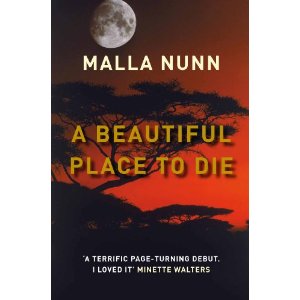
#20 Malla Nunn / A Beautiful Place to Die

Malla Nunn, A Beautiful Place to Die (London: Picador, 2010). An intriguing debut novel set in 1950s South Africa as apartheid is taking hold 4 stars

 Opening sentence:  Detective Sergeant Emmanuel Cooper switched off the engine and looked out through the dirty windscreen.

I’ve been looking for a good crime novel to sink my teeth into, and this one stood out from the crowd as I was browsing online recently. A Beautiful Place to Die is the debut crime novel by Malla Nunn, an Australian-based but Swaziland-born author, and is the first of the Emmanuel Cooper series, set in 1950s apartheid South Africa. It was awarded the Australian ‘Sisters in Crime Davitt Award for Best Adult Crime Novel’ and was shortlisted for the American Edgar Awards (‘Best Novel’ category).

The book opens in September 1952 with the discovery of a murdered police captain, Willem Pretorius, in a river by the South African settlement of Jacob’s Rest, near the Mozambique border. Detective Emmanuel Cooper is called in to investigate, and soon realises that the case is extremely sensitive, as Pretorius is a well-connected Afrikaaner within the powerful National Party movement, and Security Branch investigators are poised to take political advantage by framing a black communist for the crime. It quickly becomes clear that getting to the bottom of this murder will place a number of individuals, including Cooper himself, in a great deal of danger.

For me, the great strength of this novel was the way it used the crime narrative to illustrate the socially divisive and destructive effect of the racial segregation laws, introduced by the Nationalist government from 1948 onwards. Cooper, who served in Europe during the Second World War, notes despondantly that ‘eight years after the beaches of Normandy and the ruins of Berlin, there was still talk of folk-spirit and race purity out on the African plains’. Ironically, apartheid was gearing up for four decades of oppression at practically the same time as German fascism in Europe was defeated.

The novel convincingly captures the tensions apartheid generates within Jacob’s Rest, as well the inevitable tangles that its simplistic racial categorisations bring about: the dedicated Volk ideologue who furtively thinks of himself as part-Zulu; fair-skinned children of black and white parents who ‘pass’ illegally as whites; illicit liasons between white men and black women that fall foul of the Immorality Act because no law can successfully control desire. The novel also has interesting points to make about the gendered power-dynamics of interracial relationships, and the limited options open to black women being pursued by white men.

While I felt the first half of the book was extremely well-written, with a tremendous sense of place, portions of the second half dipped substantially for me, mainly because the plot became too melodramatic for my taste. In spite of this I still find myself keen to read the second book in the series, due to the depiction of Cooper (a complex, well-drawn investigative figure negotiating a repressive regime), the novel’s successful portrayal of 1950s South Africa, and the fact that the novel lingered in my mind for many days after I’d turned the final page.

The second novel in the series, Let the Dead Lie, was published in 2011. The publisher’s synopsis is available here.

Mrs Peabody awards A Beautiful Place to Die a slightly wobbly but fascinating 4 stars.

Creative Commons License
.

The past is a foreign country; they do things differently there

I went to an extremely good author event yesterday, hosted by the Swansea Historical Association at the city’s Waterfront Museum, on the subject of authenticity in historical crime fiction.

I thought I’d report on a few of the interesting points raised there. At first glance, this might appear to be straying from Mrs P’s declared focus on international crime. However, as the opening line of L.P. Hartley’s The Go-Between tells us, ‘the past is a foreign country; they do things differently there’. If we were plonked down in England during the Elizabethan or even the Victorian era, we’d feel like we’d been transported to another country with a strange language and very different set of political, social and cultural rules. It follows that many of the issues raised when setting crime fiction in a different historical era apply equally to setting crime novels in other countries (and vice versa). And of course some international crime fiction is historical crime fiction too. So perhaps there are some links after all (that’s my argument, in any case, and I’m sticking to it).

The two authors talking about historical crime fiction and the issue of authenticity were Susanna Gregory and Bernard Knight. Both, of course, are very well known, and are perhaps most famous for their mediaeval mysteries – the Matthew Bartholomew series in Gregory’s case, and the Crowner John series in Knight’s (although each has also written novels set in other eras, such as the Restoration and the 1950s).

Mystery in the Minster

Here, in no particular order, are a few of the issues discussed by the authors about the pleasures and pains of writing ‘authentic’ historical crime fiction.

Why choose to write historical crime fiction set in the mediaeval era? Gregory set her first crime novel in 14th-century Cambridge to disguise the fact that she was writing about a political spat taking place at her university at that time – a decision that proved cathartic and led to a second career. Knight came to crime fiction through his army service in Malaya, where he read a series of sub-standard crime novels and decided he could do better. A forensic pathologist by trade, he set his main series of novels in the 12th century as a way of exploring the establishment of the coroner system, but also as a means of escaping the modern forensics of his day job. Both felt that there were advantages to writing on a more distant era (Gregory felt that modern periods were ‘more difficult’ to portray) and that readers were very interested in ordinary people’s lives at the time. Knight had spent a great deal of time poring over mediaeval recipe books in the course of writing the Crowner John series.

Historical authenticity is important. Knight said he had an ‘obsession with getting things right’ even though authors could deploy the excuse that the primary function of a crime novel is to entertain. ‘The story is made up, but the historical matrix in which it is set is as accurate as I can make it’. However, authenticity can ‘make things awkward’ if you suddenly realise that you’ve got a detail wrong in an earlier book.

‘The more you know about any particular period, the more you realise you don’t know’ (SG). Gregory felt that she was engaged in ‘a constant process of learning’ when researching a period, and both authors admitted their fear of making mistakes that are later picked up by readers. In Gregory’s case, someone pointed out that the bronze coin she’d made a clue in one of her plots would only have been in circulation six months after the novel was set. Knight described the moment he realised that the screws securing an item to the wall in his 12th-century setting were only invented in the 14th century.

‘I always walk the territory’ (BK). ‘Me too’ (SG). Both authors stressed the importance of topographical accuracy as a means of adding to the historical authenticity of the text. Examples given were looking at the layout of streets, checking which plants were in bloom during a particular season, and working out how long a trip would take by horse in different weathers. Gregory had once run from one end of Holborn to another in order to time how long this would take a character to do (the publisher obviously also thought this was an important detail as they paid for her travel expenses to find out).

Gadzooks! How strangely thou doth speke! Knight was aware that his use of modern-day English in the Crowner John series was an ‘anacronism right from the very start’, but also that there was ‘no point in making the language authentic because no one would understand’ early-middle English. So this was a limitation he had to accept for very pragmatic reasons, and had an unavoidable impact on the historical authenticity of the text.

Too much of a good thing? Gregory quoted a useful bit of advice she’d been given by another author: ‘The secret isn’t knowing what to put in, but what to leave out’. In her view, writers can overdo the historical aspect of the text – ‘if it doesn’t fit into the plot, leave it out’. Knight also felt that too much detail could render the narrative ‘indigestible’. His strategy was to incorporate historical information into the dialogue between his characters where possible. Another option was for the author to write a historical foreword or postscript.

Is reading historical novels the best way to understand the past? Knight thought historical novels were an ‘easy way to learn about history’, while Gregory saw historical novels as ‘stepping stones’ that could inspire readers to read a serious biography or historical study. But Knight also stressed that crime novels were about entertaining the reader, and that this was perfectly OK – readers who wanted sober histories should read a history book instead.

How do you get into the mediaeval mind? (Question from mediaeval historican in the audience.) Gregory thought this process ‘extremely difficult… I’m not sure that we have’. She also felt the mediaeval world was so alien in terms of its outlook that it would be ‘too offensive’ to present to readers as it really was (rampant sexism, xenophobia and fundamentalist religious views). Knight went a step further, stating that it was ‘impossible to get into the mediaeval mind’, and pointed to the difficulty of communicating the ‘crushing effect of the church’ on 14th-century society. As a writer, he’d also had difficulties dealing with ‘anachronisms in mental attitudes’ (in one draft, he’d depicted Crowner John questioning the hanging a teenager for theft, but was challenged by an editor, who argued that coronors at the time would not have batted an eyelid at such a punishment. She won the day).

The event also provided an insight into two different research and writing methodologies: Knight apparently does his research first and then writes up a manuscript requiring minimal amends, while Gregory writes a first draft in around two weeks, and then goes through a longer process of revisions (a kind of layering process).

Lastly, an anecdote illustrating the power of the publisher: Gregory was told by her commissioning editor that she should produce a new series and that it should be set in Restoration London. When Gregory protested that she didn’t know anything about the era, the publisher retorted ‘go to a library’! The result is her Thomas Chaloner series (looking forward to tucking into Blood on the Strand shortly).

All in all, it was a very convivial and illuminating hour, which renewed my respect for the work of historical crime authors and their impressive commitment to their trade.

HAPPY MOTHER’S DAY 🙂

#19 Maurizio de Giovanni / I Will Have Vengeance

Maurizio de Giovanni, I Will Have Vengeance: The Winter of Commissario Ricciardi, translated from Italian by Anne Milano Appel (Hersilia Press, 2012 [2007]). An intriguing debut novel featuring the mournful Commissario Ricciardi  4 stars

 Opening sentence: The dead child was standing motionless at the intersection between Santa Teresa and the museum.   

I Will Have Vengeance: The Winter of Commissario Ricciardi was originally published in 2007 and is the first in a series featuring Luigi Alfredo Ricciardi, Commissario of Police with the Regia Questura di Napoli in 1930s Italy. The series has already been translated into French, Spanish and German, and its fourth installment (Il giorno dei morti / The Day of the Dead) won the prestigious Premio Camaiore in 2011.

Given its setting in the Naples of 1931, nine years into Mussolini’s rule, I expected this book to be an interesting but fairly conventional historical crime novel. From the opening line, however, it’s made clear that this text offers readers something different – an investigative figure able to see the dead and hear their last anguished utterances, which (in some cases) can be used to shed light on the manner and cause of their death.

Opting to employ this kind of narrative device is exceedingly risky and difficult to pull off. However, de Giovanni selects just the right style and tone to allow the reader to suspend disbelief, one that I found a little reminiscent of magical realist authors such as Isabel Allende:

“He saw the dead. Not all of them, and not for long: only those who had died violently, and only for a period of time that revealed extreme emotion, the sudden energy of their final thoughts. He saw them as though in a photograph that captured the moment their lives ended, one whose contours slowly faded until they disappeared” (p. 12).

Ricciardi’s daily exposure to the turbulent emotions of the dead leaves him an introverted, isolated and damaged individual, who is watched over by devoted family servant Rosa at home and by Brigadier Raffaele Maione at work. The original title of the novel, il senso del dolore (which can be translated as ‘a sense of sorrow’ / ‘a sense of pain’), could apply equally to the sorrow radiating from the departed and to its effect on Ricciardi. His is an interesting, nuanced character, imbued with an appealing stoicism when handling a ‘life sentence’ (p. 12) of receiving messages from the restless dead.

So can I Will Have Vengeance also be viewed as a historical crime novel? In many respects, yes. Mussolini’s fascist regime is mentioned very early on, and the social framework within which Ricciardi has to operate is visible throughout the text. For example, Ricciardi is shown musing on the regime’s attitude to crime, which supposedly does not exist within ordered fascist society: ‘No crime, only safety and well-being dictated by the regime. So it was ordained, by decree. Yet the dead kept vigil in the streets, in homes, demanding peace and justice’ (p.99). He is also shown having to manage a demanding superior, Vice Questore Garzo, who is loyal to the regime, albeit for personal gain rather than due to ideological conviction.

However, unlike other crime novels featuring investigators working within repressive regimes, such as Philip Kerr’s Bernie Gunther (Nazi Germany), Tim Robb Smith’s Leo Demidov and William Ryan’s Alexei Korolev (Stalin’s Russia), there is no sustained examination of the moral difficulties encountered by a policeman working in the service of the state and of the political dangers he might face. Ricciardi appears to be largely apolitical, is shielded by his record as an outstanding investigator, and does things ‘his way’ with relative ease when investigating the murder of renowned tenor Maestro Vezzi (a wonderfully drawn character, whose case will delight opera buffs). It will be interesting to see if this portrayal of Ricciardi remains the same in subsequent books within the series, or whether he is shown becoming embroiled in sticky political situations further down the line.

In sum: this is a very enjoyable read, which expertly fuses elements of the historical crime novel with a distinctive, other-worldly dimension, courtesy of its police investigator’s highly unusual abilities. I look forward to reading the other novels in the series soon.

The first chapter of the novel is available on the Hersilia Press website.

With thanks to Hersilia Press for providing me with a proof copy to review.

Mrs Peabody awards I Will Have Vengeance an entertaining, ghostly 4 stars.

Creative Commons License
.

#14 Christian von Ditfurth / A Paragon of Virtue

Christian von Ditfurth, A Paragon of Virtue (Mann ohne Makel), translated from the German by Helen Atkins (London: The Toby Press 2008 [2002]). An intriguing crime novel which sees historian turn detective to help solve a murder with links to the Nazi past  4 stars

A Paragon of Virtue

Opening sentence:  The pain shot into his left knee.

Christian von Ditfurth is a German historian turned crime writer, whose debut novel, A Paragon of Virtue, was a best-seller in Germany and forms the first of the successful ‘Stachelmann series’ (currently six novels).

Part police procedural and part PI mystery, the novel divides its investigative duties between Ossi Winter, a detective with the Hamburg police, and his old friend Josef Maria Stachelmann, a historian at Hamburg University whose area of expertise is the Third Reich. It’s ultimately Stachelmann’s archival research that will prove decisive in solving the murders of a property dealer’s wife and two children, whose deaths have taken place at yearly intervals since 1999 – he’s both a detective of history, piecing together a forgotten past through archival clues, and a detective who uses those clues to solve a present-day crime. In the process, Stachelmann becomes the historical guide of a post-war Hamburg police force with scant knowledge of its Nazi past. As he educates Ossi and his colleagues about police complicity in Jewish deportations and the seizure of Jewish assets, the reader is given a sobering insight into the criminal activities of the Nazi state.

This is a highly interesting novel, set at the turn of the new millennium when a reunited Germany was (once again) examining its relation to the Nazi past. Stachelmann’s position on this issue is made very clear: we’re told he’s the author of a study entitled Forgetting and Repressing, which is critical of post-war Germany’s lack of engagement with National Socialist history. Unsurprisingly, the big theme of the novel is justice for the crimes of the past, and it’s one that’s problematised throughout the narrative: what form should post-war justice take; to what extent, if at all, has justice been done in the decades since the war; can any form of justice ever truly be considered adequate? These questions are most fully explored in the sections told from the murderer’s perspective: to a significant degree, the novel evolves into a ‘whydunit’, with the murderer’s motivation increasingly at the forefront of the narrative.

The narrative zips along at a good pace and deploys its two contrasting detective figures well. My only reservation is the characterisation of Stachelmann, who was rather irritating at times: his regular bouts of self-pity and neurotic tendencies are rather overplayed, and would have benefited from some judicious editing. On the other hand, the author’s integration of complex historical material into the crime narrative deserves praise: the information given about the operations of the Nazi state is illuminating but never feels too much like a history lesson.

I’m very interested by the fact that von Ditfurth, as a historian, has chosen to disseminate information about the Nazi era in his capacity as crime author. It would be easy to be cynical and suspect purely monetary motives (it’s still very much the case that ‘Nazis sell’), but I do think that such writers also have a genuine educative aim, and see the crime narrative as an ideal vehicle for the discussion of the criminal activities of the Nazi regime or other repressive states (Tim Rob Smith’s Child 44 also springs to mind here). The original German novel has been reprinted seventeen times, and will therefore almost certainly have had more readers than academic studies on the period, which are far less accessible (in both senses of the word) than popular fiction.

The translation into English was supported by a grant from the Goethe-Institut, which suggests that the text is seen as having historical and cultural value. The author’s website (in German) is available here. A short excerpt in English is available here.

Two other Stachelmann novels engage with the legacy of the German past, but have yet to be translated into English. They are Lüge eines Lebens (Lifelong Lie, 2008) and Labyrinth des Zorns (Labyrinth of Rage, 2009), the fourth and fifth novels in the series.

Mrs. Peabody awards A Paragon of Virtue a slightly wobbly, but very interesting 4 stars.

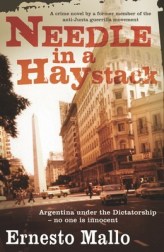
#12 Ernesto Mallo / Needle in a Haystack

Ernesto Mallo, Needle in a Haystack [La aguja en el pajar], translated from the Spanish by Jethro Soutar (London: Bitter Lemon Press 2010 [2006]). This crime novel paints a searing portrait of 1970s Argentina under military rule  5 stars

Opening sentence: Some days the side of the bed is like the edge of an enormous abyss.

This is a hard-hitting crime novel, set against the backdrop of Junta-controlled Argentina in the late 1970s, where power lies primarily in the hands of the military, and ‘disappearances’ of young political activists – supposed ‘subversives’ – are common. Such extra-judicial detentions and executions are typically not questioned by the police (the very body that should be protecting the nation’s citizenry), as doing so is perceived as a pointless exercise that would have extremely negative consequences for the individual.

Superintendent Lascano is a recently bereaved detective (see also Kimmo Joentaa), struggling to maintain his integrity in this morally bankrupt society. In the opening chapter, we see him leaving the house at the beginning of the day, trying to ignore the presumably common sights of bus passengers being searched, and a boy and a girl being driven away in a convoy of military trucks. The girl makes desperate eye-contact with Lascano ‘and then she is swallowed up by the fog’ (8). When Lascano is directed to investigate a report of two bodies dumped by the riverside, he finds that there are now three dead lying there. Unable to investigate the first two, who are clearly the victims of the death squads, he is drawn into investigating the third, and soon finds himself in danger as he treads on some highly-placed military toes.

In the process of following Lascano’s investigations, the reader is presented with a finely-drawn portrait of a corrupt Argentina and its ‘Dirty War’. The narrative is told from a number of viewpoints, giving us multiple perspectives of life under the regime, from a member of a guerrilla cell opposing the Junta (Eva), to the honest cop (Lascano and his friend Fuseli the pathologist), the decadent Argentinian (Amancio, Lara and Horacio), the Jewish businessman (Biterman), the right-wing major (Giribaldi) and the major’s wife (Maisabe). Maisabe is procured a baby by her husband – the newborn son of a young ‘subversive’, who has almost certainly been killed by the regime. The focus is very much on the enormous human price that the younger generation – ‘the kids’ – paid for trying to oppose the regime. The author, who is himself a former member of the anti-Junta movement, would have been the same age as these characters in the 1970s, and it’s hard not to see the novel as a lament for his lost contemporaries and their suffering.

One element I found very interesting was the way that members of the Junta were styled as National Socialists in the novel. For example, we’re told how shortly after a couple have been arrested, the military return to their flat to cart off their possessions: ‘Various conscripts come in and out carrying furniture … and they put everything in the back of a truck, supervised by an arrogant blond captain’ (113). For me, this scene immediately brought to mind the deportations of Jewish citizens in Germany, and the appropriation of their property by the Nazi state (signalled here by the presence of the ‘blond’ captain). Lascano is also Jewish, so there seems to be a fundamental opposition being posited in the novel between good versus evil along the fault-line of Jews:Nazis. The kind of right-wing equivalences being made here also reminded me of Imre Kertész’s 1977 novel Detective Story, which is set in an unspecified South American dictatorship and features a police-man whose interrogation methods are modelled on those of the Nazis. (Kertész is a Hungarian Holocaust survivor and writer who won the Nobel Prize for Literature in 2002, and the novel, which can loosely be viewed as a crime novel, is well worth a read – published in translation by Vintage in 2009).

It’s notable (and rather fascinating) that the English translation of Needle in a Haystack was funded by the ‘Sur Translation Support Program of the Ministry of Foreign Affairs, International Trade and Worship of the Argentine Republic’. This suggests that the novel is viewed as part of a national project of engaging with the crimes committed in the Argentine past. The first two novels are also being adapted for film in Argentina, which will undoubtedly help them reach a wider audience.

Needle in a Haystack is a compelling, absorbing and unsettling read. I’d recommend Mallo to anyone who likes quality crime novels that address serious political issues and the legacies of difficult historical pasts. It’s the first of a trilogy and the second, Sweet Money, is already out with Bitter Lemon Press.

Mrs. Peabody awards Needle in a Haystack an outstanding 5 stars.

Update: for a recent article on the process of bringing former members of the junta to justice for the theft of babies from female political prisoners, see here.

The case of the missing translation: Konop’s No Kaddish for Sylberstein

A fellow crime researcher and friend recently read a cracking little French crime novel called Pas de kaddish pour Sylberstein and recommended it to me as one I would enjoy. I duly trotted off to find the translation but came up against a sizeable problem: it’s not available in English.

The novel, by journalist Guy Konopnicky (aka ‘Konop’), was first published in France in 1994,  and went down extremely well with the critics at the time. It was also adapted for film as ‘K’ in 1997 – as I found out courtesy of the Swedish Film Database. And yet not a sniff of it in the UK or States.

However, I then discovered that the novel was available in a German translation entitled Kein Kaddisch fur Sylberstein (btb, 2004). This was a lucky break for me, as I read German a lot better than I do French, and so I was able to sample its delights after all.

Kein Kaddisch für Sylberstein.

This meandering little journey got me musing on the logic (or simply luck) that results in some texts being translated while others are not. There are a couple of good reasons I can think of that would explain why Sylberstein was translated into German. Firstly, some of it is set in Berlin and explores 20th century German history. Secondly, Germans have an insatiable appetite for both homegrown and international crime fiction (another crime researcher colleague of mine was telling me in all seriousness the other day that Swedish crime fiction sometimes appears in German before it has even been published back in Sweden). So there’s an extraordinarily huge market for crime in Germany, as this article on the Deutsche Welle website explains (in English :)).

Here in the UK, fewer translations make it through to the English-language dominated market, although there is of course a very healthy international crime fiction scene now, thanks to visionaries such as Christopher MacLehose at MacLehose Press – not to mention the good folk at Bitter Lemon Press and Arcadia.

It looks like my Konop novel slipped through the net, but perhaps (ahem) one of the above might be interested in picking up this little gem? Here’s a taster from the blurb on the inside cover of the German btb translation:

‘Paris, 20th district. Jewish antiques dealer Simon Sylberstein shoots and kills a German tourist, whom he recognises as his old tormentor. He then hands himself into the police and dies of natural causes shortly afterwards. But Police Inspector Samuel Benamou, originally from Algeria and also Jewish, can’t let go of the case: he travels to the newly reunified Berlin to continue the investigation himself. Once there, Benamou quickly realises that he’s not the only one interested in Sylberstein and his story…’

All in all, I found No Kaddish for Sylberstein an enjoyable and thought-provoking read. Darkly humorous and entertainingly over-the-top at times, it also succeeds in addressing the serious theme of post-war justice (and its lack) following the Second World War and the Holocaust. If you’re lucky enough to speak French or German, it’s available online for a reasonable price.

#10 Dominique Manotti / Affairs of State

Dominique Manotti, Affairs of State, translated from the French by Ros Schwarz and Amanda Hopkinson (London: EuroCrime 2009 [2001]). A breathtaking exposé of political power games and corruption in 1980s Paris  4 stars


Opening sentence: Outside, it’s sunny, summer’s round the corner, but the offices of the RGPP, the Paris police intelligence service, are dark and gloomy with their beige walls, grey lino, metallic furniture and tiny north-facing windows overlooking an interior courtyard.

In one way, Affairs of State is less a crime novel than a tale of power and corruption, in which murders are inevitable as the stakes for political survival rise. In another, though, this is a crime novel through and through, in the sense that it dissects a bewildering range of criminal behaviour and leaves the reader looking at the world of politics through somewhat jaundiced eyes.

The spider at the centre of the web is François Bornand, a special advisor to the French President, who is guilty of all manner of corruption and decadence in the mid-1980s: the sinking of the Greenpeace ship Rainbow Warrior, lucrative arms deals with Iran, and a never-ending consumption of high-class call girls.

Bornand is the ultimate survivor, and when information about his illicit activities threatens to reach the press, he uses a maverick security unit based at the Elysée, the very heart of the French political establishment, to protect his empire. As the bodies pile up, the novel focuses less on the puzzle of who commits each crime (readers are privy to the identities of all the murderers), than on the investigative efforts of the police and intelligence service, who would like nothing more than to bring Bornand down. In the process, we are shown the fascinating journey of rookie policewoman Noria Ghozali, who starts out at the periphery of the investigation, but makes the crucial shift into intelligence work by the end of the novel. Like one of the murder victims, Ghozali is of Arab extraction, and her battle for acceptance within the police force and wider society allows Manotti to examine French attitudes to gender and race in an uncompromising and very effective way.

What’s particularly fascinating about the novel is how closely it dares to reference the reality of French politics in the 1980s. The original title of the novel is Nos fantastique années fric, or ‘our fantastic years of dosh’, and Manotti sets out to critique what she describes in her afterword as ‘this decade in which money came to represent, for an entire political class, an end and a value in itself’. Particular venom is reserved for the Socialists who came to power with Mitterrand and who ‘assumed and practiced their new religion with the zeal of neophytes’.  A professor of economic history in Paris, Manotti demonstrates an acute understanding of the corrupting influence of money in political life – and this is really the novel’s central theme. Bornand appears to be a composite of several politicians of the time, outwardly respectable but tainted by a Vichy past, and bears a particularly marked resemblance to one individual (as I learned from Véronique Desnain’s paper at the Belfast ‘States of Crime’ conference). Manotti sails remarkably close to the wind here, and I salute her bravery in doing so.

That having been said, there are elements of the narrative that are overly melodramatic, especially towards the end of the novel. But I suspect these are designed as symbolic indicators of corruption more than anything else – and they didn’t overly detract from the power of the narrative.

One lovely extra detail: it’s noted on the inside front cover that ‘this book is supported by the French Ministry of Foreign Affairs’!

 A film of the novel, entitled Une affaire d’État, was released in 2009.

Mrs. Peabody awards State of Affairs an intrigue-filled 4 stars.

Crime novels that make you want to rant: Philip Kerr’s Field Grey (Bernie Gunther series #7)

Every now and then I read a crime novel that makes me feel grumpy, usually because of the poor quality of the writing, plotting or characterisation. Normally I don’t blog those kinds of reading experiences, and just move swiftly on to something more worthwhile. This post is going to be an exception to that rule, and concerns a once great series that has gone seriously off the rails.

A bit of a rant follows… You have been warned.

When I first discovered Philip Kerr’s ‘Berlin Noir’ trilogy in the 1990s, like many other readers I was in seventh heaven. March Violets (1989), The Pale Criminal (1990) and A German Requiem (1991) were the best crime novels I’d read in a long time, a sublime marriage of historical crime fiction and hard-boiled noir. They were also the best I’d seen set in the Nazi and Alled Occupation periods, providing a nuanced portrait of everyday life under Hitler, during the war, and in the turbulent period immediately following defeat. Collectively, they provided readers with a detailed insight into Nazi ideology and its imple-mentation, grappled with weighty themes such as guilt, justice and accountability, and examined the moral difficulties of occupying an ‘insider/outsider’ status within the regime through the figure of P.I. and sometime policeman Bernie Gunther. I’m still nostalgic for those early reading experiences (an entire holiday spent sneaking off from my beloved family to hoover up a few more chapters in delicious solitude).

After this first trilogy of Bernie Gunther novels there was considerable radio silence, and most of us assumed that the series was complete. Then, fifteen years later in 2006, another installment was published, which was swiftly followed by another three works. Each of these I purchased and read with varying degrees of pleasure, until I reached Field Grey (Quercus 2010), when a suspicion simmering at the back of my mind finally became impossible to ignore.

My suspicion was this: that Philip Kerr had intended to end the Bernie Gunther series with the third novel, A German Requiem, and that when he decided to resurrect the series fifteen years later, he made the strategic decision to take the story not just forwards but also backwards in time: forwards into the post-war era, and back to before March Violets and to other portions of the Nazi era not covered in the first three books. To put it even more bluntly: Kerr realised that he had not exploited the success of the Gunther series sufficiently, and decided to have another bite of the cherry, along the lines of George Lucas and his Star Wars prequels.

This is what we see when we compare the basic details of the first three novels with those that follow:

March Violets                     1936 Nazi Germany

The Pale Criminal              1938 Nazi Germany

A German Requiem           1947 Occupied Germany and Austria

The One from the Other   1937 Berlin / 1949 Munich

A Quiet Flame                     1950 Buenos Aires / 1932 Berlin

If the Dead Rise Not           1936 Berlin / 1954 Havana

Field Grey                             1954 Cuba, New York, Germany / 1941 Minsk /

1931 / 1940 Germany / 1940 France / 1946 Russia, Germany

So the first three novels are straightforwardly chronological (1936-1947). The remainder continue to move forward in time, but zig-zag between the post-war ‘present’ and the Weimar, Nazi or immediate post-war pasts, and between Germany, Latin America and other nations involved in World War II. In other words, books 4-7 all have structures that allow the author to dip in and out of Bernie’s previous back-story and German/ wartime history at will, and to ‘open up’ as yet unexplored and lucrative literary territory. I’m prepared to bet that if Kerr had planned a seven novel series from the start he would have written it differently, probably governed by a more conventional chronological structure. And I reckon the novels would have held together much better as a totality if he had.

One could argue that the complex temporal structure of the later books make for a more interesting read, but in the case of Field Grey, which traces Bernie’s relationship with Erich Mielke (future big cheese in the GDR Stasi) from 1931 to 1954, this approach is tested to the limit. Furthermore, the arc of their twenty-year relationship doesn’t provide a strong enough framework to sustain the novel: while there are interesting observations about post-war guilt and justice, there’s no real plot, just a series of loosely related misadventures on Gunther’s part. More seriously, the considerable amount of *new* information given about Gunther’s past has the effect of overwhelming the portrayal of the detective and his life-story from earlier works of the series. It seems particularly implausible that many of the major life events recounted in Field Grey are not referenced by Gunther in the books that have gone before. And there are some problematic disparities, such as those arising from Gunther’s differing accounts of his tranfer from Minsk in A German Requiem (Berlin Noir, Penguin: 1993, pp.592-3) and in Field Grey (pp. 89-90).

In sum, my grumpiness on finishing Field Grey appears to have had two primary causes: firstly, the unfolding of a shaggy dog story in place of a decent plot, and, secondly, the manner in which this and the other ‘later’ novels interfere with Gunther’s characterisation and the beautifully rounded entity that is the ‘Berlin Noir’ trilogy. I can’t help feeling that it would have been wiser for Kerr to have left well alone (from an aesthetic if not from a commercial point of view).

I see that there is another Bernie Gunther novel coming out in October 2011 entitled Prague Fatale. I can only hope that the title indicates what I think it does, and that Bernie is given the dignified exit he deserves.

Rant over. Thanks if you made it this far 😉

Update: Since this post, Philip Kerr has published a ninth Gunther novel entitled A Man without Breath (Quercus 2013).

I look more closely (and without ranting) at the role of Bernie Gunther in a journal article published in Comparative Literature Studies (June 2013): ‘The “Nazi Detective” as Provider of Justice in Post-1990 British and German Crime Fiction: Philip Kerr’s The Pale Criminal, Robert Harris’s Fatherland, and Richard Birkefeld and Göran Hachmeister’s Wer übrig bleibt, hat recht’.