Review of Tinker Tailor Soldier Spy: British espionage thriller meets Swedish crime

I never thought I’d say this, but I was glad of some Welsh rain this afternoon, as it gave me and Mr. Peabody the perfect opportunity to go to the cinema. There, we treated ourselves to the 1970s espionage fest that is Tomas Alfredson’s Tinker Tailor Soldier Spy, adapted from the John le Carré classic of 1974.

The film has received rave reviews, including a rare 5 stars from The Guardian’s Peter Bradshaw, and I can understand why: this is film-making of the highest quality, which is beautifully acted and styled, and recreates a tense Cold War atmosphere to perfection.

Although the plot is fiendishly complex in places, with some mind-boggling twists and turns, the fundamentals of the story are always clear. There is a Soviet mole in the highest echelons of the British Secret Service, working for ‘Karla’, the enigmatic head of the KGB. It falls to George Smiley, a forcibly ‘retired’ senior intelligence officer, to flush the mole out. The spy has to be one of four people, all of whom Smiley has worked with for years, and so he is dealing not just with a political betrayal, but with a long-running personal betrayal as well.

The film allows Smiley’s investigation to unfold at a leisurely pace, as he tracks down the key players whose recollections will allow him to identify the mole. We are also shown Smiley’s own memories of past events (including a Christmas office party with Le Carré as an extra), which he is forced to view with new eyes – a painful process that reveals how one person’s betrayal has undermined all their supposed achievements down the years. Seeing things clearly is a dominant theme: early in the film, Smiley visits an optician’s and emerges with a new pair of glasses – the big, rectangular type worn by Alec Guinness’s Smiley in the 1970s TV adaptation. But this is much more than simple homage to the famous earlier series: the new glasses have a deeply symbolic function, showing how Smiley has sharpened his vision, in order to see the truth properly for the first time.

The acting is excellent throughout. Gary Oldman is a wonderfully controlled Smiley, whose close-ups reveal, through the minutest of facial movements, the tensions that lie beneath. There are also wonderful performances by John Hurt, Benedict Cumberbatch, Toby Jones, Colin Firth and Kathy Burke (who has possibly the best line of the whole film). Hats off, as well, to the film’s cinematographers, stylists, and lighting crew, who evoke a gloomy 70s Britain so perfectly: there’s no James Bond glitz or glamour here, just a succession of dark, windowless secret-service offices and hideouts, in a 1970s palette made up almost exclusively of browns (from beige to fawn to mud and a thousand shades in-between). The humdrum office life of the secret service is beautifully depicted (Trebor Mint, anyone?) and in some ways the whole story can be read as just mundane office-room politics, with various divisional heads pitted against one another for supremacy over the years … albeit with more geo-political issues and human lives at stake than your average workplace.

So how does a review of this seemingly ultra-British film end up on a transnational crime blog? Well, the film was co-funded by France’s StudioCanal, and the director, Tomas Alfredson, is Swedish. Best known for his 2008 vampire film Let the Right One In, Alfredson has done a tremendous job of adapting le Carré’s depiction of the classic Cold War crimes of treachery and betrayal. And in its understated style and underlying melancholia, I see this film connecting back to Swedish crime writers such as Sjowall & Wahloo and Henning Mankell, whose investigative figures, like Smiley, plod their way in a dogged and melancholy fashion towards the truth.

In Tinker Tailor Soldier Spy, the quintessential British espionage thriller meets the best of Swedish crime writing. It’s a winning combination and I can only hope that the other two novels in the Karla Trilogy will make it to the big screen via the same film-making team.

There’s also a lovely A-Z of TTSS from The Guardian available here.

#11 Henning Mankell / The Troubled Man

Henning Mankell, The Troubled Man, translated from the Swedish by Laurie Thompson (London: Harvill Secker 2011 [2009]). Wallander’s final case, in which he faces his biggest challenge yet 5 stars

Opening sentence: The year Kurt Wallander celebrated his fifty-fifth birthday, he fulfilled a long-held dream.

While at the airport bookshop before going on holiday, I spotted Henning Mankell’s The Troubled Man, a novel I’ve been looking forward to reading for a good year. After a few moments I decided rather regretfully to resist, as I wasn’t sure the Very Last Wallander would make for a cheery holiday read. Later that day, while exploring the hotel, I came across the usual bookshelf of novels left by other holidaymakers. There, but of course, was another copy of The Troubled Man, at which point I gave in, put aside the carefully selected crime novels I’d brought with me and, armed with a hanky, started to read.

Before saying any more I should confess that I am a thoroughly biased reviewer when it comes to this Swedish writer and series. I have loved all the Wallander novels, and it would have taken a complete car-crash of a book for me to rate it anything other than five stars. So a five it is – and in some senses this is a rating for the entire series, which is referenced numerous times in various ways throughout the book.

Troubled Men

The first troubled man of the title is Hakan von Enke, a retired Swedish naval official and the father of Linda Wallander’s partner Hans, who disappears into thin air one day while out on his regular walk. Shortly before he vanishes, Hakan voices some concerns to Wallander about an unsettling naval incident that took place in 1982 involving a Russian submarine. Not long afterwards, Hakan’s wife Louise also disappears. To help a distraught Linda and Hans, Wallander begins an unofficial investigation, and uncovers an espionage story that reaches back into the complex history of the Cold War. This forms the central case within the novel, and is an absorbing and well-constructed read (albeit with the odd loose end that’s rather too casually tied up at the end). As ever, Mankell challenges us to question our assumptions, in this case about the dominant historical narrative of the Cold War years – there are a number of enjoyable and unexpected twists that force us to see key events in a whole new light.

The second troubled man, of course, is Kurt Wallander himself, whose personal and working life is overshadowed by a growing anxiety, in spite of the joy that becoming a grandfather brings. Now at the age of sixty, when most people start reflecting on their lives and the choices they have made, Wallander becomes a vehicle for Mankell to explore some very large themes: the value of family ties, the passing of time, the individual’s fear of losing his or her identity and, of course, death. There’s very much a feeling of closing the circle, with a number of references to Rydberg (Wallander’s mentor early in the series), Wallander’s late father (whose relationship with his son was often fraught), Baiba Leipa (his one-time love from The Dogs of Riga), and individuals from past cases (such as the husband of the victim in The White Lioness). For anyone who has travelled with Wallander down the long and winding road of this ten book series, it can’t help but be an absorbing, poignant and moving read.

One final word: if you’ve not yet read the earlier Wallander books, or if there are any in the series that you need to catch up on, I would strongly recommend doing so before embarking on The Troubled Man, which should be read at the end of the sequence as the author intends.

Mrs. Peabody awards The Troubled Man a slightly mournful, but deeply satisfying 5 stars.

Other Mankell/Wallander links you may enjoy

Henning Mankell’s official website

In the Footsteps of Wallander – a PDF guide to the locations featured in the books, films and TV series.

Scandinavian Crime Fiction – a blog that does what it says on the tin.

#8 Karin Alvtegen / Shadow

Karin Alvtegen, Shadow, translated from the Swedish by McKinley Burnett (London: Canongate 2009 [2007]). A gripping psychological thriller, but one which tips over into melodrama at times  4 stars

Opening sentence: The key to the flat had arrived in a padded envelope from the police.

Karin Alvtegen’s Shadow immediately caught my eye with its rather intriguing opening. When 92-year-old Gerda Persson dies alone, estate administrator Marianne Folkesson visits her flat to glean the details of her life, and finds the freezer packed with signed copies of books by prize-winning author Axel Ragnerfeld. What on earth could have led Gerda to put them there? And what connection might they have to a young boy who was abandoned in an amusement park back in 1975?

So far so good: a literary puzzle that leads the reader into the dark heart of a family’s story – as well as that of a traumatised Holocaust survivor – and expertly keeps us wanting to know more. Well-written and gripping, and with a multi-layered, uncompromising ending, Shadow is in many respects a highly enjoyable read. In particular, I found many of the novel’s characters sensitively drawn, and their relationships described with a keen eye for psychological detail. Alvtegen is particularly good at exploring human weaknesses, and the kind of personal prisons individuals create for themselves without even realising what they are doing. Tracing the consequences of these weaknesses, and of the criminal decisions or actions they generate, are the novel’s great strength.

However … there was one element of Alvtegen’s story-telling that grated, namely a tendency to melodrama in the final third of the novel. There came a point where so many dramatic events were piled on top of one another that the narrative threatened to tip over into ridiculousness, and to undo the finely observed psychological detail of the rest of the novel.  This tendency also weakened the depiction of a couple of characters, whose actions at certain moments just didn’t ring true.

In spite of these reservations, I did enjoy the novel, and found that the questions it raised about life choices, trauma and morality lingered on. In particular, the ‘one last question’ on the final page of the book stayed with me for a number of days after closing its covers.

Mrs. Peabody awards Shadow a thoughtful 4 stars.

Trivia special, courtesy of @Petrona: Karin Alvtegen is the great-niece of Pippi Long-stocking author Astrid Lindgren. Petrona’s own excellent review of Shadow can be read on the Euro Crime blog (and contains a more detailed description of some elements of the plot).

.

BBC4’s Wallander – Series 2 with Krister Henriksson

BBC4 has started repeating the second series of Swedish TV’s Wallander (2009-10) on successive Saturdays at 9pm. I managed to catch up with the first episode today, having had a prior engagement with Wales’ finest, The Manic Street Preachers, in Cardiff last night (splendid as ever).

This series has Krister Henriksson in the lead role. As I’ve noted in the past, I’ve always been more partial to Rolf Lassgård’s portrayal of Wallander in the film adaptations of Mankell’s novels between 2004 and 2007. But I’ve decided to give Henriksson a proper go, having realised that I’d only caught odd episodes with him over the years, rather than watching an entire series through from start to finish.

Krister Henriksson

This Saturday’s episode (21 May), entitled ‘The Revenge’  (‘Hämnden’), begins with Wallander celebrating his move to a dream house by the sea. The party is rudely interrupted by an apparent terrorist act, the bombing of Ystad’s power-station, which plunges the town into darkness. The next morning, a man is found murdered in his home, and the rather hungover investigative team is forced to ask: are the two crimes coincidence or could they be in some way linked?

I really enjoyed this opener. Based on an original storyline rather than on one of the Mankell novels, it was well-plotted, well-written and had a few nice spine-tingler moments (keep plenty of spare torches to hand in case of a power cut, everyone). The acting was excellent, and there was promising interplay between Wallander and the rest of the team, especially trainee policewoman Isabell Melin, who challenges Wallander’s rather outdated views on gender. The episode also introduces public prosecutor Katarina Ahlsell, one of those strong female characters of whom Mrs P. is so fond (played by Lena Andre, who also plays Erika Berger in the Swedish film of The Girl with the Dragon Tattoo).

While drawing on original material, the episode still feels very Wallander-y. Its tone is very close to that of the books, successfully incorporating social critique into the narrative of the police investigation.

And the rather morose-looking Henriksson as Wallander? Yes, alright, there’s some promise there. I’ll do my best to put Rolf to one side for now and let Henriksson do his stuff.

Episode 1 is repeated this coming Wednesday, and will be available on iplayer for another few days.

Update – 16 July. I’ve just watched the 9th episode in the series, ‘The Angel of Death’. At this point, I find that I’ve grown to appreciate Henriksson’s quieter, steadier depiction of Wallander. But oh dear, what a crazy, melodramatic conclusion this episode had! It knocked down a number of stereotypes, only to replace them with an even larger one when the murderer and his/her motivation was revealed. Tsk!

Update – 16 August I’ve just caught up on the 13th and final episode in the series, ‘Vittnet’ (The Witness), which was very good. The story focused on the trafficking and exploitation of illegal workers, and the difficulties of successfully prosecuting those at the top due to the intimidation of witnesses, as well as members of the police and judicial system (such as Wallander and Katarina). There was a nice dissection of the way that Swedish local government and firms subcontract their business for a reduced price to others, and then turn a blind eye to the horrendous working hours and conditions on their building sites. This probably sounds a bit worthy and dry, but wasn’t, as there was a strong human dimension to the storylines, and a touchingly upbeat ending, which I rather liked, having just read The Troubled Man (review to follow soon).

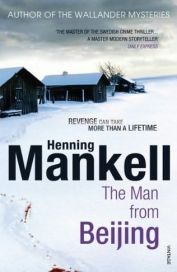
#5 Henning Mankell / The Man from Beijing

Henning Mankell, The Man from Beijing, translated from the Swedish by Laurie Thompson (London: Vintage, 2011 [2008]). A gripping crime novel spanning a hundred years and four continents. Arguably a little over-ambitious, but a highly enjoyable read nonetheless 4 stars

Opening sentence: I, Birgitta Roslin, do solomnly declare that I shall endevour, to the best of my knowledge and in accordance with my conscience, to pass judgement without fear or favour, be the accused rich or poor, and according to the laws and statutes of Sweden…

My Easter treat was a copy of Henning Mankell’s The Man from Beijing. Like many others, I’ve been a Wallander fan for many years, but have come to enjoy Mankell’s standalone novels as well, and to admire his continued enthusiasm for writing and tackling big subjects when he could so easily be resting on his laurels.

The novel opens with the discovery of a brutal massacre in the remote northern hamlet of Hesjövallen that shocks the whole of Sweden. The first few pages are also liable to shock even a seasoned crime reader. As the Sunday Times quote on the back of the novel so accurately observes: ‘it is hard to think of a crime novel with a more grisly opening’. Snacking is not to be recommended for the first 50 pages.

After reading a newspaper report, Judge Birgitta Roslin realises that she has a family connection to two of the victims, and becomes increasingly involved in unravelling this highly unusual case, which has its beginnings in the harsh histories of nineteenth-century migration and colonial oppression. Taking Roslin and the reader on a sweeping set of individual, historical, political and geographical journeys, The Man from Beijing is both a detective novel and political thriller, featuring an eclectic range of characters from all over the world.

For this reader, one of the novel’s strongest points was the characterisation of Roslin and the policewoman Vivi Sundberg (thank you Mankell for creating these complex, interesting, older women!). The plot was also gripping, but perhaps overly ambitious in places, with different sections located in 2006 Sweden, 1860s China and America, as well as present-day China and Africa. Mankell is to be applauded for the scope of the history that he tries to show us, his exploration of the complex relations between Europe, America and China, and his illumination of developing economic ties between China and Africa, but towards the end of the novel I felt that these political strands were in danger of overshadowing the crime narrative.

That having been said, the novel was still an extremely satisfying and thought-provoking read. And it’s always good to see authors pushing the boundaries of the crime novel in interesting ways.

An extract from the novel is available here.

Mrs. Peabody awards The Man from Beijing a hearty 4 stars.

The last Wallander: UK publication of Henning Mankell’s The Troubled Man

Today sees the UK publication of Henning Mankell’s tenth – and final – Kurt Wallander novel, The Troubled Man.

Here’s the Vintage synopsis:

>> The first new Wallander novel for a decade, the culmination of the bestselling series from the godfather of Swedish crime.

Every morning Håkan von Enke takes a walk in the forest near his apartment in Stockholm. However, one winter’s day he fails to come home. It seems that the retired naval officer has vanished without trace.

Detective Kurt Wallander is not officially involved in the investigation but he has personal reasons for his interest in the case as Håkan’s son is engaged to his daughter Linda. A few months earlier, at Håkan’s 75th birthday party, Kurt noticed that the old man appeared uneasy and seemed eager to talk about a controversial incident from his past career that remained shrouded in mystery. Could this be connected to his disappearance? When Håkan’s wife Louise also goes missing, Wallander is determined to uncover the truth.

His search leads him down dark and unexpected avenues involving espionage, betrayal and new information about events during the Cold War that threatens to cause a political scandal on a scale unprecedented in Swedish history. The investigation also forces Kurt to look back over his own past and consider his hopes and regrets, as he comes to the unsettling realisation that even those we love the most can remain strangers to us. <<

The Daily Telegraph carries an exclusive extract – available here.

There’s also a nice piece in The Guardian, in which Jon Henley talks to Henning Mankell about The Troubled Man, the Wallander series, and looking back over life at 60.

Can’t wait to get my hands on it.

‘Can Scandinavian crime fiction teach socialism?’

There’s a very nice article by Deborah Orr in today’s The Guardian, which explores Scandinavian crime fiction’s role in ‘framing socio-political debate’. She takes in The Killing (‘are political coalitions healthy?’), the ‘Martin Beck’ series (Marxist critique of 1960s Swedish society), Nesbo’s works (‘sexual crime as expression of discord between men and women’) as well as a couple of others in the course of her discussion. Well worth a read.

For the Lund watchers amongst you, the article also features a picture of Lund wearing a third jumper – white diamonds on black!

BBC4’s Wallander – The Pyramid

Just caught up with the New Year’s Day showing of Wallander on BBC4, which I’d missed while at my mum’s (we watched the excellent ‘Eric and Ernie’ that night instead). I hadn’t seen this adaptation of ‘Pyramiden’ before, and it was an absolute (and extremely explosive) treat. The storyline reaches back to Wallander’s first days on the Ystad force, and is a poignant exploration of the moral difficulties faced by policemen who become personally caught up in a case. For those of you who haven’t yet had the chance, it’s still available to view for a few days on iplayer. 

The film is part of the Wallander series I enjoy most, made for Swedish Television between 1994 and 2007. I particularly like the rather louche depiction of Kurt Wallander by the actor Rolf Lassgård (pictured leaning on the chair).

The other Swedish actor who plays Wallander, Krister Henriksson, is a bit more buttoned-up, and although the latter’s version is probably more faithful to the characterisation in the books, I think Lassgård’s interpretation plays better on TV. Brannagh’s take on Wallander is OK, but give me either of the original Swedish actors and adaptations any day.

Hats off to BBC4 for making the Christmas season such a festive one for crime fans – full of quality murder and mayhem. There were excellent documentaries on Nordic Noir and Italian Noir, as well as lashings of Swedish and Italian crime. It’s so good to see these programmes in their original languages – please keep them coming.

Also a nice little pressure valve when the Xmas family gatherings got too much (probably saved a life or two and Mrs. Peabody a lengthy stretch in jail).

By the way, there’s a post about the evolution of the Swedish ‘deckare’ on the ‘Gone Elsewhere’ blog – well worth a read.