Theakstons Old Peculier Crime Writing Festival 2012

I’ll be setting off early tomorrow morning to the lovely spa-town of Harrogate for the Theakstons Old Peculier Crime Writing Festival (19 – 22 July).

The programme is packed with all sorts of wonders, but I’ll be focusing in particular on the wealth of international crime writing talent taking part, including British writers who set their works beyond the UK.

These include the following (and many, many more…)

Harlan Coben (America)

Arne Dahl (Sweden)

Antonio Hill (Spain)

Ryan David Jahn (America)

Camilla Läckberg (Sweden)

Laura Lippman (America)

Liza Marklund (Sweden)

Deon Meyer (South Africa)

Stuart Neville (Northern Ireland)

Margie Orford (South Africa)

Jo Nesbø (Norway)

Jason Webster (England / Spain)

For those of you keen to hear news from the festival as it unfolds, I’ll be tweeting as @Mrs_Pea68, using the hashtag #TOPcrime2012

If you’re at the festival, perhaps see you in Betty’s or at the bar!

Review of Branagh’s Wallander: Episode 1, Series 3 – ‘An Event in Autumn’

I’ve just finished watching Episode 1 of the new Wallander series, ‘An Event in Autumn’, which got proceedings off to a hard-hitting and occasionally heart-stopping start.

It all begins so well! Wallander and his girlfriend have just moved into their dream home together, a fresh start designed to allow him to ‘leave work at the door’. He’s so happy he even smiles! Then Jussi the dog finds a skeleton under the blackberry bushes in the garden and it’s all downhill from there: the corpses pile up, there are scary encounters in poorly lit locations, and the icy winds of winter begin to blow. In sum: the classic, gloomy Wallander we know and love.

I do like Branagh’s Wallander very much (and isn’t Mankell fortunate to have found three such wonderful actors over the years to realise his creation?). The quality of the production, as in earlier series, is extremely high, and is undoubtedly anchored by Branagh’s performance, which allows us a privileged insight into the strengths and weaknesses of Wallander’s character. The frequent, beautiful shots of chilly beaches and bleak landscapes reinforce his nordic / melancholic loneliness perfectly.

For those of you interested in the theme music, it’s by Emily Barker & The Red Clay Halo, and is called ‘Nostalgia‘.

I’m already looking forward to seeing the second episode, ‘The Dogs of Riga’, next week. I’ll be intrigued to see how they adapt a novel originally set during the collapse of communism in the early 1990s.

The Crime Writers’ Association Awards 2012

Last night, the CWA awards for 2012 were announced in London.

Two of the categories were of particular interest to me as a fan of international crime fiction. Firstly (and most obviously), the CWA International Dagger, whose shortlist included three novels from Italy, and one from Norway, Sweden and South Africa respectively. Secondly the CWA Ellis Peters Historical Dagger, whose shortlist featured the Italian crime novel I Will Have Vengeance by Maurizio de Giovanni (Hersilia Press) and Philip Kerr’s Prague Fatale (Quercus), set in Nazi Germany.

The Historical Dagger shortlist was also interesting in terms of highlighting a shift away from  ‘historical crime fiction’ set in the distant historical past (such as Ellis Peters’ famous ‘Brother Cadfael’ series) to crime fiction engaging with twentieth-century history (all but two of the shortlisted novels are set following 1930).

And the winners are…..*drumroll*

CWA International Dagger: The Potter’s Field by Andrea Camilleri               (trans. by Stephen Sartarelli and published by Mantle)

The judges said ‘Camilleri’s Montalbano novels show just how much can be achieved with familiar materials when a writer conveys the sense of life in a recognizable place. He combines characters, plots, and reflections on Italy’s particular social and political problems with wry—but never bitter—satire. In this novel the late-afternoon shadows lengthen; Montalbano is feeling his age.’

Further information about the winner and the other shortlisted novels can be found on the CWA website here.

CWA Ellis Peters Historical Dagger: Icelight by Aly Monroe                              (published by John Murray)

The judges were unanimous in their decision to award Icelight the Historical Dagger, commenting that “this tale of British post-war malaise, the third of Monroe’s Peter Cotton thrillers, is authentically downbeat yet absolutely gripping. Monroe has the young le Carré’s ability to conjure atmosphere and a poetic style worthy of Len Deighton.”

Further information about the winner and the other shortlisted novels can be found on the CWA website here.

Many congratulations to all the CWA winners and I hope everyone had a great night!

Sebastian Bergman: Review of Episode 1 (with a little word on Episode 2)

Today I managed to catch up with the first installment of the Swedish crime series Sebastian Bergman, which originally aired last Saturday on BBC4. My expectations were pretty low having viewed a dire trailer made by the German broadcaster ZDF (see my earlier comments here), but happily, ‘The Cursed One’ turned out to be a decently-made, entertaining 90 minutes of crime.

The key investigative figure, Professor Sebastian Bergman, is a renowned Swedish profiler of unpleasant disposition: he’s tetchy, uncooperative, and a serial seducer of vulnerable women. Although we find out the main reason for this behaviour, he remains a troubled and rather unlikable figure, and is nicely portrayed by the actor Rolf Lassgård (well known to Henning Mankell fans as the ‘first’ TV Wallander). 

The opening episode shows Bergman inching back into policework after an extended break, following the brutal murder of a 15-year-old boy. The investigation proceeds at a brisk pace (we work through as many suspects as in the whole of The Killing 1 by the end of the first hour), uncovering a number of suburban secrets on the way. The denouement is reasonably satisfying, although I couldn’t help but be amused at how wide of the mark Bergman’s perpetrator profiling had been. 

In sum: a good start with some potential, should the relationship between Bergman and his police colleagues be allowed to develop more. There’s a nice little twist at the end that augers well.

Update on 8 June: I’ve just caught up with Episode 2, and wasn’t quite as enamoured as many people seem to have been on Twitter. As this blog’s readers will know, I’m not a fan of serial killer narratives / misogynist violence, so points had to be taken off from the word go. In addition, the development of the plot felt wholly predictable… Would I watch more Sebastian Bergman if it came to our screens? Probably, but it won’t be at the top of my list of Saturday night treats.

Saturday treats: Sebastian Bergman / CWA International Dagger / Israeli crime fiction

Three little treats on this lovely sunny day in the UK.

1. For fans of Swedish crime and of Wallander actor Rolf Lassgård: the ‘police thriller’ Sebastian Bergman begins tonight on BBC4 at 9pm. See the second half of this earlier post for an overview and trailer.

Photo from BBC/ZDF

2. CRIMEFEST 2012 – the annual International Crime Fiction Convention – is in full swing in Bristol this weekend. While extremely sad to be missing the party, I’m enjoying tweets on the various panels from @Eurocrime and @NicciPrasa amongst others. The hashtag for the event is #crimefest12.

Thrillingly, the CWA (Crime Writers’ Association) shortlists for the following ‘Daggers’ were announced there last night: International, Historical, Non-Fiction, Library, Short Story and Debut. Thanks to Rhian over at ‘It’s a Crime! (Or a Mystery…)’ for a comprehensive listing of all the works shortlisted.  

There are 6 works listed for the International Dagger (‘crime, thriller, suspense or spy fiction novels which have been translated into English from their original language, for UK publication’):

The Potter’s Field by Andrea Camilleri, trans. by Stephen Sartarelli (Mantle)
I will have Vengeance by Maurizio de Giovanni, trans. by Anne Milano Appel (Hersilia Press)
Until Thy Wrath Be Past by Åsa Larsson, trans. by Laurie Thompson (Quercus/Maclehose)
Trackers by Deon Meyer, trans. by T K L Seegers (Hodder & Stoughton)
Phantom by Jo Nesbø, trans. by Don Bartlett (Harvill Secker)
The Dark Valley by Valerio Varesi, trans. by Joseph Farrell (Quercus/Maclehose)

Further details about the novels are available via the CWA website here.

And over at Petrona, you’ll find a list of all International Dagger winners since 2006, along with a wealth of links to reviews and CWA webpages (thanks, Maxine, for this excellent resource).

3. A guest post on Israeli crime fiction by Uri Kenan at the ‘Detectives Beyond Borders’ blog caught my eye this week. For someone like me, who knew nothing about the history of crime fiction in Israel, it was a very illuminating read. I’m already looking forward to part 2, which I imagine will look at more contemporary offerings.

Peter Rozovsky, who runs the blog, is also at CrimeFest at the moment, and has already posted three reports, which are well worth a read

I hope the sun is shining for all of you wherever you are: have a lovely weekend.

Reflections on BBC4’s The Bridge / Bron / Broen

Following the utterly gripping and nail-biting finale of The Bridge, it’s time for a few reflections on this ground-breaking Danish-Swedish production.

In line with Mrs P. policy, there are NO FINALE SPOILERS (if that’s what you’re after, do head over to The Guardian‘s ‘Bridge blog‘).

The Bridge vs The Killing

Before The Bridge aired in the UK, a number of people who’d seen the series said they’d liked it even more than The Killing. Although I’ve enjoyed The Bridge hugely, I’m not yet prepared to go that far: the first series of The Killing remains my top crime-drama viewing experience and Sarah Lund still edges it over Saga and Martin’s (admittedly great) investigative duo.

This preference is mainly due to the depth of characterisation in The Killing. In the first series especially, the focus was on a small number of characters whom you got to know very well, whereas The Bridge had a larger cast and, with the exception of Saga and Martin, had less time to dig deep. Compare, for example, the picture we were able to build up of Nanna Birk Larsen as the murder victim in The Killing 1 and those of the politician / prostitute at the beginning of The Bridge (merely the first of many). And there were a number of interesting characters who featured heavily in early plot-lines of The Bridge, but then simply faded away. Their disappearing acts may be a reflection of the reality of investigations – people make their contribution or are ruled out as suspects and then the team moves on – but some of their stories felt incomplete and I’d liked to have known more.

Fabulous biting humour

Those minor quibbles aside, The Bridge was a top-notch Scandi treat that had me gripped throughout, and became increasingly assured as time went on. The last four episodes were absolutely cracking.

One particularly fine quality was apparent right from the start of the series: a biting and at times splendidly irreverent humour. Much of this was generated by the interplay between the odd-ball Danish-Swedish investigative couple, and also provided a way of managing the audience’s reaction to Saga as a character on the autistic spectrum (we’re invited to see her behaviour as ‘endearingly odd’ rather than ‘threateningly weird’). There’s been some debate about the suitability of this strategy, but I felt it worked extremely well, and that the writers kept the balance between the humour and the more serious elements of the drama just right. Episodes 7 and 8 were superb in this respect.

Hey Martin…was it something I said?!

In sum, The Bridge is high-quality crime drama firmly located in the tradition of socially-engaged Scandinavian crime fiction, with a wonderful pair of detectives and more twists than fusilli pasta. If you haven’t yet seen it, you’re in for a treat.

For earlier posts on The Bridge, see here and here.

And, for one last time, a link to the wonderful title sequence, featuring the sublime ‘Hollow Talk’ by the Choir of Young Believers.

The Curious Case of Arne Dahl’s Chinese Whispers

A recent, very interesting symposium on European Crime fiction in Manchester has led me to the works of Swedish writer Arne Dahl. My colleague Kerstin Bergman (Lund University) gave a great paper on his latest novel Viskleken (Chinese Whispers), which appears to be the first in a new breed of ‘Eurocrime’ fiction. Its investigators are members of a Europol unit drawn from a number of European countries, and are tasked with solving a set of interlocking international crimes.

Here’s some publicity blurb from the Salomonsson Agency website to give you a flavour:

A new and top-secret Operative Unit of Europol has just been established. Its members call it the Op Cop group and Police Superintendent Paul Hjelm from Sweden is at the helm. Based in The Hague with connections and national units spread all over Europe, its mandate is to fight international crime. But although information about the Op Cop group is strictly confidential, there has been a leak. The body of a dead woman is found in a London park arranged in a bizarre position, and inside the body a message addressed to “The Operative Unit, Europol” is discovered. At the same time, a furniture manufacturer in Stockholm is doing business with the infamous Calabrian mafia; an American investment bank is moving unfathomable sums of money; the workers in a Chinese furniture factory are growing ill; and during a G20 summit in London, a dying man whispers a strange phrase in Arto Söderstedt’s ear. Somehow, it’s all connected. The Op Cop group heads out into a world where the Internet, social media, and the fluidity of national borders has globalized crime. The human greed, corruption and craving for power is the same. It has just found a larger arena’.

The Salomonsson site also tells us that Chinese Whispers is the first in an Op Cop / Europol quartet, that it received the ‘Best Swedish Crime Novel’ award in 2011, and was shortlisted for the ‘Best Crime Novel of the Year’ award by the Danish Academy of Crime Writers in 2012.

If like me you’re now desperate to read the novel, I have some good news and some bad news. The good news is that it’s out in Swedish, Danish, German and Dutch, so if you speak any of those four languages you can tuck right in. The bad news is that it’s not yet available in English, and may not be for a long, long time.

The lack of an English-language translation is something that I find very curious, given Dahl’s huge commercial and critical success in Scandinavia and Germany. The author himself has given publishers every encouragement, providing extensive information about his works in English, such as the 10 novels of his debut ‘Intercrime’ series. The first of these was published in 1999, but only recently appeared as Misterioso in the US (see reviews at Petrona and Reactions to Reading), and will be published in the UK this summer as The Blinded Man. The second in the series, Bad Blood, will follow in summer 2013.

All credit to Harvill Secker crime editor Alison Hennessey for picking up the series, but does this mean that we’ll need to wait a decade before we see Chinese Whispers out in English translation? The Europol/Op Cop series follows on from the Intercrime novels, and features some of the same investigators, such as Paul Hjelm. If we plod through all the Intercrime novels in order, year by year, we’re in for a very long wait…

Perhaps another option would be to go ahead and publish Chinese Whispers straight away. I’d be very open to the latter course of action (hint hint), given the novel’s groundbreaking depiction of a European crime-fighting team grappling with globalised crime. Europol, incidentally, is a very real organisation, and its website makes for fascinating reading in its own right.

The Bridge – Review of Episodes 1 and 2

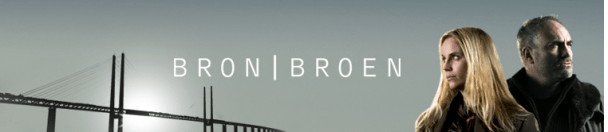
At the centre of the 7,845 metre Oresund Bridge that links Denmark and Sweden, lying across the yellow line that marks the border between the two, the lifeless body of a woman is found. Although the victim at first appears to be Swedish, the national juristiction of the case turns out to be far from clear, leading a police officer from each country being assigned to the case. Swedish investigator Saga Noren (Sofia Helm) and her Danish counterpart Martin Rodhe (Kim Bodnia) both soon realise that they’ve been pulled into a difficult, bizarre and highly complex case.

Thus begins the acclaimed crime drama The Bridge/Bron/Broen, whose first episodes aired last night on BBC4 between 9.00 and 11.00pm.

Even from the title sequence, with its beautiful, nocturnal time-lapse photography and haunting theme (‘Hollow Talk’ by the Choir of Young Believers), it was clear that we were in for a treat. By the end of the first two episodes I was fully gripped, as the investigative narrative unfolded and two intriguing sub-plots took shape: a rich wife rushing her husband to hospital for a transplant operation, and a man helping a young woman escape an abusive husband, but with a murky past of his own.

In Saga Noren and Martin Rodhe we are given a classic investigative ‘odd couple’. Saga is a particularly interesting character, whose sometimes unconventional behaviour leads her colleagues to regard her as ‘a bit special’. She is a brilliant and knowledgeable investigator, who is ruthlessly logical and focused, and finds social niceties a baffling waste of time. As already discussed in the comments of an earlier post, it’s possible that she has a form of high-functioning autism. (In terms of other TV characters, she reminded me a bit of Star Trek‘s Seven of Nine!) Martin, by contrast, is more of an old school cop, who has a complicated private life and doesn’t always do things by the book, but who seems to take Saga’s behaviour (such as calling him in the early hours with a fresh lead) in his stride. The dynamic between the two looks promising.

- Hmm, not sure what I make of you.
- Feeling's mutual

Some other random observations at this point:

In contrast to The Killing, there are moments of genuine, albeit dark humour in The Bridge, which worked well for me. Watch out for Saga’s ‘romantic’ date (and make a note of how not to put off hunky Swedes the morning after).

The obligatory autopsy scene allows us to appreciate Saga’s intelligence and investigative focus (and was therefore justifiably included in my view). There are some quite graphic photos from the autopsy featured later on, but I’m hoping that’ll be it for now.

The series has an interesting 70s styling. Its palette of browns, oranges and beiges reminded me a little of the recent film adaptation of Tinker Tailor Soldier Spy, directed by the Swede Tomas Alfredson. One of the characters (flares, leather jacket, moustache) could have stepped straight out of Life On Mars.

I’m very much enjoying the transnational flavour of the series, which is evident in the Danish/Swedish credits, the characters’ dialogue, and of course the plot itself. And yes, they do all understand one another, but Martin has to repeat himself more s-l-o-w-l-y at one point so that the Swedes can follow him properly!

The murderer’s motives look complex and interesting: ‘if you had cared there would have been no victims’. It looks like the series will follow in the tradition of Swedish crime writing (Sjowall & Wahloo, Mankell) by foregrounding social issues. Mindful of spoilers, I shall say no more.

The Oresund Bridge looks remarkably like the Severn Bridge at times (Welsh-English remake please!).

Tonight’s episodes are both repeated and available on BBC iPlayer.

Below is a handy map with the Oresund Bridge to help with orientation: it joins Denmark and its capital city Copenhagen on the left and Sweden’s Malmo, the third largest city after Stockholm and Gothenburg, on the right.

Looking forward to next week’s episodes already!

BBC4 The Bridge – start date confirmed

FOR DETAILS ABOUT SERIES TWO SEE HERE.

With many thanks to Rhian for alerting me to the following:

The Swedish/Danish crime series The Bridge begins on Saturday 21 April at 9.00 pm. Two episodes will be aired that evening (totalling two hours). Further details are available via The Radio Times, which features Sofia Helin, one of the series’ stars, on its front cover this week.

A BBC4 press release describes the series thus: “The Bridge, a 10-part investigative crime drama, begins when the body of a woman is found in the middle of the Oresund Bridge between Sweden and Denmark. A bi-national team is put together to solve the crime and the killer, always one step ahead of the police, becomes the object of a dramatic manhunt.”

The stars of The Bridge, Sofia Helin and Kim Bodnia

Not only is The Bridge a Swedish/Danish co-production, it’s a bilingual one.

The original title (which appears on the cover of the DVD) is Bron/Broen, and dialogue is delivered in both languages, reflecting the operations of the bi-national investigative team. I’m not sure if this is a first, but I find the idea of a bilingual crime series quite fascinating (imagine, for example, a British/French series investigating a murder at the exact centre of the Channel Tunnel!). Do the Swedish and Danish investigators all understand/speak their opposite number’s language? Do they switch languages depending on the country they happen to be in? I won’t easily be able to tell, as the languages will only be fully comprehensible to me via subtitles, but perhaps someone can provide illumination!

I’ve heard many good things from those who’ve already watched the series and look forward to seeing it immensely.

Check out the wonderfully atmospheric title sequence with its time-lapse photography on YouTube. The title-track, ‘Hollow Talk’, is by the Danish group Choir of Young Believers.

BBC4 lines up a double helping of Swedes for 2012: Sebastian Bergman and The Bridge

While fruitlessly browsing BBC press releases for the start date of The Killing 2, I came across an interesting bit of news: two Swedish crime series (with Danish and German input) have been acquired by BBC4, and will air in 2012.

The press release describes them as follows:

The Bridge, a 10-part investigative crime drama, begins when the body of a woman is found in the middle of the Oresund Bridge between Sweden and Denmark. A bi-national team is put together to solve the crime and the killer, always one step ahead of the police, becomes the object of a dramatic manhunt. The Bridge is a Danish/Swedish co-production.

START DATE FOR THE BRIDGE NOW CONFIRMED

Sebastian Bergman, a compelling new police thriller, stars Rolf Lassgård, one of Scandinavia’s most popular actors [the ‘first’ Wallander] in a powerful new role as profiler Sebastian Bergman.

Strong-headed, politically incorrect, abrasive and grief-stricken, Bergman has still not come to terms with the loss of his wife and daughter in the 2004 Thailand tsunami. In the first of the two thrillers, he helps police in his hometown solve the murder of a 15-year-old boy. In the second, he attempts to catch a serial killer who seems to be modeling his attacks on those of a jailed killer whom Bergman put behind bars himself.”

There’s a trailer available of Sebastian Bergman on ZDF Enterprises’ English-language website. It’s pretty dreadful (cheesy voiceover, gratuitous violence and pompous movie-trailer music).

I fervently hope that the programmes are better than the trailer suggests. I like Rolf Lassgård as an actor, and it would be a shame if he ended up in something sub-standard. The project has the same film-makers behind it as the Wallander film cycle, and expectations will be high.

UPDATE: The start date for Sebastian Bergman has now been confirmed in The Radio Times as Saturday 26 May 2012, 9pm.

My review of Episode 1 is now available here.

For the love of God, someone turn that music OFF!