Friedrich Dürrenmatt’s The Pledge (first review of Swiss crime!)

Friedrich Dürrenmatt, The Pledge (Das Verbrechen), tr. from the German by Joel Agee, Pushkin Press 2017 [1958].

 First line: Last March I had to give a lecture in Chur on the art of writing detective stories.

There are very few crime novels that I keep coming back to, but The Pledge is one of them. Written over half a century ago in 1958, it’s one of three crime novels by the renowned Swiss dramatist and writer Friedrich Dürrenmatt (the others are The Judge and his Hangman (1950) and Suspicion (1951)). The Pledge is my favourite of the three, for its fine writing and penetrating critique of the crime genre. Its tantalising subtitle is Requiem auf den Kriminalroman or ‘Requiem for the Crime Novel’.

The Pledge tells the story of Swiss police inspector Matthäi, who just is clearing his desk prior to a secondment in Jordan when a young girl’s murder is called in. After breaking the news to the girl’s parents, Matthäi is asked by the mother to promise ‘on his eternal salvation’ that he will find the murderer, and this, after a brief hesitation, he does: the pledge of the title. Thus begins a long investigation, which eventually tips over into a personal obsession that will threaten Matthäi’s sanity (making him one of the most  sympathetic investigative figures in the genre).

Matthäi’s tale is told to the figure of ‘the author’ by Dr. H, a former chief of police in Zurich, who was also once Matthäi’s boss. Dr. H is prompted to recount the story after attending the author’s talk on writing detective fiction, as a means of highlighting the ‘lies’ peddled by his work:

“What really bothers me about your novels is the storyline, the plot. There the lying just takes over, it’s shameless. You set up your stories logically, like a chess game: here’s the criminal, there’s the victim, here’s an accomplice, there’s a beneficiary. And all the detective needs to know is the rules: he replays the moves of the game, and checkmate, the criminal is caught and justice has triumphed. This fantasy drives me crazy. You can’t come to grips with reality by logic alone. Granted, we police are forced to proceed logically, scientifically; but there is so much interference, so many factors mess up our schemes that success very often amounts to no more than professional luck and pure chance working in our favour. […] But you fellows in the writing game don’t care about that. You don’t try to grapple with a reality that keeps eluding us, you just set up a manageable world. That world may be perfect, but it’s a lie.”

So it’s the disjunction between the controlled fictions produced by ‘the author’ and the frustrating ‘reality’ of Matthäi’s troubled investigation that’s the catalyst for Dr. H’s narrative – a wonderful ‘frame story’ that cheekily critiques the very genre the novel employs and implicitly wags a finger at all crime fiction fans for buying into its fantasy world.

As if all of this wasn’t clever enough, Dürrenmatt manages to have his cake and eat it too, by relating a story that thematises the impossibility of absolute closure and justice, but also provides the reader with a satisfying resolution in line with the expectations of the genre. Although of course, that could just be ‘the author’ meddling with the tale Dr. H told him…

The novel was adapted for film in 2001, directed by Sean Penn and with Jack Nicholson in the lead role.

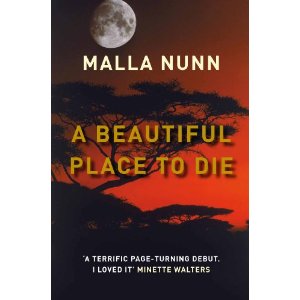
#20 Malla Nunn / A Beautiful Place to Die

Malla Nunn, A Beautiful Place to Die (London: Picador, 2010). An intriguing debut novel set in 1950s South Africa as apartheid is taking hold 4 stars

 Opening sentence:  Detective Sergeant Emmanuel Cooper switched off the engine and looked out through the dirty windscreen.

I’ve been looking for a good crime novel to sink my teeth into, and this one stood out from the crowd as I was browsing online recently. A Beautiful Place to Die is the debut crime novel by Malla Nunn, an Australian-based but Swaziland-born author, and is the first of the Emmanuel Cooper series, set in 1950s apartheid South Africa. It was awarded the Australian ‘Sisters in Crime Davitt Award for Best Adult Crime Novel’ and was shortlisted for the American Edgar Awards (‘Best Novel’ category).

The book opens in September 1952 with the discovery of a murdered police captain, Willem Pretorius, in a river by the South African settlement of Jacob’s Rest, near the Mozambique border. Detective Emmanuel Cooper is called in to investigate, and soon realises that the case is extremely sensitive, as Pretorius is a well-connected Afrikaaner within the powerful National Party movement, and Security Branch investigators are poised to take political advantage by framing a black communist for the crime. It quickly becomes clear that getting to the bottom of this murder will place a number of individuals, including Cooper himself, in a great deal of danger.

For me, the great strength of this novel was the way it used the crime narrative to illustrate the socially divisive and destructive effect of the racial segregation laws, introduced by the Nationalist government from 1948 onwards. Cooper, who served in Europe during the Second World War, notes despondantly that ‘eight years after the beaches of Normandy and the ruins of Berlin, there was still talk of folk-spirit and race purity out on the African plains’. Ironically, apartheid was gearing up for four decades of oppression at practically the same time as German fascism in Europe was defeated.

The novel convincingly captures the tensions apartheid generates within Jacob’s Rest, as well the inevitable tangles that its simplistic racial categorisations bring about: the dedicated Volk ideologue who furtively thinks of himself as part-Zulu; fair-skinned children of black and white parents who ‘pass’ illegally as whites; illicit liasons between white men and black women that fall foul of the Immorality Act because no law can successfully control desire. The novel also has interesting points to make about the gendered power-dynamics of interracial relationships, and the limited options open to black women being pursued by white men.

While I felt the first half of the book was extremely well-written, with a tremendous sense of place, portions of the second half dipped substantially for me, mainly because the plot became too melodramatic for my taste. In spite of this I still find myself keen to read the second book in the series, due to the depiction of Cooper (a complex, well-drawn investigative figure negotiating a repressive regime), the novel’s successful portrayal of 1950s South Africa, and the fact that the novel lingered in my mind for many days after I’d turned the final page.

The second novel in the series, Let the Dead Lie, was published in 2011. The publisher’s synopsis is available here.

Mrs Peabody awards A Beautiful Place to Die a slightly wobbly but fascinating 4 stars.

Creative Commons License
.

#19 Maurizio de Giovanni / I Will Have Vengeance

Maurizio de Giovanni, I Will Have Vengeance: The Winter of Commissario Ricciardi, translated from Italian by Anne Milano Appel (Hersilia Press, 2012 [2007]). An intriguing debut novel featuring the mournful Commissario Ricciardi  4 stars

 Opening sentenceThe dead child was standing motionless at the intersection between Santa Teresa and the museum.   

I Will Have Vengeance: The Winter of Commissario Ricciardi was originally published in 2007 and is the first in a series featuring Luigi Alfredo Ricciardi, Commissario of Police with the Regia Questura di Napoli in 1930s Italy. The series has already been translated into French, Spanish and German, and its fourth installment (Il giorno dei morti / The Day of the Dead) won the prestigious Premio Camaiore in 2011.

Given its setting in the Naples of 1931, nine years into Mussolini’s rule, I expected this book to be an interesting but fairly conventional historical crime novel. From the opening line, however, it’s made clear that this text offers readers something different – an investigative figure able to see the dead and hear their last anguished utterances, which (in some cases) can be used to shed light on the manner and cause of their death.

Opting to employ this kind of narrative device is exceedingly risky and difficult to pull off. However, de Giovanni selects just the right style and tone to allow the reader to suspend disbelief, one that I found a little reminiscent of magical realist authors such as Isabel Allende:

“He saw the dead. Not all of them, and not for long: only those who had died violently, and only for a period of time that revealed extreme emotion, the sudden energy of their final thoughts. He saw them as though in a photograph that captured the moment their lives ended, one whose contours slowly faded until they disappeared” (p. 12).

Ricciardi’s daily exposure to the turbulent emotions of the dead leaves him an introverted, isolated and damaged individual, who is watched over by devoted family servant Rosa at home and by Brigadier Raffaele Maione at work. The original title of the novel, il senso del dolore (which can be translated as ‘a sense of sorrow’ / ‘a sense of pain’), could apply equally to the sorrow radiating from the departed and to its effect on Ricciardi. His is an interesting, nuanced character, imbued with an appealing stoicism when handling a ‘life sentence’ (p. 12) of receiving messages from the restless dead.

So can I Will Have Vengeance also be viewed as a historical crime novel? In many respects, yes. Mussolini’s fascist regime is mentioned very early on, and the social framework within which Ricciardi has to operate is visible throughout the text. For example, Ricciardi is shown musing on the regime’s attitude to crime, which supposedly does not exist within ordered fascist society: ‘No crime, only safety and well-being dictated by the regime. So it was ordained, by decree. Yet the dead kept vigil in the streets, in homes, demanding peace and justice’ (p.99). He is also shown having to manage a demanding superior, Vice Questore Garzo, who is loyal to the regime, albeit for personal gain rather than due to ideological conviction.

However, unlike other crime novels featuring investigators working within repressive regimes, such as Philip Kerr’s Bernie Gunther (Nazi Germany), Tim Robb Smith’s Leo Demidov and William Ryan’s Alexei Korolev (Stalin’s Russia), there is no sustained examination of the moral difficulties encountered by a policeman working in the service of the state and of the political dangers he might face. Ricciardi appears to be largely apolitical, is shielded by his record as an outstanding investigator, and does things ‘his way’ with relative ease when investigating the murder of renowned tenor Maestro Vezzi (a wonderfully drawn character, whose case will delight opera buffs). It will be interesting to see if this portrayal of Ricciardi remains the same in subsequent books within the series, or whether he is shown becoming embroiled in sticky political situations further down the line.

In sum: this is a very enjoyable read, which expertly fuses elements of the historical crime novel with a distinctive, other-worldly dimension, courtesy of its police investigator’s highly unusual abilities. I look forward to reading the other novels in the series soon.

The first chapter of the novel is available on the Hersilia Press website.

With thanks to Hersilia Press for providing me with a proof copy to review.

Mrs Peabody awards I Will Have Vengeance an entertaining, ghostly 4 stars.

Creative Commons License
.

New Danish crime drama on ITV3: Those Who Kill

My thanks to Rhian over at It’s a Crime! (or a Mystery) for drawing my attention to a new Danish crime drama starting tomorrow, Thursday 23 February, on ITV3 at 10pm.

Those Who Kill (Den Som Dræber) originally aired in Denmark in March 2011 and appears to have been pretty successful – it’s been sold on to a number of other countries and will be remade for the US market (following in the footsteps of Forbrydelsen I).

The investigative team. Wait a minute! Who's that on the right?!*

The series synopsis from ITV3 reads as follows:

‘Those Who Kill is a compelling dark crime series, based on the novels by bestselling author Elsebeth Egholm. It follows the investigations of a special unit of Copenhagen’s police force, consisting of detective inspector Katrina Ries Jenson (Laura Back) and forensic psychiatrist Thomas Schaeffer (Jakob Cedergren). The pair specialise in identifying serial killers that do not fit within traditional behavioural patterns and aim to uncover the psychology of a violent killer in their attempt to solve a case surrounded by fear and mystery’.

I have to confess that this description doesn’t particularly appeal to me, as I’m rather averse to serial killer novels and dramas. They often seem to dwell excessively on sadistic acts of violence and the suffering of (usually) female victims, and of course this violence and suffering are enacted again and again with each successive murder (it’s the grim repetition that really does me in).

But what’s interesting about the ITV3 press release, which I’m guessing from its use of ‘we’ is a translation of Danish press materials, is the way that the subject of serial killings and killers is presented:

‘THOSE WHO KILL is a crime series about a violent criminal surrounded by fear and mystique – the serial killer. Up until now, we have been able to curtail their activities with early – and effective – interventions via the safety net of a comprehensive social welfare system in Scandinavia. But times have changed. Borders have opened up, social welfare is in decline, and slowly but surely the whole system has become imbued with a sense of resigned impotence and callous disregard for those it once sought to rescue. The rifts in the net have become so large that bigger fish are slipping through the mesh, and as a result, a new type of crime is starting to burgeon – killings not grounded in traditional motives and patterns of behaviour.’

So here we are given a sociological explanation for the rise of the serial killer in Scandinavia – the disintegration of the social welfare system (also a principle concern of the 1960s / 1970s ‘Martin Beck’ series by the Swedish crime writers Sjowall and Wahloo). I’d be interested to know if this rise is documented, but, whether real or not, the passage suggests a more thoughtful approach than most dramas to the topic of serial killers, through an exploration of the way in which society and its structures contribute to their making. This impression is reinforced in the description of the investigators’ activities:

‘For both Katrine and Thomas, the challange becomes one of discerning the human behind the monster. For only when they come to understand the fantasies and trauma that drive him are they able to confront him’.

On the one hand, this kind of psychological investigative approach reminds me of Val McDermid’s Carol Jordan/Tony Hill series (of which I’ve read The Last Temptation) and on the other, of historical studies seeking to understand perpetrator motivations and war-crimes (Christopher Browning’s Ordinary Men springs to mind). Both try in their different ways to move beyond the idea of killers as one-dimensional monsters, and to comprehend the logic, however distorted, of their actions.

Of course the press release could simply be sophisticated packaging for the usual serial- killer schlock, but who knows, maybe Those Who Kill will be different. I’ll probably watch, given the high quality of other recent Danish dramas on BBC4 and the welcome presence of another strong female lead, but may find myself switching off if things get too uncomfort-able.

The full press release from ITV3 can be accessed here.

*One of the main characters in the drama, Magnus Bisgaard, is played by actor Lars Mikkelsen, who will be familiar to fans of The Killing 1 from his role as the idealistic politician Troels Hartmann.

24 February update: Due to a conspiracy of circumstances involving a snowboard, suspected concussion and a trip to A+E, I didn’t get to see last night’s opening episode. But here are a few Twitter reviews to give a flavour of how Those Who Kill went down with viewers.

@richard0x4A: thosewhokill pretty good. A bit predictable but I enjoyed it. itv3 in decent foreign drama shock.

@Schmolik: ThoseWhoKill last night was distinctly “meh”. Don’t know if Lars Mikkelsen’s cheekbones are enough to keep me interested.

@Packet_editor: #thosewhokill my new The Killing fix

@crifilover: thosewhokill getting tense!

@fleetstreetfox: Hmm. I could miss that and wouldn’t mind #thosewhokill

A week in Berlin: Krimis, Krimis and yet more Krimis

I was lucky enough to spend the whole of last week on a research trip in snowy Berlin, and was sure to squeeze every last drop from the marvellous opportunities this world city has to offer.

Section of the former Berlin Wall

The main reason for my trip was to see the 5500 crime novels or Krimis (Krimi = ‘Kriminalroman’) in the Kuczynsky Collection at the Berlin Central Library for my  research into East German crime fiction.

Jürgen Kuczynsky (1904-1997), a prominent GDR academic and political adviser to Honecker, was a keen crime fan, and according to the archivists had a regular cigar-for-crime-novel exchange agreement with the famous dramatist Bertolt Brecht. I was very kindly given access to this as yet uncatalogued collection, and in the course of my visit unearthed a number of extremely interesting texts, such as Gerhard Scherfling’s fascinating East German crime novel Die Zeitungsnotiz (The Newpaper Item, 1973), in which a historian is revealed as the murderer and as a former Nazi (one for my database…). I was able to peruse these on a tatty yet comfortable sofa, which was bequeathed to the library along with Kuczynski’s books, and sits in the corner of the vast storage room where the collection is currently housed. I imagine that Jürgen and Bert had some lovely chats about crime fiction while parked there.

I was also fortunate enough to be able to visit all of Berlin’s crime bookshops. Berlin is an absolute mecca for Krimi fans, as it has not one, not two, but three wonderful bookshops packed to the rafters with crime. Finding them took me all over the city, from Prenzlauer Berg in the north-east, where the Krimibuchhandlung todsicher (‘dead certain’) is located, to Charlottenburg and the Miss Marple bookshop in the west, and finally to Schöneberg and the Hammett bookshop in the south-east, near the old Tempelhof airport.

The very helpful lady in todsicher presented me with an absolute treasure trove: a whole box of GDR crime fiction from the DIE series (a witty acronym that stands for Delikte Indizien Ermittlungen / crimes, clues, investigations).

While the other two didn’t carry GDR crime (according to the owner of Hammett, the continued existence of a ‘literary wall’ means there’s little demand for works from East German publishing houses), they did have stacks of contemporary crime fiction set in Berlin, which I was also keen to see. Notably, there appears to be a mini-explosion of twentieth-century historical series by German authors at the moment, which are being strongly promoted in mainstream bookshops as well as more specialist outlets. The following caught my eye:

Volker Kutscher’s ‘Gereon Rath’ series (2007-): three novels set in 1930s Berlin (Der nasse Fisch, Der stumme Tod, Goldstein; English descriptions and sample translations available here).

Uwe Klausner’s ‘Tom Sydow’ series (2009-): four novels set in Berlin between 1942 and 1961 (Walhalla-Code, Odessa-Komplott, Bernstein-Connection, Kennedy-Syndrom).

The ‘es geschah in Berlin Kettenroman’ (the ‘it happened in Berlin chain-novel’; 2007-): currently fourteen novels set in Berlin between 1910 and 1936, featuring investigator Hermann Kappes. This series was conceived by the famous German crime writer Horst Bosetzky, but – very intriguingly – is written by a number of different authors. It’s apparently achieved cult status in Germany.

I also picked up a standalone crime novel by Mechtild Borrmann entitled Wer das Schweigen bricht (The One who Breaks the Silence, Pendragon 2011), which won the Deutscher Krimi Preis in 2012. It’s a crime novel that engages with the legacy of the National Socialism through the story of a son researching his industrialist father’s wartime past.

None of these have been translated into English as yet, although the rights to Kutscher’s novels have been snapped up in a number of other countries, including Japan.

And as if all of that wasn’t enough…I got to hang out in Berlin the same week as the Berlinale film festival and the resignation of the German President due to a corruption scandal. No visit to Berlin is ever dull. I first visited in 1988, a year before the Wall came down, and every time I go back, I continue to be amazed at the dramatic changes taking place there – best appreciated visually from the top of the space-age Fernsehturm by the Alexanderplatz.

Fernsehturm as seen from the Alex

Most striking this time round was the disappearance of the Palast der Republik (Palace of the Republic), the East German 1970s parliamentary building on Unter den Linden, which was demolished in 2008 due to its high asbestos content. The city now has ambitious plans to rebuild the Berliner Stadtschloss (Berlin City Palace), which originally stood on the site between the 1750s and 1950 … the year in which the war-damaged building was torn down by the GDR regime! Berlin is full of these sorts of mind-blowing twists and turns, with buildings, streets and even whole districts being dramatically reshaped by historical events and the rise and fall of different regimes. On discovering that one street had undergone six name changes between 1907 and 1990, I had to retreat for a calming Bier.*

All in all, it was a highly profitable and enjoyable week, and I’m already looking forward to returning to Berlin soon. Lots of reading to keep me going until then though – my return luggage contained a ridiculous number of new Krimis, which I only just managed to lug home.

*Rosa-Luxemburg-Platz: was Babelsberger Platz (1907-10), Bülowplatz (1910-33), Horst-Wessel-Platz (1933-45), Liebknechtplatz (1945-47) and Luxemburgplatz (1947-69) before taking its current name in 1969.

BBC4: Inspector Montalbano returns!

This Saturday, following the end of the excellent Danish political thriller Borgen, BBC4 returns to international crime in the shape of Andrea Camilleri’s The Snack Thief, starring Sicily’s Commissario Salvo Montalbano.

I’ve had my differences with the Camilleri novels in the past due to their rather dated representation of women (see my review of The Terracotta Dog), and have to confess that I haven’t got on particularly well with the TV adaptation either (is it just me or has some of the novels’ humour been lost?). But I know there are lots of fans out there who will be delighted to see Montalbano back on our screens in the form of actor Luca Zingaretti. This episode was the first to be made back in 1999, and has not yet been aired in the UK.

Montalbano (second from left) and his handsome team

If I had the chance, I would definitely sneak a peek at Camilleri’s Sicily, if only to escape our current cold-snap. But by the time the episode airs, I will be in an even chillier Berlin, where I’m lucky enough to be spending the week. Tschüss for now!

The Snack Thief airs on Saturday 11 February at 9pm.

UPDATE: Series 2 of Montalbano (12 episodes) will begin on BBC4 on Saturday 25 August 2012 at 9pm. See The Radio Times for further details. With thanks to Rhian for alerting me to this information 🙂

Would the real Finland please stand up?

Finland, Finland, Finland
The country where I want to be
Pony trekking or camping
Or just watching TV
Finland, Finland, Finland
It’s the country for me

You’re so near to Russia
So far from Japan
Quite a long way from Cairo
Lots of miles from Vietnam

Monty Python, ‘Finland Song’

My first youthful awareness of Finland came via the affectionate musical tribute by the Monty Python team. A keen ‘Fin-o-phile’ ever since, I’ve very much enjoyed reading crime novels set amongst its ‘mountains so lofty’ and ‘treetops so tall’. Along the way, via the novels of Jan Costin Wagner, I’ve developed an image of the country in line with Nordic writers such as Indridason (Iceland): freezing cold, austerly beautiful, and as melancholy as can be. This brief excerpt from Costin Wagner’s Winter of the Lions illustrates the point: ‘Then he got to his feet, walked down the dimly lit corridor and through the driving snow to his car. He drove to Lenaniemi. As the ferry made the crossing, he stood by the rail in the icy wind’ (… before visiting his wife’s grave and keeping a late-night appointment with a bottle of vodka). 

However, I’ve just had an interesting reading experience that’s challenged this romantic-melancholic view of Finland. Having finished – and very much enjoyed – Costin Wagner’s Winter of the Lions (see review here), I embarked on James Thompson’s Snow Angels (HarperCollins 2010), another police procedural, set in northern Finland (Lapland), which presents a much grittier image of a country characterised by high rates of violent crime: ‘Per capita, our murder rate is about the same as most American big cities. The over-whelming majority of our murders are intimate events. We kill the people we love, our husbands and wives, brothers and sisters, parents and friends, almost always in drunken rages’. The kaamos, the ‘darkness’ that falls over the land for long winter months, is shown to trigger high levels of depression, drinking, violence and suicide, and the way that it’s depicted here moves well beyond melancholy to something altogether darker.   

These divergent depictions of Finland ‘clashed’ for me as a reader, particularly as I read the novels more or less one after the other. Much of that sense of disjunction lay in the very different tone of the novels, which in turn reflected the contrasting literary traditions in which the authors had chosen to locate themselves. Costin Wagner (German with a Finnish wife) draws heavily on the model of Nordic crime established by writers such as Sjowall and Wahloo, Mankell, and Indridason (which reveals the underbelly of society, but has a highly controlled, pared-down style, and an introverted and melancholic feel). In contrast, Thompson (American with a Finnish wife) has channelled the grit and tone of the American thriller to create a hybrid text which his publicity blurb describes as ‘nordic noir’. It’s an often engaging, but very hard-hitting first-person narrative with frequent, extreme depictions of violence (a topic for another post another time).

The contrast between these texts and their depictions of Finland acts as a useful brake for those of us who might unquestioningly accept the portrait of any given country in a crime novel – or indeed any novel – as ‘real’ or ‘authentic’ (literature as travel guide). It’s a timely reminder of an obvious point: that authors provide representations of countries in their novels, which are often very beguiling or sell well in the literary marketplace, but which may or may not be accurate in the eyes of their citizens. And it’s not necessarily a case of ‘would the real Finland please stand up’: some Finns might identify more strongly with Costin Wagner’s portrayal of Finland than Thompson’s, or vice versa, or even think that both have validity. 

A final thought: how intriguing that neither author is Finnish by birth. Given this, one could argue that neither has a true ‘native’ insight into Finnish society, although the counter-argument that the ‘outsider’ can often see you more clearly than you see yourself could equally be applied. In the case of Costin Wagner and Thompson, it would perhaps be more accurate to speak of a complex ‘insider-outsider’ status, as foreigners who have married Finns, lived in the country for a number of years and learned the language (respect!). This dual status grants the authors a highly valuable perspective from which to write about Finland, albeit in strikingly different ways.

Creative Commons License

 
.

MWA Edgar Award Nominations feature Japanese and Norwegian crime

Twitter was abuzz yesterday with news of the 2012 MWA Edgar Award Nominations. For those who don’t know (I didn’t) MWA stands for Mystery Writers of America, and the award is named in honour of one of the best-known fathers of crime, Edgar Allan Poe.

The entire list of nominations is available on Janet Rudolph’s Mystery Fanfare blog. As a fan of international crime fiction, I was particularly pleased to see two translated novels in the ‘Best Novel’ category: The Devotion of Suspect X, a Japanese novel by Keigo Higashino and 1222 by the Norwegian author Anne Holt.


Both novels have been loitering in my TBR pile and I’m hoping that their nomination for this prestigious prize is the encouragement I need to finally get reading.

#18 Jan Costin Wagner / The Winter of the Lions

Jan Costin Wagner, The Winter of the Lions, translated from German by Anthea Bell (London: Harvill Secker, 2011 [2009]). The third novel in the beguiling Kimmo Joentaa series. 4 stars

 Opening sentence:  Kimmo Joentaa had been planning to spend the last hours of Christmas Eve on his own, but it didn’t turn out like that.

I was given a copy of The Winter of the Lions by my lovely brother for Christmas (following a sisterly nudge in the right direction) and it proved to be the perfect festive read, as the novel’s action begins on 24th December and ends on New Year’s Eve. The evocative cover, with its snowy Finnish birches, also made the novel an attractive winter gift.

Regular readers to this blog will know that I’m a firm fan of of the Kimmo Joentaa series, which, intriguingly, is set in Finland but is authored by a German whose wife is Finnish. The novels are suffused with nordic melancholia, and are in large measure a study of grief, as the first novel, Ice Moon, opens with the death of Detective Joentaa’s young wife. Thus, while each book contains a discrete police investigation, collectively they trace the arc of Joentaa’s grief and the slow process by which he comes to terms with his loss. The Winter of the Lions, set around three years later, sees him embarking on a fragile and rather unconventional new relationship with a women he meets through his duties as a policeman.

One of the big strengths of the series is its focus on the characters within the police team, in a way that’s reminiscent of Scandinavian writers such as Sjowall & Wahloo and Mankell. Joentaa isn’t the only team member with problems, and there are some very human depictions of individuals trying to juggle the demands of their professional lives with the stresses and strains of life beyond the office. In this novel, however, the team also has to deal with the collective trauma of one of their own being murdered. Forensic pathologist Patrik Laukkanen is found dead on a snowy cross-country ski trail in the forest, the victim of a frenzied knife attack. Soon afterwards, another man is found stabbed, and when the link between the two victims is established it proves to be a strange one: both were guests on the popular Hamalainen talk show. As the front cover tantalisingly points out, ‘careless talk costs lives’…

As in previous Joentaa novels, sections of the narrative are written from the murderer’s point of view, and we gradually build up a picture of their character and the circumstances that have led them to commit their crimes. The murderer in The Winter of the Lions is portrayed with sensitivity and a degree of sympathy, although the consequences of his/her crimes for the families of the victims are also carefully spelled out. Here, again, trauma and grief are key themes, and as in Ice Moon, there are some intriguing similarities between the murderer and the investigator whose job it is to track him/her down.

I enjoyed The Winter of the Lions almost as much as the previous two Joentaa novels (although I missed the presence of Ketola, Joentaa’s former boss), and will certainly be back for more. At the end of this third book, I realise that the value of the series lies less for me in the plot or investigative process and more in the novels’ use of the crime genre to explore human reactions to death, trauma and loss. Melancholy and beguiling, these novels are a wintry treat of the highest order.

For other Mrs P. posts on the Joentaa series see Ice Moon and Silence.

The first few chapters are available via the Random House website.

Incidentally, Silence was made into a German film in 2010 (entitled Das letzte Schweigen [the final silence]. You can see the trailer here, which looks great and makes wonderful use of the Finnish *summer* landscape (for a change). It’s in German, but don’t let that put you off!

Mrs Peabody awards The Winter of the Lions a snow and vodka fuelled 4 stars.

Creative Commons License
.

In Praise of Columbo

In a mad moment before Christmas, I bought a boxset of the entire 10 series of Columbo (including the original TV pilots), and have had a lovely time since then reliving the days of my youth, when this programme was a staple of our family’s TV viewing.

In total, Columbo was on screen for an amazing 35 years between 1968 and 2003, and has held up remarkably well given its age – a tribute to the brilliance of the show’s two big concepts (the character of Columbo and the ‘inverted mystery’ formula), and its high production values.

Just one more thing...

In Lt. Columbo of the LAPD, writers Richard Levenson and William Link created a unique police detective, who was wonderfully realised by Falk. Seemingly bumbling, incompetent and dishevelled (looking like ‘an unmade bed’ in his crumpled mac), his razor-sharp intellect was always fatally underestimated by the murderer, who believed that he or she had committed the perfect crime. Interestingly, and in contrast to investigators in other American police procedurals such as Starsky and Hutch or Cagney and Lacey, Columbo is shown operating largely on his own – we never see a police-partner, Columbo’s superiors, or any action at the police precinct. He’s actually a very clever fusion of policeman (title and frequently flashed badge), private eye (his appearance and constant snooping),  and ‘Golden Age’ detective (his unerring ability to solve the murder, typically committed in the L.A. equivalent of an English country house).  

This wonderful character was then combined with the innovative ‘inverted mystery’ formula to produce a highly addictive show. Each episode opened with a 10 to 15 minute section showing an individual carrying out a murder, thereby inverting the usual ‘who-dunnit’ formula and making the viewer an eye-witness to the detail of the crime. The focus of the rest of the episode was on how Columbo solved the murder and furnished proof of the culprit’s guilt, so that justice could be served. Dogged and persistent, Columbo would seize on any ‘loose ends’ in the case (e.g. why was the victim’s car radio tuned to a classical station when he was a country music fan?) and return again and again to probe the suspect’s story until the truth was finally revealed.

As Andrew Donkin notes in the sleeve notes for my Playback/Universal Columbo boxset, ‘this structure made the show particularly hard to write for, as the ending had to justify the time invested by the audience who already knew the answer [of the murderer’s identity]’  (p.2). A particular challenge was keeping the episodes fresh: while there’s a great deal of pleasure to be derived from the repetitive structure of the show, and the reassuring certainty that Columbo will always nail the criminal, there’s also a risk that the audience will get bored. This was countered in a number of ways: episodes that played with the formula and audiences expectations (such as ‘Double Shock’, which featured twins as suspects); a steady stream of top writing and directing talent, included Steven Bochco and Steven Spielberg (the latter was responsible for the first ever episode, ‘Murder by the Book’, in which a crime writer bumps off his writing partner), and, of course, the numerous, fabulous guest stars who appeared throughout the many years of the show.

The guest stars are a particular pleasure to watch now. Given that Columbo was essentially a two-hander between Peter Falk and the murderer, who was carted off to prison at the end of each episode, there was ample opportunity for often incredibly famous actors to shine in the latter role. Drawn to the show by its quality, the chance to play a gloriously villainous character, and to hog the limelight before Columbo’s entrance, they included (in no particular order):

* Ray Milland * Johnny Cash * Leonard Nimoy * Martin Landau * Vincent Price * Martin Sheen * Ida Lupino * Donald Pleasance * Robert Culp * Dick van Dyke * Patrick MacGoohan * Robert Vaughn * Janet Leigh * William Shatner * Faye Dunaway * Rue McClanahan * Blythe Danner * John Cassavetes * Valerie Harper * Ricardo Montalban *

Peter Falk with guest star William Shatner (aka Captain Kirk)

The other aspect of the show I sneakingly enjoy is its class dynamic: the murderers are typically ultra-affluent, well-educated, oh-so-arrogant types, who are brought low by a scruffy police detective from a humble background. This is not to say that Columbo delivers a detailed social critique of American society (the visually stunning upper-class settings are homage to Agatha Christie as much as anything else), but there’s a sustained contrast between the intelligence, abilities and moral goodness of the hard-working ordinary man and the greed, decadance and arrogance of the super-rich (apologies to any wealthy, morally-upright philanthropists who may be reading!). Notably, it’s the villain’s snobby assumption that Columbo could not possibly pose a threat to them that proves to be their undoing. Columbo frequently makes the point that he’s accumulated skills and experience from the hard graft of hundreds of investigations, whereas the murderer has only ever carried out one crime. They really don’t stand a chance.  

Peter Falk died last year at the age of 83. I will always be deeply, DEEPLY envious of Mr. Peabody, who as a young man on his first trip to America in the 1980s, encountered Falk in the elevator of a hotel in Florida where Columbo was being filmed. Seeing that he’d been recognised, the great actor leaned over, shook hands with the star-stuck teenager, and breathed the immortal line….. ‘How ya doin’, kid?’. 

Just how good is that?!

If you’re a fan of Columbo you might be interested in The Ultimate Columbo website – a treasure trove of information about the programme, its actors and individual episodes.

*****

Thanks to Norman, who has just made me aware of a fascinating intertextual link, namely that the figure of Columbo was partially based on the character of Porfiry Petrovich from Dostoyevsky’s Crime and Punishment. Judith Gunn, in her post on the author, examines the the similarities between the two (and the narrative frameworks of both texts), which are striking and persuasive.