TV crime drama (Deep Water & McMafia) and John le Carré’s The Pigeon Tunnel

Two TV crime dramas in the pipeline have recently caught my eye.

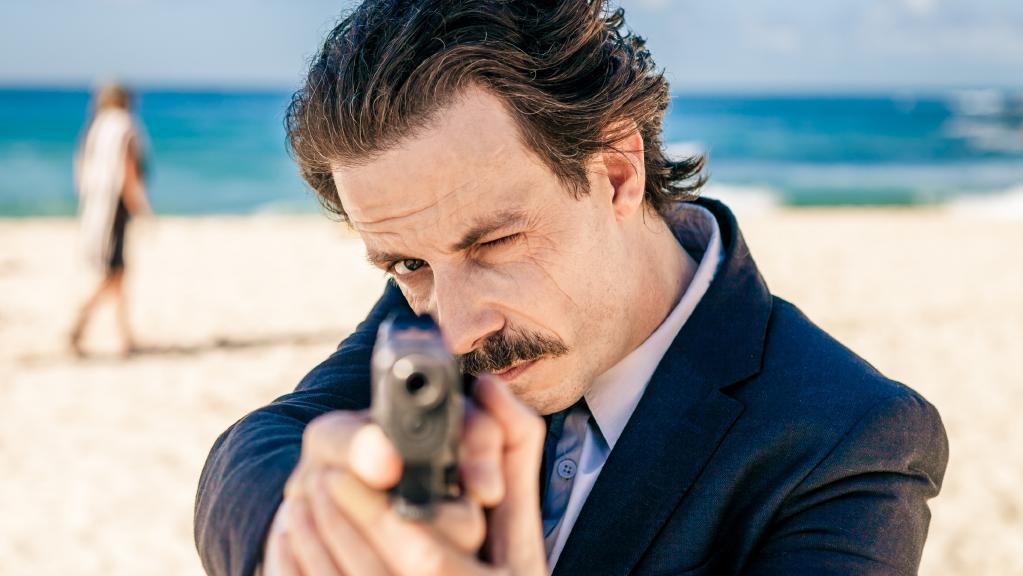
deep-water-photo-sean-oreilly-sbs

Noah Taylor in Deep Water (photo Sean O’Reilly/SBS)

Deep Water (BBC Four)

From the BBC press release: ‘A gripping four-part crime drama set in contemporary Australia, the series is inspired by the unsolved gay-hate crime epidemic that swept through Sydney in the 80s and 90s, known as the Bondi Beach Murders.

The drama unfolds after detectives Tori Lustigman and Nick Manning are assigned a brutal murder case. They uncover evidence that suggests the killing is connected to a spate of unexplained deaths, ‘suicides’ and disappearances throughout the 80s and 90s. Is this the result of shoddy police work, indifference, or something far more sinister?’

The series stars Noah Taylor as detective Nick Manning; Yael Stone as detective Tori Lustigman; William McInnes as Inspector Peel; Daniel Spielman as Rhys; and Danielle Cormack as Brenda. It’s a Blackfella Films production for SBS Broadcasting Australia, Screen Australia & Screen New South Wales. Transmission date to be confirmed, but probably in the autumn.

There’s a bit more info in this Guardian article by Steph Harmon.

mcmafia

McMafia (BBC One)

From the BBC press release: ‘Inspired by Misha Glenny’s bestselling book McMafia – a hard-hitting look at global crime – Hossein Amini and James Watkins have created a thrilling international crime drama that centres on one family in London.

James Norton (War & Peace, Happy Valley) will play the lead, Alex Godman, the English-raised son of Russian exiles with a mafia past. 

McMafia charts Alex’s journey through a terrifying labyrinth of international criminals, money launderers, corrupt politicians and ruthless intelligence agencies. He finds himself embroiled in an underworld that stretches from London to Moscow, Dubai to Mumbai, Africa to the Americas; a battleground where Mexican cocaine cartels compete with Pakistani drug lords, Balkan smugglers and the Russian Mafia itself. What starts out as a story of survival and revenge becomes an epic tale of a man’s struggle against the lures of corruption in the modern world and in himself.

This fast-paced thriller is epic and intimate, glamorous and gritty, global in scale and forensic in detail. It delves into how, with the rise of globalization, the corporate has become criminal and the criminal corporate and how, driven by the global demand for cheap products, everyone is complicit in some way.

The writing team includes David Farr (The Night Manager, Spooks, Troy – Fall Of A City), Peter Harness (Doctor Who, Wallander, Jonathan Strange & Mr Norrell) and Laurence Coriat (Wonderland, Me Without You).’ Cuba Pictures. Transmission date tbc.

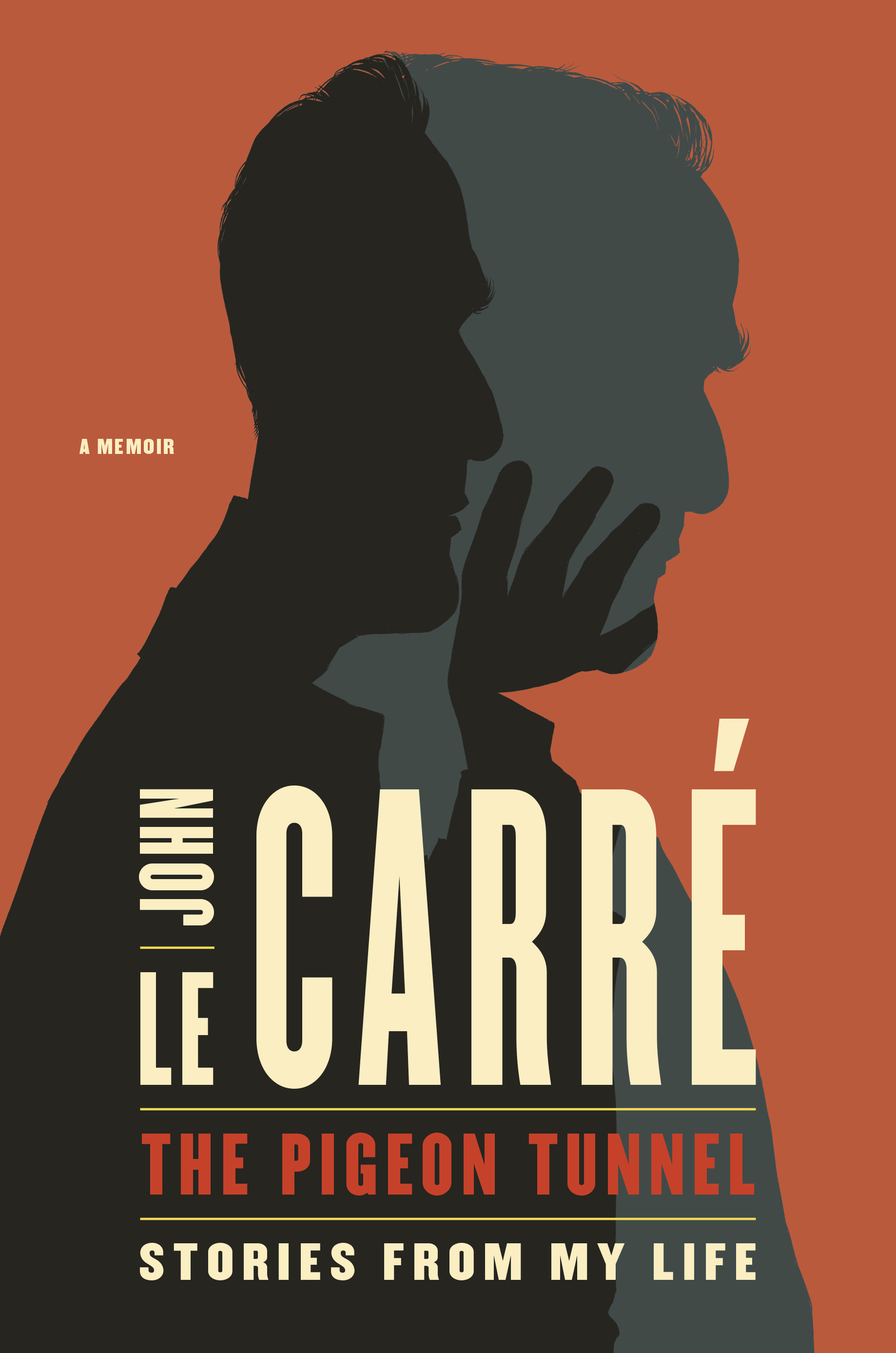
The Pigeon Tunnel: Stories from My Life - John le Carré (CNW Group/Penguin Random House Canada Limited)

The Pigeon Tunnel: Stories from My Life – John le Carré (Penguin)

Regular readers of this blog will know that I’m a huge John le Carré fan (see my post ‘In praise of John le Carré‘), so I’m delighted that his autobiography The Pigeon Tunnel: Stories from my Life is now out with Penguin. Stacks of fabulous content has been released to promote the book, including an extract, readings from le Carré’s works by actors such as Rachel Weisz, and fantastic TV interview snippets. My favourite insight from the author so far: conflict makes for a good story (thus ‘the cat sat on the mat’ is not a promising start, whereas ‘the cat sat on the dog’s mat’ is).

le Carré will be reading extracts from The Pigeon Tunnel on BBC Radio 4 from Monday 12 September in the ‘Book of the Week’ slot.

Merry Christmas! Mrs Peabody’s festive round-up

I’m behind on my Christmas preparations this year, which means that this festive round-up is a little later than usual. On the plus side, it may help a few of you out of a last-minute present conundrum, or lead you to a nice, independent bookshop because it’s too late for online orders. You might also be moved to buy yourself a little gift. Go on, you deserve it.

The following are just some of my favourite crime novels of the year. All, in my view, would make a delightful escape from the mayhem of Christmas or family, especially when curled up on the sofa with a nice glass of wine.

Anne Holt and Berit Reiss-Anderson, The Lion’s Mouth (NORWAY: trans. by Anne Bruce, Corvus, 2014). Anne Holt is often described as the queen of Norwegian crime, and has drawn expertly on her own career in the police, law and government in the creation of the ‘Hanne Wilhelmsen’ police series (she was even Norwegian Minister of Justice for a while). This fourth installment in the series, originally published in 1997, explores the suspicious death of the Norwegian Prime Minister, who is found dead in her office just six months following election. A fusion of locked-room mystery, Borgen and police procedural, it’s a quietly satisfying read that’s held up well.

Arnaldur Indridason, Reykjavik Nights (ICELAND: trans. by Victoria Cribb, Harvill Secker, 2014). This prequel to the ‘Murder in Reykjavik’ series is a wonderfully absorbing read, which traces the start of Erlendur’s journey from young policeman to detective as he investigates the death of a homeless man and the disappearance of a woman. Set in 1974, the year Iceland celebrated 1100 years of settlement, we are also shown how a traumatic childhood event begins to shape Erlendur’s personal life and investigative career. The novel is a great read for those who are new to the series and for long-established Erlendur fans alike.

Hannah Kent, Burial Rites (AUSTRALIA/ICELAND: Picador, 2013). This impressive debut novel by a young Australian author is not for those looking for ‘cosy’ Christmas crime. Kent spent some time in Iceland as an exchange student and describes the book as her ‘dark love letter’ to the country: set in northern Iceland in 1829, it explores the case of Agnes Magnúsdóttir, the last Icelandic woman to be executed for murder. The figure of ‘the murderess’ tells us a lot about the gender, class and power relations of the time, and the picture the author paints of every-day, rural Icelandic life is fascinating. The story, setting and their links to the Icelandic sagas stayed with me long after reading it.

Lahlum

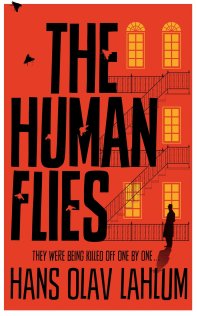
Hans Olav Lahlum’s The Human Flies (NORWAY: trans. by Kari Dickson, Mantle, 2014, [2010]) sounds like a horror film that’s best avoided after a large meal. However, it turns out to be something quite different: a well-constructed and witty homage to the classic crime fiction of Agatha Christie, set in 1968 Oslo, which has some interesting historical depth. Featuring ambitious young police detective Kolbjørn Kristiansen on his first big case – the murder of a former resistance fighter – readers are treated to an apartment building of intriguing suspects and a page-turning investigation, as well as the considerable intellect of Kristiansen’s wheelchair-bound partner Patricia.

Laura Lippman, After I’m Gone (USA: Faber and Faber, 2014). Ignore the rather daft cover. After I’m Gone is a literary crime novel that dissects a murder case by means of a rich narrative with some wonderful characterisation (the latter is one of Lippman’s great strengths). Told on a number of different time levels, it traces the stories of five women left behind when white-collar criminal Felix Brewer disappears in July 1976 – his wife Bambi Gottschalk, his three daughters, and his mistress Julie – as well as the investigation into Julie’s murder by detective Sandy Sanchez in the present. An engrossing, quality read.

Anya Lipska, Death Can’t take a Joke (UK/POLAND: The Friday Project, 2014). This is the second in the ‘Kiszka and Kershaw’ series, featuring Polish ‘fixer’ Janusz Kiszka and London police detective Natalie Kershaw. While I enjoyed Lipska’s first novel, Where the Devil Can’t Go, the second is where the series really gets into its stride: the duo’s investigation into two deaths, including one of Kiszka’s closest friends, is a tightly constructed page-turner with an engaging, blackly comic tone. The novel also features one of the best first chapters I’ve read this year… For a more in-depth exploration, head over to Margot Kinberg’s marvellous Confessions of a Mystery Novelist blog.

Marco Malvaldi, Game for Five and Three Card Monte. 1 and 2 of the ‘Bar Lume Trilogy’ (ITALY: Europa Editions/World Noir 2013/14). These light-hearted crime novels feature amateur detective Massimo Viviani, the maverick owner of Bar Lume, investigating mysterious deaths in Pineta in Northern Italy. Massimo is ably assisted in his work by four cantankerous, octogenarian barflies, including his own extremely opinionated grandfather. Witty, entertaining and stylishly packaged.

Eduardo Sacheri, The Secret in Their Eyes (ARGENTINA: trans. by John Cullen, Other Press, 2011 [2005]). I was given this novel last Christmas and it became one of my first and favourite reads of the year. Benjamin Miguel Chaparro, a newly retired Deputy Clerk in Buenos Aires, begins to write a novel about a case that has haunted him since 1968 – the murder of a young wife, Liliana Colotto, in her own home one summer’s morning. Oscillating between the past and the present, and spanning twenty-five years of Argentine history, the narrative tells the story of the murder and its repercussions for those left behind: husband Ricardo Morales, investigator Benjamin, and the murderer himself. The 2010 film adaptation was also a cracker. A full review is available here.

Olivier Truc, Forty Days without Shadow (FRANCE/LAPLAND: trans. by Louise Rogers LaLaurie, Trapdoor, 2014). This novel uses its criminal investigation as a means of exploring the history, culture and climate of Lapland. It also features the reindeer police! The novel opens with Sámi-Norwegian reindeer policeman Klemet Nango and partner Nina Nansen investigating the theft of a priceless Sámi drum from a museum. Shortly afterwards, Sámi herder Mattis is found dead, and ‘Patrol P9′ finds itself grappling with two crimes that could well be interlinked. A gripping novel that shines a spotlight on a fascinating part of the world. A full review is available here.

If the crime lover in your life is into TV drama, then my two top picks are as follows:

The Australian series The Code, which aired on BBC4 a few weeks ago and I reviewed enthusiastically here. This six-part political thriller opens with the mysterious death of Aboriginal teenager Sheyna Smith in Lindara, a remote New South Wales township. The circumstances of her death are hushed up, so when Ned Banks (a journalist for an internet newspaper) and his brother Jesse (an internet hacker on the autistic spectrum) start to investigate, you just know there’s going to be trouble. An utterly gripping, intelligent drama.

British police drama Happy Valley, a hard-hitting, six-part series that traces the fall-out from a kidnapping in the West Yorkshire valleys, while exploring its protagonists’ complex personal lives. Sarah Lancashire gives an absolutely outstanding performance as policewoman Catherine Cawood, together with an excellent supporting cast. Be warned that there is some very graphic (though in my view not gratuitous) violence. I think that 18 would be a more accurate rating than the 15 on the box. An addictive and top quality crime series.

And my own indulgence this Christmas? That would be the American drama True Detective, which I’m very much looking forward to watching. Have you indulged yourself as well? Do share if so!

Wishing all the readers of this blog a very happy and relaxing Christmas.

See you all in 2015!

German Zimtsternchen (little cinnamon star).    Quite addictive.

Catching up with Australian political thriller The Code

This post is about Series 1 of The Code.

******

The last couple of weeks have been busy, so it was only last night I realised that a bit of a gem is currently being shown in the BBC4 Saturday night crime slot.

The Code is a six-part Australian political thriller, which begins with the mysterious death of Aboriginal teenager Sheyna Smith in Lindara, a remote New South Wales township. For reasons that are unclear, the circumstances of her death have to be hushed up, so when Ned Banks (a journalist for an internet newspaper) and his brother Jesse (an internet hacker on the autistic spectrum) start to investigate, trouble comes a-calling. Back in Lindara, Sheyna’s schoolteacher Alex Wisham gets pulled into the case in unexpected ways.

Jesse does stuff that he most probably shouldn’t do

I caught up with the first episode this evening, and very much liked what I saw. The plot is gripping, the characterisation is excellent, and the production is sleek and stylish, with wonderful shots of the Australian outback calling to mind New Zealand’s Top of the Lake. By coincidence, the character of Ian Bradley is played by David Wenham, who also appeared in Top of the Lake, and there’s another well-known face in Lucy Lawless (Xena; Spartacus; Battlestar Galactica) as Alex Wisham. Dan Spielman and Ashley Zukerman create a very nice dynamic as brothers Ned and Jesse.

Shades of Top of the Lake (wide open spaces hiding secrets and lies), The Bridge (young Jesse) and Sherlock (the neat use of graphics) – what’s not to like?

There’s an article exploring the drama with its creator Shelley Birse over in The Guardian (some spoilers). Note also the irony of an Australian political thriller being partially funded by the Australian government!

There’s a BBC guide to the characters and cast here.

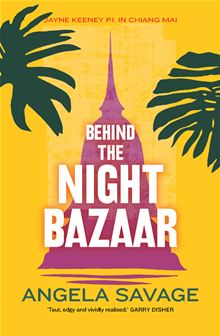
#44 / Angela Savage, Behind the Night Bazaar

Angela Savage, Behind the Night Bazaar (ebook: Melbourne, Text Publishing, 2006)         4 stars

Opening line: The sluggish Bangkok traffic forced Jayne Keeney to slow to a crawl at Siam Square.

Behind the Night Bazaar is the first novel in the Jayne Keeney series by Australian author Angela Savage, and was shortlisted for the Ned Kelly Best First Book Award in 2007. It’s one I’ve been meaning to read for ages and am glad I finally have, as it’s an excellent debut that vividly evokes its Thai setting. As a bonus, it’s distracted me from the cold of the British winter and triggered some happy back-packing memories from my youth.

Jayne Keeney is an Australian private investigator based in Bangkok, who is pulled into a murder investigation when visiting her good friend Didier, an HIV-outreach worker in Chiang Mai. Certain that the authorities are guilty of a cover-up, Jayne sets out to expose the truth behind the case and to right some wrongs.

Among the many things I liked about this crime novel were the depiction of Jayne as an independent woman and highly capable investigator who speaks flawless Thai (being bilingual is an essential asset for her work); the inspiration Jayne takes from crime classics such as Sherlock Holmes and Miss Marple during her investigation (even as the narrative draws on the conventions of hard-boiled crime); the wonderful evocation of place and the insights we’re given into Thai culture (oh the food!); and last but not least, the guest appearance of a diva academic…(I promise we’re not all like that).

The author also explores larger social issues, such as HIV and the sex trade (drawing on her own time in Bangkok as head of the Australian Red Cross HIV/AIDS sub-regional programme), and I was impressed by the way that these were integrated into the main narrative. Savage takes care to avoid stereotyping, providing a nuanced examination of difficult issues, such as why women might opt to become sex-workers. Notable too, are the rounded depictions of the villains in the novel, which show us the flawed logic they employ to justify their crimes.

In sum, The Night Bazaar is a highly impressive opener, and I’m very much looking forward to the next novel in the series, The Half Child.

Angela has an author/crime blog that’s a great read, and has recently posted her crime picks of the year over at Pulp Curry – including the rather intriguing Australian/Icelandic novel Burial Rites.

Creative Commons License

.

#36 / Wendy James, The Mistake

Wendy James, The Mistake (Penguin / Michael Joseph ebook, 2012). An outstanding portrait of a family in crisis and the repercussions of past mistakes  4.5 stars

Opening line: If, before all this happened, before her – before their – unravelling, she had been asked how her life was, she’d have said that life was good.

The Mistake is Australian author Wendy James’ fourth novel. Like her first, Out of the Silence, which won the Ned Kelly Award for ‘Best First Crime Novel’ and was shortlisted for the Dobbie women’s writing award, it’s a hybrid narrative aimed at a diverse reading audience (doesn’t that cover remind you of something by Jodi Picoult?). While not a conventional crime novel, it raises profound questions about legal and moral boundaries, and the media’s role in pre-judging those it deems to be guilty of transgressing social and cultural norms.

Jodie Garrow is a middle-class wife and mother living in the affluent New South Wales town of Arding. She has the requisite lawyer husband, two children and a dog, and is a respected figure in the local community. However, when daughter Hannah breaks a leg on a school trip to Sydney, Jodie’s carefully ordered existence begins to fall apart. The hospital Hannah is taken to is the same one where Jodie secretly gave birth to a daughter many years before, and when a nurse from that time recognises her, a damaging piece of information comes to light: there is no record of baby Elsa Mary having been given up for adoption as Jodie claims. In the absence of legal proof, the baby may have to be classified as a ‘missing person’ by the police, with suspicion of foul play falling on Jodie as the last documented person to see her alive.

While the question of what happened to the baby looms large, the exploration of the fallout from Jodie’s ‘mistake’ (whatever that turns out to be) is central to this rich, multi-layered narrative. The novel can be read simultaneously as a portrait of a complicated woman, of a family in crisis, of a possible crime, and of the vilification of ‘bad mothers’ by the press. The ‘bad mother’, in this context, is a woman who fails to show the requisite ‘maternal’ qualities or emotion to convince the public that she is innocent of wrong-doing (as in, to a greater or lesser degree, the examples of Lindy Chamberlain, Sally Clark and Kate McCann). We are shown in brilliantly-drawn detail the destruction of an individual’s reputation, and the social consequences for the entire family of the doubts raised about Elsa Mary’s fate.

What stood out for me in particular was the novel’s excellent characterisation, which allows a nuanced picture of Jodie’s identity and her relationships with others to emerge. There’s also a superb analysis of how Jodie is shaped by class, which helps to illuminate her response to her unplanned pregnancy at the age of nineteen. Fittingly for a novel that is critical of a rush to judgement, no absolute moral position is taken. It thereby success-fully avoids stereotyping and knee-jerk reactions, focusing instead on the very individual circumstances that lie behind the case.

I read The Mistake in almost one sitting, and can therefore happily testify to its properties as a page-turner. The plotting and pace are excellent (although there is one ‘lead’ that would surely have been followed up sooner), and its ending will stay with me for a long time to come.

My thanks to Angela Savage for encouraging me to read this novel following an earlier post on crime novels that critique the media (Leif G.W. Persson’s Linda, Gillian Flynn’s Gone Girl and Yvonne Erskine’s The Brotherhood). You can read Angela’s own review of The Mistake here as well as Bernadette’s review at ‘Fair Dinkum Crime’ here.

Mrs. Peabody awards The Mistake a thought-provoking and utterly gripping 4.5 stars

Creative Commons License

.

The press on trial: crime fiction and the media

One of my favourite things when reading crime fiction is the random emergence of a theme that links successive books. I experienced this recently with three quite diverse novels from Sweden, America and Australia, all of which focused heavily on the role of the media. None were too flattering of journalists and their trade, using the crime narrative to put the press ‘on trial’.

Leif G.W. Persson’s Linda, as in the Linda Murder (2005), is a recently translated Swedish police procedural that investigates the killing of Linda Wallin, a trainee police-woman at Vaxjo Police Academy. The novel is particularly scathing of the media’s sensationalist depictions of female murder victims, which are designed to generate sales: ‘From trainee police officer Linda Wallin, 20. To the Linda murder […] The Kajsa murder, the Petra murder, the Jenny murder… They had quite simply been transformed from women of flesh and blood into media messages’. This transformation is especially resonant in its original Swedish context, where the victim’s first name forms part of a compound noun that reduces her life to no more than its violent end – in this case, the Lindamordet [‘the Lindamurder’]. In contrast, the narrative notes drily, ‘men’s names were never used as prefixes to the word ‘murder”.

Gillan Flynn’s 2011 novel Gone Girl, a darkly humorous dissection of a marriage gone sour, critiques the media’s damaging influence when reporting criminal cases. Husband Nick Dunne, dealing with the press in the aftermath of his wife’s disappearance, soon discovers how fickle journalists can be: he’s styled as an anxious, bereft husband one minute, and as a sinister-looking potential murderer the next. Before long, he’s forced to hire a savvy lawyer who specialises in manipulating media narratives in his clients’ favour. The truth becomes largely superfluous: expensive lawyers and public opinion appear to count more than any meaningful judicial process (one can’t help thinking of the media circus that was the OJ Simpson case, and of the more recent Pistorius case).

Yvonne Erskine’s 2011 novel The Brotherhood is a 360 degree examination of the events leading up to and following a Tasmanian policeman’s murder. The police are shown having to manage press reactions to the killing from the minute the news gets out, a time-consuming and politically sensitive job, as the main suspect has Aboriginal heritage. We’re also introduced to amoral journalist Tim Roberts, who writes up a potentially damaging story knowing that he might jeopardise the case. Investigative journalism is portrayed here as seedy and self-interested, with no positive contribution to make to society.

Three crime novels obviously don’t make a trend, but I’d be interested to know if there are others that are similarly critical of the media. Of course, some crime novels contain more sympathetic depictions of the press: Stieg Larsson’s Mikael Blomkvist and Liza Marklund’s Annika Bengtzon are two examples of journalists who are given leading investigative roles within crime narratives, and who are depicted as thoughtful practitioners of their trade.

If you think of more, let me know – I’ll compile a list if we gather enough!

Update 3 May 2013: The Guardian has just run a profile of Gillian Flynn (interesting discussion on misogyny and female villains amongst other things, including the press angle). My review on Wendy James’ The Mistake (as recommended by Angela Savage in the comments below), can be read here.

What’s your first crime novel of 2013?

For some reason, I always take particular care when choosing my first crime novel of the new year. I like it to be a good one, and one that’s perhaps a little different to crime novels that I’ve read recently. This year I opted for a classic that I’ve been meaning to read for the longest time and was lucky enough to find under the Christmas tree: Patricia Highsmith’s The Talented Mr. Ripley. Originally published in 1955, it’s still brilliant and chilling in equal measure.

Just for fun, I asked some crime aficionados on Twitter for their first crime novel of the year. Please do feel free to add your own below in the comments. It’ll be interesting to see what kinds of patterns emerge, if any.

I’m off now for my annual adventure on the outdoor ice-rink at the Winter Wonderland. I’ll report back on my bumps and bruises a little later…

Mrs. Peabody’s 2012 review

It’s been a busy year for Mrs. Peabody Investigates, with reviews of international crime fiction from Denmark, Finland, Germany, Italy, Northern Ireland, South Africa, Sweden, Switzerland and the USA. There were also a number of lively discussions on subjects including autopsy scenes; violence and women; Jewish detective figures; national image; strong female protagonists, and the crime writer as social commentator. Many thanks to everyone who joined in with their expertise and views! Last but not least, interviewing crime writers at the Harrogate Crime Writing Festival and contributing to Mark Lawson’s ‘Foreign Bodies’ series on Radio 4 were definite highlights.

So to finish off the year, here’s a random round-up of the best – and worst – of Mrs Peabody’s 2012 (with thanks to apuffofjack for the idea).

Most Satisfying Read: Tom Franklin’s Crooked Letter, Crooked Letter (2010), a gripping examination of the repercussions of a murder, set in the American Deep South of the 1970s, 1980s, and the present day.

Most Disappointing Read: Jussi Adler-Olsen’s Disgrace.Wooden characterisation was the real villain of this crime novel, but I’m still hoping for better from the next in the Department Q series.

Best Historical Crime Novel: Tie between Malla Nunn’s A Beautiful Place to Die (2010), which provides a fascinating insight into apartheid South Africa in the 1950s, and Stuart Neville’s The Twelve (2010) – hard-hitting Belfast noir exploring the legacy of The Troubles.

Crime Novel that Lingered Longest in the Mind: Jim Thompson’s The Killer Inside Me (1952), which presents a chilling, but surprisingly nuanced portrait of murderer Lou Ford.

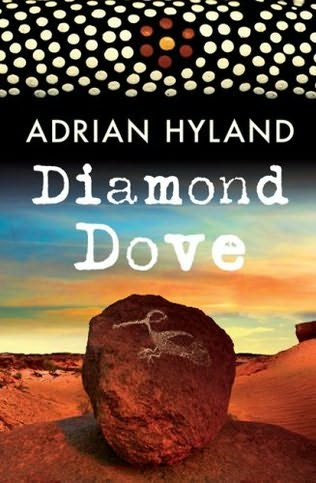
Best Female Detective: Tie between Edie Kiglatuk from M.J. McGrath’s White Heat (2011) and Emily Tempest from Adrian Hyland’s Diamond Dove (2006) (reviews pending). In many ways, these characters are twins: feisty, tough women who have complex insider / outsider roles in marginalised indiginous communities (the Inuit of the Arctic Circle and the Aboriginal people of the Australian outback).

Best Male Detective: Finnish-Jewish police inspector Ariel Kafka in Harri Nykänen’s Nights of Awe (2010): a highly original and witty investigator, whom I look forward to meeting again (albeit with a slightly less convoluted plot).  

Best Discovery: Leif G.W. Persson is well-known in his native country as a top criminologist and crime writer, but his razor-sharp dissections of Swedish society have only started to be translated relatively recently. I’ve just finished Another Time, Another Life (2012), which was a gem, and am keen to read more.

Last Policeman

Most Original Premise: Ben Winters’ The Last Policeman (2012) is a ‘pre-apocalypse police procedural’, in which Detective Hank Palace investigates a suspicious suicide six months before asteroid 2011GV1 is due to hit the earth. The first in a trilogy (review pending).

Best Re-read: Jakob Arjouni’s Turkish-German Kemal Kayankaya series (1985-2012). A ground-breaking detective who uses intelligence and wit to make his way in a largely racist society. The first in the series, Happy Birthday, Turk (1985), remains a cracker.

Best Use of Humour: Leif G.W. Persson uses satirical humour to great effect as he lifts the lid on the workings of Swedish society. Look out for the pathologist nicknamed ‘Esprit de Corpse’ in Another Time, Another Life.

Best crime TV series: The Killing III, in which Sarah Lund strode forth for the last time (still in denial that it’s over *sob*).

Best crime film: Tie between Romanzo Criminale (dir. Michele Placido, 2006), which traces the rise and fall of an Italian street gang, and Once Upon a Time in Anatolia (dir. Nuri Bilge Ceylan, 2011), which plays out over a dream-like night of a police investigation (reviews to follow).

Most Anticipated Reads for 2013: Stuart Neville’s Ratlines (2013), set in a 1960s Ireland whose government is keen to play down its links with former Nazis, and Y.A. Erskine’s The Brotherhood (2011), a much-praised depiction of police corruption and betrayal set in Tasmania.

All best wishes for a healthy and happy New Year, filled with lots of  wonderful crime fiction.

Depictions of violence and women in crime fiction (with list of STRONG WOMEN IN CRIME)

A few days ago an extremely interesting discussion kicked off in the ‘about’ section of this blog on depictions of violence and women in crime fiction. I’m taking the slightly unusual step of reproducing the thread here (in a lightly edited form), as it would other-wise remain largely invisible. It closes with a fabulously affirmative list of ‘strong women in crime’, sourced via Twitter and the blog.

With thanks to the participants in the discussion – Susan, Cassandra, Maxine and Bernadette – and to everyone who put forward their favourites for the list!

The discussion began with a comment about Sjöwall and Wahlöö’s Roseanna (1965).

Susan Wright: I recently discovered your blog thanks to Mark Lawson’s ‘Foreign Bodies’ series on Radio 4. I’m enjoying your reviews and I agree with many of your opinions, especially about the cliched representations of women in some crime fiction. Like you I thought Varesi’s River of Shadows was wonderfully atmospheric but marred by the sex scenes. I’m now reading the first Martin Beck novel; having been told it was a Marxist critique and had a left-wing perspective, I was surprised by the prurient description of the victim, particularly the interview of her boyfriend by the US cop which goes into graphic detail about her sex life. I know this was written before 70s feminism, but I was disappointed all the same. It seems cliches about women and female sexuality are not limited to Italian male crime authors.
Mrs P: What you’ve said about Roseanna, the first Martin Beck novel, has really got me thinking. It’s a little while since I read it, but I understood the role of those sexual details in a slightly different way. I saw them as providing the reader with a portrait of Roseanna as a very independent, sexually-liberated person, and instead of indulging in the stereotypes one might find in literature of the time (that her sexuality was what ‘got her into trouble’), the authors give her full victim status. Beck, for example, never wavers in his quest to bring her murderer to justice. So in that respect the novel is arguably groundbreaking.

But I take your point, and think I may need to read the novel again, so that I can see that interview with the American cop in the context of the whole narrative!

Susan Wright: I agree it is a groundbreaking novel and the authors wanted to show Roseanna (and themselves) as modern and sexually liberated, but I found some of their approach quite disturbing, almost voyeuristic, although I suppose all fiction is voyeurism to some extent! As well as the American cop scene, at one point Beck asks a colleague to write a detailed description of the corpse which I also found a little prurient. I cannot ever recall reading a crime novel which described a male victim in that way. I’m only half way through the book but it is striking how few women there are and how marginal they seem, though I suppose this reflects how different women’s roles were in the 60s – so far there are no female police. I like Beck’s compassion, not just for Roseanna but for the woman Karin who worked on the cruise boat and has fled a violent man.

Cassandra Clark (author): I am disturbed by what Susan Wright says as it resonates so closely with my own feelings about the kind of obsessively detailed descriptions of violence against women in some crime novels. I don’t think it’s good enough to say it takes place in the 1960s so it’s OK. The same prurience is rarely directed towards male murderees. Maybe we should ask ourselves why not? I suppose until it is (though heaven protect us against what that will mean for our humanity) there will be no equality between men and women. This is just a thought. I have to deal with this problem every time I write because my series is set in the fourteenth century when things were a bit rough – and women had even less say than now.

Mrs. P: Depictions of violence against women in crime fiction (especially sadistic sexual violence) have bothered me as long as I’ve been reading in the genre, and I would agree with you that this is a topic that should be acknowledged and properly discussed. Every now and then I consider writing a blog post on the subject and then get cold feet, because in many ways it’s such a minefield. In any case – a few thoughts in response to your comment:

Time of publication: I agree that misogyny should not be excused if it appears in a book written in the 1960s, but it does provide at least a partial explanation that helps us understand its presence.

Authorial intent: some authors like Val McDermid have been criticised for writing eye-watering depictions of violence against women (usually by serial killers). I’ve heard McDermid argue that her intent is to highlight the shocking realities of misogyny and violence against women in our society, which are often ignored. However, the risk that a reader might get some kind of perverse kick out of those depictions remains, as the author can never completely steer the interpretation of his or her writing. Her later books have apparently toned down this element.

The same problem could be said to exist in relation to David Peace’s ‘Red Riding’ quartet (1974, 1977, 1980 and 1983), which explore the Ripper killings in some detail, and which I greatly admire. (This is where things get complicated for me – why do I view some depictions of violence against women as justifiable and some not? I need to think about this in more detail, but think it has to do with the purpose of those depictions / what the inclusion of those depictions achieves in the larger context of the narrative.)

Misogyny sells? One really depressing thought for me is that publishers / film studios are actively on the lookout for explicit depictions of violence against women (whether in crime fiction or other genres such as horror), because they know that these will sell. What that says about us as a society is pretty bleak.

Equality: funnily enough, I happen to be reading An Uncertain Place by the French crime novelist Fred Vargas at the moment, which features an unbelievably brutal murder of a man, with some pretty prurient features! Still undoubtedly an exception to the rule, and I agree with you that this isn’t the kind of equality for which we should aim!

There was a bit of a media storm in 2009, when Jessica Mann, an author and critic, declared that she was no longer willing to review some books due to their misogynist content. (Her original statement can be accessed here). Val McDermid then wrote a response (she felt that female authors were being unfairly targeted for criticism).

I’d be very interested to hear in a little more detail how you deal with all of these complexities as a writer yourself…

Maxine (Petrona blog): I am allergic to crime novels depicting violence (torture, serial killer, mentally unstable kidnappers, etc.) against women, children and other victims and I am afraid that the genre seems to be increasingly popular. I have failed to finish several “raved about” books on these grounds, and failed even to start others, e.g. Stuart MacBride’s latest whose plot blurb is horribly off-putting.

That having been said, I do not think the criticism of Roseanna by Sjowall/Wahloo is fair. I think this is a serious book, not prurient, and I feel that Beck’s sympathy for the victim drives him on to solve a crime that others would long since have forgotten. I think the S/W novels are as far from some of the poorly written, sensationalist rubbish that is written these days as it is possible to be!

Mrs. P: I feel the same way about Roseanna, but to be fair this was an impression gained from a partial reading of the book (am keen to see what Susan thinks on completion!).

Thanks also for the link (via Friendfeed) to the blog-post you wrote on the Mann discussion. Some extra links there that might be of interest to others…

bernadetteinoz (Reactions to Reading blog): This is a perennial topic and one I suspect will be with us for several generations yet. I do my best to avoid books in which the violence against women feels particularly prurient but, like you Mrs P, I might not always appear consistent as I do tend to take intent into account and, of course, it is usual that I have to infer intent from things outside the book in question (e.g. the author’s previous work). Somewhat perversely I absolutely do not think that we should be censoring our publications based on the fact that some perverted sicko somewhere might get some enjoyment or, heaven forbid, some ideas, from what he (and it will almost definitely be a he) reads. That way madness (and totalitarian dictatorships lie).

I think I do disagree with one point made earlier in this discussion, well half-disagree anyway. I think the reason we don’t see nearly as many graphic descriptions of torture and sexually motivated violence occurring to men in crime fiction is that the genre is after all in some ways a reflection of real life and that kind of violence does not happen as much to men in real life as it does to women. However, the kind of violence that men are often subject to – being shot or dying in violent person-to-person fighting – is depicted quite a lot. George Pelecanos’ books are full of it as are the books of many other authors I’m sure – but I can’t name heaps of them because I tend to avoid them just as I do the books in which violence against women for the sake of it appears to be a central point to the book’s existence.

Mrs P: I absolutely agree with you about the censorship issue, although one thing I’m interested in is the ‘self-censorship’ angle, by which I mean authors who may change their approach to depicting violence in a series, due to audience reactions or because they feel that they went a step too far in their early work. I’ve heard David Peace say (at a reading in Belfast a couple of years ago) that he would have written parts of his ‘Red Riding’ quartet differently today, particularly the detailed depictions of what was done to the female child victims in the novel. He saw this shift as being partly due to his own development as a writer; he now felt elements of those depictions were gratuitous. I’d be very interested to hear if other authors have modified their depictions of violence as their writing careers progressed (in either direction, in relation to either gender, and if so why).

‘Gendered’ types of violence as a reflection of real life: this is a really good point, and I think what Val McDermid was arguing when defending depictions of violence against women in her own books (as I heard her do at a Harrogate panel in 2006). I was barely able to read portions of The Last Temptation , but I could at least see what she was trying to achieve. It did put me off reading her works for a while though. George Pelecanos: another author I greatly admire, whose novel The Big Blowdown is on my list of all-time crime greats. His depictions of violence seem to me to be carefully contextualised in larger narratives of ethnic and class tensions, and work for that reason in my view.

Maxine: Agree with you both on the censorship aspects, and Bernadette makes a good point about the “macho” violence which is more commonly the way it is done to males in crime fiction, than the type of nastiness done to the weak (women, children). Reminds me of the way some comedians on TV are said to target the disabled.

Val McDermid seems to have toned down her torture-style books over the past few years, so she herself may be an example. Probably to do with appealing to a wider, non-crime-reading audience.

It is nice to me that some of the very best-selling and top (my view!) crime authors don’t depict unnecessary violence while still being hard-hitting, e.g. M. Connelly, D. Meyer, I. Rankin, R. Rendell, L. Marklund. I also like authors like Peter Temple who address tough issues such as abuse of children (in care homes), young women, etc. – making the topics harrowing and not airbrushing, but still not dwelling on them in unnecessarily “revelling in it” ways. Connelly, Marklund etc. do quite a bit of this, too.

Mrs P: I very much agree with your last paragraph, Maxine: a huge amount depends on the quality of the writer, and the skill with which he or she situates depictions of violence in the context of larger issues. That’s when the crime novel reaches its full potential as a vehicle for critiquing society, and highlighting crimes and injustices perpetrated within it.

Cassandra Clark: I do agree that context is important, but when people say it’s ok if well written this is to put aesthetics above ethics. Something to discuss there, I feel. I also question one of the contributors’ remarks about violence being mostly done to women and therefore it’s a true picture of society. (Novelists are not journalists.) I haven’t checked the statistics but I would imagine most murders are a result of street violence between young men. It’s the criticism of unbalance, also levelled at crime novels set in Iceland or Sweden – more corpses than inhabitants! – leading one to imagine the crime rate in these places is ten times higher than that in Chicago, tipping the balance towards blatant untruth and undermining the argument that they provide a true picture of society. What gets me down is the constant dwelling on women as victims. Yes, we know about misogyny but what do we know about how to fight back? If detailed descriptions of the nasty things people can do to other people is considered necessary to tell a good story then I want to see a few winning women in this literary-engendered battle. In fact, come to think of it, that’s how I deal with it in my own writing. Hildegard fights back. I hope she always will.

bernadetteinoz: I’ll respond to this as I was the one who made the original claim and I do think it stands up. If women are going to be subject to violence it is most likely to be domestic violence or sexual assault by someone she knows (and by knows I mean everything from is ‘married to’ to ‘has met briefly’) – that’s what the health stats say anyway (which I know about from my day job) – I think crime fiction reflects this, though of course it takes things to extremes (often for no good reason, sometimes to make a perfectly valid point) – of course there is also a whole load of serial killer fiction in which mostly women are tortured and whatnot, but most of these are cashing in on a trope that I think had its origins in something far less flashy and probably a lot more realistic (e.g. the guy meets girl and when she says no he decides she meant yes and rapes her scenario). That certainly appears to be what the early books depicting quite graphic violence from authors like Patricia Cornwell were doing (I think Cornwell lost track of this early theme, but that’s another story).

That said I think there is a whole load of crime fiction that does not treat women as victims – there are loads of strong female characters who fight the good fight either due to some trauma in their own past or their viewing of the realities of what has happened to other people they know. Certainly most of the crime fiction I read these days does not cast women as the perennial victim. But I rarely read any of the mainstream crime/thriller/ slasher stuff in which people are making things out of human skin or collecting women’s body parts or any of that kind of nonsense.

Cassandra Clark: Yes, I think I was generalising about mainstream i.e. best-seller paperbacks. What about a list of strong women novels then?

Mrs. P: Great idea – and a lovely way to wrap up this discussion.

Update, 5 December: Margot Kinberg has written a very thoughtful blog post over at Confessions of a Mystery Novelist about some of the more difficult questions raised in this discussion (such as why graphic depictions of violence sell). It’s well worth a read.

Update, 9 February: Thanks to author J.J. Marsh for alerting me to her excellent discussion with author Frances di Plino entitled ‘Feminists and crime fiction – an odd couple?’.

STRONG WOMEN IN CRIME

  • Lena Adams (Karin Slaughter’s Grant County series, USA)
  • Adelia Aguilar (Ariana Franklin, ‘Mistress of the Art of Death’ series, UK)
  • Jo Beckett (Meg Gardiner’s Jo Beckett series, USA)
  • Annika Bengtzon (Liza Marklund’s Bengtzon series, Sweden)
  • Tempe Brennan (Kathy Reichs’ Tempe Brennan series, USA)
  • Siobhan Clarke (Ian Rankin’s Rebus novels, UK)
  • Jenny Cooper (M. R. Hall’s Jenny Cooper series, UK)
  • Dr. Anya Crichton (Kathryn Fox’s Anya Crichton series, Australia)
  • DCI Kate Daniels (Mari Hannah’s Kate Daniels series, UK)
  • Evan Delaney (Meg Gardiner’s Delaney series, USA)
  • Marie Donovan (Alex Walter’s Marie Donovan series, UK)
  • Detective Elinborg (Arnadur Indridason, Outrage, Iceland)
  • Bell Elkins (Julia Keller, A Killing in the Hills, USA)
  • Erica Falck (Camilla Läckberg’s Fjällbacka series, Sweden)
  • Amanda Fitton / Campion (Margery Allingham, Campion series, UK)
  • Charlie Fox (Zoë Sharp’s Charlie Fox series, UK)
  • Ruth Galloway (Elly Griffiths’ Ruth Galloway series, UK)
  • Bina Gelbfish (Michael Chabon, The Yiddish Policeman’s Union, USA)
  • Noria Ghozali (Dominique Manotti, Affairs of State, France)
  • Gunnhildur ‘Gunna’ Gísladóttir (Quentin Bates’ Gísladóttir series, UK; set in Iceland)
  • Thóra Gudmundsdóttir (Yrsa Sigurðardóttir’s Thóra series, Iceland)
  • Mumtaz Hakim (Barbara Nadel’s Hakim and Arnold series, UK
  • Dr. Clare Hart (Margie Orford’s Clare Hart series, South Africa)
  • Barbara Havers (Elizabeth George’s Inspector Lynley series, USA; set in UK)
  • Hildegard of Meaux (Cassandra Clark’s Hildegard of Meaux series, UK)
  • Irene Huss (Helene Tursten’s Huss series, Sweden)
  • Smilla Jaspersen (Peter Hoeg’s Miss Smilla’s Feeling for Snow, Denmark)
  • Lena Jones (Betty Webb’s Lena Jones series, USA)
  • Carol Jordan (Val McDermid’s Tony Hill series, UK).
  • Jayne Keeney (Angela Savage’s Keeney series, Australia)
  • Nhu ‘Ned’ Kelly (P.M. Newton, The Old School, Australia)
  • Detective Constable Maeve Kerrigan (Jane Casey’s Maeve Kerrigan series, UK)
  • Edie Kiglatuk (M.J. McGrath, White Heat, UK; set in the Arctic)
  • Sal Kilkenny (Cath Staincliffe’s Sal Kilkenny series, UK)
  • Simone Kirsch (Leigh Redhead’s Kirsch series, Australia)
  • Anni Koskinen (Barbara Fister’s Anni Koskinen series, USA)
  • Aimée Leduc (Cara Black’s Aimée Leduc series, USA; set in Paris)
  • DCI Janine Lewis (Blue Murder, UK; TV series created by Cath Staincliffe)
  • Karin Lietze (Pieke Biermann, Violetta, Germany)
  • Dr. Sara Linton (Karin Slaughter’s Grant County series, USA)
  • Sarah Lund (The Killing, Denmark; TV)
  • Rory Mackenzie (Meg Gardiner, Ransom River, USA)
  • Kathleen Mallory (Carol O’Connell’s Mallory series, USA)
  • Ella Marconi (Katherine Howell’s Marconi series, Australia)
  • Miss Marple (Agatha Christie’s Miss Marple series, UK)
  • Rebecka Martinsson (Åsa Larsson’s Martinsson series, Sweden)
  • Sharon McCone (Marcia Muller’s Sharon McCone series, USA)
  • Anna-Maria Mella (Åsa Larsson’s Martinsson series, Sweden)
  • Kinsey Millhone (Sue Grafton’s Kinsey Millhone series, USA)
  • Alex Morrow (Denise Mina’s Morrow series, UK)
  • DS Rachel Narey (Craig Robertson, Cold Grave, UK)
  • Saga Norén (The Bridge; Denmark and Sweden; TV)
  • Maureen O’Donnell (Denise Mina’s Garnethill trilogy, UK)
  • Anna Pigeon (Nevada Barr’s Anna Pigeon series, USA)
  • Stephanie Plum (Janet Evanovich’s Stephanie Plum series, USA)
  • Annie Raft (Kerstin Ekman, Blackwater, Sweden)
  • Agatha Raisin (M.C. Beaton’s Agatha Raisin series, UK)
  • Annie Raymond (Penny Grubb’s Annie Raymond series, UK)
  • Detective Inspector Louise Rick (Sara Blaedel’s Louise Rick series, Denmark)
  • Jane Rizzoli and Maura Isles (Tess Gerritsen’s Rizzoli and Isles series, USA)
  • Mattie Ross (Charles Portis, True Grit, USA)
  • DS Geraldine Steel (Leigh Russell’s Geraldine Steel series, UK)
  • Kay Scarpetta (Patricia Cornwell’s Scarpetta series, USA)
  • DC Janet Scott and DC Rachel Bailey (Scott and Bailey, UK; TV)
  • Lisbeth Salander (Stieg Larsson’s Millennium Trilogy, Sweden)
  • Jill Shadow (T. J. Cooke, Kiss and Tell, UK)
  • Vera Stanhope (Ann Cleeves’ Vera Stanhope series, UK)
  • Clarice Starling (Thomas Harris, The Silence of the Lambs, USA)
  • D.I. Roberta Steel (Stuart McBride’s Logan McRae series, UK)
  • Emily Tempest (Adrian Hyland’s Emily Tempest series, Australia)
  • Jane Tennison (Prime Suspect, UK; TV)
  • Elsie Thirkettle (L.C. Tyler’s Elsie and Ethelred series, UK)
  • Baroness Ida ‘Jack’ Troutbeck (Ruth Dudley Edwards’ Troutbeck series, UK)
  • Harriet Vane (Dorothy L. Sayers’ Lord Peter Wimsey and Harriet Vane series, UK)
  • V.I. Warshawski (Sara Paretsky’s Warshawski series, USA)
  • Merrily Watkins (Phil Rickman’s Merrily Watkins series, UK)
  • Hanne Wilhelmsen (Anne Holt’s Hanne Wilhelmsen series, Norway)

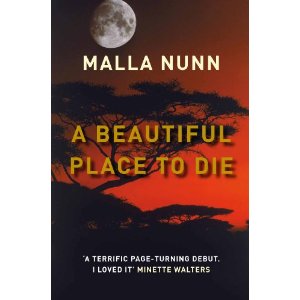
#20 Malla Nunn / A Beautiful Place to Die

Malla Nunn, A Beautiful Place to Die (London: Picador, 2010). An intriguing debut novel set in 1950s South Africa as apartheid is taking hold 4 stars

 Opening sentence:  Detective Sergeant Emmanuel Cooper switched off the engine and looked out through the dirty windscreen.

I’ve been looking for a good crime novel to sink my teeth into, and this one stood out from the crowd as I was browsing online recently. A Beautiful Place to Die is the debut crime novel by Malla Nunn, an Australian-based but Swaziland-born author, and is the first of the Emmanuel Cooper series, set in 1950s apartheid South Africa. It was awarded the Australian ‘Sisters in Crime Davitt Award for Best Adult Crime Novel’ and was shortlisted for the American Edgar Awards (‘Best Novel’ category).

The book opens in September 1952 with the discovery of a murdered police captain, Willem Pretorius, in a river by the South African settlement of Jacob’s Rest, near the Mozambique border. Detective Emmanuel Cooper is called in to investigate, and soon realises that the case is extremely sensitive, as Pretorius is a well-connected Afrikaaner within the powerful National Party movement, and Security Branch investigators are poised to take political advantage by framing a black communist for the crime. It quickly becomes clear that getting to the bottom of this murder will place a number of individuals, including Cooper himself, in a great deal of danger.

For me, the great strength of this novel was the way it used the crime narrative to illustrate the socially divisive and destructive effect of the racial segregation laws, introduced by the Nationalist government from 1948 onwards. Cooper, who served in Europe during the Second World War, notes despondantly that ‘eight years after the beaches of Normandy and the ruins of Berlin, there was still talk of folk-spirit and race purity out on the African plains’. Ironically, apartheid was gearing up for four decades of oppression at practically the same time as German fascism in Europe was defeated.

The novel convincingly captures the tensions apartheid generates within Jacob’s Rest, as well the inevitable tangles that its simplistic racial categorisations bring about: the dedicated Volk ideologue who furtively thinks of himself as part-Zulu; fair-skinned children of black and white parents who ‘pass’ illegally as whites; illicit liasons between white men and black women that fall foul of the Immorality Act because no law can successfully control desire. The novel also has interesting points to make about the gendered power-dynamics of interracial relationships, and the limited options open to black women being pursued by white men.

While I felt the first half of the book was extremely well-written, with a tremendous sense of place, portions of the second half dipped substantially for me, mainly because the plot became too melodramatic for my taste. In spite of this I still find myself keen to read the second book in the series, due to the depiction of Cooper (a complex, well-drawn investigative figure negotiating a repressive regime), the novel’s successful portrayal of 1950s South Africa, and the fact that the novel lingered in my mind for many days after I’d turned the final page.

The second novel in the series, Let the Dead Lie, was published in 2011. The publisher’s synopsis is available here.

Mrs Peabody awards A Beautiful Place to Die a slightly wobbly but fascinating 4 stars.

Creative Commons License
.