Smörgåsbord: New BBC crime (River, Arne Dahl) & German Histo-Krimis

There are some tasty morsels on offer this week…

WARNING: Embargoed for publication until 04/08/2015 - Programme Name: River - TX: n/a - Episode: River - First Look (No. n/a) - Picture Shows: EMBARGOED UNTIL 00:01HRS, TUESDAY 4th AUGUST, 2015 John River (STELLAN SKARSGARD) - (C) Kudos - Photographer: Nick Briggs

John River (STELLAN SKARSGARD) – (C) Kudos – Photographer: Nick Briggs

Tonight (Tuesday 13 October, 9.00-10.00) sees the start of an intriguing new six-part crime drama on BBC One.

River is set in London, but stars well-known Swedish actor Stellan Skarsgård as police officer John River – just the latest evidence of the mark Scandinavia is making on our crime culture. The series is a police procedural with a twist, because it seems that River is able to commune with the dead, including his former colleague ‘Stevie’ Stevenson (played by Nicola Walker, who’s also the police lead in Unforgotten over on ITV at the moment). I’m very interested to see how the excellent Cardiff-born screenwriter Abi Morgan pulls this idea off, which we see surfacing in crime series every now and then – the 1969/70 TV series Randall and Hopkirk (Deceased) springs to mind, as do the historical crime novels of Maurizio de Giovanni, featuring Commissario Riccardi. The image of detectives haunted by the victims of cases they haven’t yet managed to solve is a very powerful one, and in the hands of these actors, could be very effective indeed.

There’s a nice interview with Stellan Skarsgård by Jake Kerridge in today’s The Telegraph.

UPDATE: I’ve just watched Episode 1 and am VERY excited. This is one of the best British crime dramas I’ve seen in a long time (probably since Happy Valley). It has a hugely original premise, which is flawlessly executed, and the writing and acting are both top-notch. The opening, which involves an ABBA reference, Tina Charles’ ‘I Love to Love’ and a gritty chase scene, had me completely gripped, and if anything, things just got better from there. Skarsgård is particularly good, projecting an almost tangible sense of grief following the loss of his colleague Stevie, but there are a number of other great characters too, from Stevie herself to River’s no-nonsense boss and new partner Ira (look out for a breathtakingly audacious quip after they are introduced). The cinematography and styling are also wonderful: London takes on a Bladerunner feel in places and there is a striking use of colour (reds, greens and blues in particular). Original – stylish – brilliantly written and acted: make sure you watch this SOON.

Arne-Dahl-Series-2-cast

The A-Unit team, series 2

Over on BBC Four, Beck is making way for Arne Dahl, which starts on Saturday, 17. October at 9.00. This is the second series about the Swedish A-Unit – an ensemble police drama with a number of quirky characters, including a new team-member I’m pleased to see is a languages expert. I have to confess that I never completely got into series 1, but know that plenty of viewers did. The first episode involves the murders of a number of Polish women and is in Swedish and Polish with subtitles. In it, we also see Kerstin Holm take up her new role as A-Unit leader.

bj

Lastly, historical crime fans may be interested in a piece that Marina Sofia and I have written about German Histo-Krimis over at ‘Crime Fiction Lover. Our flimsy cover was a celebration of the Oktoberfest (cue naff picture of Bier maidens), but what we really wanted to do was tell everyone about the MASSES of great historical crime fiction that’s been produced in Germany, Austria and Switzerland, especially since reunification. Some of the novels are already in translation, others are not (needless to say, we’re working hard on getting the latter published in English…).

Roberto Costantini’s Italian/Libyan Balistreri Trilogy

I picked up the first novel in Roberto Costantini’s Balistreri TrilogyThe Deliverance of Evil (trans. N. S. Thompson, Quercus, 2014 [2011]), at this year’s CrimeFest after seeing the author on a couple of panels. Costantini was extremely articulate about how his personal links to Tripoli and Rome shaped the trilogy and how his writing style is influenced by his work as an engineer. My interest was also piqued by the description of his main protagonist, Commissario Michele Balistreri, as a morally flawed individual with a complex political past.

Cost

Coming in at just over 600 pages, The Deliverance of Evil is a novel for readers who enjoy complex, multi-layered crime narratives. Framed by Italy’s two Football World Cup victories in 1982 and 2006, it spans twenty-five years of Italian history, but also explores the legacy of Mussolini’s right-wing dictatorship and of the so-called ‘strategy of tension’ – a series of right-wing terrorist attacks in the 1960s and 1970s (possibly encouraged by the military and intelligence services), which were blamed on communists to provoke a political shift to the right. Balistreri, the narrative’s main investigator, acts as a kind of repository for this complex history: as a young man, he was drawn to the ultra right-wing Ordine Nuovo, but when it became involved in terrorist acts, worked undercover for the state in an attempt to stop them. When the narrative opens in 1982, he has supposedly left that past behind him, after being transferred to a quiet police post in Rome.

cover_tu_sei_il_male_web

The original Italian cover

The crime at the heart of the narrative is the murder of Elisa Sordi, a young woman who works for a religious housing organisation. The detective, keen to enjoy the 1982 World Cup final, is distracted during the initial investigation. This and a number of other factors result in the case remaining unsolved until 2006, when another woman is murdered in apparently similar circumstances. Wracked with remorse and guilt for his earlier failures, Balistreri vows to solve both cases and uncover the truth.

The Deliverance of Evil is a hugely absorbing, accomplished piece of work. While the denouement, which resembles an intricate origami creation, had me raising an eyebrow a little at times, the figure of Balistreri, together with the clever construction of the narrative and its dissection of Italian privilege, politics and racism made for a highly gripping read. I’ll definitely be seeking out the second in the trilogy, which moves back in time to the 1960s to explore Balistreri’s troubled past in Libya.

I have a bit of a thing about crime trilogies or quartets. They’re often quite special, which I think is due to two factors. Firstly, they give authors the chance to explore multiple facets of an overarching story in a group of novels, allowing them to create extended and complex literary worlds. Conversely, the limit of having a set number of novels (as opposed to an on-going series), encourages authors to take more risks, especially in terms of the characterisation of their protagonists and the overall denouement. Standalones and trilogies/quartets are thus usually more hard-hitting than a series, not least because they don’t need to safeguard the investigator or main protagonist indefinitely. They also often undertake a wide-ranging social and/or political critique, which I like.

10_peace_quartet

Here are few of my favourite crime trilogies and quartets:

David Peace’s Yorkshire Noir/Red Riding Quartet (1974197719801984), which is set against the backdrop of the Yorkshire Ripper case and provides a brilliant depiction of corrupt policing cultures.

Andrew Taylor’s Roth/Requiem for an Angel Trilogy (The Four Last ThingsThe Judgement of Strangers, The Office of the Dead) which skillfully excavates the history of a female serial killer, beginning in the present day and moving back to the 1970s and the 1950s.

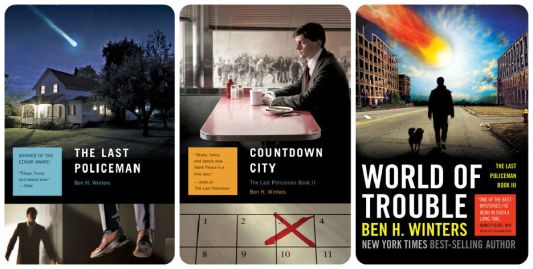
Ben Winter’s Last Policeman Trilogy (The Last Policeman, Countdown City, World of Trouble), set in a superbly realised world on the brink of destruction (I still need to read the final novel, and am looking forward to it very much).
Winter last policeman

Stieg Larsson’s Millennium Trilogy (The Girl with the Dragon Tattoo, The Girl who Played with Fire, The Girl who Kicked the Hornet’s Nest), featuring the remarkable, indefatigable Lisbeth Salander.

Leif G.W. Persson’s Story of a Crime Trilogy (Between Summer’s Longing and Winter’s End, Another Time, Another Life and Free Falling, As in a Dream), which probes the unsolved assassination of Olof Palme in an absorbing and darkly sardonic manner.

Philip Kerr’s Berlin Noir Trilogy (March Violets, The Pale Criminal, A German Requiem), which explores Nazi Germany in 1936 and 1938 and Allied Occupation in 1947 through the eyes of former Berlin policeman Bernie Gunther. The author later extended the trilogy into a series, but the original three novels remain the best in my view.

Perhaps you have others we could add to this list? 

Update: Well, what a brilliant response. Thanks to MarinaSofia, Margot, Rebecca, Bernadette, David, Tracey and Angela for their suggestions (see also their comments and those of others below), and to Barbara, Jose Ignacio and Craig Sisterson via Twitter for trilogies/quartets by women authors. All listed below…

Further great crime fiction trilogies and quartets: 

Lisa Brackman’s China Trilogy (Rock, Paper, Tiger; Dragon Day; Hour of the Rat)

James Ellroy’s L.A. Quartet (The Black Dahlia, The Big Nowhere, L.A. Confidential, White Jazz)

Lyndsay Faye’s New York Trilogy (The Gods of Gotham, Seven for a Secret, The Fatal Flame)

Gordon Ferris’ Glasgow Quartet (The Hanging Shed, Bitter Water, Pilgrim Soul, Gallowglass)

Alan Glynn’s Land Trilogy (Winterland, Bloodland, Graveland – set in Ireland)

Jean-Claude Izzo’s Marseille Trilogy (Total Chaos, Chourmo, Solea)

Peter May’s Lewis Trilogy (The Blackhouse, The Lewis Man, The Chessmen)

William McIllvaney’s Laidlaw Trilogy (Laidlaw, The Papers of Tony Veitch, Walking Wounded – set in Glasgow)

Adrian McKinty’s Troubles Quartet (The Cold Cold Ground, I Hear the Sirens in the Street, In the Morning I’ll Be Gone and Gun Street Girl – set in Ireland)

Denise Mina’s Garnethill Trilogy (Garnethill, Exile, Resolution – set in Glasgow, Scotland)

Denise Mina’s Paddy Meehan Trilogy (The Field of Blood, The Dead Hour, The Final Breath – set in Glasgow, Scotland)

Leonardo Padura’s Havana Quartet (Havana Blue, Havana Gold, Havana Red, Havana Black)

George Pelecanos’ D.C. Quartet (The Big Blowdown, King Suckerman, The Sweet Forever, Shame the Devil)

Dolores Redondo’s Baztan Trilogy. The first, The Invisible Guardian is available in translation and is set in Spain’s Basque country. The other two are entitled Legado en los huesos (Legacy in the Bones) and Ofrenda a la tormenta (Offering to the Storm).

John Williams Cardiff Trilogy (Five Pubs, Two Bars And A Nightclub; Cardiff Dead; The Prince of Wales)

Robert Wilson’s Falcon Quartet (The Blind Man of Seville; The Silent and the Damned; The Hidden Assassins; The Ignorance of Blood – set in Spain)

CrimeFest 2015: The Petrona, CWA International Dagger and EuroNoir

I can’t believe it’s already a week since the end of CrimeFest 2015. Time for my second post on this marvellous event, and some key highlights:

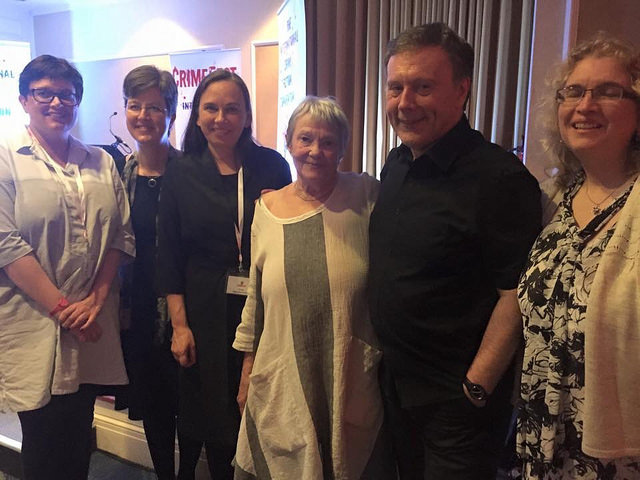
The Petrona Award: Yrsa Sigurðardóttir’s The Silence of the Sea, translated by Victoria Cribb, won the 2015 Petrona Award for the best Scandinavian crime novel of the year in translation. The award was presented by CrimeFest’s guest of honour Maj Sjöwall, which was very special for all concerned.

Petrona group

The Petrona judging team with Yrsa and Maj (centre). Photo: Andy Lawrence

The Petrona shortlist this year was wonderfully strong, with novels by Kati Hiekkapelto (Finland), Jørn Lier Horst (Norway), Arnaldur Indriðason (Iceland), Hans Olav Lahlum (Norway) and Leif G W Persson (Sweden). Fuller information about the shortlisted novels is available here and further details can also be found at the Petrona Award website.

The CWA’s 2015 International Dagger shortlist was announced at CrimeFest on the Friday night. The six shortlisted novels are:

  • Lief G.W. Persson, Falling Freely, as in a Dream (trans. Paul Norlen/Transworld/ SWEDEN)
  • Pierre LeMaitre, Camille (trans. Frank Wynne/Maclehose Press/FRANCE)
  • Deon Meyer, Cobra (trans. K.L.Seegers/Hodder and Stoughton/SOUTH AFRICA)
  • Karim Miské, Arab Jazz (trans. Sam Gordon/MacLehose Press/FRANCE)
  • Dolores Redondo, The Invisible Garden (trans. Isabelle Kaufeler/HarperCollins/ SPAIN)
  • Andreas Norman, Into a Raging Blaze (trans. Ian Giles/Quercus/SWEDEN)

Further details can be found on the CWA website, with the award being presented at the end of June. I’ve read a grand total of two, so need to do some catching up.

Euro Noir

Euro Noir panel with Barry Forshaw, Roberto Costantini, Gunnar Staalesen, Michael Ridpath and Jørn Lier Horst

Two CrimeFest panels I particularly enjoyed were the Nordic Noir and Euro Noir panels, moderated by Quentin Bates and Barry Forshaw respectively, and featuring Kati Hiekkapelto (Finland), Gunnar Staalesen (Norway), Clare Carson (UK/Orkney), Craig Robertson (UK/Faroes), Roberto Costantini (Italy), Michael Ridpath (UK/Iceland) and Jørn Lier Horst (Norway). Interesting observations abounded:

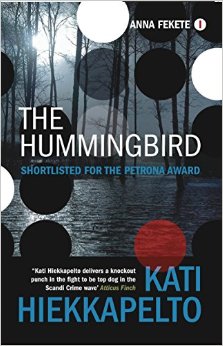
HummingbirdHiekkapelto’s The Hummingbird is set in fictional, northern Finnish town. It shows a darker side of Finland: alcoholism, loneliness and some poverty. She tries to write about Finland with the eyes of an outsider, like her investigator Anna Fekete, and sees Finland as being not very welcoming of immigrants. She’s rare in choosing to write about migration issues.

Staalesen describes the Norwegian town of Bergen as very film noir – it rains 250 days a year and so is an excellent setting for crime (the latest in his famous ‘Varg Veum’ P.I. series, We Shall Inherit the Wind, is about to be published by Orenda Press). For him, crime fiction is a way of telling stories about society and how we live our lives today. In contrast to many other countries, the status of crime fiction in Norway is high: it’s viewed as respectable literature due to its quality and its use as a form of social critique (e.g. Karin Fossum).

In her novel Orkney Twilight, Carson writes about Orkney from memories of childhood, which is apt because novel is about memory. Carson’s father was an undercover cop, and she’s drawn on the experience of being a young woman figuring out her father’s secret life. Orkney is a mysterious place with continuous light in summer; Carsen weaves Norse mythology throughout the narrative, which fits with the idea of undercover police/spies as master storytellers. She feels folklore is a way of talking about things that can’t be solved in life and that crime fiction is a modern version of that form, in that it gets to grips with unresolvable issues like death.

Ironically, given amount of murders committed in Nordic novels, Scandinavia and the Faroe Islands are probably safest places in world. There were no murders in Faroes for 26 years … until Robertson started writing his novel The Last Refuge. He feels a bit guilty about that.

Horst

Lier Horst used to get up at 5am every day to write while still working as a policeman. You have to set goal and put in the work – ‘it’s a hard job’. His first novel was based on a real murder. He saw the crime scene on the first day of his job and it stayed with him (the murderer was never caught). Writing about murders has ‘taught me a little about death, but a lot about life’, especially people’s emotions.

Barry Forshaw has coined the term ‘Scandi Brit’ for Brits like Michael Ridpath and Quentin Bates who set their novels in northern climes. Ridpath says it’s a challenge to write about other countries, but invigorating one. He regularly consults Icelanders on points of accuracy, which is a big help.

Cost

Costantini uses his engineering background to construct his plots. His acclaimed ‘Commissario Balistreri’ trilogy explores thirty years of Italian history from the 1960s to the 1990s, as well as developments in the Middle East. (I have bought the first and am looking forward to reading it.) He created a policeman with a compromised right-wing past as a deliberate challenge to readers.

There was praise for translators and their huge contribution to international crime fiction. Staalesen and Lier Horst are grateful to have the services of top translators Don Bartlett and Anne Bruce. Both are excellent, managing the most difficult of tasks like translating humour effectively.

Other highlights during CrimeFest included seeing Ragnar Jónasson hit the top of the Kindle bestseller list with his debut novel Snowblind late on Saturday night, chatting to authors like William Ryan and remembering how much good crime fiction I still need to read (e.g. the rest of his Captain Korolev series), and meeting friends old and new, like the lovely Elena Avanzas (@ms_adler, who blogs at Murder, she read), Maura and Karen from the Swansea Sleuths bookgroup, and Anya Lipska, who’s part of the newly formed and utterly marvellous Killer Women organisation. So much murderous creativity in one place and time! Roll on next year.

Under African skies: Férey’s Zulu and Sherif’s Bound to Secrecy

By chance, I’ve read two novels set in Africa recently: Caryl Férey’s Zulu (translated by Howard Curtis, World Noir/Europa Editions 2010) and Vamba Sherif’s Bound to Secrecy (HopeRoad 2015). While different to one another in many respects, both are highly interesting, worthwhile reads that explore the key theme of power in African contexts.

Caryl Férey is an intriguing author. He’s French, but chooses to set his crime novels in countries far from home, such as New Zealand (Utu), South Africa (Zulu) and Argentina (Mapuche). What unites his work is a focus on ethnic/social minorities and power structures, which are explored in gritty, noir crime narratives.

Zulu, the winner of the French Grand Prix for Best Crime Novel of 2008, is a highly absorbing read, which features the talented but psychologically damaged head of the Cape Town homicide unit, Ali Neumann. He and his team investigate the brutal slaying of a young woman in a post-Apartheid South Africa fractured by racial tension, violence and drugs crimes. The novel provides both a fascinating insight into difficult aspects of the Apartheid past (such as the rivalry between the black ANC and Inkatha movements) and contemporary challenges such as AIDS.

Unsurprisingly, there’s lots of hard-hitting violence throughout, which makes for uncomfortable reading, but is (mostly) linked to the larger social and political contexts the novel explores. On the basis of Zulu, I’m keen to read Férey’s other two works soon.

Vamba Sherif is another intriguing and very well travelled author. He was born in Kolahun, Liberia in 1973, moved to Kuwait in his early early teens, then settled in Syria and The Netherlands, where he read Law. His crime novel Bound to Secrecy is the first published by independent publisher HopeRoad, which aims to support literary voices neglected by the mainstream.

In contrast to Zulu, which is 400 pages in length, Bound to Secrecy is a compact read – more of a novella – focusing on the mysterious disappearance of paramount chief Tetese in the Liberian border town of Wologizi. In terms of its tone, the narrative also differs enormously to Férey’s work – it has an otherworldly, unsettling quality, partly due to the remoteness of Wologizi and partly due to the author’s subversion of crime conventions. Detective William Mawolo’s investigation is continually hampered by the silence of the townsfolk, the contradictory evidence he uncovers and a series of disturbing events that leave him and the reader in a state of confusion. The novel has echoes of Kafka, and the figure of Mawolo reminded me of Dürrenmatt’s compromised detectives, who seek clarity and resolution, but can’t always find them.

Unlike Zulu, Bound to Secrecy doesn’t provide detailed information about its country’s troubled history (the West African country of Liberia). Instead, it explores the central theme of power – both on those who wield it and those who are subject to it – in an elliptical, abstract way. The narrative also has some interesting things to say about gender roles and the power of women. Beautifully written, this compelling literary crime novel will draw me back for a second reading.

There’s a good interview here with Sherif, which also provides a bit of information about Liberian literature and culture.

*****

On a sad note, we heard yesterday that crime writer Ruth Rendell has died. One of the most prominent and ground-breaking UK crime authors of the twentieth-century, she’ll be hugely missed. Her final novel, Dark Corners, will be published in October (and may we all still be writing at 85).

There have been some wonderful obituaries and pieces that explore Rendell’s legacy as a crime writer and as a Labour peer in the House of Lords. I’ve added a few links below:

Ruth Rendell

The Guardian obituary

Tribute by Val McDermid in The Guardian

Financial Times obituary by Barry Forshaw

Appreciation by Margot Kinberg at Confessions of a Mystery Novelist

New York Times obituary

A list of Rendell’s works via the British Council

Bernhard Jaumann’s Afrika-Krimis and European crime drama The Team

It’s been a little while since I last posted, because I’m on a final push with the Crime Fiction in German volume. I’m nearly there – the entire draft’s been printed out and just needs some final checks before it goes off to the University of Wales Press. I’m obviously biased, but think it looks rather splendid.

16271683479_b5659f34a0_k (1)

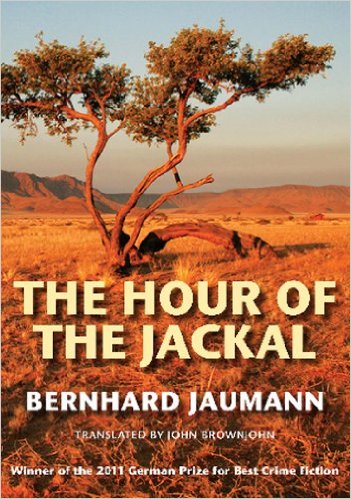
One bonus in the final phase of editing has been finding out more about the Afrika-Krimi – German-language crime fiction set in Africa – courtesy of a chapter by Julia Augart, who’s based at the University of Namibia. Namibia was a German colony between 1884 and 1915, and one novel she discusses is Bernhard Jaumann’s Steinland (Stoneland, 2012), which explores that post-colonial legacy in the context of current land reform policies. I hoovered up the novel while I was editing the chapter, and it was a fascinating read. While that one’s not translated yet, Jaumann’s 2010 novel The Hour of the Jackal is out in English (John Beaufoy Publishing): like Steinland, it features the excellent detective inspector Clemencia Garises.

Although things have been a bit hectic, I’ve managed to keep up with Broadchurch on ITV. The general reaction to this second series has been disappointment, as it’s definitely not lived up to the quality of the first. But I’m still watching, as (eye-raising legal daftness aside) I love the Hardy and Miller dynamic, and Olivia Coleman’s acting in particular. By contrast, Spiral series 5 (the one I’m not watching…) has been getting strong reviews.

Some very interesting news in – thanks to Jacky Collins – about a European crime drama called The Team, which is currently in production. Based on the work of Interpol, the drama will follow a European team as it investigates three murders, in Antwerp, Berlin and Copenhagen, and will switch between Dutch, German and Danish as the location of the action changes. It’s a product of the EBU (European Broadcasting Organisation), and is funded via the EU and eight of its member states.

The Team: Jasmine Gerat (Germany) Lars Mikkelsen (Denmark) and Veerie Baetens (Belgium)

The Team: Jasmine Gerat (Germany) Lars Mikkelsen (Denmark) and Veerie Baetens (Belgium). Photo: The Telegraph/EBU

And look who’s in it! I think the whole thing is a stroke of genius on the part of the EBU: the concept of a European Union is undergoing something of a battering at the moment, not least in the UK. What better way to persuade audiences of the positive benefits of European cooperation than a top-notch crime drama? Other ‘Eurocrime’ novels and series have existed before (such as Arne Dahl’s ‘Intercrime’ series), but as far as I’m aware, this is the first time that one has been instigated and funded via the EU itself. I love the deliberately multicultural and multilingual approach the makers are taking, and hope it does really well.

You can find out more about The Team here. It’s being shown in Denmark, Germany, Austria, Switzerland, Sweden and Belgium later this month. Let’s hope it makes its way here very soon.