

Thomas Mullen’s Darktown (Abacus, 2016)
First line: It was nearing midnight when one of the new lampposts on Auburn Avenue achieved the unfortunate fate of being the first to be hit by a car.
I had seen Thomas Mullen’s Darktown recommended by a number of bloggers on their ‘Best of 2016’ lists, and snapped up a copy in Foyles a few months ago. It proved to be an excellent, hugely satisfying read.
Set in Atlanta, Georgia in 1948, Darktown is a murder mystery that also explores a key moment in the city’s history: the induction of eight African American police officers into the Atlanta Police Department for the very first time. These pioneers were Claude Dixon, Henry Hooks, Johnnie Jones, Ernest Lyons, Robert McKibbens, John Sanders, Willard Strickland and Willie Elkins (pictured below).
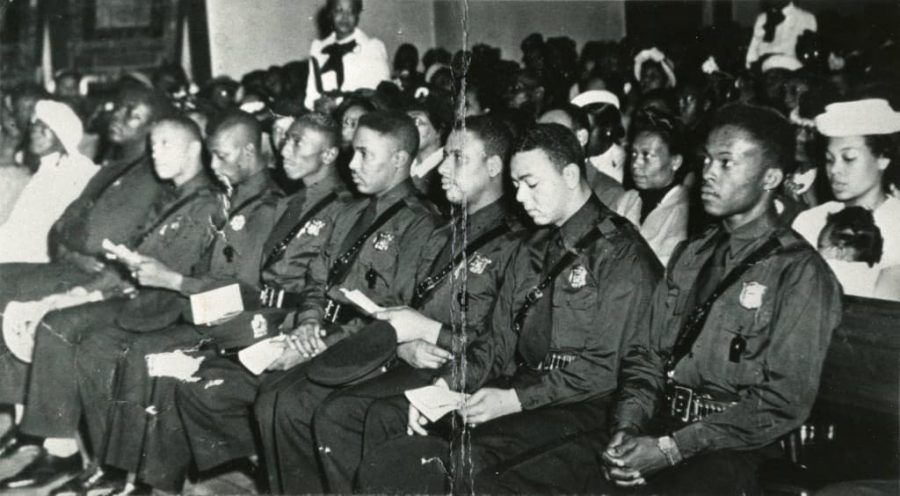
Atlanta’s first African American police officers, April 1948
The new black police officers faced the most difficult of uphill struggles: they were stationed at a YMCA rather than at police headquarters, and were thus effectively segregated from the rest of the force; they were assigned lowly beat duties in ‘Darktown’, as Atlanta’s black neighbourhoods were dismissively termed; they patrolled on foot without access to patrol cars; they were forbidden to arrest white suspects, and had no prospect of promotion. On top of all that, as the novel shows, they had to deal with scepticism from the African American community, whose past experience told it not to trust the police, and racial prejudice from their white police colleagues, who sought to openly disparage and undermine their efforts.
Mullen takes this scenario and breathes life into it quite brilliantly. We are shown how two sets of policemen become caught up in the investigation of a young black woman’s murder – black policemen Lucius Boggs and Tommy Smith, and white policemen Lionel Dunlow and Denny Rakestraw (Rake). Each of their characters is superbly delineated, and they are often used to unsettle stereotypes and easy assumptions: Lucius is the son of the highly respected and relatively affluent Reverend Boggs, and is thus part of an emerging college-educated black middle class. Smith comes from a less affluent background and served in the Second World War, like Rake, whose German mother has also given him some insights into the experience of being an ‘outsider’ in the US. These different personal perspectives create a rich and multifaceted narrative.
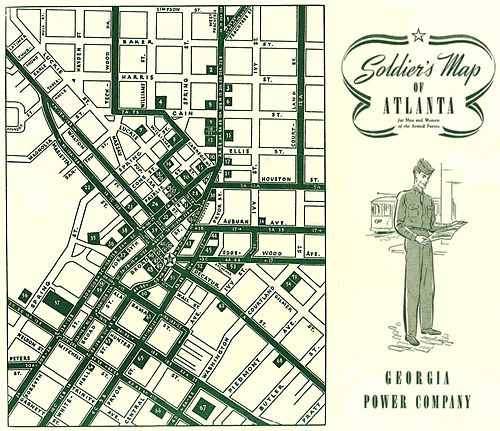
Map of central Atlanta, produced for the Armed Forces in 1940. The novel opens on Auburn Avenue (centre right)
The novel is also a stunning portrait of post-war Atlanta, and opened this (privileged white) reader’s eyes to the dangerous and wearing realities of living in a society where racism is deeply ingrained in all areas of life. The power of the narrative lies in its cumulative detail about segregation laws and unwritten rules, such as avoiding eye contact if you happen to be a black person talking to someone who is white. This is a shifting, uncertain world where even acts carried out with good intentions can very quickly backfire. The threat of violence is grimly real, both in particular parts of the city and in the countryside, where racism often takes cruder forms.
Darktown is beautifully written, and still feels acutely relevant today. A TV series with Jamie Foxx as executive producer is in the pipeline, and a second novel, Lightning Men, is out this September.
 Mrs. Peabody Investigates