Holiday reading and the 2015 Betty Trask Award: The Spring of Kasper Meier

The Crime Fiction in German volume has had its final polish and been delivered into the tender care of the University of Wales Press. Time for a little break, then – a tour of west Wales in our trusty VW camper, with plenty of downtime for reading in various seaside cafes.

I’ve been eyeing up my real and virtual bookshelves to see what I fancy taking along. So far I have the following modest pile, which will no doubt expand a bit by tomorrow morning.

 Behind God's Back

Finnish author Harri Nykänen’s Behind God’s Back (trans. Kristian London, Bitter Lemon Press, 2015) is the second in the Ariel Kafka series – I enjoyed the first, Nights of Awe, very much. Here’s the publisher description:

>> There are two Jewish cops in all of Helsinki. One of them, Ariel Kafka, a lieutenant in the Violent Crime Unit, identifies himself as a policeman first, then a Finn, and lastly a Jew. Kafka is a religiously non-observant 40-something bachelor who is such a stubborn, dedicated policeman that he’s willing to risk his career to get an answer. Murky circumstances surround his investigation of a Jewish businessman’s murder. Neo-Nazi violence, intergenerational intrigue, shady loans – predictable lines of investigation lead to unpredictable culprits. But a second killing strikes closer to home, and the Finnish Security Police come knocking. The tentacles of Israeli politics and Mossad reach surprisingly far, once again wrapping Kafka in their sticky embrace. << 

Emily St. John Mandel, The Lola Quartet (Picador 2015). I’ve heard lots of good things about this Canadian/British Columbia writer, who often uses crime conventions in her literary works (have heard comparisons to David Mitchell of Cloud Atlas fame):

Emily’s website describes Lola as ‘literary noir’, with the following overview >> Gavin Sasaki is a promising young journalist in New York City, until he’s fired in disgrace following a series of unforgivable lapses in his work. The last thing Gavin wants is to return to his hometown of Sebastian, Florida, but he’s drifting toward bankruptcy and is in no position to refuse when he’s offered a job by his sister, Eilo, a real estate broker who deals in foreclosed homes.

Eilo recently paid a visit to a home that had a ten-year-old child in it, a girl who bears a strong resemblence to Gavin and who has the same last name as Gavin’s high school girlfriend Anna, whom Gavin last saw a decade ago. Gavin — a former jazz musician, a reluctant broker of foreclosed homes, obsessed with film noir and private detectives — begins his own private investigation in an effort to track down Anna and their apparent daughter.<<

And then today saw the announcement of the 2015 Betty Trask Award, a £10,000 prize for debut writers under 35. The winner is Ben Fergusson’s The Spring of Kasper Meier (Little, Brown, 2014), which is set in the ruins of Berlin after 1945 and looks mighty like a crime novel to me. So that’s coming along too.

Here’s the blurb from Ben’s website >> Set in Berlin in 1946, The Spring of Kasper Meier follows the friendship that develops between Kasper Meier, a black-market trader, and Eva Hirsch, the young woman who is blackmailing him. As soldiers in Berlin begin to be killed in mysterious circumstances, both Kasper and Eva’s troubled pasts threaten to reveal themselves, and their fragile lives begin to spiral out of control. <<

The novel has also featured on the Radio 2 bookclub (you can access a free extract via its website here).

What holiday reading do you have lined up? All recommendations gratefully received!

Deutschi Crime Night and the ‘Crime Fiction in German’ volume

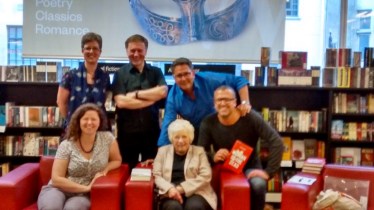
The wonderful Deutschi Crime Night took place yesterday at Waterstones Piccadilly. The panelists were Austrian author Bernhard Aichner, German author Sascha Arango, the acclaimed translator Anthea Bell, New Books in German editor Charlotte Ryland and me, with Euro Noir expert Barry Forshaw in the chair – who did us proud.

Embedded image permalink

Photo by Charlotte Ryland

The discussion was wide-ranging and fascinating, and included the following: Sascha on his decision to set The Truth and Other Lies in a unidentifiable, universal space (like Nesser’s ‘van Veeteren’ series), in contrast to the regionally rooted writing he does for the Kiel episodes of the German TV crime drama Tatort (Crime Scene), and about the influence of Patricia Highsmith’s Ripley series on his writing; Bernhard on his creation of the ‘lovable serial killer’ Blum and the research he carried out for Woman of the Dead in a funeral home and at autopsies; Anthea on the process of translating the novel, which she really enjoyed, and on translating more generally, which she described as ‘finding the author’s voice’.

In addition, we took a canter through the crime fiction of Germany, Austria and Switzerland, discussing early German-language crime, crime greats from the Weimar period such as Fritz Lang’s M, Nazi crime fiction, Austrian crime fiction’s use of satire, Swiss writer Friedrich Dürrenmatt’s complex detective figures, and the boom in historical crime fiction since the fall of the Berlin Wall in 1989 (I drew on the forthcoming Crime Fiction in German volume when making my contribution to this portion of the discussion, of which more below). Charlotte filled us in on the work of New Books in German and some crime fiction coming our way soon, including the beguilingly entitled Der nasse Fisch (The Wet Fish) by Volker Kutscher and Melanie Raabe’s Die Falle (The Trap). She also helped us ponder the question of why German-language crime hasn’t quite had the breakthrough it deserves in the UK, with a publisher in the audience adding that she was confident it has the capacity to do so. A good boost would be provided by some German-language crime in the BBC4 Saturday crime slot…

Waterstones crime event

Anti-clockwise from front: Charlotte Ryland, Anthea Bell, Bernhard Aichner, Sascha Arango, Barry Forshaw, Mrs Pea (photo by Jennifer Kerslake)

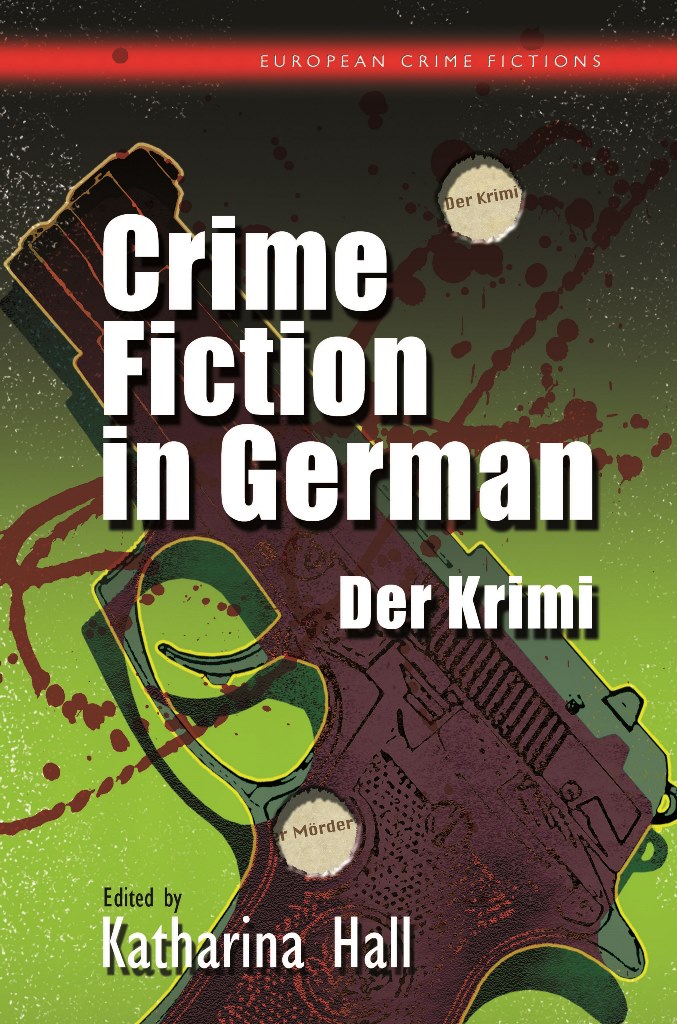
Barry also kindly gave me the opportunity to talk about the Crime Fiction in German volume, which is out in March 2016 and will provide the first comprehensive overview in English of German-language crime from its origins in the 1800s to the present day. I’ve set up a tab about the volume here, and you can see further details on the University of Wales Press website. The volume is part of the UWP ‘European Crime Fictions‘ series, which already contains volumes on French, Italian, Iberian and Scandi crime.

The cover for the Crime Fiction in German volume has just been finalised and looks gorgeous. I love the psychedelic green (Schwarzwald on speed?) and the lashings of blood. And just look at those clever little bullet holes.

German CF cover final

Finally, as a few people from our lovely audience were asking for reading recommendations after the event, here are some past ‘Mrs. Peabody Investigates’ posts about German-language crime:

Alles Gute und viel Spaß!

Krimi-tastic! Aichner’s Woman of the Dead and Arango’s The Truth & Other Lies

Not just one, but two seriously page-turning Krimis from the German-speaking world have crossed my path recently.

AichnerWoman of the Dead (Totenfrau, trans. Anthea Bell/Orion 2015), by Austrian writer Bernhard Aichner, features an unforgettable heroine/anti-heroine, the motorbike-riding undertaker Brünhilde Blum. She is a woman with a secret, who, when her beloved husband is killed, starts dealing with the case in a highly individual way. This fast-moving thriller is an extremely readable mash-up of Austrian and American crime. Its setting is recognizably Austrian (Innsbruck and the Tyrolean countryside), and its bleak assessment of Austrian society echoes other crime narratives such as Elfriede Jelinek’s Greed (Gier, 2000). At the same time, the book draws on Lindsay’s Dexter, Tarantino’s Kill Bill (‘the bride’) and Larsson’s The Girl with the Dragon Tattoo (Lisbeth Salander) – influences that might allow it to be viewed as ‘feminist noir’, the subject of this recent The Mary Sue post. I was gripped from start to finish, although I did find the novel’s moral framework and its call to empathize with a killer rather unsettling at times. I’ll be very interested to see where the next book in the ‘Blum trilogy’, House of the Dead, takes our highly unusual investigator. You can read an extract from Woman of the Dead here

The Truth and other lies

Sascha Arango’s The Truth and Other Lies (Die Wahrheit und andere Lügen, trans. Imogen Taylor/Simon and Schuster 2015) is equally compelling and features another off-the-wall protagonist, Henry Hayden – a famous novelist whose comfortable life begins to unravel after he makes a fatal error. Hayden is a darkly comic creation whose story involves a wife, a mistress and a floundering police team, and keeps the reader effortlessly engaged throughout. Intriguingly, even though Arango is a screenwriter for the German TV crime series Tatort, which has a strongly regional flavour, his novel has an international rather than a specifically German feel. The characters’ names sound English, American, German, Dutch, Swedish or eastern European and there are barely any discernible geographical markers. In literary terms, the obvious influence is Patricia Highsmith’s Tom Ripley, but I was also reminded of Ingrid Noll’s blackly humorous novel The Pharmacist (Die Apothekerin, 1994), whose protagonist carries out a series of crimes to smooth her way to a prosperous middle-class life. Like the latter, Arango’s Truth is a stylish, witty and entertaining read. You can listen to an audio extract here.

Both Bernhard Aichner and Sascha Arango will be appearing at the Deutschi Crime Night at Waterstones Piccadilly next Thursday, 11th June at 7.00pm, with Barry Forshaw (moderating), Anthea Bell the translator, Charlotte Ryland from ‘New Books in German’ and yours truly. The event is FREE and all you need to do if you’d like to come along is RSVP piccadilly@waterstones.com. You can find out more info here. Should be lots of fun!