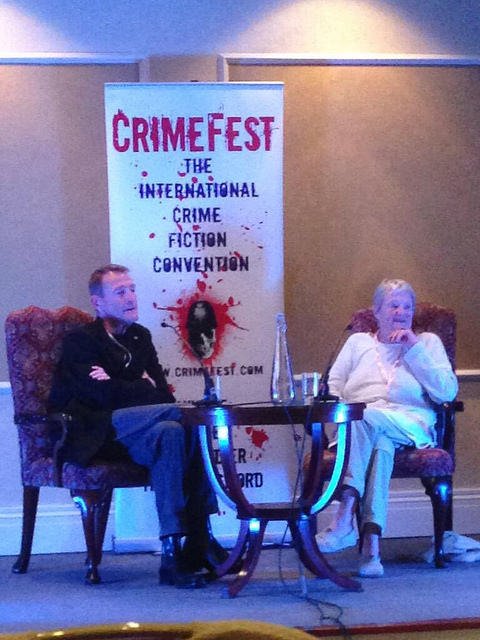
CrimeFest 2015: The Petrona, CWA International Dagger and EuroNoir

I can’t believe it’s already a week since the end of CrimeFest 2015. Time for my second post on this marvellous event, and some key highlights:

The Petrona Award: Yrsa Sigurðardóttir’s The Silence of the Sea, translated by Victoria Cribb, won the 2015 Petrona Award for the best Scandinavian crime novel of the year in translation. The award was presented by CrimeFest’s guest of honour Maj Sjöwall, which was very special for all concerned.
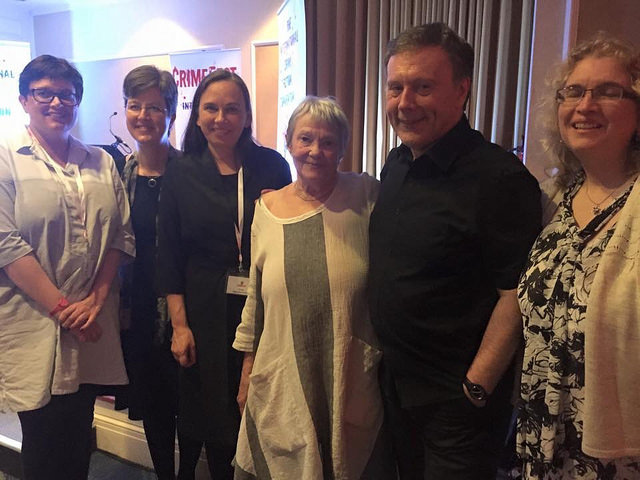
Petrona group

The Petrona judging team with Yrsa and Maj (centre). Photo: Andy Lawrence

The Petrona shortlist this year was wonderfully strong, with novels by Kati Hiekkapelto (Finland), Jørn Lier Horst (Norway), Arnaldur Indriðason (Iceland), Hans Olav Lahlum (Norway) and Leif G W Persson (Sweden). Fuller information about the shortlisted novels is available here and further details can also be found at the Petrona Award website.

The CWA’s 2015 International Dagger shortlist was announced at CrimeFest on the Friday night. The six shortlisted novels are:

  • Lief G.W. Persson, Falling Freely, as in a Dream (trans. Paul Norlen/Transworld/ SWEDEN)
  • Pierre LeMaitre, Camille (trans. Frank Wynne/Maclehose Press/FRANCE)
  • Deon Meyer, Cobra (trans. K.L.Seegers/Hodder and Stoughton/SOUTH AFRICA)
  • Karim Miské, Arab Jazz (trans. Sam Gordon/MacLehose Press/FRANCE)
  • Dolores Redondo, The Invisible Garden (trans. Isabelle Kaufeler/HarperCollins/ SPAIN)
  • Andreas Norman, Into a Raging Blaze (trans. Ian Giles/Quercus/SWEDEN)

Further details can be found on the CWA website, with the award being presented at the end of June. I’ve read a grand total of two, so need to do some catching up.

Euro Noir

Euro Noir panel with Barry Forshaw, Roberto Costantini, Gunnar Staalesen, Michael Ridpath and Jørn Lier Horst

Two CrimeFest panels I particularly enjoyed were the Nordic Noir and Euro Noir panels, moderated by Quentin Bates and Barry Forshaw respectively, and featuring Kati Hiekkapelto (Finland), Gunnar Staalesen (Norway), Clare Carson (UK/Orkney), Craig Robertson (UK/Faroes), Roberto Costantini (Italy), Michael Ridpath (UK/Iceland) and Jørn Lier Horst (Norway). Interesting observations abounded:
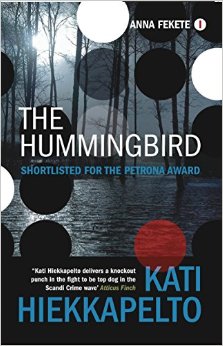
HummingbirdHiekkapelto’s The Hummingbird is set in fictional, northern Finnish town. It shows a darker side of Finland: alcoholism, loneliness and some poverty. She tries to write about Finland with the eyes of an outsider, like her investigator Anna Fekete, and sees Finland as being not very welcoming of immigrants. She’s rare in choosing to write about migration issues.

Staalesen describes the Norwegian town of Bergen as very film noir – it rains 250 days a year and so is an excellent setting for crime (the latest in his famous ‘Varg Veum’ P.I. series, We Shall Inherit the Wind, is about to be published by Orenda Press). For him, crime fiction is a way of telling stories about society and how we live our lives today. In contrast to many other countries, the status of crime fiction in Norway is high: it’s viewed as respectable literature due to its quality and its use as a form of social critique (e.g. Karin Fossum).

In her novel Orkney Twilight, Carson writes about Orkney from memories of childhood, which is apt because novel is about memory. Carson’s father was an undercover cop, and she’s drawn on the experience of being a young woman figuring out her father’s secret life. Orkney is a mysterious place with continuous light in summer; Carsen weaves Norse mythology throughout the narrative, which fits with the idea of undercover police/spies as master storytellers. She feels folklore is a way of talking about things that can’t be solved in life and that crime fiction is a modern version of that form, in that it gets to grips with unresolvable issues like death.

Ironically, given amount of murders committed in Nordic novels, Scandinavia and the Faroe Islands are probably safest places in world. There were no murders in Faroes for 26 years … until Robertson started writing his novel The Last Refuge. He feels a bit guilty about that.

Horst

Lier Horst used to get up at 5am every day to write while still working as a policeman. You have to set goal and put in the work – ‘it’s a hard job’. His first novel was based on a real murder. He saw the crime scene on the first day of his job and it stayed with him (the murderer was never caught). Writing about murders has ‘taught me a little about death, but a lot about life’, especially people’s emotions.

Barry Forshaw has coined the term ‘Scandi Brit’ for Brits like Michael Ridpath and Quentin Bates who set their novels in northern climes. Ridpath says it’s a challenge to write about other countries, but invigorating one. He regularly consults Icelanders on points of accuracy, which is a big help.

Cost

Costantini uses his engineering background to construct his plots. His acclaimed ‘Commissario Balistreri’ trilogy explores thirty years of Italian history from the 1960s to the 1990s, as well as developments in the Middle East. (I have bought the first and am looking forward to reading it.) He created a policeman with a compromised right-wing past as a deliberate challenge to readers.

There was praise for translators and their huge contribution to international crime fiction. Staalesen and Lier Horst are grateful to have the services of top translators Don Bartlett and Anne Bruce. Both are excellent, managing the most difficult of tasks like translating humour effectively.

Other highlights during CrimeFest included seeing Ragnar Jónasson hit the top of the Kindle bestseller list with his debut novel Snowblind late on Saturday night, chatting to authors like William Ryan and remembering how much good crime fiction I still need to read (e.g. the rest of his Captain Korolev series), and meeting friends old and new, like the lovely Elena Avanzas (@ms_adler, who blogs at Murder, she read), Maura and Karen from the Swansea Sleuths bookgroup, and Anya Lipska, who’s part of the newly formed and utterly marvellous Killer Women organisation. So much murderous creativity in one place and time! Roll on next year.

CrimeFest 2015: legendary crime writer Maj Sjöwall in interview with Lee Child

I’m just back from this year’s CrimeFest, which was particularly special for a number of reasons. This is the first of two posts on the event, and focuses on Lee Child’s interview with the legendary Swedish crime writer Maj Sjöwall.

17835933215_3f7ace1780_z

Maj Sjöwall and Lee Child at CrimeFest, Saturday 16 May (with thanks to the unknown photographer!)

Sjöwall, co-author of the highly influential ‘Martin Beck’ series with her husband Per Wahlöö, was the festival’s guest of honour. The almost mythical position she holds as the ‘godmother of Scandinavian crime’ was illustrated by the standing ovation she received on entering the room with Lee Child. What we heard from her in the course of the conversation was wide-ranging and fascinating:

  • The ‘Martin Beck’ series (1965-75) grew out of national and international events: 1960s Sweden was turning from a social democratic country to a more right-wing country, and it was the era of the Vietnam War and student demos. The series was designed to show what was happening to Swedish society and how the police was becoming more militarised, but in bumbling way, like a small-town police force.
  • They choose the crime genre as a vehicle because it was entertaining and would reach a wide audience. She and Per sat face to face over a table and worked together, talking extensively about the stories and the language they would use. The aim was to make the novels as accessible as possible.
  • In the case of Roseanne, the first novel, they’d been on a boat trip and seen a beautiful American woman travelling on her own. As Per was looking at her just a bit too closely, Maj decided, ‘we’ll kill her!’ (just one example of her splendidly wry humour).
  • Crime fiction wasn’t a big thing in Sweden at that time (just a few ‘bourgeois amateur sleuths’). There were no police procedurals. They wanted the novels to be realistic, so they kept the pace of the narrative slow and a created a police team rather than focusing on just one hero.
  • Their influences were Chandler, Hammett and Simenon. The American 87th Precinct novels by Ed McBain were NOT a direct influence as is often thought. They only read these after they started writing the series. (Given the similarities between the two, one can only say that this was a remarkable case of synchronicity!)
  • The series took off around book three or four. But it tended to be read by young left-wingers who were already converted to the [Marxist] ideals and values it promoted. So as authors, they were not necessarily reaching the audience they wanted to influence.
  • Of police investigator Martin Beck: he is a ‘quite boring’, classic civil servant, ‘but has a very important quality – empathy’. He reflects the masculine police world of the time and is depicted realistically: he’s married to the job and has a complex relation-ship with his wife and children. The authors were criticised for this: it was felt that police in crime novels should not have a private life. Now it’s a big part of modern crime (Child added that it’s ‘almost a requirement’).
  • They decided on ten novels from the start, and thought of the series as one long novel that was split into ten (influenced by Balzac).

The ten novels in the series also match the number of letters in Martin Beck’s name.

  • Was the series successful in critiquing/changing Sweden? Maj responds by saying that she doesn’t think books can change the world, but that they can influence and help to change the ways that people think.
  • The novels were first translated into French and German, then later into English. Maj thinks they paved the way for other crime writers in those countries. [She’s certainly right in relation to West Germany, where the Beck series had a significant influence on the Soziokrimi (social crime novel) movement of the 1960s and 1970s. Intriguingly, the series was also published in East Germany, which approved of the series’ political viewpoint].
  • Child sees the influence of Sjöwall and Wahlöö in Ian Rankin’s Rebus and other crime writing far beyond Scandi borders. In a brief Twitter conversation, Rankin told me: ‘Actually, I’m pretty sure I’d written a few Rebus novels before reading the Becks. On the other hand… it is feasible I’d been reading *about* the Becks and the notion of a real-time series may have chimed’.
  • Maj does not have explanation for why series is so popular. She likes the recent work of Leif G. W. Persson because he stays close to reality. But in her view too many contemporary crime novels are set in small towns and focus on personal narratives.
  • One of Maj’s favourite Beck novels is The Locked Room, due to its structure and logic, and the memories she has of writing it.

The Sjöwall interview was sponsored by British Institute for Literary Translation, which is very fitting: we would never have been able to read the Beck series without the services of marvellous translators like Lois Roth, Joan Tate, Alan Blair, Thomas Teal and Paul Britten Austin. Huge thanks to them! Here’s a list of the ‘Martin Beck’ novels and a few interesting links:

  • 1965 – Roseanna (Roseanna)
  • 1966 – Mannen som gick upp i rök (The Man who Went Up in Smoke)
  • 1967 – Mannen på balkongen (The Man on the Balcony)
  • 1968 – Den skrattande polisen (The Laughing Policeman)
  • 1969 – Brandbilen som försvann (The Fire Engine That Disappeared)
  • 1970 – Polis, polis, potatismos! (Murder at the Savoy)
  • 1971 – Den vedervärdige mannen från Säffle (The Abominable Man)
  • 1972 – Det slutna rummet (The Locked Room)
  • 1974 – Polismördaren (Cop Killer)
  • 1975 – Terroristerna (The Terrorists)
17648112258_a7b8326930_z

A wonderful memento from a wonderful event

Coming up in the next CrimeFest post: The 2015 Petrona Award, Euro Noir and other international delights.

New Bitter Lemon signings, The Edgars and CrimeFest

Here’s a round up of some interesting crime fiction news and events.

Joshua Farrington of The Bookseller reports that >>Bitter Lemon Press has signed a series of deals for female crime writers from around the world, with the books set to lead the publisher’s schedule in the second half of the year.

Publisher and co-founder Laurence Colchester has acquired titles from Brazil’s Patrica Melo, Turkey’s Esmahan Aykol and Argentina’s Claudia Piñeiro.

Melo’s The Body Snatcher is the story of a drug deal gone wrong, with police corruption and blackmail. Melo’s previous novels Lost World, The Killer, In Praise of Lies and Inferno were published in English by Bloomsbury. The Body Snatchers, which will be published in July, is translated by Clifford E. Landers.

Divorce Turkish Style by Esmahan Aykol will be published in September. It is the third in a murder mystery series featuring crime bookshop owner and accidental investigator Kati Hirschel. The previous two books, Hotel Bosphorous and Baksheesh were also published by Bitter Lemon Press, translated by Ruth Whitehouse.

Piñeiro’s Betty Boo is set in Buenos Aires, and sees a sensitive woman trying to save her career and personal life while caught up in a criminal conspiracy. Piñeiro’s previous titles, translated by Miranda France, were also published by Bitter Lemon Press. Betty Boo will be published in January 2016.

Colchester said: “We are very proud to bring these three women crime writers from Brazil, Turkey and Argentina to English speaking readers. It is part of our mission as an independent press to introduce new voices from abroad and here, in the autumn season of 2015, are three of the most successful women writing in the crime genre today.”<<

Over in the States, the annual Edgar Awards have taken place. A full list of the nominees and winners is available here. The focus is on English-language crime, and a number of titles have already migrated to my groaning TBR pile, such as Ben Winter’s World of Trouble, which is the final installment in The Last Policeman series (see my discussion of his earlier work here).

The winner in the best novel category was Stephen King’s Mr. Mercedes, which I’m currently half way through and enjoying very much (although I will never look at a hamburger in the same way again).

Last but not least, the international crime fiction convention CrimeFest takes place in Bristol next week, with a sterling programme you can see in full here. I’m very much looking forward to attending, not least because this year’s special guest is Swedish crime writer Maj Sjöwall, co-author of the seminal Martin Beck series, and she will be helping us to present the 2015 Petrona Award for Best Scandinavian Crime Novel of the Year.

I have been enjoying all the online speculation about the Petrona shortlist. The judges have now made their choice…! But will you agree?!

Under African skies: Férey’s Zulu and Sherif’s Bound to Secrecy

By chance, I’ve read two novels set in Africa recently: Caryl Férey’s Zulu (translated by Howard Curtis, World Noir/Europa Editions 2010) and Vamba Sherif’s Bound to Secrecy (HopeRoad 2015). While different to one another in many respects, both are highly interesting, worthwhile reads that explore the key theme of power in African contexts.

Caryl Férey is an intriguing author. He’s French, but chooses to set his crime novels in countries far from home, such as New Zealand (Utu), South Africa (Zulu) and Argentina (Mapuche). What unites his work is a focus on ethnic/social minorities and power structures, which are explored in gritty, noir crime narratives.

Zulu, the winner of the French Grand Prix for Best Crime Novel of 2008, is a highly absorbing read, which features the talented but psychologically damaged head of the Cape Town homicide unit, Ali Neumann. He and his team investigate the brutal slaying of a young woman in a post-Apartheid South Africa fractured by racial tension, violence and drugs crimes. The novel provides both a fascinating insight into difficult aspects of the Apartheid past (such as the rivalry between the black ANC and Inkatha movements) and contemporary challenges such as AIDS.

Unsurprisingly, there’s lots of hard-hitting violence throughout, which makes for uncomfortable reading, but is (mostly) linked to the larger social and political contexts the novel explores. On the basis of Zulu, I’m keen to read Férey’s other two works soon.

Vamba Sherif is another intriguing and very well travelled author. He was born in Kolahun, Liberia in 1973, moved to Kuwait in his early early teens, then settled in Syria and The Netherlands, where he read Law. His crime novel Bound to Secrecy is the first published by independent publisher HopeRoad, which aims to support literary voices neglected by the mainstream.

In contrast to Zulu, which is 400 pages in length, Bound to Secrecy is a compact read – more of a novella – focusing on the mysterious disappearance of paramount chief Tetese in the Liberian border town of Wologizi. In terms of its tone, the narrative also differs enormously to Férey’s work – it has an otherworldly, unsettling quality, partly due to the remoteness of Wologizi and partly due to the author’s subversion of crime conventions. Detective William Mawolo’s investigation is continually hampered by the silence of the townsfolk, the contradictory evidence he uncovers and a series of disturbing events that leave him and the reader in a state of confusion. The novel has echoes of Kafka, and the figure of Mawolo reminded me of Dürrenmatt’s compromised detectives, who seek clarity and resolution, but can’t always find them.

Unlike Zulu, Bound to Secrecy doesn’t provide detailed information about its country’s troubled history (the West African country of Liberia). Instead, it explores the central theme of power – both on those who wield it and those who are subject to it – in an elliptical, abstract way. The narrative also has some interesting things to say about gender roles and the power of women. Beautifully written, this compelling literary crime novel will draw me back for a second reading.

There’s a good interview here with Sherif, which also provides a bit of information about Liberian literature and culture.

*****

On a sad note, we heard yesterday that crime writer Ruth Rendell has died. One of the most prominent and ground-breaking UK crime authors of the twentieth-century, she’ll be hugely missed. Her final novel, Dark Corners, will be published in October (and may we all still be writing at 85).

There have been some wonderful obituaries and pieces that explore Rendell’s legacy as a crime writer and as a Labour peer in the House of Lords. I’ve added a few links below:

Ruth Rendell

The Guardian obituary

Tribute by Val McDermid in The Guardian

Financial Times obituary by Barry Forshaw

Appreciation by Margot Kinberg at Confessions of a Mystery Novelist

New York Times obituary

A list of Rendell’s works via the British Council