Two compelling female detectives: Rachel (The Girl on the Train) and Maud (Elizabeth is Missing)

I’m writing this post from under a pile of essays – or at least it feels that way. In any case, time for a quick breather from marking to flag up two interesting reads, both from the UK.

While on a train journey recently, I couldn’t resist starting Paula Hawkins’ The Girl on the Train (Riverhead 2015), a psychological thriller that’s been a huge word-of-mouth hit. Its ‘accidental detective’ is Rachel Watson, a rail-commuter who in true Rear Window fashion, sees something disturbing out of the window that will change her life. The novel is a very enjoyable ride (albeit with a few too many coincidences towards the end), but what I particularly liked about it was its characterisation. Rachel, whose life has disintegrated since the end of her marriage, is a complex creation who gives a vivid insight into the destructive effects of alcoholism. She makes for a very intriguing investigator, especially as her drinking means she sometimes can’t trust her own memory.

The author is originally from Zimbabwe, although she’s lived in the UK for many years. There’s an interesting Guardian article on her and the novel here.

Rachel reminded me of another excellent female investigator I encountered recently – 82-year-old Maud Horsham in Emma Healey’s Elizabeth is Missing (Viking 2014). Maud is also investigating a mystery – the disappearance of her best friend Elizabeth – and does so in the most difficult of circumstances: she has dementia and her memory, or rather lack of memory, is constantly tripping her up. A gripping psychological crime novel, Elizabeth also offers the reader a sobering and moving exploration of what it’s like to live with dementia – both for Maud as an individual and for her family. Like Rachel, Maud is portrayed as a determined, characterful, complex woman. I enjoyed meeting both of them very much.

Come to think of it, we could add Christine Lucas from S. J. Watson’s Before I go to Sleep to these two. Do we have a little subgenre emerging?

London calling: Forensics, European crime fiction…and cake

I’m just back from a couple of crime-filled days in London. The main reason for my visit was to speak at a symposium on European crime fiction and data visualisation (of which more later), but I travelled up a day early in order to see the Forensics exhibition at The Wellcome Trust.

16498201563_555d7a914b_z

The Wellcome Trust is by Euston Square station. Get there early, as it’s a popular exhibition

I’ve already written about the Forensics exhibition in a previous post, so here’s a summary of the parts I particularly liked.

  • Its focus, as one would expect, is scientific, but it also incorporates photography and artwork reflecting on violence, murder and its aftermath, which provide some genuinely thought-provoking perspectives.
  • Frances Glessner Lee’s ‘Nutshell Study of Unexplained Death’ – a crime scene recreated in a dollhouse for police training purposes in the 1940s – was fascinating for its miniature juxtaposition of detailed handcrafts and gruesome homicide.
  • Room 4, which explores how forensic archaeologists have gathered evidence of political and war crimes in Chile, Rwanda and Yugoslavia, was highly moving in its emphasis on bearing witness and justice.
  • The vast array of exhibits yielded wildly diverse treasures such as exquisite drawings of deadly plants, a porcelain Royal Doulton morgue table and Sir Bernhard Spilsbury’s hand-written autopsy cards (although I did wonder how the poor victims would have felt about having their personal details on public display…).
  • I took some great new definitions and phrases away with me: the word ‘autopsy’ means ‘to see with one’s own eyes’ and constitutes ‘the last chance to question the dead’; Eduard Locard, head of the first police crime lab in Lyon, introduced ‘the exchange principle’, based on the theory that ‘every contact leaves a trace’ (perpetrator on victim and victim on perpetrator), and Erle Stanley Gardener asserted that medical experts giving evidence at trials ‘must serve but one client, and that client should be truth’.

A note of warning: the exhibition is not for faint-hearted, as some of the images and commentary it contains are extremely graphic. I was grateful for a strong and steadying cup of coffee in the Wellcome Cafe afterwards. But I would highly recommend a visit – see the exhibition website for more details here.

16493725653_5dc547c089_z

Drawing breath in the Wellcome cafe…

Friday was spent at the British Library, taking part in the symposium ‘Towards a Digital Atlas of European Crime Fiction?’ – part of an AHRC project run by Dominique Jeannerod and Federico Pagello of Queen’s University Belfast. The project is evidence of how rapidly the ‘digital humanities’ – which explore the contribution of ‘big data’, technology and data visualisation to humanities research – are expanding, and was of course particularly interesting as it considered these areas in relation to European crime.

17113220571_2d25ebc389_z

Eduardo Paolozzi’s statue of Isaac Newton at the British Library

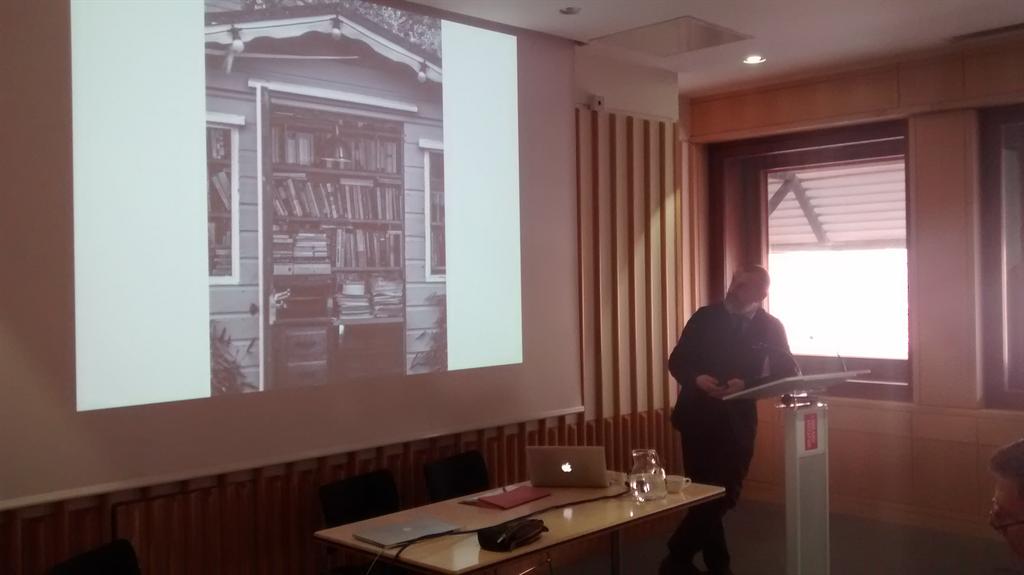
The morning was spent hearing the project contributors’ findings. What I liked about this section was the chance to see some data visualisations, to discuss the metho-dological and technical challenges involved in their creation (e.g. getting from ‘dirty’ to ‘clean data’), and to get an idea of the kinds of case studies involved (French, Hungarian and European crime). I had expected the speakers to be evangelical about digital research, but they discussed its advantages and disadvantages in very even-handed and thoughtful ways – such as the capacity of ‘distant reading’ to make trends visible against the time that inputting and cleaning data can take. The project is designed to have an exploratory function and as someone considering increased use of digital methods in my research, I found these reflections very useful indeed.

17112350002_673f6fcc1e_z

Federico Pagello (Queens), discussing ‘dirty’ vs ‘clean data’

The afternoon saw presentations from researchers on diverse digital tools and analysis in research on Czech, French, New Zealand and German crime (the latter from yours truly, on my Nazi-themed crime fiction database and this blog), as well as a talk from Samuel Schwiegelhofer of the Paris Bibliothèque des littératures policières (BiLiPo – a library dedicated to crime fiction!). That was followed by a marvellous keynote from Ian Sansom (crime author and academic), which ranged from the work of theorist Franco Moretti to the horse’s head in The Godfather and Ian’s garden shed.

Embedded image permalink

Professor Ian Sansom with his shed. Photo by Federico Pagello

All in all, the symposium was a rich and valuable experience, not least because it provided the chance to meet like-minded researchers from around the world, and has made me think deeply about my own research and its digital possibilities. Many thanks to the organisers for making it such a successful event.

If you’re interested in finding out more about the project, then take a look at the International Crime Fiction Research Group blog or follow the group on Twitter – @crimefictionrg. A website with lots of useful resources is on its way.

Last but not least, the trip provided a great opportunity to meet friends and co-conspirators from the crime blogosphere, including Jacky Collins, Andy Lawrence, Ewa Sherman and Sarah Ward. There were pilgrimages to The Scandinavian Kitchen and Maison Bertaux (the latter, London’s oldest patisserie, was a great find courtesy of Andy).

Large amounts of cake may have been consumed.

16927694999_97f2ef5a2f_z17113890475_61cf3c7f09_z

Stieg Larsson sequel, crime versus thrillers, Easter bunnies

Big news this week: the sequel to Stieg Larsson’s acclaimed ‘Millennium Trilogy’ is well on its way. The cover and English title – The Girl in the Spider’s Web – were revealed by MacLehose Press on Monday, although its contents will remain firmly under wraps until publication on 27 August. Here’s what we know: the sequel is ‘based on Larsson’s universe and characters’, is written by Swedish writer David Lagercrantz; will be published in Sweden by Norstedts; is titled Det som inte dödar oss  (That Which Doesn’t Kill Us) and is currently being translated into 38 languages.


Like many, I have rather mixed feelings about the publication of the new novel. On the one hand, I thought the trilogy had a pretty perfect resolution and am not sure it could be bettered. On the other, I loved Lisbeth Salander and am keen to see how her story develops. I don’t envy Lagercranz the task of taking on such a weighty literary legacy – it must be hugely difficult to find a voice and narrative that are faithful to the original, but more than pure mimicry. I’m keeping my fingers crossed that he’s found a way through. For more information, see this Guardian article by Alison Flood.

There was another interesting article in The Guardian yesterday by Val McDermid, entitled ‘Why crime fiction is left-wing and thrillers are right-wing’ (thanks to Vicky Newham for flagging this up on Facebook).

In it McDermid argues (with help from Ian Rankin) that ‘the current preoccupations of the crime novel, the roman noir, the Krimi lean to the left. It’s critical of the status quo, sometimes overtly, sometimes more subtly. It often gives a voice to characters who are not comfortably established in the world – immigrants, sex workers, the poor, the old. The dispossessed and the people who don’t vote. The thriller, on the other hand, tends towards the conservative, probably because the threat implicit in the thriller is the world turned upside down, the idea of being stripped of what matters to you. And as Bob Dylan reminds us, “When you ain’t got nothing, you got nothing to lose.”’

That got me thinking hard about whether these political distinctions hold up more widely. While I can think of plenty of examples to support McDermid’s argument – especially in the context of European crime – I can also think of a number of exceptions. Golden Age crime fiction is often thought of as being ‘conservative in style, setting, characterisation, subject matter and socio-political views’, with a dubious social order in relation to class, gender and race being restored at the end of the narrative (quote from Lee Horsley’s excellent chapter on ‘Classic Detective Fiction’ in Twentieth Century Crime Fiction, OUP, pp. 12-65, p. 39). Hard-boiled crime fiction features private investigators not known for their tolerance or diplomatic skills. They may well be critical of the status quo, but are often shown delivering violent, eye-for-an-eye justice rather than handing criminals over to the law so they can be properly put on trial. There’s an interesting discussion on these points in an article by Arlene Teraoka, which explores the lack of a private eye tradition in German crime fiction – arguably due to the P.I.’s fascistic tendencies – and the post-war preference for paternalistic police inspectors who guarantee a democratic social order (who also have their conservative sides…).

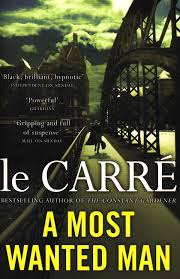
Equally, two exceptions in relation to thrillers spring to mind. John le Carré’s works are highly critical of the power wielded by governments and shady secret services, and repeatedly highlight the price vulnerable individuals pay in these larger political games (e.g. The Spy who Came in from the Cold, The Looking Glass War, A Most Wanted Man). I also read a very good Swedish thriller in the course of my Petrona judging duties that raises big moral questions about the conduct of national intelligence agencies in wartime – Joakim Zander’s The Swimmer.

In sum, different crime genres/subgenres are flexible enough to be employed for liberal or conservative political ends, and elements of both can even co-exist alongside one another in individual texts. But I’ll be bearing McDermid’s assertions in mind as I read on, to see if her distinctions hold up as current trends.

Update: Over on findingtimetowrite, Marina Sofia also muses on Val McDermid’s article and gives a wonderful overview of the Quais du Polar, at which Val’s comments were originally made. The post gives a summary of various crime writers’ views about writing on politics from the event; these provide a very nice counterpoint to this post – showing how crime fiction is used by many writers as a progressive means of critiquing and exploring the power structures of their societies.

Wishing you all a very happy Easter break filled with fluffy bunnies, chocolate and lots of crime fiction!