Iceland Noir 2014: volcanoes, glaciers and crime

Having been extremely jealous of everyone at Iceland Noir last year, it was brilliant to make it this November, not least because Reykjavik has been on my wishlist of places to visit for a long, long time. The event was held at Nordic House, and was expertly organised by author Quentin Bates and the rest of the Icelandic Noir team, who put together a great programme over two days. Quite a few bloggers have already posted reports (see list below), so I’m going to focus on the panels/discussions that particularly interested me and say a little about my first impressions of Iceland … with plenty of photos!

IMG_4654

Nordic Perspectives panel – and yes, it was early in the morning…

Nordic Perspectives. This panel featured David Hewson (UK), Hans Olav Lahlum (Norway), Lilja Sigurðardóttir (Iceland) and Michael Ridpath (UK), with Jake Kerridge moderating. It was interesting to see how these authors positioned themselves or their countries’ crime output in relation to ‘nordic crime’. Sigurðardóttir felt that Icelandic crime had affinities to Scandinavian crime through its focus on the complexity of the criminal (citing the work of Norwegian author Karin Fossum as an example). However Lahlum saw himself as a historical crime writer rather than a Nordic crime writer, while Ridpath’s Icelandic-American investigator is an insider-outsider figure who negotiates different cultural traditions.

This panel also included discussion of historical crime fiction and adaptation. Lahlum told us that Norwegian crime fiction often engages with historical events, especially the Second World War (as evidenced in his novel The Human Flies). Hewson discussed his adaptation of the Danish TV crime drama The Killing, which involved adding contextualising historical detail. For example, the beginning and end of The Killing II are set in Ryvangen Memorial Park, which was the site of partisan executions by the Nazis and points to the core theme of the series – the long-term impact of war on society. Hewson provided extra information about the memorial, as British readers would not be aware of its significance (interesting; now on my TBR pile).

IMG_4658 2

‘Translating crime across cultures’ panel

The ‘translating crime fiction across cultures’ panel featured Viktor Arnar Ingólfsson (Iceland), Mari Hannah (UK), Bogdan Hrib (Romania) and Vidar Sundstøl (Norway), with academic Jacky Collins moderating. I left this panel wanting to read Sundstøl’s Minnesota Trilogy: the first installment, The Land of Dreams, won the prestigious Riverton Prize in 2008, and its exploration of Norwegian-American history and culture sounds right up my street. It was also interesting to hear Hrib discussing Romanian crime novels and his ongoing mission to see them more widely translated into English: there are currently just three, published by Profusion Press, which I’m now curious to read. Mari Hannah tantalised us by revealing that she’s written a novel partly set in Norway (a break from the Kate Daniels series, which we were reassured is also continuing). Icelandic author Ingólfsson currently has one novel translated into English – The Flatley Enigmawith others translated into German, which appears to be quite a common route for Icelandic writers (those Germans do love their nordic Krimis!).

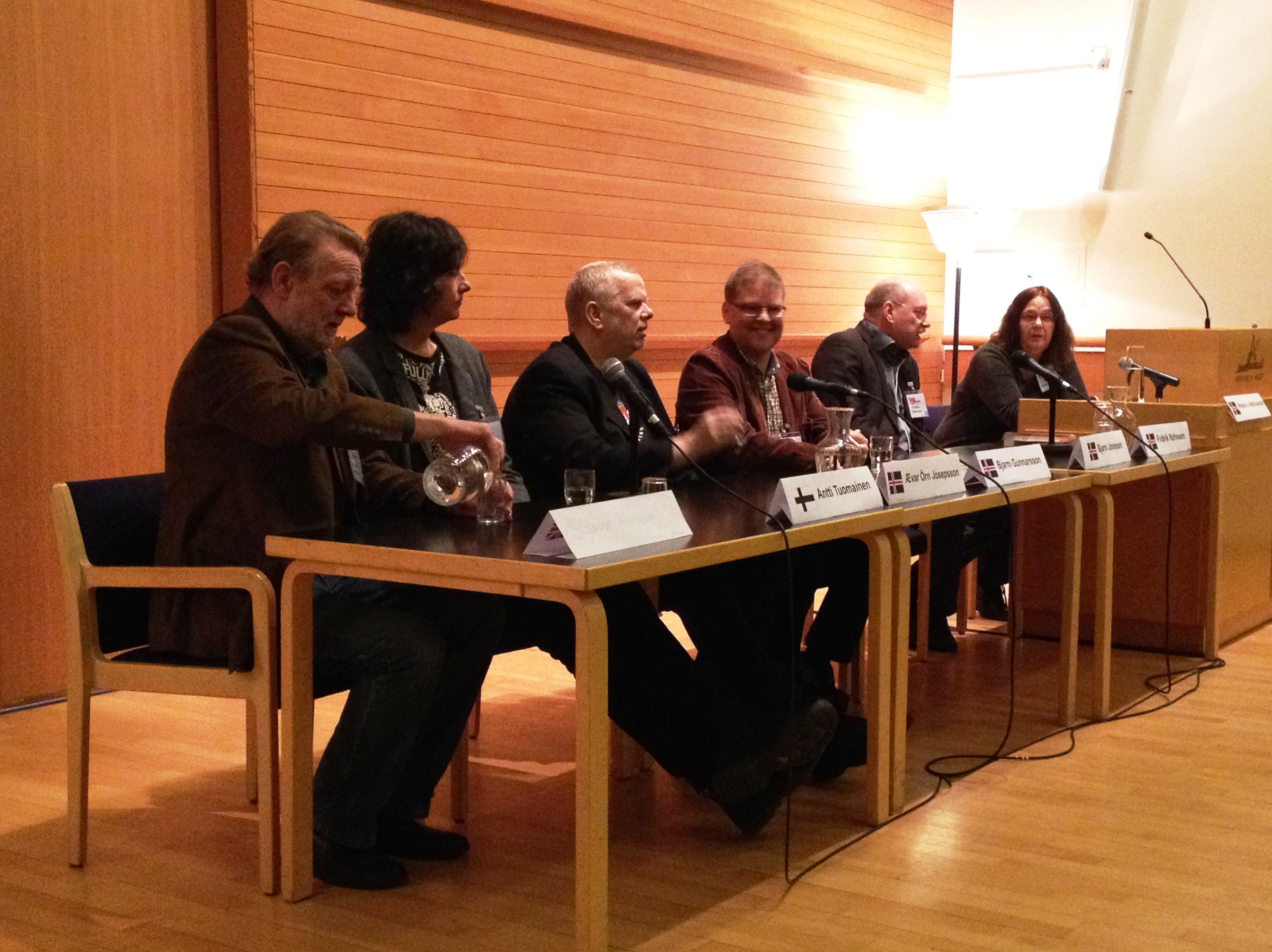
A companion panel on the Saturday celebrated the inaugural Icepick Award for best crime novel translated into Icelandic, with Antii Tuomainen (Finnish author of The Healer) and Icelandic translators Ævar Örn Jósepsson, Bjarni Gunnarsson, Bjarni Jónsson and Sigadur Karlsson (Magnea Matthiasdóttir moderating).
IMG_4733

Icepick Award panel – a sea of translators!

The panel gave a fascinating insight into the dialogue between writers and translators about linguistic and cultural issues during the process of translation, although Gunnarsson also illustrated the important role of technology today: when translating Nesbo, he used Google Earth to take a closer look at Oslo, a city he’s never visited but now feels he knows well. Tuomainnen made lifelong friends in the translation community with his heartfelt appreciation for the work of the translator; he also specifically thanked Sigurdur Karlsson for translating his work and for bringing it to the attention of Icelandic publishers in the first place, thereby highlighting the influential role translators play in identifying promising new work. The Icepick was awarded on the Saturday evening at the Iceland Noir dinner (for further details, see my previous post).

IMG_4686 2

The ‘settings’ panel

Tuomainnen popped up again on the settings panel with Ragnar Jónasson (Iceland), Johan Theorin (Sweden) and Vidar Sundstøl (Norway), moderated by Jacky Collins. The settings discussed included urban Finland, a village in northern Iceland, an isolated Swedish island and the American Midwest. In each case, the novel’s location plays a crucial role – sometimes even becoming a character in its own right – and is used to create unease or suspense (Theorin’s Öland novels), a sense of remoteness and isolation (Jonasson’s Dark Iceland series), or to explore themes such as migration (Sundstol’s Minnesota Trilogy) and climate change (Tuomainen’s The Healer).

IMG_4735 2

The ‘supernatural in crime fiction’ panel – a suitably shaky shot from the back…

One of my favourite panels was on supernatural crime, featuring James Oswald (Scotland), Johan Theorin (Sweden), Alexandra Sokoloff (US) and Michael Sears (South Africa) in discussion with Jake Kerridge. It was fascinating to hear the varying reasons why crime authors use supernatural elements in their work: as a means of exploring the clash between the rational and irrational (Oswald), illustrating evil (Sokoloff), exploring cultural beliefs (Sears) or taking genre in new direction (Theorin). Hearing the panelists talk about the extra dimensions the supernatural can add to a crime narrative reminded me why I like hybrid crime fiction so much: there’s a creativity at work here that pushes the boundaries of the genre and – when it works – can produce fantastic results. Sokoloff rather intriguingly described a magpie approach when writing – she has blended Jewish lore and witch-y elements into her novels to create particular effects. And it struck me that at least two other writers at the conference – Tuomainen and Icelandic author Yrsa Sigurðardóttir – also write hybrid crime fiction (drawing on traditions of apocalyptic literature and horror). The days when crime publishers were reluctant to publish this type of fusion fiction thankfully appear to be over.

Other blog posts, articles and tweetery on Iceland Noir 2014:

  • Crime Fiction Lover – lots of coverage including the debut authors’ panel, featuring blogger and Petrona judge Sarah Ward, whose novel In Bitter Chill (Faber and Faber 2015) I’m greatly looking forward to reading
  • Crimepieces – Sarah Ward with three posts
  • The Reykjavik Grapevine on the author reading held at Solon on Thursday evening
  • Miriam Owen live-tweeted Iceland Noir via @NordicNoirBuzz

Do also check out the site for next year’s rather wonderful-looking Shetland Noir (Iceland Noir will be back in 2016).

I’m going to finish up with a few Reykjavik/Iceland photos to show those of you who haven’t yet visited what a great place this is!

1. An Eymundsson bookshop in Reyjkavik. This capital, which is around the size of my hometown Swansea, with a population of around 200,000, has at least five massive bookshops. Iceland is a nation of book lovers with a deep appreciation of culture (probably instilled by long winter nights and the reading aloud of Icelandic sagas). Fittingly, Reykjavik is a UNESCO City of Literature.

IMG_4852

Booktastic Reykjavik

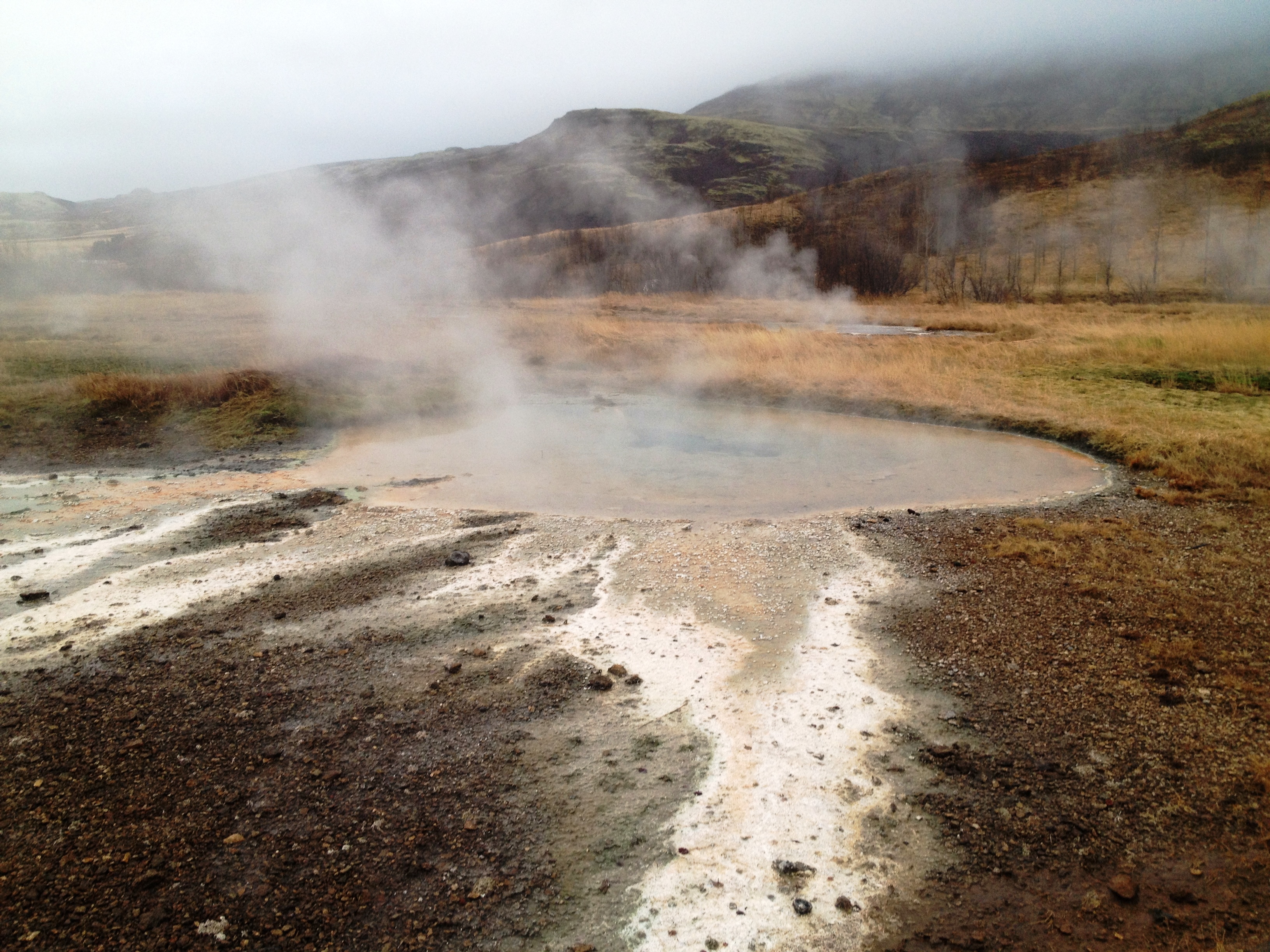
2. The bubbling, steaming landscape of Haukadalur. Wandering around on a crust of earth just above plentiful geothermal activity, with geysers going off at regular intervals, instils an added appreciation of our volatile, ever-changing planet. In a land not heavy on natural resources, Icelanders have made the most of their free geothermal energy to heat their homes, create outdoor thermal pools, grow tomatoes, process aluminium, keep their streets de-iced, and so on… Ingenious and admirable.
IMG_4787

The land of fire and ice – a geothermal landscape here, but glaciers are not far away

3. Reykjavik is charming. Here are a few random photos.

IMG_4887

Hallgrímskirkja, which looks a lot like a space rocket, guarded by the statue of Leifur Eiriksson

IMG_4907

View over Reykjavik from the top of the Hallgrímskirkja – on the day the sun came out
IMG_4921

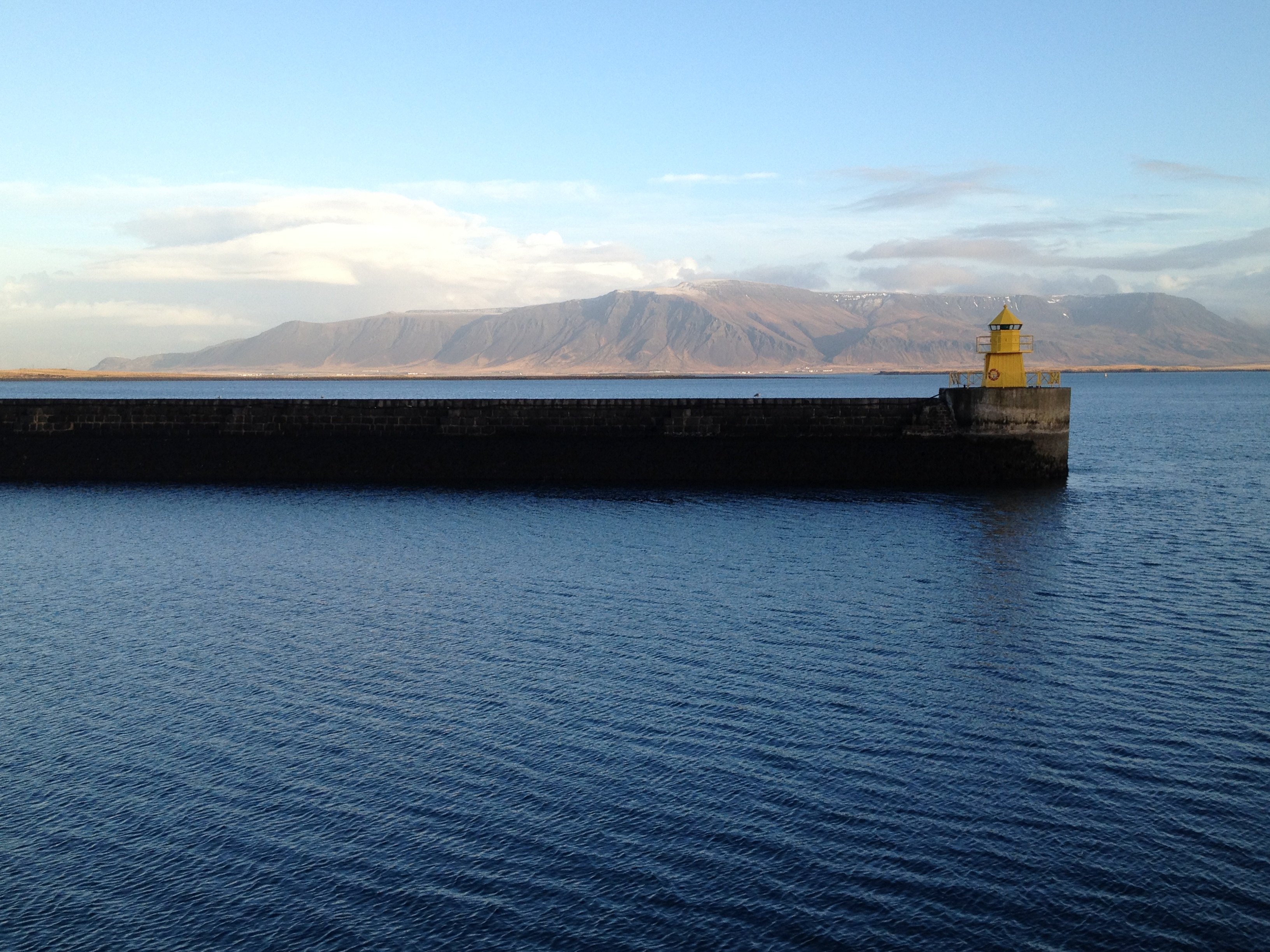
Reykjavik Harbour, looking out to Faxafloi Bay and the mountains beyond

4. There’s a lot of Icelandic wool. Which gets turned into gorgeous mittens to feed my newly discovered mitten addiction.

IMG_5031

Takk fyrir Icelandic sheep!

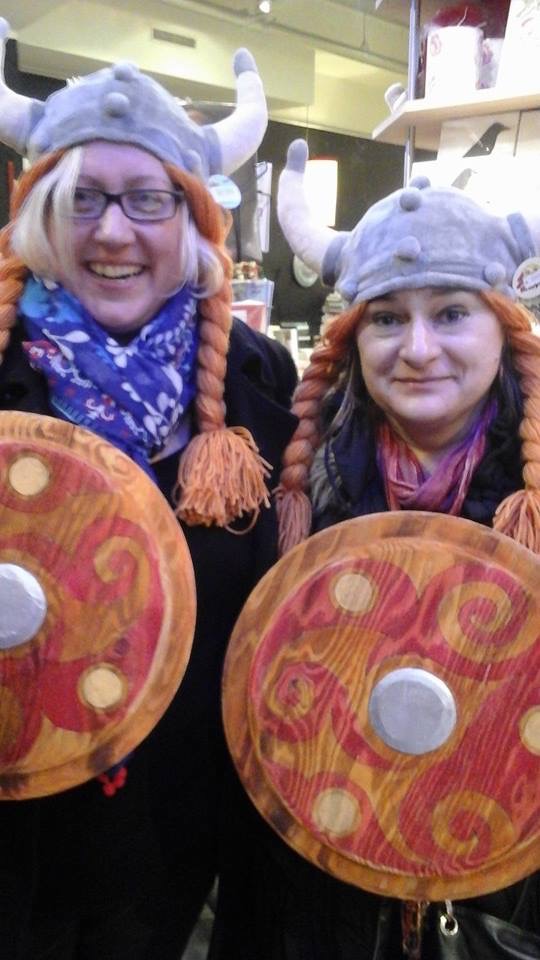
5. Friendly Vikings. I think this is my favourite Iceland Noir photo.
IMG_4946

Miriam and Ewa – awesomely stylish Vikings

Huge thanks to the Iceland Noir organisers for making the event such a wonderful success!

Iceland Noir: Winner of first Icepick Award announced!

Hot off the presses from Iceland Noir! The winner of the inaugural Icepick Award, given to the best crime novel translated into Icelandic in 2014, is…

 IcepickSmall

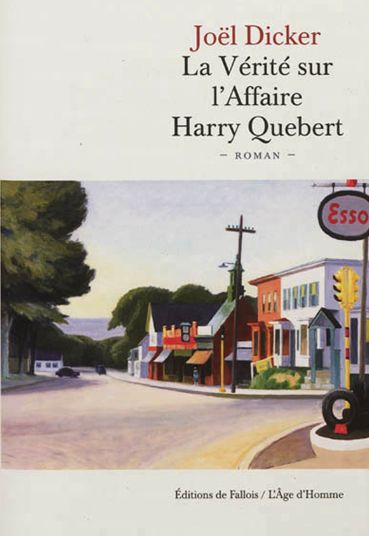
… Swiss author Joël Dicker’s La Vérité sur l’affaire Harry Quebert [The Truth About the Harry Quebert Affair], translated from the French by Friðrik Rafnsson.

harry_quebert

This novel is a publishing phenomenon – here’s the blurb from Penguin, which has certainly made me want to read the book:

>> The Truth About the Harry Quebert Affair is a fast-paced, tightly plotted, cinematic literary thriller, and an ingenious book within a book, by a dazzling young writer.

August 30, 1975: the day fifteen-year-old Nola Kellergan is glimpsed fleeing through the woods, never to be heard from again; the day Somerset, New Hampshire, lost its innocence. Thirty-three years later, Marcus Goldman, a successful young novelist, visits Somerset to see his mentor, Harry Quebert, one of the country’s most respected writers, and to find a cure for his writer’s block as his publisher’s deadline looms. But Marcus’s plans are violently upended when Harry is suddenly and sensationally implicated in the cold-case murder of Nola Kellergan—with whom he admits he had an affair. As the national media convicts Harry, Marcus launches his own investigation, following a trail of clues through his mentor’s books, the backwoods and isolated beaches of New Hampshire, and the hidden history of Somerset’s citizens and the man they hold most dear. To save Harry, his own writing career, and eventually even himself, Marcus must answer three questions, all of which are mysteriously connected: Who killed Nola Kellergan? What happened one misty morning in Somerset in the summer of 1975? And how do you write a book to save someone’s life?<<

The Icepick Award is judged both on the quality of the original work and its translation, acknowledging the vital role of the translator in allowing crime fiction to travel beyond national and linguistic boundaries to the ever grateful reader. The process of translating (which of course involves not just linguistic but detailed cultural knowledge) is often invisible, so it’s very welcome to see it being celebrated by the award.

The shortlist for the 2014 Icepick Award, with novels from America, Finland, Norway, Switzerland and Sweden, was as follows:

Joël Dicker, La Vérité sur l’affaire Harry Quebert [The Truth About the Harry Quebert Affair] – Icelandic translation from French: Friðrik Rafnsson

Gillian Flynn, Gone Girl – Icelandic translation from English: Bjarni Jónsson

Jo Nesbø, Panserhjerte [The Leopard] – Icelandic translation from Norwegian: Bjarni Gunnarsson

Håkan NesserMänniska utan hund [Man Without Dog] – Icelandic translation from Swedish: Ævar Örn Jósepsson Antti Tuomainen, Veljeni vartija [My Brother’s Keeper] – Icelandic translation from Finnish: Sigurður Karlsson The award is founded by the Reykjavik Crime Festival Iceland Noir, The Icelandic Association of Translators and Interpreters and The Icelandic Crime Writing Association. 

Iceland Noir 2014 and BBC1’s The Fall

I’ll be heading to Reykjavik next week for Iceland Noir 2014. To say I’m a little excited is something of an understatement.

As this poster shows, Iceland Noir 2014 features the crème de la crème of Icelandic and international crime writers. There’s an exciting programme running over two days, with lovely extras such as Reykjavik crime walks, jazz-infused crime readings and the announcement of the Icepick Award (shortlist available here). With luck we’ll also have some northern lights swirling above. I’m very much looking forward to meeting old friends and new, and to uncovering lots of fabulous new crime fiction. There may be some tweeting too…

My reading on the plane out will be Ragnar Jónasson’s novel Snjóblinda (Snowblind, 2010), the first in his ‘Dark Iceland’ series.

Here’s a brief description: >> Winter in a small, isolated fishing town in the northernmost part of Iceland, only accessible via a small mountain tunnel. A young woman is found lying in the snow, bleeding and unconscious. An old writer falls to his death in the local theatre. A young police officer, new in town, must distinguish between truth and lies, while uncovering hidden crimes of the past, in a community where he can trust no-one, before the constant snowstorms and the twenty four hour darkness push him over the edge. << I’ll be tucking into the German translation, but am pleased to hear that the novel will be published in English translation by Orenda Press in 2015.

Online chatter has alerted me to the start of the second series of BBC1’s The Fall, which features Gillian Anderson as police superintendent Stella Gibson on the trail of Belfast serial killer Paul Spector. I’ve not seen any of this crime drama as yet. The Northern Ireland setting and the female lead have definitely piqued my interest, but the focus on the serial killer, and his depiction as mild-mannered family man by day and murderer of women by night, has rather put me off, as has the view of critics such as Rachel Cooke. My neighbour Ernie (who’s not at all keen on the serial-killer angle either) considers it a well-made drama with depth, so now I’m in two minds again. Have any of you watched it? Would you recommend viewing it or not?

25 years on: the fall of the Berlin Wall and the ‘deutsch-deutscher Krimi’

On a wall in my study hangs a Falk map of Berlin, on which the Berlin Wall is marked with a subtle rosy line. It’s the map I used on my year abroad in Germany, in the tumultuous year of 1989. In the space of six months I visited West and East Berlin (via Checkpoint Charlie), stayed with an East German family in Karl Marx Stadt (relatives of my German boyfriend), and then, rather disbelievingly, watched the Wall fall on TV with my great-aunt (who had seen it go up in 1961) before heading back to Berlin, this time to climb through a freshly created hole in the Wall and ponder the craziness of history while standing in the former no-man’s land.

This image of the Berlin Wall was taken in 1986 by Thierry Noir and corresponds with my memories of it in 1989

9th November 2014 marks the 25th anniversary of the remarkable day that East Germany collapsed without a single shot being fired. It’s being commemorated with a programme of events in Berlin, culminating in a Lichtgrenze (Border of Light), which sees 12 kilometers of the Wall’s former route lit with 8000 helium lights as an act of remembrance and as ‘a symbol of hope for a world without walls’. This is what it’ll look like at night:

Embedded image permalink

Lichtgrenze installation, 7-9 November (http://www.bauderfilm.de/lichtgrenze/)

Of course, one of the myriad ways in which the legacy of the East German past is still being explored is via crime fiction. Here are some examples of recent Krimis that engage with the so-called ‘deutsch-deutscher’ (German-German) question. (Unfortunately only the first one is in English translation at the moment, but hopefully the summaries below will give non-German speakers a flavour of what’s out there. And who knows, perhaps some publishers might be tempted?)

Simon Urban, Plan D (Schoeffling, 2011; Harvill Secker translation, 2013). This gutsy alternative history imagines a 2011 world in which the Berlin Wall did not fall. A blackly humorous satire, it follows the misadventures of Volkspolizei (People’s Police) investigator Martin Wegener, while giving readers an insight into life in East Germany and its historical contexts. I reviewed it favourably in 2013, and posted an East German glossary that explains some of the key events and terms in the novel.

Christa Bernuth’s Innere Sicherheit (Inner Security; Piper, 2006) is set in the East Germany of the early 1980s, before reunification seemed likely. GDR police investigator Martin Beck (a nod to Sjöwall/Wahlöö?) looks into a fatal case of Republikflucht (‘flight from the republic’) that’s not all it seems. Why has the victim been shot with a bullet used by the West? And what are her links to the West German terrorism of the 1970s? There’s an extract available (in German) on the author’s website.

Uwe Klausner, Stasi-Konzern (Stasi Business; Gmeiner, 2014). Retired police chief Tom Sydow is strolling through a West Berlin park on 9. October 1964 when shots ring out. A man has been murdered, but perpetrator and corpse quickly disappear. Sydow discovers the victim was meeting a Stasi officer and is pulled into a case that leads to the top of the East German secret police. This is the sixth installment in the historical ‘Sydow’ series. The fifth, Kennedy-Syndrom, is set in August 1961, just as the Berlin Wall goes up.

Oliver G. Wachlin, Wunderland (Wonderland; Emons, 2008). This humorous ‘Berlin-Krimi’ takes place as the Wall is falling in 1989. West German police investigator Hans Dieter Knoop views a corpse by a lake who’s wearing ice-skates … even though the water’s not yet frozen. He sets about solving this puzzle in the midst of the historical jubilation around him, and receives some unexpected visitors from the East. The second in the series, Tortenschlacht (Death by Cake), plays in 1990, shortly before German reunification.

Jay Monika Walther, Goldbroiler oder die Beschreibung einer Schlacht (Roast Chicken or the Chronicle of a Slaughter; Orange Cursor, 2009). Set shortly after the fall of the Berlin Wall in Warnemünde, this novel shows former East German citizens floundering economically in the new order. The villains are former Nazis from the west, who co-opt eastern neo-Nazis, former Stasi members and disgruntled former GDR citizens into activities such as extortion, smuggling and importing women as sex workers from eastern Europe. A bleak view of the reunited Germany.

As this small selection shows, there’s a huge amount of diversity in crime novels that engage with the East German past – in terms of the historical moment they examine (from 1961 to 1990), the perspectives they adopt (investigators from East and West), the themes they pick up (political repression, corruption, the impact on ordinary people of major social and political changes), and the style in which they are written (satirical, thriller, comic). They link to other legacies of the German past (National Socialism, left-wing terrorism) and sometimes form part of larger historical series attempting to process twentieth-century German history (Klausner’s ‘Sydow’ novels). All of them form part of a wider boom in German-language historical crime fiction, which was triggered by 1989 and the renewed interest in Germany’s ‘double past’ of fascism and communism – Eric Hobsbawm’s ‘age of extremes’ writ large. I’ve just finished a chapter on this subject for the University of Wales Crime Fiction in German volume, which has been very illuminating to write. A final point: only one of the authors above actually had lived experience of East Germany – Oliver Wachlin, who was born in the GDR in 1966. The latter is obviously not a prerequisite for writing crime about the GDR, but I find it interesting nonetheless.

The famous image of the East German Trabi busting through the Berlin Wall

Here are a few extra links to articles and websites about the former East Germany and the fall of the Berlin Wall. Coverage has been excellent:

A brilliant collection of video clips from rbb (Rundfunk Berlin-Brandenburg) that chronicle the history of the Berlin Wall and its fall. They can be viewed in German or in English.

Before and after shots of the Berlin Wall and the city from The Guardian. Click on the old image and the modern one appears – quite uncanny!

Great piece on the fall of the Berlin Wall by Timothy Garton Ash, a historian who was also an eye witness – some great images too.

An interesting piece by Philip Oltermann, on how some positive aspects of GDR society (from football to gender equality to education) are only now being properly acknowledged.

Over at Kafka’s Mouse, PD Smith has a great post on the changes to urban Berlin in the wake of reunification, with before and after images.

The British Museum currently has a major exhibition on exploring German history through a variety of objects. It’s called Germany – Memories of a Nation, and runs until January 2015. There’s a companion Radio 4 series: you can listen to an episode on the two Germanies here – the object in question is a wet-suit that was used in an escape attempt from the East in 1987.