Dylan Thomas at 100 / Getting hooked on crime fiction

Today, 27. October 2014, is the 100th birthday of poet Dylan Marlais Thomas. As I live in Swansea, just around the corner from where he was born, I thought I’d mark his centenary on the blog.

Today I was lucky enough to have a tour of 5 Cwmdonkin Drive, the lovingly restored Thomas family home, which I would heartily recommend. Here are some photos to give you an idea:

The bedroom where Dylan Thomas was born…100 years ago today

Dylan’s TINY bedroom and a reconstruction of his writing desk

They made him an awesome birthday cake! With smarties!

And for the last few days, the city has been buzzing with all manner of Dylan events, from the Do Not Go Gentle festival (featuring Danish band Eggs Laid by Tigers, who set Dylan’s poetry to music) to the Dylathon at the Swansea Grand Theatre, a non-stop, 36-hour reading of Dylan’s writings and works. I’m very excited to be heading to the final session tonight, which features Ian McKellen, Sian Phillips, Katherine Jenkins and The Morriston Orpheus Choir, amongst others.

AND … last night Port Talbot boy Michael Sheen’s production of Under Milk Wood was broadcast live from the 92nd Street Y in New York, the same venue where the only recording of the piece with Dylan Thomas was made in 1953. It’s a vivid, humorous and moving evocation of a day in the life of a Welsh town called Llareggub (spell it backwards…!) and is well worth a listen. My favourite character is Mr. Pugh, who yearns to murder his cold, nagging wife: ‘Alone in the hissing laboratory of his wishes, Mr. Pugh … mixes especially for Mrs. Pugh a venomous porridge unknown to toxicologists which will scald and viper through her until her ears fall off like figs, her toes grow big and black as balloons, and steam comes screaming out of her navel’. And there we have our link to crime! It’s always there if you look closely enough…

Marina Sofia interview photo (1)

In other news, the lovely Marina Sofia invited me to take part in her ‘what got you hooked on crime’ interview series. It was great to be asked and I had a lot of fun answering her questions. If you’d like to see my responses, they are over at her findingtimetowrite blog, and take in most of the books featured on the pile above. Perhaps you have some views on my choices?

Catching up with Australian political thriller The Code

This post is about Series 1 of The Code.

******

The last couple of weeks have been busy, so it was only last night I realised that a bit of a gem is currently being shown in the BBC4 Saturday night crime slot.

The Code is a six-part Australian political thriller, which begins with the mysterious death of Aboriginal teenager Sheyna Smith in Lindara, a remote New South Wales township. For reasons that are unclear, the circumstances of her death have to be hushed up, so when Ned Banks (a journalist for an internet newspaper) and his brother Jesse (an internet hacker on the autistic spectrum) start to investigate, trouble comes a-calling. Back in Lindara, Sheyna’s schoolteacher Alex Wisham gets pulled into the case in unexpected ways.

Jesse does stuff that he most probably shouldn’t do

I caught up with the first episode this evening, and very much liked what I saw. The plot is gripping, the characterisation is excellent, and the production is sleek and stylish, with wonderful shots of the Australian outback calling to mind New Zealand’s Top of the Lake. By coincidence, the character of Ian Bradley is played by David Wenham, who also appeared in Top of the Lake, and there’s another well-known face in Lucy Lawless (Xena; Spartacus; Battlestar Galactica) as Alex Wisham. Dan Spielman and Ashley Zukerman create a very nice dynamic as brothers Ned and Jesse.

Shades of Top of the Lake (wide open spaces hiding secrets and lies), The Bridge (young Jesse) and Sherlock (the neat use of graphics) – what’s not to like?

There’s an article exploring the drama with its creator Shelley Birse over in The Guardian (some spoilers). Note also the irony of an Australian political thriller being partially funded by the Australian government!

There’s a BBC guide to the characters and cast here.

The 2014 Nobel Prize for Literature goes to Patrick Modiano (who’s a bit of a crime writer)

The winner of the 2014 Novel Prize for Literature was announced yesterday. He is French writer Patrick Modiano, who appears to be extremely well known at home, but less so internationally, although some of his works have been translated into English down the years, and have won acclaim in Germany for their engagement with the wartime past.

Patrick Modiano

I’ve not read any of Modiano’s works, but am keen to do so for two reasons. Firstly, he’s of Jewish-Italian, Belgian and French extraction, and much of his writing focuses on the German Occupation of France (1940-44) and the themes of history, memory, identity and guilt.

Secondly, he’s the author of an intriguing, off-beat crime novel, entitled Rue des Boutiques Obscures (the street of shadowy shops), which was published in 1978 and received the Prix Goncourt, France’s premier literary prize, the same year.

The novel was translated into English by Daniel Weissbort, published by Jonathan Cape in 1980, and republished by Verba Mundi in 2004. Here’s the blurb from the back cover of the latter:

>> In this strange, elegant novel, Patrick Modiano portrays a man in pursuit of the identity he lost in the murky days of the Paris Occupation, the black hole of French memory.

For ten years, Guy Roland has lived without a past. His current life and name were given to him by his recently retired boss, Hutte, who welcomed him, a one-time client, into his detective agency. Guy makes full use of Hutte’s files – directories, yearbooks, and papers of all kinds going back half a century – but his leads are few. Could he really be the person in that photograph, a young man remembered by some as a South American attaché? Or was he someone else, perhaps the disappeared scion of a prominent local family? He interviews strangers and is tantalized by half-clues until, at last, he grasps a thread that leads him through the maze of his own repressed experience.

On one level Missing Person is a detective thriller, a 1950s film-noir mix of smoky cafés, illegal passports and insubstantial figures crossing bridges in the fog. On another level, it is also a haunting meditation on the nature of the self. Modiano’s sparce, hypnotic prose, superbly translated by Daniel Weissbort, draws his readers into the intoxication of a rare literary experience. <<

An amnesiac detective investigating his own identity and past in a post-war Parisian setting. Mmmmm, yes please!

See also: ‘Nobel Prize winner Patrick Modiano hailed as modern Marcel Proust’The Guardian, Thursday 9 October.

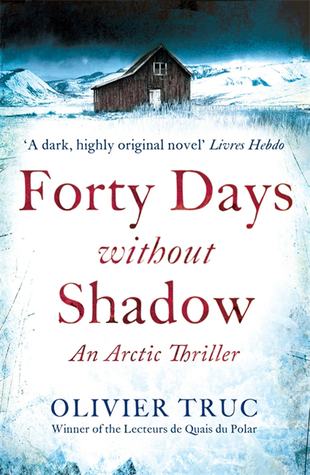
Arctic crimes: Olivier Truc’s Forty Days without Shadow (Lapland)

Olivier Truc, Forty Days without Shadow, trans. by Louise Rogers LaLaurie (Trapdoor 2014)

Opening lines: It was the most extraordinary day of the year, pregnant with the hopes of humanity. Tomorrow, the sun would be reborn.

The prize-winning novel Forty Days without Shadow came my way as a submission for the Petrona Award. Although by a French author, it’s eligible due to its Scandinavian setting and its publication in English translation (our slightly quirky rules allow some unusual works to be considered for the prize, which is highly welcome in my view).

The author – journalist and TV producer Olivier Truc – made a documentary in 2008 on the fascinating subject of the Norwegian Reindeer Police (Reinpolitiet), which deals largely with herder disputes, and covers 56,000 square miles of Lapland with just fifteen personnel. Truc paints a wonderful portrait of this highly specialised police force in his absorbing debut novel, and in the process places the Arctic and its indigenous cultures centre stage. In these respects he has a lot in common with British author M.J. McGrath, who successfully deployed the research she carried out for her non-fiction book The Long Exile when creating her ‘Edie Kiglatuk’ series, set in the Canadian High Arctic.

Reindeer Police

At the start of Forty Days, we see Sámi-Norwegian reindeer policeman Klemet Nango and his young partner Nina Nansen being pulled into the investigation of a theft. A priceless Sámi drum has disappeared from the local museum, and needs to be recovered before a UN conference on indigenous peoples takes place in the region. Shortly afterwards, Sámi herder Mattis is found dead, and ‘Patrol P9’ finds itself grappling with two crimes that could well be interlinked, and whose roots lie in both the recent and more distant past.

The novel uses its criminal investigations as a means of exploring different aspects of Lapland and its history. One fascinating point is that present-day Lapland lies across Norway, Sweden, Finland and Russia (see map below), which on the one hand leads to tensions, but on the other encourages international cooperation. However, those borders are relatively recent – only a few hundred years old – and are insignificant as far as the reindeer are concerned, which follow their usual migratory patterns, blissfully unaware of national jurisdictions. The borders are thus exposed as artificial constructs, imposed by colonising governments out of tune with the natural world, and prone to exploiting the land and its indigenous populations rather than safeguarding them.

The novel brilliantly evokes the winter setting of Lapland – the end of the long darkness of forty days of winter night, and the slow, welcome return of the sun, which shows itself for a scant twenty-seven minutes on its first day back. Through the interactions of various characters – some nuanced and some symbolic – we’re also shown the tensions between Norwegians and Sámi, and the impact of religion, politics and modernisation on the traditional Sámi way of life. Simultaneously entertaining and insightful, with an engrossing plot, this is a cracking debut that illuminates a world most of us know little about. The final section of the novel has shades of Peter Høeg’s Smilla’s Sense of Snow about it too, which is never a bad thing.

As the novel celebrates Sámi culture and present-day efforts to reclaim a Sámi cultural identity, I thought I’d finish by linking to the Sámi allaskuvla or Sámi Educational College, which works with ‘the Sámi community, particularly with young people, to preserve and promote the Sámi language, traditions, occupations, skills and knowledge’, and ‘supports Sámi society’s progress towards equality with the majority society’. It celebrates its 25th anniversary this year.