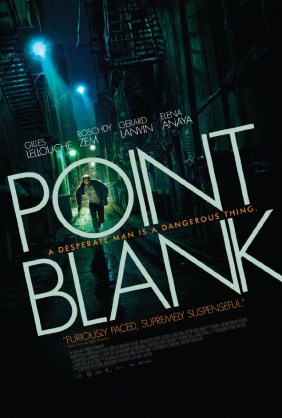
French thriller Point Blank on BBC4 – Saturday 31 August

French crime thriller Point Blank airs tomorrow, Saturday 31 August, in the 9.00pm international crime slot on BBC4. This one has had a number of favourable reviews (Empire gave it 4 stars), and looks to be 80 minutes packed full of heart-stopping action and suspense.

You can see a trailer for the film on the Radio Times website (although I’m not usually a fan of hostage/countdown scenarios, I have to admit it does look very good).

The Radio Times synopsis reads as follows: ‘Violent strangers threaten to kill the pregnant wife of Paris hospital employee Samuel Pierret unless he smuggles out an injured patient in this blisteringly exciting crime thriller from director Fred Cavayé (Anything For Her). Rugged Gilles Lellouche is perfect as the Hitchcockian “Wrong Place, Wrong Time, Wrong Man” whose life spirals out of control as he is drawn into a web of police corruption and murder in high places.’

And … here’s a lovely bit of news: Sergio over at the fabulous Tipping My Fedora blog has nominated Mrs. Peabody Investigates for a WordPress Family Award.

I’m touched and honoured – thank you, Sergio! – as the award celebrates what I most value about blogging: the global ‘family networks’ that our interactions in the virtual world create. I have to say, in spite of our rather bloody-thirsty interests as crime fans, that the crime blogging community is a particularly warm, welcoming and friendly one!

The idea with this award is that recipients nominate another 10 other WordPress blogs. But given that I’d nominate lots of the same blogs as Sergio and my fellow nominees (could get very confusing), I’ll just point you to the blogroll on the right of this page, which will lead you to all kinds of criminal delights. Enjoy!

At last! BBC4’s international crime slot gets back into gear

I don’t know about you, but I feel like I’ve been waiting forever for the BBC to deliver on its March 2013 crime press release. While Arne Dahl has aired, three new series (Inspector de Luca, Young Montalbano and The Bridge 2) and two stand-alone films have yet to be shown.

Finally, after a summer of Wallander and Sebastian Bergmann repeats, it looks like things are starting to move. This Saturday – 24 August – will see the showing on BBC4 of the 2010 Norwegian film The King Of Devil’s Island (9.00 to 10.50pm). The film, originally titled Kongen av Bastøy, is based on a true story, and explores Norway’s treatment of youth criminality in the early twentieth century. 

Here’s the BBC blurb: ‘The King of Devil’s Island (dir. Marius Holst) tells the unsettling tale of a group of young delinquents banished to the remote prison of Bastøy, Norway, in 1915. Under the guise of rehabilitation the boys suffer a gruelling daily regime at the hands of the prison governor (Stellan Skarsgård), until the arrival of new boys Erling and Ivar (Benjamin Helstad and Magnus Langlete) sparks a chain of events that lead to rebellion’. I last saw Skarsgård in the film version of Mamma Mia. Something tells me this will be a very different kind of role.

A short review of The King of Devil’s Island and programming details are available at The Radio Times.

I’m not sure when the outstanding series will be aired, as the BBC keeps its cards notoriously close to its chest – hopefully we will know more soon. For those who can’t wait, here’s a trailer for The Bridge 2 from Swedish broadcaster SVT, which looks brilliant. No subtitles needed. Thanks to @AndyLawrence5 for sending this my way.

#40 / Ioanna Bourazopoulou, What Lot’s Wife Saw (first review of Greek crime!)

What Lots Wife Saw

Ioanna Bourazopoulou, What Lot’s Wife Saw, translated from the Greek by Yannis Panas (Edinburgh: Black and White Publishing, 2013 [2007])  4.5 stars

Opening line: Perhaps reality is but a mass delusion, thought Phileas Book, watching the waves of the Mediterranean Sea breaking against the concrete quays of Paris.

Well! I was hoping for something a bit different when I opened this book, and it certainly didn’t disappoint. Winner of the 2008 Athens Prize for Literature, What Lot’s Wife Saw is a dazzling, hybrid crime novel that takes readers on an extraordinary journey of the imagination.

The novel is set in the future, twenty-five years after The Overflow, a tsunami that destroyed large portions of southern Europe, and whose cause was the eruption of a highly addictive violet salt through the Dead Sea Rift. The harvesting of this valuable commodity at a remote ‘Colony’ is now controlled by the mysterious Consortium of Seventy-Five, but when the operation is placed in jeopardy following the suspicious death of the Colony’s Governor, an expert is asked to help investigate.

And this is where things get really interesting. The expert is Phileas Book, who works for The Times newspaper compiling Epistlewords, a new kind of three-dimensional crossword shaped like a Greek meandros or key pattern, which uses fragments of letters (and the ways in which their ‘soundhues’ interact with one another) as clues. For this reason, Book is asked to inspect six letters from inhabitants of the Colony who were close to the Governor, in the hope that he will be able to ‘detect’ the truth of what happened. Along with Book, we are given access to the letters, and invited to take up the role of investigators, by comparing and contrasting the accounts of these rather dubious individuals, and trying to sift the truth from what may well be a tissue of lies. The six letter-writers are Bernard Bateau, Presiding Judge; Andrew Drake, Captain of the Guards; Montague Montenegro, Orthodox Priest; Charles Siccouane, the Governor’s Private Secretary; Niccolo Fabrizio, Surgeon General; and Regina Bera, the Governor’s wife. All have secrets that they would rather not share…

What I’ve said so far doesn’t even come close to conveying the richness of the narrative, which manages – don’t ask me how – to combine a re-imagining of the biblical tale of Sodom and Gomorrah with a critique of multinationals and totalitarianism. From a literary perspective, the novel feels like a slightly bonkers mash up of Thomas Pynchon (think the tour de force that is Gravity’s Rainbow), Agatha Christie (won’t say which one) and The Usual Suspects (super-stylish narrative construction). Really.

If you’re looking for an easy read, then put this book to one side for now. But if you’re in the mood for a challenging, vividly imagined and highly original crime novel with plenty of chutzpah and heart, then this one could be for you. A compelling read that’s perhaps a little too long in the middle, but is redeemed by a bravura ending, What Lot’s Wife Saw will stay in my mind for a while to come.

Mrs. Peabody awards What Lot’s Wife Saw a staggeringly inventive 4.5 stars

With thanks to Black and White Publishing for sending me an advance copy of this book.

Creative Commons License

.

Canadian reading pleasures 2

Now back from three lovely weeks in Canada, I can confirm that British Columbia – or at least the fraction we saw of its expanse (four times that of the UK) – is breathtakingly beautiful. We divided our stay between Vancouver and Vancouver Island, with lots of time spent on ferries, water-taxis and seaplanes, and my abiding memory will be the blue of the seascapes and the American Olympic mountains to the south.

Evening view from the Vancouver Island ferry as it threads its way through the Gulf Islands

In my previous post I mentioned Munro’s Books, a famous bookshop in Victoria on Vancouver Island.  Thanks to a tip from Cathy Ace, the Welsh-Canadian crime novelist, I subsequently found my way to Chronicles of Crime, a mystery bookshop run by Frances Thorsen on Fort Street. If you’re a crime fan and are ever in Victoria, you MUST visit this wonderful bookshop, which is an absolute treasure-trove and an excellent place to meet other crime aficionados. Frances also ships overseas (time to sit on the credit card)…

Chronicles of Crime. The armchair in the foreground is very comfortable

I spent a couple of happy hours browsing the bookshelves, which are helpfully and imaginatively categorised.

Yes please!

As a tourist, I obviously made a beeline for the Canadian section, and picked up some reading to help me get a feel for different parts of this vast country.

Copyright Lonely Planet

Louise Penny’s Bury the Dead (2010) – Quebec City, Quebec (on the lower right of the map).  This is the sixth instalment in the acclaimed Inspector Gamache series, and provides a fascinating insight into the tensions between French and English-speaking parts of Canada. Set during a freezing winter in the heart of old Quebec, the novel has a great sense of history and place, and Gamache is a well-drawn investigative figure. However, with three major plot-lines, I felt there was too much going on in the narrative, and the writing style grated in places. I’m new to the series, and might benefit from going back to earlier books.  

Anthony Bidulka, Amuse Bouche (2003) – Saskatoon, Saskatchewan (left of centre on map). I very much enjoyed this first novel in the Russell Quant series, whose highly engaging P.I. (‘cute, gay, with a nose for good wine and bad lies’), is based in the city of Saskatoon in the Canadian plains. I’ll definitely be chasing up the other Quant novels in due course. 

Stanley Evans, Seaweed on the Street (2005) and Seaweed on Ice (2006) – Victoria, Vancouver Island, British Columbia (far left on map). These novels were the find of the trip for me. I’d not heard of the author before, who started writing this series in his seventies (there’s hope for us all yet). Set in downtown Victoria and in the coastal areas surrounding the city, it features Silas Seaweed, a Coast Salish (First Nations) neighbourhood cop, whose investigations illuminate the traditions of Canada’s aboriginal communities and the difficulties they face in modern life. Well-written and with a wry sense of humour, they capture Victoria perfectly and were a pleasure to read while staying there. The second novel, Ice, which opens with the disappearance of an elderly Jewish immigrant, can also be added to my research database – a happy bonus.

So now I feel like I’ve made a modest start on Canadian crime fiction, although there’s clearly much more work to be done! I’ll be browsing the Crime Writers of Canada website, which has a wealth of useful resources, for more in the near future. I think I’ll start in the Canadian crime novels by region section…