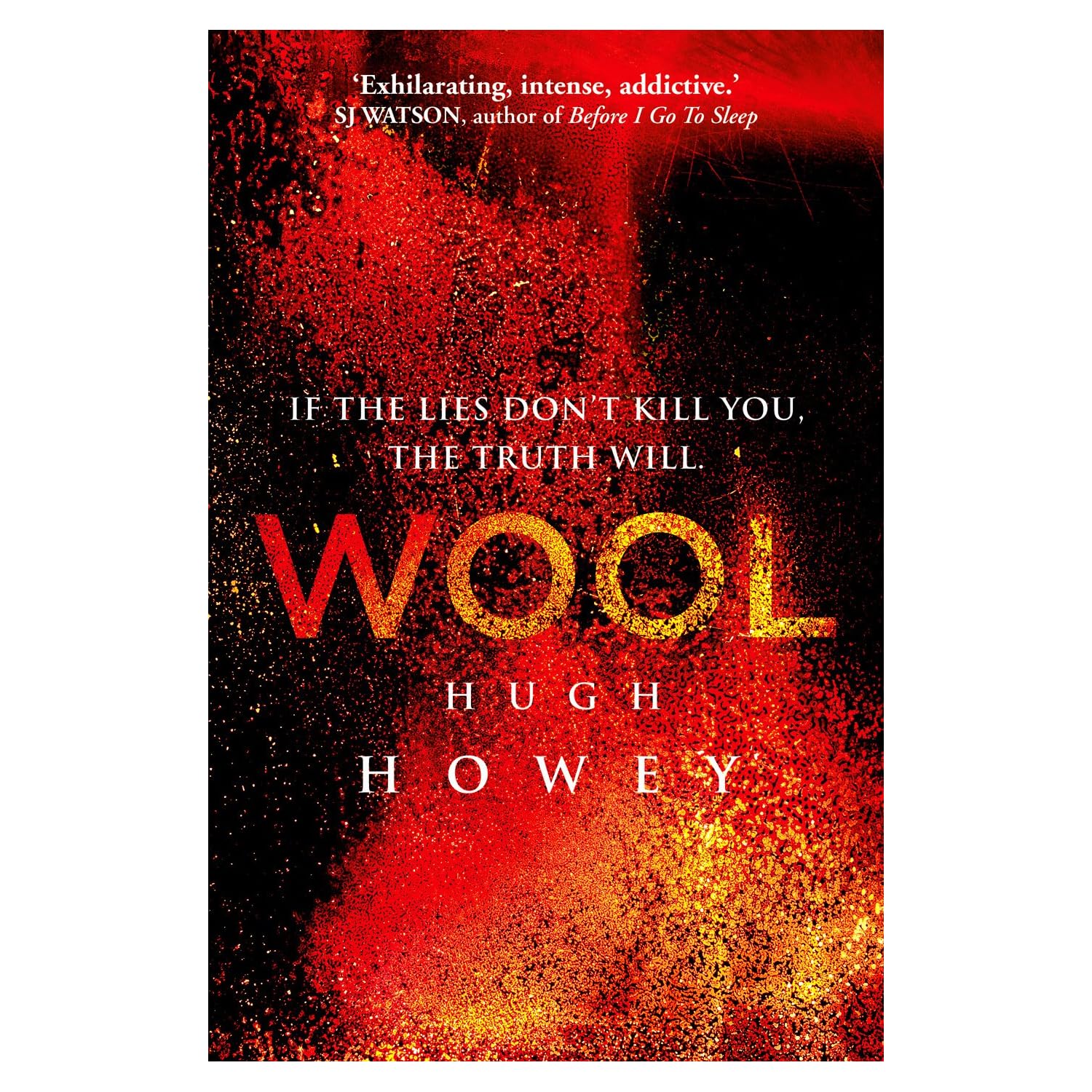
Welcome to the silo: Hugh Howey’s Wool

Hugh Howey, Wool (Books 1-5), Century 2013

Opening line: The children were playing while Holston climbed to his death.

Hugh Howey’s Wool is a self-publishing success story that began in 2011 with a standalone on the Kindle Direct Publishing platform. When it took off, ‘quite by accident and all on its own’, Howey added another four interlocking stories, which were gathered in a Wool omnibus and published in hardback earlier this year. The film rights have also been sold. It’s basically every indie author’s dream come true.

Wool transports us to the world of ‘the silo’ – the home of humankind in an apparently ravaged, post-apocalyptic future. The silo is a self-contained community divided into different sectors (such as IT, mechanical, nursery, food farms) that are spread over more than a hundred floors connected by a single, DNA-like spiral staircase. This enclosed world is described in minute detail, down to the sherpa-like silo porters who carry communications and supplies up and down the well-trodden stairs. The only glimpse of the desolate outside world is ‘up top’, on screens that become increasingly grimy until ‘a cleaning’ takes place…

So far, so sci-fi. But what makes Wool really take off for me are the elements of crime fiction woven into the narrative. Firstly, in line with standard crime conventions, there are a number of murders – some obvious and some more subtle – which are investigated with varying degrees of success by characters in the five ‘books’. Secondly, and in common with many other crime novels, there is an exploration of the rules and regulations governing society, and the ways in which crimes are dealt with by the law enforcement system. Except here, of course, we are dealing with the extremely unusual closed community of the silo, which shapes conceptions of criminality and punishment in entirely unprecedented ways.

Royalty Free Spacescape Images | Depositphotos

The biggest crime in the silo – ‘the great offence’ – is ‘expressing any desire to leave’. As soon an individual utters the words ‘I want to go outside’, the law is broken, resulting in a literal expulsion from the community. Once outside, wearing only a protective suit against the toxic elements, he or she is ‘put to cleaning’ – wiping the sensors that give the silo’s inhabitants their view of outside. And all diligently obey this command, although it is initially not clear to us why.

The first book starts with Sheriff Holston – the key figure entrusted with maintaining law and order within the silo – requesting to go outside. And this opening is typical of Wool, which is filled with wonderful plot ideas and scenarios. For why would anyone wish to leave the safety of the silo for the hostile environment outside, let alone the sheriff, who has himself overseen past cleanings, and should know exactly what fate awaits him?

While occasionally a little rough around the edges in terms of its writing and credibility, Wool is a compelling read – a fabulous page-turner that brings a possible future vividly to life, and grapples with big issues such as the rights of the individual, freedom of information, and the power exerted by the state over its citizens. The five interlinked stories detail the lives of several individuals – men and women, young and old – with the standout character of Jules or Juliette quickly becoming my personal favourite.

If you like the idea of a fusion of sci-fi and crime – and a rollicking good story – this is one for you. The energy and freshness of the narrative would undoubtedly also serve it well in the young-adult fiction market, which is where Howey first made his mark.
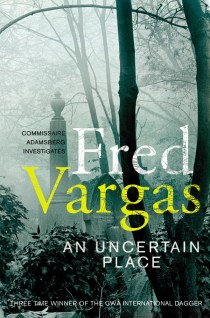
#32 / Fred Vargas, An Uncertain Place

Fred Vargas, An Uncertain Place, translated from the French by Sian Reynolds (London: Vintage, 2012 [2008]). A rather gruesome outing for Commissaire Adamsberg and his team  3.5 stars

Opening line: Commissaire Adamsberg knew how to iron shirts.

Fred Vargas is one of my favourite crime writers, but I always regard her novels as something of a guilty pleasure. By rights, I shouldn’t really like them, as I tend to favour crime novels that engage with history, politics or society (such as Dominique Manotti’s Affairs of State), and which feature grounded, rational policemen (I’m a sensible type at heart). Not novels involving a hunt for a werewolf (Seeking Whom He May Devour), or a Commissaire who wanders aimlessly around Paris using intuition to solve his crimes.

And yet the Adamsberg novels have afforded me more reading pleasure than almost any other crime series I’ve read. This has a great deal to do with the quality of the writing – there’s a reason why Vargas has won the CWA International Dagger three times – and the way in which she uses her medieval historian’s knowledge to take the roman policier in a pleasingly original direction. Add in a large dash of quirky gallic – her police team are eccentrically and extravagently ‘French’ – et voilà, you have a classy, distinctive crime series on your hands that’s mighty hard to resist.

Those who’ve loved previous Adamsberg novels are not likely to be disappointed by An Uncertain Place, as all the usual ingredients are present and correct. For British readers and Anglophiles, there’s also the bonus of an initial stop in London, which includes a splendidly gothic discovery at the entrance of Highgate Cemetery.

So why have I given An Uncertain Place only 3.5 stars?

For me, this crime novel went slightly too far in two respects:

1. It features a truly gruesome murder and crime-scene description. An explanation of the murderer’s rationale and methods are supplied further on in the narrative, but I still found the enormous amount of detail too much to stomach (not helped by the fact that I read the worst bit over lunch).

2. Vargas is usually very skilled at suggesting that other-worldly forces are at work while maintaining a plausible crime narrative in a ‘realistic’ French setting. As in previous novels, the tension between those in the police team who work intuitively and those who rely on logic is thematised (Adamsberg and his disciples are the ‘cloud shovellers’, while Retancourt leads the ‘rational positivist movement’). But Vargas jumps in a clear direction at the end of the narrative, and it was one that left me rather cross. So – with a little sigh – 3.5 it is.

An Uncertain Place was my January read for the 2013 Translation Challenge.

Mrs. Peabody awards An Uncertain Place an enjoyable but slightly infuriating 3.5 stars.

Creative Commons License

.

Saturday smörgåsbord: Richard III, Petrona Remembered and Spiral 4

This week has seen lots of interesting crime news – a veritable smörgåsbord of delights.

The confirmation that the bones found under a Leicester car park are indeed those of King Richard III, has resulted in some knock-on coverage for Scottish crime writer Josephine Tey’s The Daughter of Time. This 1951 classic tops the Crime Writers’ Association list of 100 best crime novels, and shows Inspector Grant ‘re-open’ the case of ‘the princes in the Tower’ whilst laid up in hospital with a broken leg. Can he really prove that Richard is not the callous murderer that history paints him to be…?

An interesting article in the Canadian Globe and Mail explores the value of the novel’s critique of history, and its assertion that many historical narratives are falsely constructed for political ends. Nikolai Krementsov, professor of the history of science and technology at the University of Toronto, gives it to his students to illustrate the difference between primary and secondary sources, and says ‘I know no book that gives such as clear account of what history is and what its function is in society … It should be mandatory reading for historians, investigative journalists and policemen’.

He also points out that Tey is writing at the beginning of the Cold War, a time of enormous political transition when lots of inconvenient wartime facts were in the process of being forgotten. ‘In that atmosphere, she wrote a definitive account, not of Richard III, but of how history can be manipulated’.

This week saw the birth of a new crime fiction blog, Petrona Remembered,  which has been set up in memory of the wonderful crime blogger Maxine Clarke.

The team behind the site aims ‘to develop a resource for current and future fans of the genre and we want you to help us. We’re asking writers, bloggers, readers, translators and anyone else who loves a crime or mystery novel to send us a submission about that book. It can be a review, a pitch, a love letter, a poem or, a video. Or something else entirely. Each week we’ll post a new submission and, over time, this site will become a jumping off point to a world of much-loved crime fiction’.

I personally like the idea of a crime haiku :). Submissions great and small are welcome, and you can find out more here.

A new annual award, The Petrona, for the best Scandinavian crime novel, is also being established. Maxine was particularly partial to some top-notch Scandi crime, so this feels very fitting.

Last but not least, for those of you suffering withdrawal symptoms from Borgen, help is on the way in the form of Spiral series 4. Parisian Captain Laure Berthaud and her colleagues are back as of tonight for 12 gritty episodes, taking over the BBC4 Saturday evening ‘international slot’ from 9.00pm until 11.00pm.

Further information and a clip from the first episode can be found here.

Mrs. Peabody’s 2013 reading challenges

A little late in the day, I’ve been thinking about my reading goals for 2013, and have decided to take part in two challenges.

I’m not normally one for reading challenges, because I already have plenty of ‘performance enabling’ and research targets to meet in my professional life. Adding yet more items to tick off the list hasn’t seemed like a particularly good idea.

However, a combination of factors has drawn me to these challenges:

  1. They will help me broaden my reading in a more directed way.
  2. There are ‘easy’ levels, which look invitingly…easy.
  3. They both look like great fun.

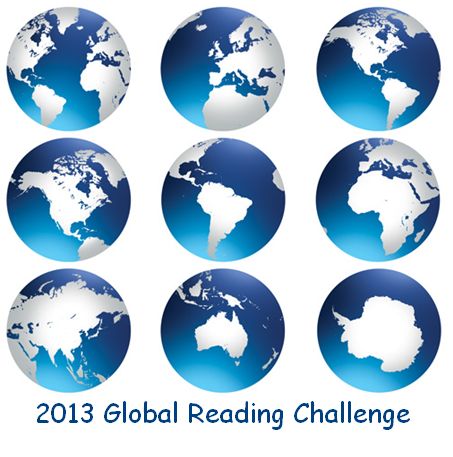
The first is the 2013 Global Reading Challenge

The ‘Easy Challenge’ involves ‘reading one novel from each of these continents in the course of 2013: Africa, Asia, Australasia/Oceania, Europe, North America, South America, and The Seventh Continent (Antarctica or your own ‘seventh’ setting, e.g. the sea, the space, a supernatural/paranormal world, history, the future)’.

You’re also asked to ‘find a country, state or author that is new to you from your own continent’.

If you fancy joining me, you can sign up here via the host blog, Kerrie’s ‘Mysteries in Paradise’. There are links to challenges from past years, so that you can get ideas for reading; other wonderful posts out there will also provide inspiration. For example, there’s a great list of Latin American crime fiction over at ‘Ms. Wordopolis Reads’.

The second is the 2013 Translation Challenge

Hosted by ‘Curiosity Killed the Bookworm’, this challenge is a simple one: you’re asked to read one translated book a month.

You can sign up here. There’s also a handy set of links to publishing houses known for their support of translated crime fiction, to help create a reading list.

Those of you with eagle eyes may have noticed that the challenges overlap – books read for one could very well also be submitted for the other. This is a deliberate strategy on my part: if the nineteen-book total begins to feel unmanagable, I can double up where necessary and still complete them both. This could be viewed as a subtle bit of cheating or as a cunning back-up plan. I prefer the latter interpretation… 🙂

My January book for the Translation Challenge was Fred Vargas’ An Uncertain Place (France) and February’s will be Hakan Nesser’s The Return (Sweden), sequel to the wonderful Borkmann’s Point. I probably won’t be submitting these to the Global challenge though, as I’m on the hunt for something a bit more exotic from Europe. Suggestions welcome!

I’ll be building lists of the books I’ve read for my 2013 challenges here.