BBC Radio 4’s ‘Foreign Bodies’ episode guide…with a bit of Mrs. Peabody in #2!

Mark Lawson’s ‘Foreign Bodies’ series kicked off yesterday with an exploration of two seminal detectives from Belgium –  Hercule Poirot and Jules Maigret. Val McDermid, Andrea Camilleri, P.D. James, Jakob Arjouni and Camilla Lackberg all joined Mark for a fascinating discussion about these two key investigative figures.

Today it was the turn of Friedrich Dürrenmatt’s Swiss detective Inspector Bärlach, featuring a contribution from your very own Mrs. P… Our discussion took in Dürrenmatt’s links to earlier Swiss crime writer Friedrich Glauser, Dürrenmatt’s exploration of the moral crisis facing Europe following the Holocaust, and his subversion of the detective genre to question the possibility of justice. The crime novels discussed included The Judge and his Hangman (Der Richter und sein Henker, 1950), Suspicion (Der Verdacht, 1951) and The Pledge (Das Verprechen, 1958).

Listings for the first 7 episodes are now up on the ‘Foreign Bodies’ website. They air Monday to Friday on Radio 4 at 13.45, and are then available online. For good measure, there’s an omnibus edition on Friday at 21.00.

Episode 1  Belgium: Hercule Poirot and Jules Maigret (Agatha Christie and Georges Simenon)

Episode 2  Switzerland / Germany: Inspector Bärlach (Friedrich Dürrenmatt)

Image for Inspector Barlach

Episode 3  Czechoslovakia: Lieutenant Boruvka (Josef Skvorecky)

Episode 4  The Netherlands: Commissaris Van Der Valk (Nicolas Freeling)

Episode 5  Sweden: Inspector Martin Beck (Maj Sjöwall and Per Wahlöö)

Episode 6  UK: Commander Dalgliesh / Chief Inspector Wexford (P.D. James and Ruth Rendell)

Episode 7  Sicily: Inspector Rogas (Leonardo Sciascia)

You can also hear Bernard Hepton (who played Toby Esterhase in the BBC adaptation of Tinker Tailor Soldier Spy) begin his sublime Radio 4 reading of Dürrenmatt’s novella The Judge and his Hangman (available until 29 October).

Roseanna, the first of the Martin Beck dramatisations – will air on Radio 4 on Saturday 27 October at 14.30, but if you can’t wait, help yourself to this sneak preview.

Mrs. P’s review of Friedrich Dürrenmatt’s The Pledge is available here.

UPDATE 28 October: Mark Lawson has written an overview article about the ‘Foreign Bodies’ series for The Guardian entitled ‘Crime’s Grand Tour: European Detective Fiction’.
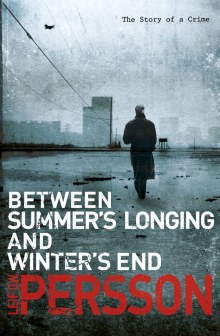
#27 / Leif G.W. Persson, Between Summer’s Longing and Winter’s End: The Story of a Crime

Leif G.W. Persson, Between Summer’s Longing and Winter’s End: The Story of a Crime, trans. from the Swedish by Paul Norlen (London: Black Swan, 2011 [2002]). An epic crime novel and bravura account of one of Sweden’s greatest unsolved crimes  4 stars

Opening line: The best informant is the one who hasn’t understood the significance of what he has told.

Like Peter Høeg’s Miss Smilla’s Feeling for Snow, this novel opens with an unexplained fall from a tall building in the freezing depths of a Scandinavian winter. In the case of Persson’s Between Summer’s Longing and Winter’s End, the casualty is a young American, John Krassner, whose death is initially presumed to be suicide, but might well be something more sinister – for how to explain the fact that his shoe hit the ground a good ten seconds after his body?

For a significant portion of the text, the reader might reasonably assume that Krassner’s death is the ‘crime’ referenced in the novel’s subtitle. However, as the narrative unfolds over a sprawling 638 pages, it becomes clear that his demise is linked to a much larger crime – one that took place in Sweden in 1986 and remains unsolved to this day. If you can’t quite remember that event, I’d advise you to stay away from reviews until you’ve finished the book (my reading experience was considerably enhanced by putting two and two together at a relatively late stage – the biggest ‘OMG’ reading moment I’ve had in years). But if you can’t wait, or are looking for illumination after reading the novel, click here

In common with a number of Swedish crime authors since the 1960s, Persson has a rather jaundiced view of Swedish society and is highly critical of the authorities and the power wielded by the state. The police are depicted as racist or misogynist bunglers, with the Swedish secret police force (Säkerhetspolisen or Säpo) shown in a particularly harsh light. What makes the strength of this critique startling and more than a little interesting is the author’s own long-held position within the Swedish establishment. As the blurb on the inside front cover tells us, Persson has enjoyed an eminent career as ‘Scandinavia’s most renowned criminologist and leading psychological profiler’, as well as being an advisor to the Swedish Ministry of Justice and a professor serving on the National Swedish Police Board. It would be interesting to know how these august bodies reacted to the very negative depictions of the state and its law enforcement agencies within the novel.

One of the few likeable figures in the book is Superintendent Lars Martin Johansson, the ‘honest Swedish cop’ who digs the deepest into Krassner’s death. But even he is only able to discover a portion of the truth: as individual acts collide with one another and fuse with shady political operations in Sweden and beyond, a set of events unfolds whose complexities are beyond the understanding of a lone investigator. In the end, only the reader is provided with a privileged viewpoint in which everything adds up, while being given to understand that no ordinary Swede would ever have a hope of getting near the truth. And of course this is just one possible imagining of those seminal events in 1986 – there are numerous other ways these might have played out.

This is not a crime novel for the faint-hearted: its hundreds of pages, multiple narrative perspectives and complex plotlines require considerable commitment. But once the different strands come together together in the final part the novel, the reader’s efforts are rewarded as the ambition, range and intelligence of the narrative is revealed.  In many ways a political and social history of Sweden since the Second World War, this Kafkaesque narrative tackles big themes (the relation of the individual to the state, loyalty, betrayal, trauma, the precariousness of democracy), but is also rich in satirical humour (look out for ‘Anderson’s Confusion Syndrome’) – and for me was a highly satisfying read.

Between Summer’s Longing and Winter’s End is the first in a trilogy. The second part has recently been translated into English, entitled Another Time, Another Life.

Mrs. Peabody awards Between Summer’s Longing and Winter’s End an ambitious and satisfying 4 stars.

Creative Commons License

.

Jo Nesbø’s Harrogate Crime Festival interview on Radio 4’s Front Row

Newsflash! Norwegian author Jo Nesbø’s interview with Mark Lawson at the Theakstons / Harrogate Crime Writing Festival will feature on tonight’s Front Row.

You can listen on Radio 4 at 19.15, or catch up later at the Front Row website, where the whole of the interview is also available (and most interesting it is too).

Nesbø  will also feature in the ‘Foreign Bodies’ series which Lawson is presenting for Radio 4 from 22 October (see previous post for further details). Harry Hole is one of the 15 fictional detectives used by the series to explore how crime writing depicts the history of modern Europe.

Image for Foreign Bodies

Copyright BBC Radio 4

Also spotted: the ‘Front Row Crime Writers Collection’ – a marvellous set of interviews with leading crime novelists including Henning Mankell, Andrea Camilleri, Val McDermid, P.D. James and John le Carré.

‘Foreign Bodies’: New fifteen-part Radio 4 series on European crime fiction begins 22 October 2012

This major new series showcases the best of European crime fiction and will be an absolute treasure trove for fans of international crime. Entitled ‘Foreign Bodies: A History Of Modern Europe Through Literary Detectives’, and presented by Front Row’s Mark Lawson, it will air on Radio 4 over three weeks, at 1.45pm from Monday 22 October to Friday 9 November (accessible here). In addition, we’ll be treated to dramatizations of Sjöwall and Wahlöö’s Swedish Martin Beck novels (1965-75), and Swiss crime writer Friedrich Dürrenmatt’s The Judge and His Hangman (1950). What riches.

Many thanks to @_alisongray for alerting me to the following BBC press release:

“BBC Radio 4 begins a fascinating season of programmes this month featuring a 15-part examination by Mark Lawson of European crime fiction.

In ‘Foreign Bodies: A History Of Modern Europe Through Literary Detectives’, Lawson investigates the tensions and trends of Europe since the Second World War by focusing on some of the celebrated investigators from European fiction, and their creators.

The series accompanies dramatizations of all the Martin Beck novels, starring actor Stephen Mackintosh in the title role. Written by Maj Sjöwall and Per Wahlöö the novels are widely acknowledged as some of the most important and influential crime fiction ever written. The authors paved the way for subsequent generations of crime writers to illustrate society and its most dysfunctional elements through crime and criminal investigations, future fallible heroes – Kurt Wallander and John Rebus to name but two – making the best fist they can of their own lives, whilst trying to tackle the violence and crime around them.

Gwyneth Williams, Controller BBC Radio 4, said: “This Autumn we explore the mood and mores of European cities in the company of eccentric detectives. And what better way to take a Radio 4 journey through Europe than to travel with the likes of Martin Beck, Inspector Rogas, Pepe Carvalho, Kemal Kayankaya.

The first of the Turkish-German Kemal Kayankaya series (1994)

“And at the heart of the series we bring you a complete dramatization of the little-known but hugely respected Martin Beck books by Maj Sjöwall and Per Wahlöö – all ten of them. These are the stories that inspired the Scandinavian explosion of crime writing we have seen in recent years and are referenced by many eminent writers such as Ian Rankin. Stephen Mackintosh plays Martin Beck and he is sure to hook you in.”

In crime fiction, everyday details become crucial clues: the way people dress and speak, the cars they drive, the jobs they have, the meals they eat. And the motivations of the criminals often turn on guilty secrets: how wealth was created, who slept with who, or a character’s role during the war. The intricate story of a place and a time is often explained in more detail in detective novels than in more literary fiction or newspapers, both of which can take contemporary information for granted.

In ‘Foreign Bodies’, Mark Lawson focuses on some of the most celebrated investigators – everyone from popular modern protagonists including Henning Mankell’s Kurt Wallander; Jo Nesbø’s Harry Hole; and Andrea Camilleri’s Inspector Montalbano; through to Ian Rankin’s Inspector Rebus; Lynda La Plante’s DCI Jane Tennison; and Sjöwall and Wahlöö’s Martin Beck; back to a Belgian created by an Englishwoman and a French cop created by a Belgian – Agatha Christie’s Hercule Poirot and Georges Simenon’s Jules Maigret.

Through the framework of cases investigated by these fictional European police heroes and heroines, ‘Foreign Bodies’ pursues the shadows of the Second World War and the Cold War, conflicts between the politics of the left and right, the rise of nationalist sentiments and the pressures caused by economic crises and migration. Among the writers helping Lawson with his inquiries into their characters are: Jo Nesbø, Andrea Camilleri, PD James, Henning Mankell, Liza Marklund, Ian Rankin and Lynda La Plante.

The ten Martin Beck detective novels featuring Detective Inspector Martin Beck and his colleagues in the National Police Homicide Department in Stockholm will air in two parts. The dramatizations of the first five novels will start on October 27th, 2012 with the second five airing in Spring 2013. The radio dramas are written by Katie Hims and Jennifer Howarth, and directed by Mary Peate and Sara Davies.

Accompanying the dramas and Mark’s series, Radio 4 Extra will broadcast a reading, in five parts, of The Judge and His Hangman in October. Originally published as a novella in 1950 by Swiss writer Friedrich Dürrenmatt, it explores the themes of guilt and responsibility following the Second World War, and shows protagonist Inspector Bärlach finding his own solution to bringing a career criminal to justice.”