#23 / Harri Nykänen, Nights of Awe

Harri Nykänen, Nights of Awe, translated from the Finnish by Kristian London (London: Bitter Lemon Press, 2012 [2004]). The first in a new series featuring Finnish-Jewish police inspector Ariel Kafka 4 stars
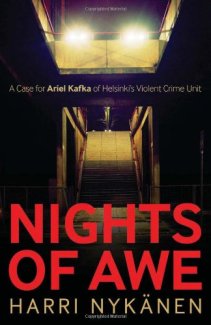
Opening line: Men are born, they live, and they die.

Ariel Kafka, a detective in Helsinki’s Violent Crime Unit and one of only two Jewish policemen in Finland, is called to investigate the deaths of two Arabs in the Linnunlaulu area of the city. As the case unfolds over the Days of Awe, the ten days of repentance leading up to Yom Kippur, Kafka is faced with the unwelcome possibility that the crimes have a Jewish dimension, in the shape of Israeli / Mossad involvement.

The main strength of this Finnish crime novel for me was the wonderfully realised and very likeable investigative figure of Ariel Kafka. Nykänan succeeds in creating a rounded first-person narrator with a distinctive Finnish-Jewish voice (surely a first), which draws entertainingly on the wise-cracking archetype of the hard-boiled detective. The following quote illustrates how nicely these elements are blended together:

‘It wasn’t the first time I had been asked this question [You’re Jewish and you’re a cop?]. People seemed to have a strong belief that Jews have some secret, Old Testament-based motive for not joining the police force. In reality there was only one reason: the lousy pay.’ 

Nykänen, a former crime journalist, uses the narrative to explore Kafka’s triple identity as Finn/Jew/cop, and the tensions generated when these different elements come into conflict with one another. We’re also given a strong sense of the Jewish community in Helsinki (there are around 1500 Jews currently living in Finland), and its efforts to uphold Jewish traditions. The novel reminded me a little of the Rabbi Small series in its descriptions of Jewish life and religious debates (such as the question of  whether women should be accepted as part of the minyan – the quorum necessary to allow public worship). There are also interesting reflections on the way that the legacy of the Holocaust has shaped individuals and families, and the difficulties that ‘diasporic’ Jews have taking a position in relation to the politics and actions of the Israeli state.

Intriguingly, as a Jewish Chronicle article by Jenni Frazer reveals, Nykänen is not himself Jewish, but carried out extensive research for the novel, including discussions with Dennis Paderstein, a Finnish-Jewish chief inspector in Helsinki. The author views the Finnish-Jewish community as being ‘very small, but important’, and in many ways the novel is a celebration of its continued existence.

Less successful, perhaps, is the novel’s rather convoluted plot, which lost me in a number of places as the body count rose, although it did make a kind of sense in the end. In spite of this weakness, I would gladly read others in the series. There are apparently three more (Ariel and the Spiderwoman, Behind God’s Back and Holy Ceremony), which have already been translated into German. Hopefully, more English translations will follow soon.

Mrs. Peabody awards Nights of Awe a slightly flawed but highly entertaining 4 stars.

See also my earlier post on an intriguing trio of Jewish detectives.

Creative Commons License

.

Spiral 2 and ‘Romanzo Criminale’

Following the Sebastian Bergman two-parter, BBC4 will be repeating series 2 of Spiral (Engrenages) from this Saturday, 9 June, at 9.00pm. It looks like there will be two episodes each week, following the pattern of The Killing, Borgen and the like.

For those catching up, there’s a nice little review in the Radio Times to set the scene.

Spiral: gritty and urban, innit?

While looking around the website, an Italian crime series that aired back in October 2011, but is being repeated on Sky Arts 1, also caught my eye. Romanzo Criminale (‘Crime Novel’) has been styled as an ‘Italian Killing’ (pure hype, as the two series are completely different to one another), but I must say that I like the look of it, especially given its interesting historical and political setting.

70s mobster chic means looooaads of wonga

Amy Raphael describes the series in her Radio Times article as follows:

‘Set in Rome between 1977 and 1992, Romanzo Criminale has been an Italian television sensation, based on the exploits of a real-life criminal street gang.

La Banda della Magliana was a mob of fearless, ultraviolent suburban youths, who became, in the words of judge [and author] Giancarlo de Cataldo, “a real criminal power”.

De Cataldo’s novel [on La Banda] was first made into a film, but the television series that followed has aired in Italy to rapturous acclaim. One broadsheet called it “perhaps the best series ever made in Italy”, while another insisted that “it’s the only Italian series of which we can be proud… that we can export abroad”.

Opening in 1977, the drama is sharply written, beautifully shot, funny, violent and political. These were Italy’s “years of lead” when student protesters fought the police and the Red Brigades tried to destabilise the country. It’s a compelling backdrop for a series that’s brutally honest about Italy’s bloody criminal past.’

Has anyone already seen the series, and if so, what did you think of it?

Sebastian Bergman: Review of Episode 1 (with a little word on Episode 2)

Today I managed to catch up with the first installment of the Swedish crime series Sebastian Bergman, which originally aired last Saturday on BBC4. My expectations were pretty low having viewed a dire trailer made by the German broadcaster ZDF (see my earlier comments here), but happily, ‘The Cursed One’ turned out to be a decently-made, entertaining 90 minutes of crime.

The key investigative figure, Professor Sebastian Bergman, is a renowned Swedish profiler of unpleasant disposition: he’s tetchy, uncooperative, and a serial seducer of vulnerable women. Although we find out the main reason for this behaviour, he remains a troubled and rather unlikable figure, and is nicely portrayed by the actor Rolf Lassgård (well known to Henning Mankell fans as the ‘first’ TV Wallander). 

The opening episode shows Bergman inching back into policework after an extended break, following the brutal murder of a 15-year-old boy. The investigation proceeds at a brisk pace (we work through as many suspects as in the whole of The Killing 1 by the end of the first hour), uncovering a number of suburban secrets on the way. The denouement is reasonably satisfying, although I couldn’t help but be amused at how wide of the mark Bergman’s perpetrator profiling had been. 

In sum: a good start with some potential, should the relationship between Bergman and his police colleagues be allowed to develop more. There’s a nice little twist at the end that augers well.

Update on 8 June: I’ve just caught up with Episode 2, and wasn’t quite as enamoured as many people seem to have been on Twitter. As this blog’s readers will know, I’m not a fan of serial killer narratives / misogynist violence, so points had to be taken off from the word go. In addition, the development of the plot felt wholly predictable… Would I watch more Sebastian Bergman if it came to our screens? Probably, but it won’t be at the top of my list of Saturday night treats.