Saturday treats: Sebastian Bergman / CWA International Dagger / Israeli crime fiction

Three little treats on this lovely sunny day in the UK.

1. For fans of Swedish crime and of Wallander actor Rolf Lassgård: the ‘police thriller’ Sebastian Bergman begins tonight on BBC4 at 9pm. See the second half of this earlier post for an overview and trailer.

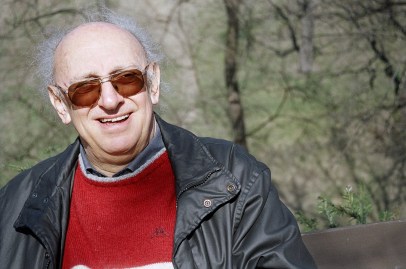
Photo from BBC/ZDF

2. CRIMEFEST 2012 – the annual International Crime Fiction Convention – is in full swing in Bristol this weekend. While extremely sad to be missing the party, I’m enjoying tweets on the various panels from @Eurocrime and @NicciPrasa amongst others. The hashtag for the event is #crimefest12.

Thrillingly, the CWA (Crime Writers’ Association) shortlists for the following ‘Daggers’ were announced there last night: International, Historical, Non-Fiction, Library, Short Story and Debut. Thanks to Rhian over at ‘It’s a Crime! (Or a Mystery…)’ for a comprehensive listing of all the works shortlisted.  

There are 6 works listed for the International Dagger (‘crime, thriller, suspense or spy fiction novels which have been translated into English from their original language, for UK publication’):

The Potter’s Field by Andrea Camilleri, trans. by Stephen Sartarelli (Mantle)
I will have Vengeance by Maurizio de Giovanni, trans. by Anne Milano Appel (Hersilia Press)
Until Thy Wrath Be Past by Åsa Larsson, trans. by Laurie Thompson (Quercus/Maclehose)
Trackers by Deon Meyer, trans. by T K L Seegers (Hodder & Stoughton)
Phantom by Jo Nesbø, trans. by Don Bartlett (Harvill Secker)
The Dark Valley by Valerio Varesi, trans. by Joseph Farrell (Quercus/Maclehose)

Further details about the novels are available via the CWA website here.

And over at Petrona, you’ll find a list of all International Dagger winners since 2006, along with a wealth of links to reviews and CWA webpages (thanks, Maxine, for this excellent resource).

3. A guest post on Israeli crime fiction by Uri Kenan at the ‘Detectives Beyond Borders’ blog caught my eye this week. For someone like me, who knew nothing about the history of crime fiction in Israel, it was a very illuminating read. I’m already looking forward to part 2, which I imagine will look at more contemporary offerings.

Peter Rozovsky, who runs the blog, is also at CrimeFest at the moment, and has already posted three reports, which are well worth a read

I hope the sun is shining for all of you wherever you are: have a lovely weekend.

Reflections on BBC4’s The Bridge / Bron / Broen

Following the utterly gripping and nail-biting finale of The Bridge, it’s time for a few reflections on this ground-breaking Danish-Swedish production.

In line with Mrs P. policy, there are NO FINALE SPOILERS (if that’s what you’re after, do head over to The Guardian‘s ‘Bridge blog‘).

The Bridge vs The Killing

Before The Bridge aired in the UK, a number of people who’d seen the series said they’d liked it even more than The Killing. Although I’ve enjoyed The Bridge hugely, I’m not yet prepared to go that far: the first series of The Killing remains my top crime-drama viewing experience and Sarah Lund still edges it over Saga and Martin’s (admittedly great) investigative duo.

This preference is mainly due to the depth of characterisation in The Killing. In the first series especially, the focus was on a small number of characters whom you got to know very well, whereas The Bridge had a larger cast and, with the exception of Saga and Martin, had less time to dig deep. Compare, for example, the picture we were able to build up of Nanna Birk Larsen as the murder victim in The Killing 1 and those of the politician / prostitute at the beginning of The Bridge (merely the first of many). And there were a number of interesting characters who featured heavily in early plot-lines of The Bridge, but then simply faded away. Their disappearing acts may be a reflection of the reality of investigations – people make their contribution or are ruled out as suspects and then the team moves on – but some of their stories felt incomplete and I’d liked to have known more.

Fabulous biting humour

Those minor quibbles aside, The Bridge was a top-notch Scandi treat that had me gripped throughout, and became increasingly assured as time went on. The last four episodes were absolutely cracking.

One particularly fine quality was apparent right from the start of the series: a biting and at times splendidly irreverent humour. Much of this was generated by the interplay between the odd-ball Danish-Swedish investigative couple, and also provided a way of managing the audience’s reaction to Saga as a character on the autistic spectrum (we’re invited to see her behaviour as ‘endearingly odd’ rather than ‘threateningly weird’). There’s been some debate about the suitability of this strategy, but I felt it worked extremely well, and that the writers kept the balance between the humour and the more serious elements of the drama just right. Episodes 7 and 8 were superb in this respect.

Hey Martin…was it something I said?!

In sum, The Bridge is high-quality crime drama firmly located in the tradition of socially-engaged Scandinavian crime fiction, with a wonderful pair of detectives and more twists than fusilli pasta. If you haven’t yet seen it, you’re in for a treat.

For earlier posts on The Bridge, see here and here.

And, for one last time, a link to the wonderful title sequence, featuring the sublime ‘Hollow Talk’ by the Choir of Young Believers.

Petros Markaris: Greek crime writer and social commentator

The Guardian on Monday carried extensive coverage of the post-election turmoil in Greece: the break-up of the latest coalition talks between the three main parties, the risk of continued financial collapse, and a possible exit from the Euro.

In the middle of a double-page spread on the crisis, next to an article entitled ‘Greek party leaders round on left-wing radical as talks fail’ and beneath a picture of Syriza leader Alexis Tsipras, was a prominent piece by Julian Borger on the crime writer Petros Markaris, who is currently working on the final novel of (what I’m dubbing) his ‘Greek Tragedy’ trilogy.

Petros Markaris

The first two novels in the trilogy, Expiring Loans (2010) and The Settlement (2011 or 2012), explore Greece’s recent financial and social collapse. They are proving hugely resonant with readers, not least because there is a strong element of judicial catharsis woven into the narrative: the murder victims in Expiring Loans are players in the financial sector, while The Settlement features the self-styled ‘National Tax Collector’, who poisons wealthy, tax-evading Greeks with hemlock. Mindful that temperatures are running high, the backcover of the latter carries the sober instruction: ‘this novel is not to be imitated’.

Expiring Loans

There are a couple of particularly interesting assertions made in the Borger article, ‘Crime writer Petros Markaris channels Greek rage into fiction’:

  • Markaris ‘has combined the roles of thriller writer and social commentator in Greece to such an extent that he has become one of the most widely-quoted voices of the crisis’.

I wonder what Markaris’ starting point was? Was he a social commentator who consciously selected crime fiction as a vehicle to communicate his views to a mass readership, or did he begin as a crime writer and then develop his role as a social commentator via his work? Either way, the fact that a crime writer has become such an influential and authoritative voice on the Greek crisis is fascinating.

  • Markaris says: ‘crime writing provides the best form of social commentary, because so much of what is going on in Greece now is criminal’. And: ‘I wanted to tell the real story of how the crisis has developed and how it affects ordinary people’.

These statements underscore the important role that crime fiction can play in highlighting and dissecting larger ‘social crimes’ such as state corruption, and its impact on ordinary people (The Settlement opens with the suicides of four elderly women unable to cope on a reduced state pension). One might add that crime novels are particularly well placed to provide these kinds of timely social analyses, because they tend to be written and published more quickly than their ‘literary’ cousins. They also reach a significantly wider readership than ‘literary’ novels, which gives them a greater chance of feeding into current public debate.

Markaris’ status as a social commentator is undoubtedly exceptional, due to the extraordinary political and social contexts in which he is writing, but his presence in a British broadsheet, amidst the news and political analysis of the day, is an intriguing illustration of the influence that crime writers and their crime fiction can have in wider national and international contexts.

Expiring Loans and The Settlement both feature Athenian police inspector Costas Haritos. Unfortunately, neither novel has been translated into English as yet (please hurry, dear publishers!), but previous Haritos novels, such as Che Committed Suicide, are already out. A review of Basic Shareholder, apparently due soon, is available on The Game’s Afoot.

For examples of Markaris in action as a social commentator, see his interview (in English) with the German magazine Der Spiegel and the translation of his piece ‘The Lights are going out in Athens’ on the ‘Breach of Close’ blog (which originally appeared in German newspaper Die Zeit).

The Curious Case of Arne Dahl’s Chinese Whispers

A recent, very interesting symposium on European Crime fiction in Manchester has led me to the works of Swedish writer Arne Dahl. My colleague Kerstin Bergman (Lund University) gave a great paper on his latest novel Viskleken (Chinese Whispers), which appears to be the first in a new breed of ‘Eurocrime’ fiction. Its investigators are members of a Europol unit drawn from a number of European countries, and are tasked with solving a set of interlocking international crimes.

Here’s some publicity blurb from the Salomonsson Agency website to give you a flavour:

A new and top-secret Operative Unit of Europol has just been established. Its members call it the Op Cop group and Police Superintendent Paul Hjelm from Sweden is at the helm. Based in The Hague with connections and national units spread all over Europe, its mandate is to fight international crime. But although information about the Op Cop group is strictly confidential, there has been a leak. The body of a dead woman is found in a London park arranged in a bizarre position, and inside the body a message addressed to “The Operative Unit, Europol” is discovered. At the same time, a furniture manufacturer in Stockholm is doing business with the infamous Calabrian mafia; an American investment bank is moving unfathomable sums of money; the workers in a Chinese furniture factory are growing ill; and during a G20 summit in London, a dying man whispers a strange phrase in Arto Söderstedt’s ear. Somehow, it’s all connected. The Op Cop group heads out into a world where the Internet, social media, and the fluidity of national borders has globalized crime. The human greed, corruption and craving for power is the same. It has just found a larger arena’.

The Salomonsson site also tells us that Chinese Whispers is the first in an Op Cop / Europol quartet, that it received the ‘Best Swedish Crime Novel’ award in 2011, and was shortlisted for the ‘Best Crime Novel of the Year’ award by the Danish Academy of Crime Writers in 2012.

If like me you’re now desperate to read the novel, I have some good news and some bad news. The good news is that it’s out in Swedish, Danish, German and Dutch, so if you speak any of those four languages you can tuck right in. The bad news is that it’s not yet available in English, and may not be for a long, long time.

The lack of an English-language translation is something that I find very curious, given Dahl’s huge commercial and critical success in Scandinavia and Germany. The author himself has given publishers every encouragement, providing extensive information about his works in English, such as the 10 novels of his debut ‘Intercrime’ series. The first of these was published in 1999, but only recently appeared as Misterioso in the US (see reviews at Petrona and Reactions to Reading), and will be published in the UK this summer as The Blinded Man. The second in the series, Bad Blood, will follow in summer 2013.

All credit to Harvill Secker crime editor Alison Hennessey for picking up the series, but does this mean that we’ll need to wait a decade before we see Chinese Whispers out in English translation? The Europol/Op Cop series follows on from the Intercrime novels, and features some of the same investigators, such as Paul Hjelm. If we plod through all the Intercrime novels in order, year by year, we’re in for a very long wait…

Perhaps another option would be to go ahead and publish Chinese Whispers straight away. I’d be very open to the latter course of action (hint hint), given the novel’s groundbreaking depiction of a European crime-fighting team grappling with globalised crime. Europol, incidentally, is a very real organisation, and its website makes for fascinating reading in its own right.

An intriguing trio of Jewish detectives

When reading lots of books randomly in quick succession, I often find that they form themselves into little groups in my mind. This was recently the case with Tom Franklin’s Crooked Letter, Mala Nunn’s A Beautiful Place to Die and Peter May’s The Blackhouse, which had lots of interesting connections (see previous post). Now another three novels have gravitated towards one another, and this time the common denominator is their innovative treatment of the Jewish detective.

It all started on a long train journey from Manchester, which thanks to double engine failure took twice as long as scheduled. While the delay was annoying, it supplied me with some extra reading hours, which I used to start the first of the Rabbi Small novels by Harry Kemelman. By the time I got home, I’d pretty much finished it, and was eyeing up another novel high on my TBR list, Harri Nykänen’s Nights of Awe. Then it was straight to my bookshelf to pull down an old favourite, Michael Chabon’s The Yiddish Policeman’s Union

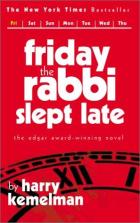
There are eleven novels in the Rabbi Small series, the first of which, Friday the Rabbi Slept Late, was written in 1964. The rabbi has not long arrived in the seashore town of Barnard’s Crossing when he’s pulled into the case of a young girl murdered near the synagogue. As much as anything, the novel is a study of small-town America, exploring the tensions between the quiet Talmudic scholar and his congregation, whose main goal is to be financially and socially successful. Some of its members don’t think much of Small, but it turns out that his training as a rabbi is extremely valuable to their Jewish community, especially when it comes to proving that the murder wasn’t committed by one of them.

As Kemelman has Small explain: ‘In the old days, the rabbi was hired not by the synagogue but by the town. And he was hired not to lead prayers or to supervise the synagogue, but to sit in judgement on the cases that were brought to him […]. He would hear the case, ask questions, examine witnesses if necessary, and then on the basis of the Talmud, he would give his verdict’. This background places Small in the perfect position to help with the murder case – and is a wonderfully original premise for a detective.

Pulitzer prize-winning Michael Chabon is one of the world’s finest writers in my view: an incredibly inventive and original author whose use of language makes me swoon. The Yiddish Policeman’s Union, published in 2007, is his homage to the hard-boiled detective genre, featuring world-weary P.I. Meyer Landesman. But what’s most extraordinary about this novel is its audacious starting point: it’s set in an alternate present in which 3 million Jews escaped the Holocaust through a resettlement programme to Alaska (an actual idea suggested in 1940 by US politician Harold Ickes). They are the ‘Frozen Chosen’, but now face a problem because their lease on the Federal District of Sitka is up. The Independent on Sunday called it ‘a dazzling, individual, hyperconfident novel. Only a shmendrik would pass it up’. I concur.

I’ll be reviewing this extraordinary crime novel in more detail in another post, but if you’re interested in learning more, Patricia Cohen’s New York Times article on the author’s visit to the real Sitka makes for a fascinating read.

 Nights of Awe

Last but not least is Harri Nykänen’s Nights of Awe, a Finnish police procedural just out with Bitter Lemon Press. Set during the ‘Days of Awe’ that lead up to Yom Kippur, it features Ariel Kafka, inspector in the Violent Crime Unit of the Helsinki police and one of only two Jewish policemen in Finland. I haven’t read this novel as yet, but purchased the book on the strength its unusual detective and the reviews I’ve seen for it (see for example Bernadette’s at Reactions to Reading and Norman’s at Crime Scraps Review).

What links these novels for me is their highly original approach to the figure of the Jewish detective (a Finn / a rabbi / someone who only exists because the author has rewritten history) and the innovative contexts in which they are situated (small-town America, Alaska and Finland). This kind of inventiveness, when teamed with excellent writing, is an unbeatable combination for me.

I’m very much looking forward to reading Nights of Awe now and will report back in due course!