Review of Tinker Tailor Soldier Spy: British espionage thriller meets Swedish crime

I never thought I’d say this, but I was glad of some Welsh rain this afternoon, as it gave me and Mr. Peabody the perfect opportunity to go to the cinema. There, we treated ourselves to the 1970s espionage fest that is Tomas Alfredson’s Tinker Tailor Soldier Spy, adapted from the John le Carré classic of 1974.

The film has received rave reviews, including a rare 5 stars from The Guardian’s Peter Bradshaw, and I can understand why: this is film-making of the highest quality, which is beautifully acted and styled, and recreates a tense Cold War atmosphere to perfection.

Although the plot is fiendishly complex in places, with some mind-boggling twists and turns, the fundamentals of the story are always clear. There is a Soviet mole in the highest echelons of the British Secret Service, working for ‘Karla’, the enigmatic head of the KGB. It falls to George Smiley, a forcibly ‘retired’ senior intelligence officer, to flush the mole out. The spy has to be one of four people, all of whom Smiley has worked with for years, and so he is dealing not just with a political betrayal, but with a long-running personal betrayal as well.

The film allows Smiley’s investigation to unfold at a leisurely pace, as he tracks down the key players whose recollections will allow him to identify the mole. We are also shown Smiley’s own memories of past events (including a Christmas office party with Le Carré as an extra), which he is forced to view with new eyes – a painful process that reveals how one person’s betrayal has undermined all their supposed achievements down the years. Seeing things clearly is a dominant theme: early in the film, Smiley visits an optician’s and emerges with a new pair of glasses – the big, rectangular type worn by Alec Guinness’s Smiley in the 1970s TV adaptation. But this is much more than simple homage to the famous earlier series: the new glasses have a deeply symbolic function, showing how Smiley has sharpened his vision, in order to see the truth properly for the first time.

The acting is excellent throughout. Gary Oldman is a wonderfully controlled Smiley, whose close-ups reveal, through the minutest of facial movements, the tensions that lie beneath. There are also wonderful performances by John Hurt, Benedict Cumberbatch, Toby Jones, Colin Firth and Kathy Burke (who has possibly the best line of the whole film). Hats off, as well, to the film’s cinematographers, stylists, and lighting crew, who evoke a gloomy 70s Britain so perfectly: there’s no James Bond glitz or glamour here, just a succession of dark, windowless secret-service offices and hideouts, in a 1970s palette made up almost exclusively of browns (from beige to fawn to mud and a thousand shades in-between). The humdrum office life of the secret service is beautifully depicted (Trebor Mint, anyone?) and in some ways the whole story can be read as just mundane office-room politics, with various divisional heads pitted against one another for supremacy over the years … albeit with more geo-political issues and human lives at stake than your average workplace.

So how does a review of this seemingly ultra-British film end up on a transnational crime blog? Well, the film was co-funded by France’s StudioCanal, and the director, Tomas Alfredson, is Swedish. Best known for his 2008 vampire film Let the Right One In, Alfredson has done a tremendous job of adapting le Carré’s depiction of the classic Cold War crimes of treachery and betrayal. And in its understated style and underlying melancholia, I see this film connecting back to Swedish crime writers such as Sjowall & Wahloo and Henning Mankell, whose investigative figures, like Smiley, plod their way in a dogged and melancholy fashion towards the truth.

In Tinker Tailor Soldier Spy, the quintessential British espionage thriller meets the best of Swedish crime writing. It’s a winning combination and I can only hope that the other two novels in the Karla Trilogy will make it to the big screen via the same film-making team.

There’s also a lovely A-Z of TTSS from The Guardian available here.

Sisters in Crime Book Bloggers Challenge / Ingrid Noll

Over at Barbara Fister’s blog, you can find details of the Sisters in Crime Book Bloggers Challenge, which celebrates 25 years of Sisters in Crime and the wealth of quality crime fiction written by women. 

I’m embarking on the Easy challenge: write a blog post about a work of crime fiction by a woman author; list five more women authors who you recommend.

My choice is The Pharmacist (Die Apothekerin), by one of Germany’s most successful and respected crime novelists, Ingrid Noll.

Ingrid Noll is in now her seventies, and only started writing seriously in her mid-fifties, after her three children had left home. The delayed start to her career as an author -perhaps not too unusual for a woman of her generation – gives all of us late developers hope and is one of the reasons I’ve selected her for this challenge.

I’ve also chosen Noll because (as she herself says), her novels are predominantly concerned with the lives of ordinary women, and how they set about achieving their goals within the constraints of a patriarchal, bourgeois society … by fair means or foul. She’s the writer of darkly humorous and highly original crime novels, often compared to those of Patricia Highsmith, which offer an entertainingly twisted vision of female empowerment – part of the German subgenre known as the Täterinnenkrimi (female perpetrator crime novel). At the same time her depictions of relationships avoid gender stereotyping: both her male and female characters are complex and interestingly flawed, which allows you to sympathise with them and despair of them all at the same time.

Poster for the 1997 film adaptation of Die Apothekerin/The Pharmacist

The Pharmacist, first published in 1994, is narrated in the first person by Hella Moormann. She is the pharmacist of the title, currently a hospital patient, who during the dull evening hours relates her life-story to Rosemarie Hirte, a mousy woman who keeps falling asleep in the next-door bed. We hear how Hella’s penchant for shady characters and co-dependency leads her into a relationship with the younger, amoral Levin, and how before long, she is drawn into a series of dubious, not to mention criminal events. The big question is: just how passive is Hella? Is she a victim of her machiavellian boyfriend? Or is she actually much more in control of the situation than she would care to admit? And just how wise is she to tell her story to the seemingly innocent Frau Hirte, whose snores may not be all they seem?

Delicious stuff!

The Pharmacist, trans. from the German by Ian Mitchell (London: HarperCollins, 1999).

Five other women crime writers I would recommend:

Josephine Tay, author of The Daughter of Time – another ‘hospital mystery’ (UK)

Maj Sjowall, co-author of the Martin Beck series (Sweden)

Fred Vargas, author of the Adamsberg series (France)

Dominique Manotti, author of Affairs of State and a very different writer to Vargas (France)

P.D. James, the grand Dame of British crime writing (UK)

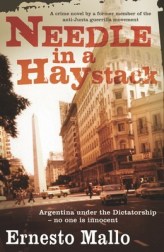
#12 Ernesto Mallo / Needle in a Haystack

Ernesto Mallo, Needle in a Haystack [La aguja en el pajar], translated from the Spanish by Jethro Soutar (London: Bitter Lemon Press 2010 [2006]). This crime novel paints a searing portrait of 1970s Argentina under military rule  5 stars

Opening sentence: Some days the side of the bed is like the edge of an enormous abyss.

This is a hard-hitting crime novel, set against the backdrop of Junta-controlled Argentina in the late 1970s, where power lies primarily in the hands of the military, and ‘disappearances’ of young political activists – supposed ‘subversives’ – are common. Such extra-judicial detentions and executions are typically not questioned by the police (the very body that should be protecting the nation’s citizenry), as doing so is perceived as a pointless exercise that would have extremely negative consequences for the individual.

Superintendent Lascano is a recently bereaved detective (see also Kimmo Joentaa), struggling to maintain his integrity in this morally bankrupt society. In the opening chapter, we see him leaving the house at the beginning of the day, trying to ignore the presumably common sights of bus passengers being searched, and a boy and a girl being driven away in a convoy of military trucks. The girl makes desperate eye-contact with Lascano ‘and then she is swallowed up by the fog’ (8). When Lascano is directed to investigate a report of two bodies dumped by the riverside, he finds that there are now three dead lying there. Unable to investigate the first two, who are clearly the victims of the death squads, he is drawn into investigating the third, and soon finds himself in danger as he treads on some highly-placed military toes.

In the process of following Lascano’s investigations, the reader is presented with a finely-drawn portrait of a corrupt Argentina and its ‘Dirty War’. The narrative is told from a number of viewpoints, giving us multiple perspectives of life under the regime, from a member of a guerrilla cell opposing the Junta (Eva), to the honest cop (Lascano and his friend Fuseli the pathologist), the decadent Argentinian (Amancio, Lara and Horacio), the Jewish businessman (Biterman), the right-wing major (Giribaldi) and the major’s wife (Maisabe). Maisabe is procured a baby by her husband – the newborn son of a young ‘subversive’, who has almost certainly been killed by the regime. The focus is very much on the enormous human price that the younger generation – ‘the kids’ – paid for trying to oppose the regime. The author, who is himself a former member of the anti-Junta movement, would have been the same age as these characters in the 1970s, and it’s hard not to see the novel as a lament for his lost contemporaries and their suffering.

One element I found very interesting was the way that members of the Junta were styled as National Socialists in the novel. For example, we’re told how shortly after a couple have been arrested, the military return to their flat to cart off their possessions: ‘Various conscripts come in and out carrying furniture … and they put everything in the back of a truck, supervised by an arrogant blond captain’ (113). For me, this scene immediately brought to mind the deportations of Jewish citizens in Germany, and the appropriation of their property by the Nazi state (signalled here by the presence of the ‘blond’ captain). Lascano is also Jewish, so there seems to be a fundamental opposition being posited in the novel between good versus evil along the fault-line of Jews:Nazis. The kind of right-wing equivalences being made here also reminded me of Imre Kertész’s 1977 novel Detective Story, which is set in an unspecified South American dictatorship and features a police-man whose interrogation methods are modelled on those of the Nazis. (Kertész is a Hungarian Holocaust survivor and writer who won the Nobel Prize for Literature in 2002, and the novel, which can loosely be viewed as a crime novel, is well worth a read – published in translation by Vintage in 2009).

It’s notable (and rather fascinating) that the English translation of Needle in a Haystack was funded by the ‘Sur Translation Support Program of the Ministry of Foreign Affairs, International Trade and Worship of the Argentine Republic’. This suggests that the novel is viewed as part of a national project of engaging with the crimes committed in the Argentine past. The first two novels are also being adapted for film in Argentina, which will undoubtedly help them reach a wider audience.

Needle in a Haystack is a compelling, absorbing and unsettling read. I’d recommend Mallo to anyone who likes quality crime novels that address serious political issues and the legacies of difficult historical pasts. It’s the first of a trilogy and the second, Sweet Money, is already out with Bitter Lemon Press.

Mrs. Peabody awards Needle in a Haystack an outstanding 5 stars.

Update: for a recent article on the process of bringing former members of the junta to justice for the theft of babies from female political prisoners, see here.

#11 Henning Mankell / The Troubled Man

Henning Mankell, The Troubled Man, translated from the Swedish by Laurie Thompson (London: Harvill Secker 2011 [2009]). Wallander’s final case, in which he faces his biggest challenge yet 5 stars

Opening sentence: The year Kurt Wallander celebrated his fifty-fifth birthday, he fulfilled a long-held dream.

While at the airport bookshop before going on holiday, I spotted Henning Mankell’s The Troubled Man, a novel I’ve been looking forward to reading for a good year. After a few moments I decided rather regretfully to resist, as I wasn’t sure the Very Last Wallander would make for a cheery holiday read. Later that day, while exploring the hotel, I came across the usual bookshelf of novels left by other holidaymakers. There, but of course, was another copy of The Troubled Man, at which point I gave in, put aside the carefully selected crime novels I’d brought with me and, armed with a hanky, started to read.

Before saying any more I should confess that I am a thoroughly biased reviewer when it comes to this Swedish writer and series. I have loved all the Wallander novels, and it would have taken a complete car-crash of a book for me to rate it anything other than five stars. So a five it is – and in some senses this is a rating for the entire series, which is referenced numerous times in various ways throughout the book.

Troubled Men

The first troubled man of the title is Hakan von Enke, a retired Swedish naval official and the father of Linda Wallander’s partner Hans, who disappears into thin air one day while out on his regular walk. Shortly before he vanishes, Hakan voices some concerns to Wallander about an unsettling naval incident that took place in 1982 involving a Russian submarine. Not long afterwards, Hakan’s wife Louise also disappears. To help a distraught Linda and Hans, Wallander begins an unofficial investigation, and uncovers an espionage story that reaches back into the complex history of the Cold War. This forms the central case within the novel, and is an absorbing and well-constructed read (albeit with the odd loose end that’s rather too casually tied up at the end). As ever, Mankell challenges us to question our assumptions, in this case about the dominant historical narrative of the Cold War years – there are a number of enjoyable and unexpected twists that force us to see key events in a whole new light.

The second troubled man, of course, is Kurt Wallander himself, whose personal and working life is overshadowed by a growing anxiety, in spite of the joy that becoming a grandfather brings. Now at the age of sixty, when most people start reflecting on their lives and the choices they have made, Wallander becomes a vehicle for Mankell to explore some very large themes: the value of family ties, the passing of time, the individual’s fear of losing his or her identity and, of course, death. There’s very much a feeling of closing the circle, with a number of references to Rydberg (Wallander’s mentor early in the series), Wallander’s late father (whose relationship with his son was often fraught), Baiba Leipa (his one-time love from The Dogs of Riga), and individuals from past cases (such as the husband of the victim in The White Lioness). For anyone who has travelled with Wallander down the long and winding road of this ten book series, it can’t help but be an absorbing, poignant and moving read.

One final word: if you’ve not yet read the earlier Wallander books, or if there are any in the series that you need to catch up on, I would strongly recommend doing so before embarking on The Troubled Man, which should be read at the end of the sequence as the author intends.

Mrs. Peabody awards The Troubled Man a slightly mournful, but deeply satisfying 5 stars.

Other Mankell/Wallander links you may enjoy

Henning Mankell’s official website

In the Footsteps of Wallander – a PDF guide to the locations featured in the books, films and TV series.

Scandinavian Crime Fiction – a blog that does what it says on the tin.