Disappearing into thin air: Sarah Ward’s The Vanishing Act (Wales) and Laura Lippman’s Lady in the Lake (USA)

Sarah Ward, The Vanishing Act, Canelo Crime 2024

First line: Elsa drove her car down the rutted road, the suspension on her ancient Fiesta groaning as it was thrown from grassy mound to pothole.

Sarah Ward’s The Vanishing Act is part of the ‘Mallory Dawson’ series set in Wales, where I happen to live, and I’ve very much enjoyed seeing places I know and love depicted in her gripping mysteries — Eldey (Caldey) Island, St Davids with its stunning Gothic cathedral, and now the ancient Brechfa (Glyn Cothi) forest in Carmarthenshire.

Sarah has a real gift for creating compelling crime scenarios. In The Vanishing Act, young Elsa goes to do her weekly clean of a holiday cottage deep in the forest, only to find it empty. But the kettle is still boiling on the Aga, half-made sandwiches are lying on the kitchen countertop and a chair is overturned. The family renting the cottage clearly left in a hurry, but why? Elsa phones Mallory to seek advice, who in turn contacts DI Harri Evans. He remembers being called out to a disturbing, supposedly supernatural event at the cottage many years earlier. Could there be a link? Mallory is tasked with digging into past events, and when the disappearance turns into possible murder, she finds herself back on the police team as a civilian investigator.

I thoroughly enjoyed The Vanishing Act. I love the characterization of the down-to-earth Mallory, who is rethinking her life after leaving the police and a divorce, and whose investigative skills and courage are an asset to every case. There’s also something of a Scandi feel about the isolated forest setting and its other-worldly vibe — a place where it pays to be wary of the darkness lurking in its depths. A gripping, satisfying read.

Interested in Welsh crime? Then the article ‘Ten killer crime novels set in Wales’ is for you!

Laura Lippman, Lady in the Lake, Faber & Faber 2019

First lines: I saw you once. I saw you and you noticed me because you caught me looking at you, seeing you.

I stumbled across this trailer yesterday for the new TV crime drama Lady in the Lake, starring Nathalie Portman as Maddie Schwarz. It looks like it could be an amazing adaptation of Laura Lippman’s 2019 novel.

I read Lady in the Lake last year and enjoyed it on a number of levels. Set in 1960s Baltimore, it’s a crime novel exploring the disappearances of Tessie, a Jewish girl, and Cleo, a Black woman, but is also a story of female emancipation. 37-year-old Maddie Schwarz ditches her comfortable but dull existence as an affluent Jewish wife, convinced that there has to be more to life. Her chance involvement in the discovery of a body sets her on a path to becoming an investigative journalist in the male-dominated newsrooms of the city.

Drawing on real cases and figures, Lady in the Lake is also an exploration of the social fabric of the city — of class and gender and ethnic tensions — and sets itself apart by giving space to multiple voices within the community, not least Cleo herself. It’s what I would describe as an ambitious social crime novel that is maybe slightly too ambitious at times. Ideal, then, for a long-form, seven-part TV adaptation that will allow the material to breathe.

The first two episodes of Lady in the Lake air on 19 July on Apple TV. 

Mrs Peabody is away for the next month or so, but has packed a goodly assortment of crime, ranging from Rebecca F. Kuang’s Yellowface and Zadie Smith’s The Fraud to Janet Evanovich’s Seven Up (I’m a big Stephanie Plum fan). What’s on your summer bookshelf?

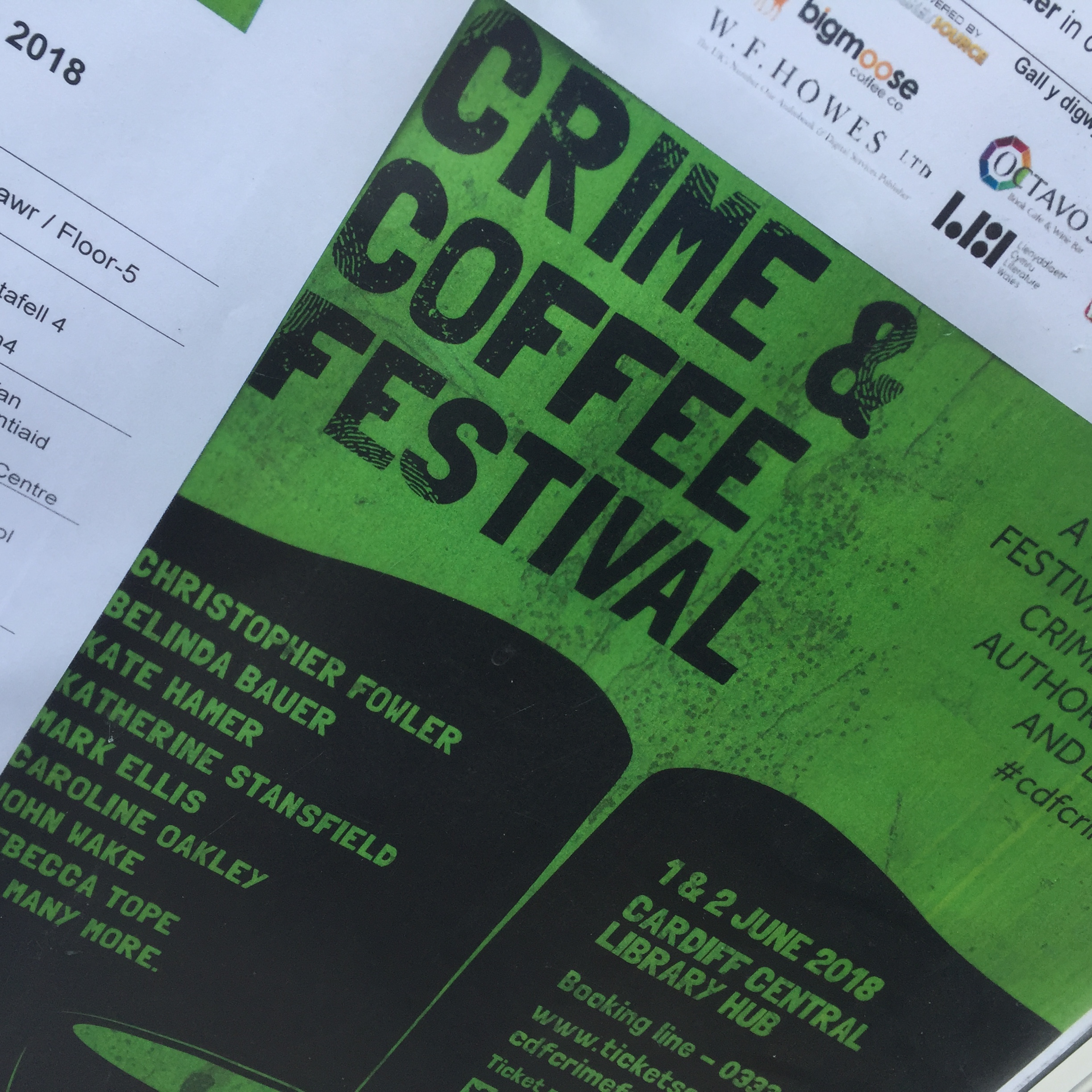
A celebration of Welsh crime fiction & ‘Crime Cymru’ at Cardiff Libraries’ ‘Crime & Coffee Festival’

The inaugural ‘Crime & Coffee Festival’ was held in Cardiff on 1-2 June, organised by Cardiff Libraries (@cdflibraries), which provided a very lovely and hospitable setting for the event.

A number of the writers featured at the festival are members of Crime Cymru, a collective of Welsh crime writers who live in Wales, identify as Welsh, or set their books in Wales. ‘Cymru’, in case you’re wondering, is the Welsh word for Wales and is pronounced ‘kum-ri’. You can follow their activities on Facebook or Twitter (@CrimeCymru), or check out their website here: http://crime.cymru/.

The rather impressive line up for the ‘Crime & Coffee Festival’ included Belinda Bauer, Christopher Fowler, Katherine Stansfield, Kate Hamer, Mark Ellis, Rosie Claverton, Alis Hawkins and Matt Johnson, along with Welsh-language crime writers Gareth Williams, Geraint Evans and Jon Gower.

I managed to get along to some of the Saturday sessions, all of which featured lively discussions with panellists and attentive, engaged audiences.

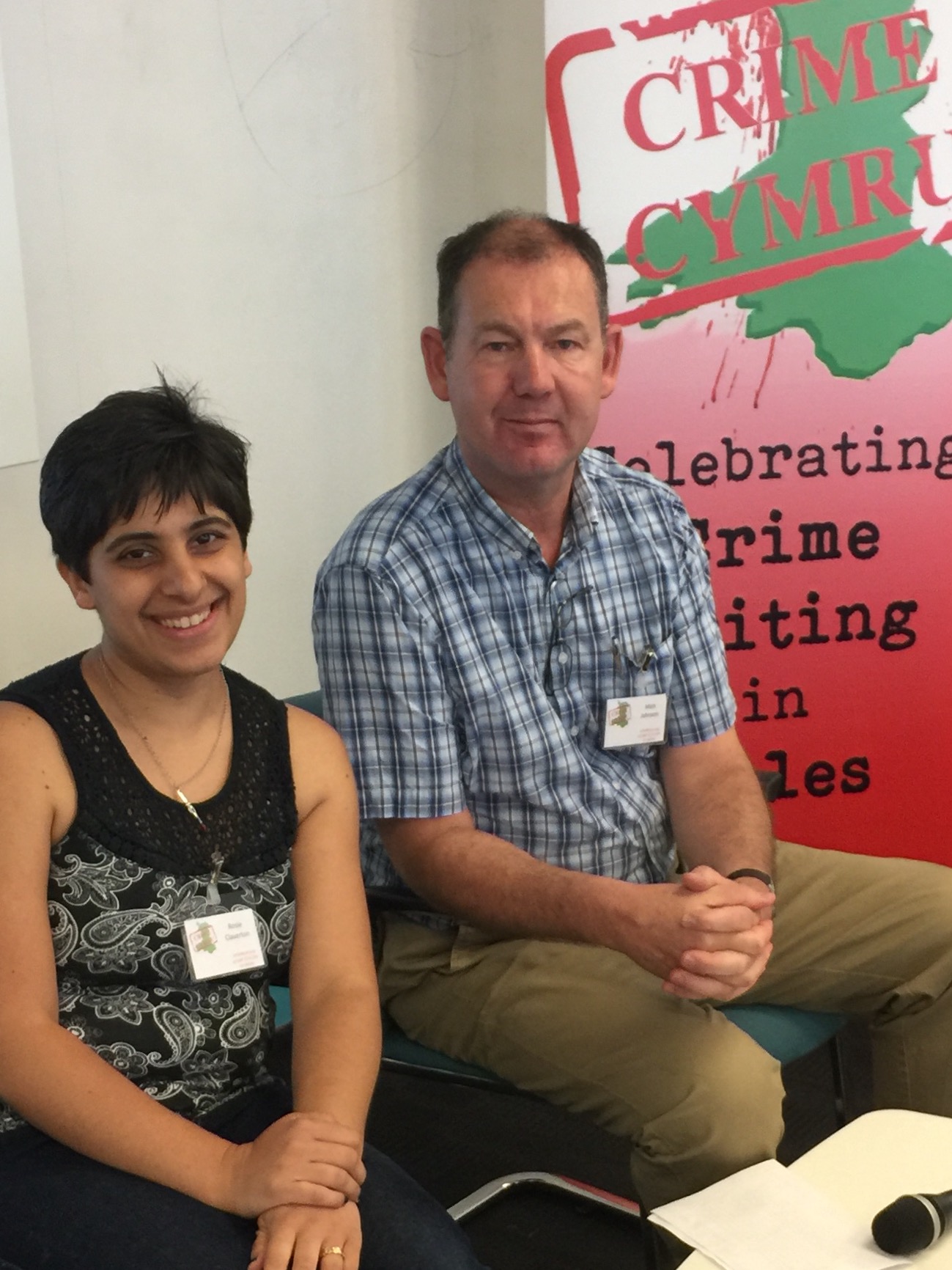
One stand-out session for me was ‘Beyond Psychopaths: Mental Health in Crime Fiction’, with Rosie Claverton and Matt Johnson. Rosie is a junior psychiatrist, whose ‘Amy Lane’ mysteries features an agoraphobic investigator suffering from anxiety. Matt is a former soldier and policeman who left the service with C-PTSD (complex post-traumatic stress disorder), and took up writing as a form of therapy. His ‘Wicked Game’ trilogy draws on his own experiences, and the first was shortlisted for the CWA John Creasy Dagger.

It was fascinating to hear Rosie and Matt, informed by very different professional and personal experiences, discussing the depiction of mental health conditions in crime fiction and film (such as One Flew Over the Cuckoo’s Nest and Gone Girl). Both emphasised the importance of researching mental health issues, and felt that writers had a responsibility to ‘find out and not simply imagine’. Reading will get you a long way, but MIND, the mental health charity, is apparently also able to put writers in touch with individuals willing to discuss their experiences, thus helping to minimise inaccurate depictions of mental health issues.

I picked up Binary Witness, the first in the ‘Amy Lane’ series, at the Octavo’s festival bookshop (after reading the first chapter I won’t be putting my bins out late any time soon).

Rosie Claverton and Matt Johnson

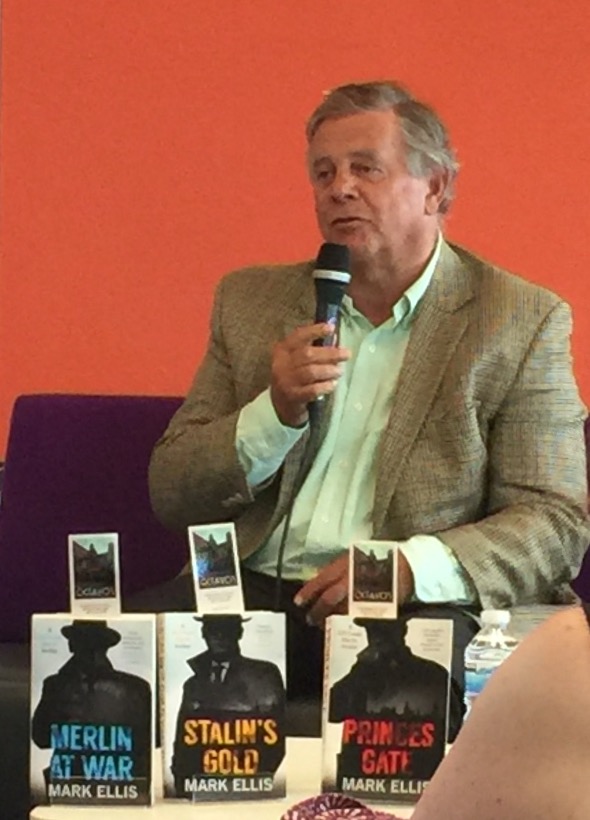
The afternoon featured an engaging discussion with Mark Ellis, author of the ‘DCI Frank Merlin’ series, set in World War Two London. Mark told us a bit about how he came to write the series (partly inspired by anecdotes his Welsh mum told him about the war), about Merlin’s Spanish heritage, and about the rich possibilities that wartime opened up for the criminal community in London – a bonanza for the unscrupulous. His discussion partner was his editor Hazel Cushion, who also runs the Octavo’s Book Cafe and Wine Bar in Cardiff Bay. On my list of places to visit shortly!

Mark Ellis

The evening brought us all a wonderful treat, in the shape of Belinda Bauer, who’s undoubtedly one of the UK’s most exciting and most versatile crime authors. Belinda has written a number of outstanding novels, including Blacklands and Rubbernecker (a particular favourite of mine), which have been garlanded with prizes such as the CWA Gold Dagger. Her eighth novel, Snap, has just been published by Penguin.

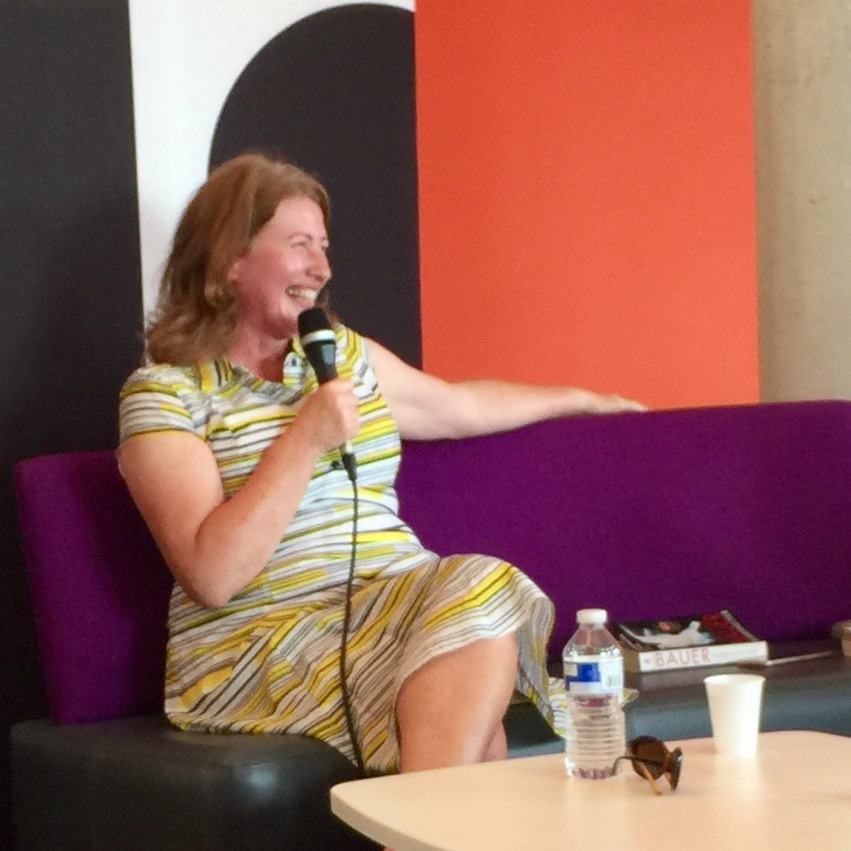
A slightly blurry shot of Belinda Bauer, but one that captures the fun we all had.

Belinda was in conversation with Kate Hamer, and in spite of the sometimes grim subject matter, there was a lot of laughter.

Belinda talked a little about Snap and read us an unsettling extract from the opening chapter, which depicts what happens when three children are left by their mum in a car after it breaks down. We also heard how – rather astonishingly – she now reads only non-fiction, because she’s too aware of the mechanics of fiction to enjoy it when writing herself, and feels it frees her up to write whatever she wants (she probably wouldn’t have written Rubbernecker if she had known that there were other novels featuring leading protagonists with Asperger’s Syndrome at the time).

The need for meticulous research was another key theme – especially the importance of going to places to experience, for example, how they would smell. Rubbernecker, which features an anatomy student, involved visits to the Wales Centre for Anatomical Education in Cardiff, which wasn’t easy as she is rather squeamish. But, as she also wisely noted: ‘research always pays off’.

Another intriguing revelation: Belinda lived in South Africa for ten years in her youth, and would like to set a novel there during the Apartheid era. I’m very much hoping she does…

If you haven’t yet read any of Belinda Bauer’s novels, then I recommend you do: they have wonderfully compelling premises, are dark but leavened with sardonic humour, and feature beautifully rounded, interesting characters.

Congratulations and thank you to everyone involved in organising the first Coffee & Crime Festival. It was a rip-roaring success!