
What do you do when your TBR pile is so vast it defies all hope of control? Answer: give up and read what you want.

In that spirit, I picked up Eva Dolan’s Long Way Home (Vintage, 2014). Lots of people had told me about this debut and as soon as I started reading, I could see that the praise for the novel was justified: it’s a beautifully written police procedural, which explores migrant experiences in the UK in a realistic and very sobering way. Its main investigative protagonists, Detectives Zigic and Ferreira of the Peterborough Hate Crimes Unit – with Serbian and Portuguese heritage respectively – are both extremely well drawn, and the story, which starts with the discovery of a body in a burned-out garden shed, is gripping and believable. It’s a hugely accomplished first novel, and I’m already looking forward to the second in the series, Tell No Tales.
While researching my article on post-war justice in crime fiction this week, I came across the German crime novel Auge um Auge (Eye for an Eye), which explores how doctors involved in medical crimes under National Socialism often went unpunished.
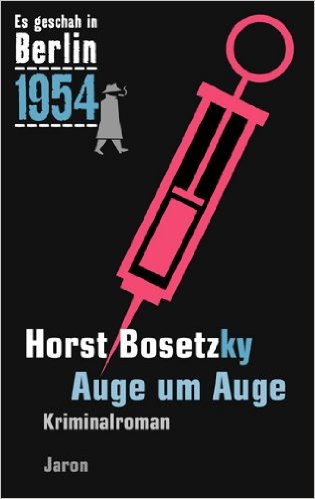
Auge um Auge is part of a remarkable historical crime series called ‘Es geschah in Berlin’ (‘It happened in Berlin’), which uses the cases of policeman Hermann Kappe to trace German history from 1910, before the collapse of the German empire, through to the Cold War era. To date, there are 26 novels set at two-year intervals from 1910 to 1960 (nephew Otto Kappe takes over the investigative reins in 1956):

The image above shows how the novels are packaged, with the series title and year highlighted on the cover, together with a striking abstract design. It also shows that the novels – rather unusually – are written by a collective of authors. Horst Bosetzky, a well known German crime author since the 1960s, conceived the series in 2007 with publishing house Jaron, and the other writers work under his overall guidance.
The series has also been called a Kettenroman or ‘chain novel’, which is a neat term. At the moment, ‘Es geschah in Berlin’ is the most ambitious use I’ve seen of a crime series to ‘investigate’ twentieth-century German history and I’ll definitely be checking out the other novels. Hopefully they’ll make their way into translation too.
In other news:
I’ve been flying the flag for German crime in the Times Literary Supplement, with a review of a fascinating volume called TATORT GERMANY: The Curious Case of German-Language Crime Fiction (Camden House), which is edited by Lynn M. Kutch and Todd Herzog. Unfortunately the review’s behind a paywall, but I bought a copy of the TLS yesterday, and was delighted to see a whole page dedicated to German literature.

Most interesting find of the week: a 2015 Penguin Special by Erich Schlosser called Gods of Metal, an essay exploring America’s nuclear capacity and the frightening ease with which a high-security weapons complex in Tennessee was breached in 2012. Schlosser meets members of the Plowshares movement, who break into nuclear facilities as a form of civil protest, and are subsequently branded as criminals by the state. Thought-provoking stuff, timed to coincide with the 70th anniversary of Hiroshima.

 Mrs. Peabody Investigates