Louise Erdrich’s The Round House (USA), James Wolff’s The Man in the Corduroy Suit (UK/Russia), and Becky Chambers’ A Closed and Common Orbit (USA/Space)

Hello, everyone! It’s been a while hasn’t it? I hope you’re all as well as can be and embarking on some quality autumn reading.

Here’s a small selection of the crime that’s grabbed me lately. All three novels are loosely part of larger series, but can be read as standalones. All draw on the crime genre in intriguing ways.
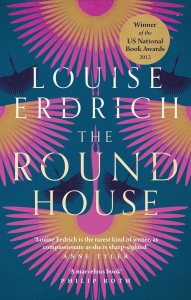
Louise Erdrich, The Round House, Corsair 2013 [2012], USA

First line: Small trees had attacked my parents’ house at the foundation.

How have I managed to miss Louise Erdrich on my literary travels? She’s such a prolific and acclaimed author, and her writing is so very good. I’ve caught up with two of her novels thus far — The Round House (2012) and The Sentence (2021). The Night Watchman (2020), which won a Pulitzer, is next on my list.

Erdrich is viewed as a ‘literary’ author rather than crime writer, but her novels often explore the impact of individual and institutional crimes. The Round House, in particular, is a stunning dissection of a crime and its spiralling consequences. Our narrator, Joe Coutts, reflects on the traumatic summer of 1988, when his mother Geraldine was raped and fell into a deep depression that threatened to destroy her.

The Coutts live on an Ojibwe reservation in North Dakota, and Joe’s father Bazil, a tribal judge, initially seeks justice for his wife via legal means. However, it’s unclear exactly where the crime against Geraldine took place — on land that’s under federal government or reservation jurisdiction? — and this slows the investigation. Frustrated, 13-year-old Joe and his friends start looking for clues, which in turn fuels a desire for revenge. The questions of what kind of justice should prevail and at what cost are thus central. So too are past and present crimes committed by the state against the Ojibwe, and especially Ojibwe women. It’s an intricate, expertly told tale, and there’s a warmth and complexity to the main characters that’s hugely compelling.

The Round House is part of Erdrich’s ‘justice trilogy’ (all three works can be read as standalones, but intersect thematically). The others are The Plague of Doves and LaRose, now also on my list.

If you’d like to learn more about this superb author, who continues to draw extensively on her Native American heritage, head over to this article on Britiannia.com.
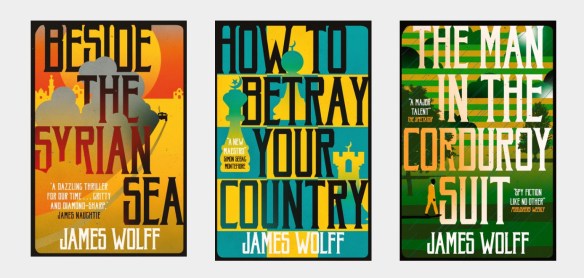
James Wolff, The Man in the Corduroy Suit, Bitter Lemon Press 2023, UK

First line: Confidential. We are writing to inform you that a 64-year-old woman named Willa KARLSSON was admitted to University College Hospital last night in an unconscious state.

One of the heirs to the late, great espionage writer John le Carré is James Wolff, who like the latter once worked for the British government in a rather opaque capacity.

Along with Mick Herron of ‘Slow Horses’ fame, Wolff shares le Carré’s deep interest in the individuals who work for the intelligence services. Some are brilliant but flawed, some are social misfits looking for a home, some are pen-pushers in search of glory, and some are collateral damage, sacrificed to strategic aims or power plays. What Herron and Wolff both excel at is capturing the Catch-22 absurdities of service life, depicting surreal, blackly comical scenarios that are more The Office than James Bond. At the same time, they raise some really serious questions about the purpose of the intelligence services and what they do — their novels are a long way from being mere comic romps.

The maverick hero of The Man in the Corduroy Suit is (wait for it) corduroy-suit-wearing Leonard Flood, a relatively junior intelligence officer who is tasked by the shadowy ‘Gatekeeping’ section to investigate the possible Russian poisoning of British agent Willa Karlsson. We follow Flood as he burrows expertly into Willa’s life and work, to the point where, like many of le Carré’s protagonists, he has big moral and ethical decisions to make.

This is the third espionage novel in the excellent ‘Discipline Files’ trilogy. I read them completely out of order, but you may wish to start with the first, Beside the Syrian Sea.

Becky Chambers, A Closed and Common Orbit (Wayfarers 2), Hodderscape 2016, USA / Space

First Line: Mimetic AI housing is banned in all GC territories, outposts, facilities and vessels.

The author Becky Chambers is another recent discovery, and quite frankly she’s a marvel. Both of her parents worked in the field of space science, and this has clearly shaped her own writing imagination…

Chambers’ ‘Wayfarers’ series, which won a prestigious Hugo Award in 2019, has been variously described as space opera, solar punk and hope punk, and explores the future of humanity via the stories of individuals and small groups living on space ships or space stations, or in GC (Galactic Commons) colonies.

While not crime fiction as such, questions of crime, justice and closure dominate A Closed and Common Orbit. The novel tells the story of AI Lovelace — recently decanted from a space ship into an illegal body following an emergency — and her engineer friend Pepper, whose own extraordinary tale of youthful survival unfolds in the course of the narrative. Those tracking current AI debates may be interested in the more hopeful possibilities the novel depicts of future human-AI interactions, as well as cross-species communications and tolerance (there are fabulous depictions of alien civilisations and cultures throughout).

A Closed and Common Orbit is the ‘standalone sequel’ to The Long Way to a Small Angry Planet. While the latter isn’t crime, it’s a great introduction to Chamber’s character-rich work. Like all of the novels discussed in this post, it has a big heart and plenty of humanity, which is certainly something we need right now.

Let me know in the comments what you’ve been enjoying too!

About time: Emily St. John Mandel’s Sea of Tranquility (Canada / the future / space)

Emily St. John Mandel, Sea of Tranquility, Picador 2022

First line: Edwin St. John St. Andrew, eighteen years old, hauling the weight of his double-sainted name across the Atlantic by steamship, eyes narrowed against the wind on the upper deck: he holds the railing with gloved hands, impatient for a glimpse of the unknown, trying to discern something — anything! — beyond sea and sky, but all he sees are shades of endless grey.

I was going to wait for Sea of Tranquility to come out in paperback, but cracked just ahead of the ‘Platy Jubes’ weekend. By the time the Queen had given her final wave from the Buckingham Palace balcony, I’d read it twice: the first time romping through, the second time savouring the writing, story and sheer inventiveness of it all.

In 1912, disgraced minor aristocrat Edwin St. Andrew experiences what he thinks is a hallucination. For a split second, in a remote forest on Vancouver Island, he’s plunged into darkness, then senses a cavernous space and the sound of a violin. In 2203, a novel by Moon Colony Two dweller Olive Llewellyn includes a passage in which a man plays the violin in an airship terminal while trees rise around him. And in 2401, an era when time travel is a crime, Gaspery-Jacques Roberts is sent to investigate a space-time anomaly caught on film in 1994 — which features notes from a violin. It’s the start of his sleuthing at various moments in time…

This genre-bending fusion of crime and science fiction — cri-sci-fi? — is pulled off with tremendous style. The first scene-setting chapters build steadily, and around a third of the way through the novel really catches fire. The resolution to the mystery is like a finely crafted Chinese puzzle and well worth the wait.

And because this is Emily St. John Mandel, author of the highly acclaimed Station Eleven, there’s much more besides: very human, likeable characters; visions of a future world and what it means to survive a pandemic; questions about the nature of reality and what truly matters in life; and an exploration of institutional power and the price of taking it on. But there’s also plenty of wry humour, including a laugh-out-loud bit  featuring Marvin the cat.

If you too have a weakness for cri-sci-fi, then put Sea of Tranquility on your reading list right away. And if you’re looking for other science fiction novels with strong elements of crime, check out my past reviews below:

Welcome to the silo: Hugh Howey’s Wool

Dazzlingly original: Adam Roberts’ The Real-Town Murders

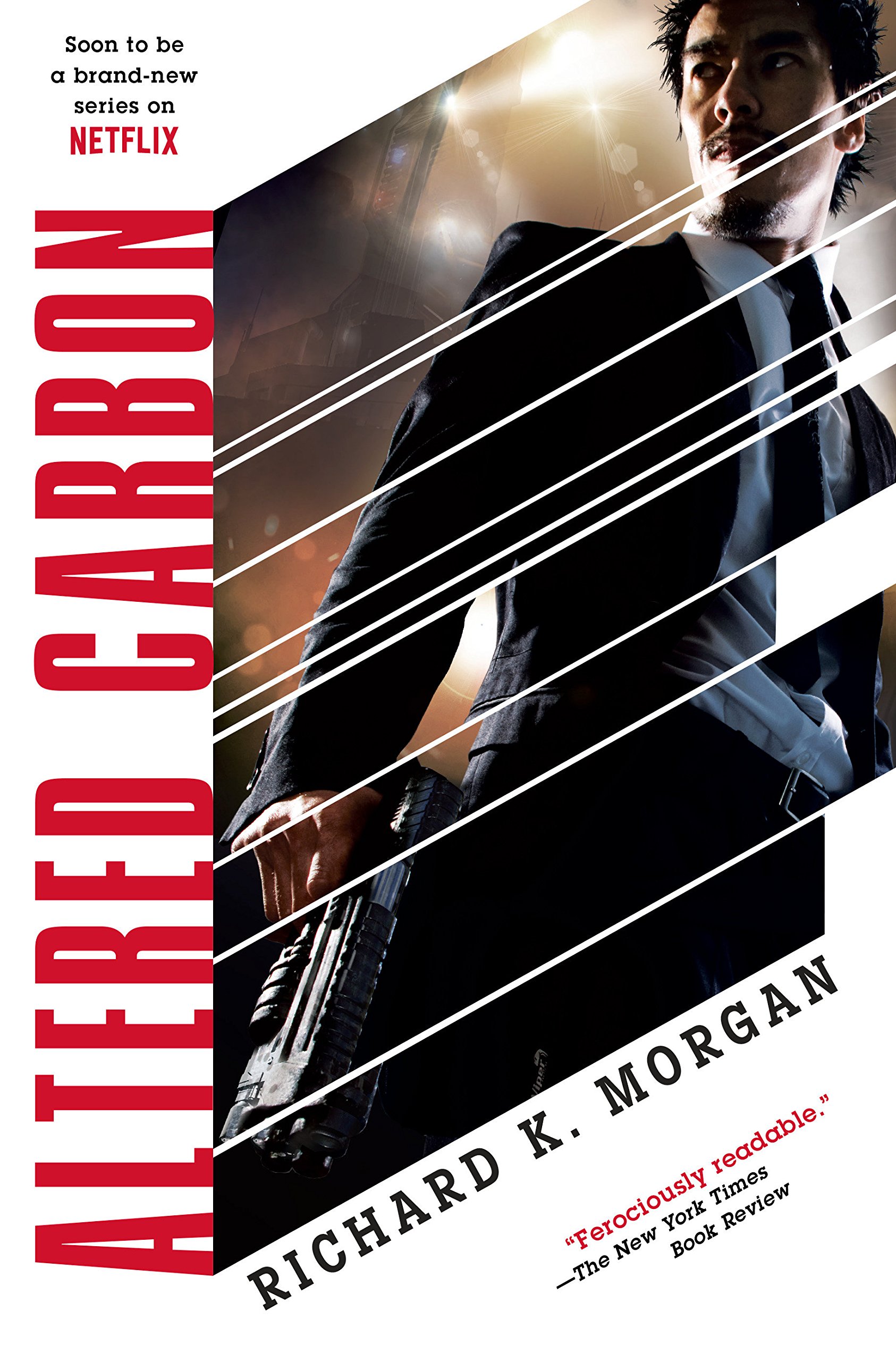
Smörgåsbord: Richard K. Morgan’s Altered Carbon

Smörgåsbord: Harper’s Force of Nature (Australia), Morgan’s Altered Carbon (UK/US) and Kushner’s The Mars Room (US)

Hooray! Getting back into the reading groove with these lovelies!

Jane Harper, Force of Nature, Abacus 2017

First line: Later, the four remaining women could fully agree on only two things.

Jane Harper has been the breakout star of Australian crime fiction in the last couple of years. Her debut, The Dry, completely blew me away (review here), and this follow up, the second in the ‘Aaron Falk’ series, was an immensely satisfying read.

Five women from the Melbourne company BaileyTennants set off on a corporate team-building exercise – a three-day hike in the remote Giralang Ranges. Only four return. The fifth, Alice Russell, is missing – a particular concern to Federal Police investigator Aaron Falk, as she’s a whistleblower in his current case. Together with colleague Carmen Cooper, he heads to Giralang to figure out how much the other women – from the company chairwoman to a lowly data-inputting assistant – know about Alice and her disappearance.

The scenario outlined above wouldn’t normally pull me in as a reader, but I was so impressed by The Dry that I wanted to read more of Harper’s work. And I’m glad I did. In Force of Nature she builds a gripping narrative using alternating timelines – the investigation in the present, and the experiences of the women on the hike in the past. The two strands are skilfully interwoven, and the characters and power dynamics within the group are extremely well drawn. If you haven’t yet found your way to Harper’s work, then you have a treat in store – she really is an extremely good, intelligent writer, and I love the sense of place her novels evoke.

Richard Morgan, Altered Carbon, Orion 2008 (2002)

First line: Two hours before dawn I sat in the peeling kitchen and smoked one of Sarah’s cigarettes, listening to the maelstrom and waiting.

If Force of Nature is immensely satisfying, then Richard Morgan’s Altered Carbon is utterly mind-bending. It can perhaps most accurately be described as a neo-noir sci-fi detective novel – or as a gritty PI tale set in a dystopian but impressively believable future.

Four hundred years from now, mankind lives in colonies scattered on a number of far-flung planets. Technology has all but eliminated death: human consciousness is now stored in ‘stacks’ (implants at the base of the skull), which can be transferred into new bodies or ‘sleeves’ when necessary. So if you’re fatally shot, as former elite soldier and convict Takeshi Kovacs is at the start of this novel, it’s the beginning rather than the end. Kovacs wakes up on Earth, a long way from his home planet, in a new body – originally belonging to a nicotine-addicted ex-policeman – and discovers he’s been brought there by a billionaire to investigate a murder, a job he can’t afford to refuse.

And that’s just the starting point. The entire novel is brimming with great ideas and SF scenarios: convicts placed into storage during prison sentences who are met by their grandchildren on their release; husbands who open the front door to find that the stranger before them is actually their wife in a new ‘sleeve’; the mega-rich who live for hundreds of years and keep multiple new-and-improved bodies in storage…

The crime element is often a bit overshadowed in sci-fi crime novels, but Altered Carbon can rightly claim to be a PI novel – its investigation is strongly foregrounded throughout. Kovacs is a flawed but likeable figure, whose wise-cracking, tough-guy persona will appeal to fans of traditional noir. But be warned, this is a hard-hitting work that contains truly eye-watering levels of violence. Think Tarantino in space on speed.

All in all, then, an amazing debut novel – one which has been followed by two further novels, a graphic novel and a Netflix adaptation (though the latter apparently plays fairly freely with its source).

Rachel Kushner, The Mars Room (Vintage 2018)

First line: Chain Night happens once a week on Thursdays.

This isn’t a conventional crime novel, but rather a novel about a crime and what comes after. Its central character, Romy Hall, is serving two consecutive life sentences at Stanville Women’s Correctional Facility after killing the man who was stalking her. Through her eyes, we are shown the reality and bleakness of American prison life, and through her recollections, we trace her early years in San Francisco and the events leading up to the killing. At the centre of it all stands ‘The Mars Room’, the strip club where Romy worked to pay her way and to provide for her son Jackson.

This is a novel about the circumstances that shape an individual, the choices she makes, and how larger forces outside her control (such as a substandard justice system) shape her destiny. It’s also the story of a prison community – including Romy’s fellow inmates Laura Lipp, Conan, Betty, Sammy and Teardrop – and is extremely moving, although moments of lightness and humour are allowed to peep through. A searing novel, beautifully written, and one you won’t easily forget.

The Mars Room was shortlisted for the 2018 Man Booker Prize.